
Translated material
"This is not a teaching." What kind of mistakes the Hawaii authorities made, announcing a missile strike
Reconstruction by minute
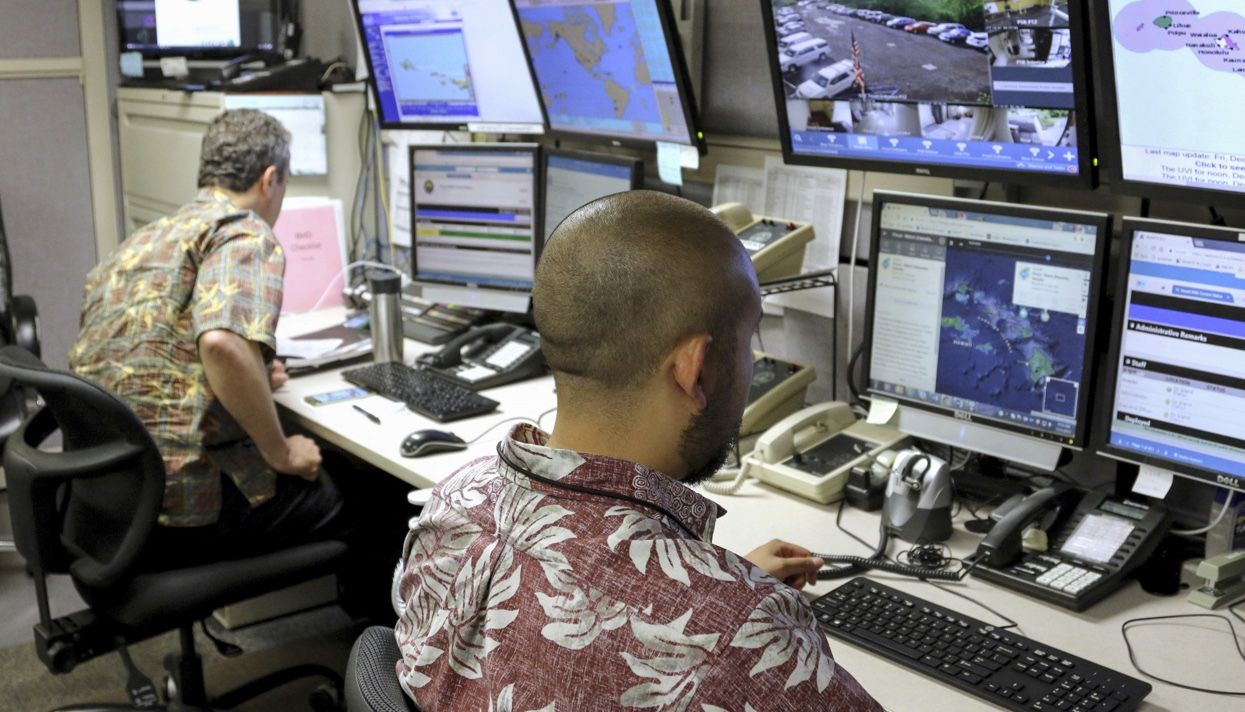
The US Federal Communications Commission (FCC) published a preliminary report on the causes of false anxiety about the missile strike in Hawaii on January 13. The report restored the course of the events of the day when the residents of the state received messages on the phones marked "this is not a teaching." As it turned out, this was preceded by a chain of misunderstandings, during which the duty officer decided that Hawaii really threatened a missile blow. Soon after the publication of the report, it was announced that the employee was dismissed.
On January 13, the head of the night shift of the Hawaiian Emergency Situations Service (EMA) decided to conduct educational anxiety for the daily shift employees in difficult conditions, during the transfer of duty. At 8 in the morning, he warned of his plan of the head of the daytime shift, but he did not understand him - and decided that the alarm would be arranged for a night shift to passing watch.
At 8:05, the head of the night shift called the staff of the Pacific Command of the Armed Forces of the United States. He turned on them a message about the threat that began and ended with the words “training, training, training”, but, contrary to the rules, also contained the phrase “this is not educational anxiety”.
The record was heard by three duty officers. One of them, in his own words, heard the phrase “this is not a learning alarm”, but did not hear the word “training” - and decided that the threat of attack was real. At 8:07 , with the help of a special program, he launched the transfer of warning to the residents of Hawaii. To do this, he had to confirm the computer that he wanted to send a message.
The head of the daytime shift due to misunderstanding was not present. Other officers claim that they heard the word "training" and understood that the threat is false. However, from the words that sent the officer notification it follows that he was not alone in the threat. The testimony of all those present converge in the fact that during the call the words "this is not a learning alarm."
At 8:08, the officer on duty received a notice on his phone - so they realized in the center that the residents of the state were transmitted a message about the impending attack. At 8:09, the head of the service announced false alarm to Governor David Aiju, at 8:10 - to the Pacific command (“Confirming what they knew there,” the report said) and the Gonolulo police.
At 8:12 EMA employees canceled the transfer of alarm report. The transmission of the communication message was not provided for by the protocol. At 8:20, the service wrote about false alarm in social networks. Four minutes later, Governor Gawyev retweeted a message about this. He could not do this before, because, in his own words , he did not know the password from his twitter.
From 8:13 to 8:26 a service was associated with its units on the islands and journalists to report false anxiety. At this time, many residents called EMA to understand what was happening. The lines were overloaded, and many could not get through. At 8:27, the employees of the Hawaiian EMA began to discuss the formulation of the refutation, in the process, contacting the federal department (Fema) in the process. The message with the refutation was sent to residents of the islands at 8:45 , 38 minutes after a false warning.
FCC called the incident a combination of human errors and unfinished instructions - in particular, the absence of a protocol in case of false anxiety. In particular, in the Hawaiian emergency service, educational and real alarm were declared using the same interface with the same formulations for both cases; To declare a real threat it was not required to add any passwords. Local protocols allowed the employee to send a notification to all residents of the state alone, without control from colleagues. In addition, too many exercises were carried out in Hawaii without warning, which increased the risk of error.
As for human errors, due to poor communication between the chiefs of the night and daytime shifts, educational anxiety was started without sufficient supervision. <...> Further, the head of the night shift lost a message that differs from the approved scenario and containing the words "this is not an educational anxiety." Finally, the duty officer, apparently, could not understand that this was a training, although his colleagues realized that the threat was not real (English.).