
Translated material
Monetary metal: Platinum
In the last issue (TRV-hobby, No. 246 [1]) it was described about three main coin metals-gold, silver and copper, from which coins were minted for thousands of years. Other metals were used in past centuries for minting coins rarely. However, there was a period in the history of Russia - from 1828 to 1845, when platinum coins were released for circulation 3, 6 and 12 rubles, with large circulations - almost 1.5 million coins were minted, which is unique for world practice.
Platinum is one of the most heavy and expensive metals. Its average content in the earth's crust is only 5 mg per ton. In terms of density (21.45 g/cm3), platinum is only a little inferior to the most heavy metals - Osmia and Iridia: a brick made of platinum would weigh more than 40 kg!
Platinum has been known to the Aborigines of South America since ancient times. The grains of this heavy white metal were found with gold in placers. It was not possible to melt the metal in the strongest flame: the platinum melts only at a temperature of 1769 ° C. In Europe, Platinum became known only in the 16th century; She was brought by the Spaniards from their American possessions. They called the metal platinum; In Spanish Plata -silver, and Platina is diminutive from Plata , “little silver”, “silver”. Indeed, the color of the platinum resembled silver; B. L. Pasternak compared the first snow with the color of the platinum, "when he shines through the foliage with a platinum from the tick ...".
The scientific description of platinum first gave in 1740 the Spanish surveyor and astronomer Antonio de Ulio (1716–1795) worked in Peru. Soon, samples of this metal were studied by chemists in England and Sweden. For a long time, Platinum did not find application and was much lower than gold. This was used by unscrupulous jewelers who mixed platinum to gold. Both metal are easily rafted, and with a 20% platinum content, the melting temperature decreases by 450 OS compared to clean platinum, and with 10% of the platinum-already by 550 OS. Outside, the product was gold.
The counterfeiters placed a platinum disk in the center of the gold coin. It was very difficult to detect such fakes: the density of gold and platinum is close. As a result, the Spanish government ordered to stop the import of platinum into the country, drown all its reserves into the sea, and later, when developing gold placers in Colombia, thoroughly separated platinum from gold and drown under the supervision of royal officials in the Columbian rivers Bogota and Kauk.
This continued until the second half of the 18th century, when the platinum was learned to clean and process, and chemists found use: platinum is extremely resistant to aggressive chemical acids and alkalis. In 1784, the first platinum tiger was made, in 1809 - a platinum retort weighing 13 kg; Such retorts were used to concentrate sulfuric acid. Platinum products were made by forging or hot pressing, since there were no electric furnaces that give a fairly high temperature. Over time, they learned to melt platinum in the flame of explosive gas. At the World Exhibition of 1862 in London, one could see platinum samples weighing up to 200 kg. Despite the impressive mass, such a sample, if it were in the form of a cube, would have a size of a little more than 20 cm.
For the first time in Russia, Platino was first discovered near Yekaterinburg in the Urals in 1819, and in 1824, platinum placers were opened in the Nizhny Tagil District. On Mount Solovyov in the Nizhny Tagil area, in only three years, about old nuggets weighed up to 9 kg were found. Many of them are stored in the collections of the diamond fund. In 1904 in the Urals, the largest (from preserved) nugget of platinum weighing 8395 was found in the Urals.
The Ural deposits were so rich that Russia quickly took first place in the world for the extraction of this metal. So, more than 1.5 tons of platinum were obtained in Russia alone - more than 100 years in South America. And by the end of the 19th century, the production of platinum in Russia was 40 times higher than the total prey in all other countries. Until 1914, the second country in the scale of production of platinum was Colombia. In the 1930s, Canada entered the leaders, and after the Second World War-South Africa (in the USSR, data on the extraction of platinum, as well as other strategic materials, were classified)

In 1826, Metallurgists P. G. Sobolevsky and V.V. Lubarsky invented the method of forging platinum with the help of pressing and subsequent exposure in a red -hot state. In 1828, at the suggestion of the Minister of Finance of the Russian Empire, Count Yegor Frantsevich (George Ludwig) Kankrin (1774–1845), the release of platinum coins began. Cankrin was a brilliant professional. He received education in his homeland, in Germany. Being during the Patriotic War of 1812 the general departments of the Russian troops, Cankrin made an incredible in the history of Russia: out of 425 million rubles, allocated for warfare, less than 400 million were spent in 1812–1814 and not a penny was stolen!
Cankrin conducted successful financial reform. He had the courage to refuse Emperor Nicholas I in money intended, as the minister believed, for unnecessary expenses. Yegor Frantsevich did a lot to study the geology of Russia, contributing to the attraction of foreign scientists on an expedition, including Alexander von Humboldt. In honor of Cankrin, the genus of Kankrinia plants is named, as well as the Kankrinite mineral found in the Urals.
Count Cankrin proved the profitability of platinum coins. The platinum on the Ural mines mined a lot, she did not find industrial use in Russia. The owners of the Ural mines of the Demidovs benefit from the sale of platinum to the government.
The size of the produced three-, six- and 12-ruble platinum coins (23.3, 28.5 and 35.95 mm) corresponded to silver coins with a face value of 25 and 50 kopecks. and 1 rub (Fig. 1). But since the platinum was then six times more expensive than silver (at the end of 2017 - 50 times!), The face value on the coins turned out to be unusual.

In 1844, Cankrin resigned due to illness and age. And in 1845, at the insistence of the new Minister of Finance, F.P. Vronchenko, the release of platinum coins was stopped, and all the coins were urgently withdrawn from the appeal. The reasons for this panic measure are different. According to one version, they were afraid of fakes of these coins abroad (where platinum was supposedly cheaper) and their secret import to Russia. However, not a single fake coin was found among the seized.
According to a more believable version, the demand for platinum and its price in Europe grew so much that the metal in Russian coins has become more expensive than their face value. But then one should already be afraid of another: the secret removal of coins from Russia and their remelting. Interestingly, the famous English physicist Michael Faraday at his popular lecture on platinum, read in London on February 22, 1861, showed Russian platinum coins. Having analyzed their composition, he found that coins contain 96.1%, platinum, 1.2% iridium, 0.5% ruthenium, 0.25% palladium, 1.55% of iron and 0.4% of copper. Faraday paid tribute to the Russian masters, who managed to mint coins from an insufficiently cleaned and therefore rather fragile platinum.
Modern more accurate studies of the composition of these coins were conducted by the expert of the State Historical Museum Andrei Vladimirovich Budnikov. Their goal was to clarify the composition and find out how the genuine coins of 1828-1845 differ from many high -quality fakes. The study of the chemical composition was carried out by the X-ray-fluorescence method; The depth of the analyzed layer is the tenth fractions of a millimeter. Hundreds of measurements were carried out.
It turned out that there may be a lot of impurities in genuine platinum coins of 1828–1845: iron - 5.62%, copper - 2.24%, nickel - 0.55%, iridium - 2.55%, rhodium - 0.6%, palladium - 1.54%, ruthenia - 0.15%. According to the author of the study, “the distribution of impurities is uneven both within the circle and between them, regardless of the year of the release and face value of the coin. This heterogeneity is externally emphasized by the frequently encountered “bandedness” on the surface of coins, the presence of welds between individual portions of platinum (Fig. 2) .

Modern fakes, in most cases made of cast platinum, do not have this sign. Platinum of genuine and fake coins differs in density. In coins of metal obtained according to the method of Sobolevsky and Lyubarsky, the density has a reduced value (sometimes less than 20 g/cm3) against 21.46 g/cm3, characteristic of pure cast platinum. In most cases, genuine platinum coins have magnetic properties, sometimes strong: the circle is attracted to the magnet. ”
The minting of platinum coins resumed in the USSR in 1977 and continued in 1991. So, in the period of preparation for the 1980 Olympics, five coins were minted with a face value of 150 rubles. From the platinum of the 999th sample with a circulation from 7820 to 24 160 copies (Fig. 3).

In 1988, in a series dedicated to the millennium of the baptism of Rus', a platinum coin “The Word about Igor’s Regiment” was released (Fig. 4). The coinage of anniversary and commemorative platinum coins continued in the post -Soviet time. They have a face value of 25, 50 and 150 rubles. and mass 1/10, 1/4 and 1/2 ounces. Platinum coins were produced in the series "Enlightenment", "Russian Ballet" (Fig. 5), etc.


Platinum coins and other countries are produced. Among them are the United States (Fig. 6), Canada, Great Britain (Fig. 7), China, France, Portugal, Estonia, etc.

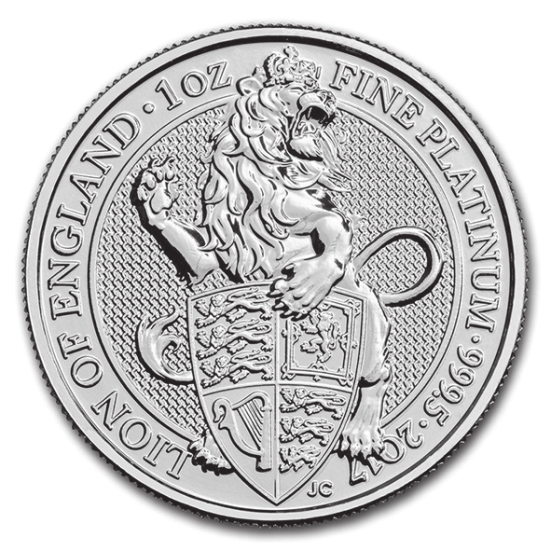
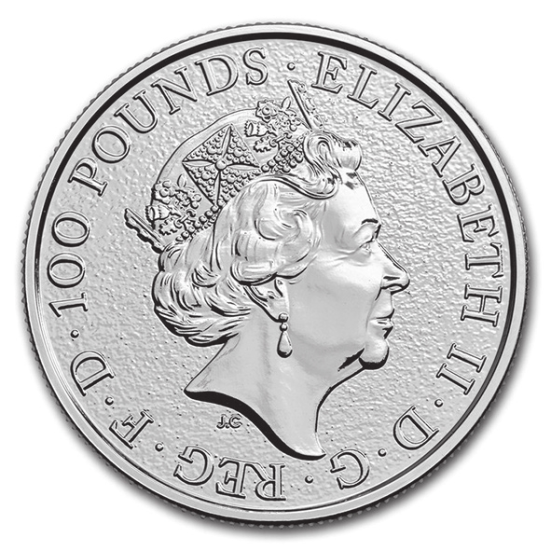
Rice. 7. British platinum Coin "British Leo" (2017; nominal value - 100 pounds, mass - 1 ounce, test - 999.5)
Widely use expensive platinum in jewelry. Not everyone, for example, knows that Platinum, when contents only 8.4%, makes the gold alloy completely white.
Ilya Lenson,
cand. chem. sciences, associate professor of the Higher Chemical College of RAS
1. Leleson I. Minute metals. The oldest: gold, silver, copper // Trv-hunger, No. 245 of January 16, 2018.