
Translated material
Oscar Rabin. Boarded truth
The famous non-conformist artist-90 years old
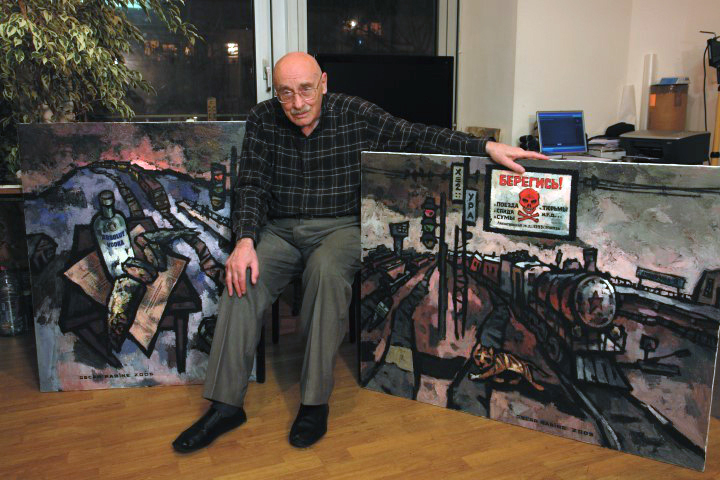
Photo: oscar-rabin.web61.server4.configcenter.info
In the Moscow Publishing House, the Book of the journalist and art critic Alexander Shatalov “Amethyst Casket: notes on exhibitions and fates” are preparing for the exit. It included articles and essays dedicated to the informal art of the Soviet era, including published in NT. We offer readers an excerpt from the book.
Eric Bulatov, artist : the end of the 1950s, when Oscar Rabin appeared, it was the time when the resistance of official ideology began. Previously, under Stalin, this was impossible, for this they killed ... Rabin was the first artist to openly and completely calmly show what he was doing without asking for permission from the authorities. It was a real revolution. He was the first to be so bold, calmly and accurately showed the wrong side of our life.
Lianozovo. Avangardist picnic
Vladimir Nemukhin, an artist : Lianozovo, where Oscar Rabin settled and which went down in history, is a suburb of Moscow along the Savelovskaya road, perhaps thirty or about that. Why Lianozovo? Because the father -in -law Rabin Evgenievich Leonidovich Kropyvnitsky* lived nearby, in Dolgoprudny, in the same incredible hut.
* Kropyvnitsky Evgeny Leonidovich (1893–1979), poet, artist, head of the non-certificate Lianozovsky circle in the 1950-1960s in Moscow
Oscar Rabin: In Khrushchev’s time, part of the camps was released near Moscow. There was a women's camp in Lianozovo, he was transferred from there to another place, and the huts were reproached and handed out to the employees. One room was given to me, and even then by Big B lay-because I was the head of the personnel department, who was bothering for me, drew two paintings, but not his own, copied from somewhere. So we ended up in Lianozovo. Well, then Lianozovskaya life began.
Kira Sapgir, writer : I have never left a feeling of amazing, amazing, very positive contrast. You go on this outcome-dirty, sad, in which there are not the slightest aesthetics, except for some wonderful weeds that bloomed there, and the burdocks ... The Rephys were still indescribably good ... You go to the blockage hut, you enter a huge, as the ceiling, where the ceiling is supported by a kind of Corinthian column-a wooden riser. And there is a table on which there is always food. Honestly, neither then, nor now we did not eat as delicious as Oscar, Valentina and Evgeny Leonidovich Kropyvnytsky. And the potato there was special, and the herring was amazing, and tea ...
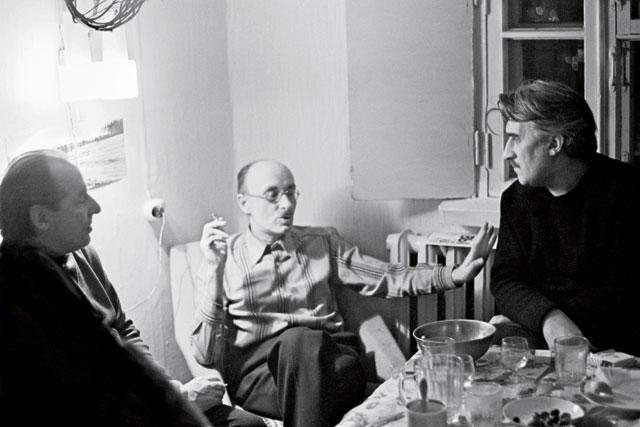
Nikolay Vecheomov, Oscar Rabin
And Vladimir Nemukhin. 1977 photo: Igor Palmin
Vladimir Nemukhin: Usually the shows of paintings ended with a tea party. Or someone brought an ordinary green bottle of vodka, some vinaigrette, some kind of sausage will cut, black bread. Drink on a glass. No one got drunk, there were no drunken meetings, absolutely. Once Vasiliev-Mon ** appeared, and we decided to arrange an avant-garde picnic. We came to Oscar a little inflated. Of course, one or two bottles of vodka were bought. There were already ten people there, and probably decided to look for a place in the captivity. We pass some ponds small, and there was spring, and Vasiliev-Mon saw frog caviar in these ponds: “Friends, caviar! We have something to eat. ” Quickly took out a spoon out of his backpack, he scooped up and ate this caviar. Behind him <Poet Henry> Sapgir: “Friends, an incredible event! Long live the frog caviar! I’ll definitely write something about this. ” Our ladies somewhat disdainly looked at this caviar. And I took and tried. She resembled some kind of fish. The taste of fish with tina. Well, in general, unpleasant food. Thus, we noted the avant -garde picnic, biting the frog caviar stormy events of that time ...
** Vasiliev-Mon Yuri Vasilievich (1925–1990), sculptor, graph, painter
Kira Sapgir: They seemed to me some gods. Or these were the last goblin, which were expelled from megacities. The intellectual elite, which survived from this world. And they did not survive. It turned out that they are stronger because it was a pure power.
"Bulldozer exhibition": non -conformers
Vladimir Sychev, photographer : In early September 1974, a rumor was dispersed in Moscow that an application for an official exhibition of non-conformist artists, who were then called “unofficial artists”, was submitted. Exhibitions of these artists, who then registered 28 people, were held in apartments in turn. They opened the doors for everyone, and for some time people came to watch paintings and get acquainted with the artists. Naturally, they sold their paintings, but it was illegal.
Oscar Rabin: They called us differently, mainly in a abusive sense. The non -conformers in the Union of Artists were not officially and were not listed anywhere.
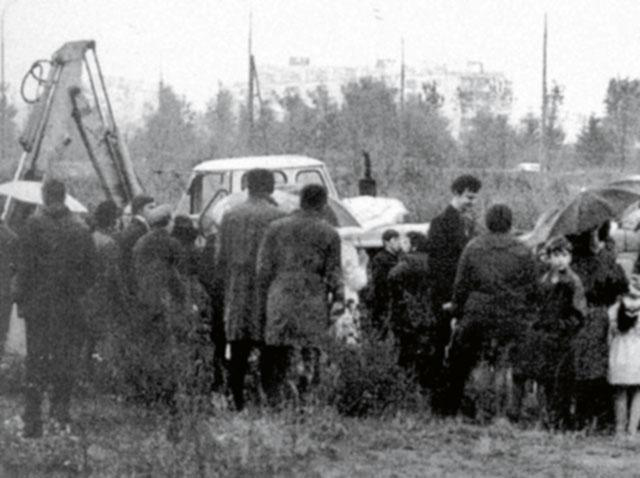
In civilian photo: Venecianov.ru
Vladimir Sychev: It was raining, small, nasty autumn rain. I came to the wasteland in Belyaevo with friends - American journalists who by that time had to go to my exhibitions. I hung on one side of the avenue, and as I then understood, the main events developed on the other side. On both sides were Lada cars, the most primitive, people in civilian were sitting there, and I immediately noticed that all those present were photographed from these cars. I began to take photos one after another (I shoot quickly and imperceptibly), and gave the first three films to an American journalist. Unfortunately, he did not return these films to me ...
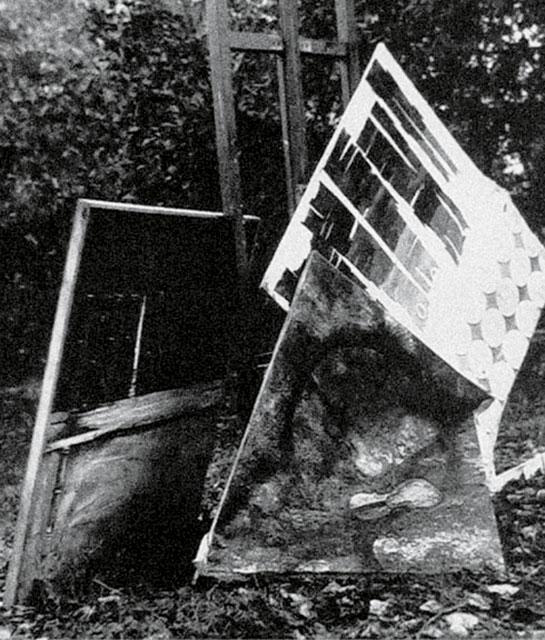
Photo: Venecianov.ru
Vladimir Nemukhin: I was pushed aside by a person, you won’t pass through them. I say: "Let me go, let me go." And I see, the Oscar begins to unfold his work, and suddenly a bulldozer goes to him. It was terrible. And at this time, his son Sasha flies away, there, ahead of the bulldozer, some kind of piece of iron sticks out, he grabs this piece of iron, and the bulldozer literally stops at Rabin's feet. I break through, young men fly up to me and say: "We will not let you in, we’ll burn the work." I say: “Scoundrel, I give you my picture for kindling. Go burn it if you have enough courage. Bastard! " I give him a picture, he pushes me aside, throws everything, and earned. They lit something, some kind of bonfire appeared. Foreigners immediately came up, correspondents. Of course, they immediately attacked them, opened apparatuses from them, pulled out films. Therefore, there are almost no bulldozer personnel. And the events did not develop for three minutes, for quite some time it all happened. Then they turned on the watering machines: they scored some slurry, dirt and let's water all ... We arrived at police cars. Elsky *** was taken, Rukhina ****, Oscars were taken to the police department.
*** Elskaya Nadezhda Vsevolodovna (1947–1978), artist.
**** Rukhin Evgeny Lvovich (1943–1976) - artist
Vladimir Sychev: The next day, Monday, we were taken to court. The court was very strange. 5 people were judged: Oscars Rabin, Sasha Rabin, Elsky, Rukhina and me. They sentenced to 15 days, but released after 4, because we announced a hunger strike and really didn’t eat anything ... The police were a little in fright.
In Paris
Oscar Rabin: I always wanted to go to Paris, dreamed about it. This was not available to an ordinary Soviet man. At first I left with a Soviet passport as a tourist, I had a tourist visa for 3 months. Then she was extended in the Soviet consulate. Then I was invited to the second floor to the consul. And the consul read to me the decree of the Supreme Council signed by Brezhnev, on the deprivation of citizenship.
Kira Sapgir: They arrived for 7 months earlier than me. They seemed to me old -timers. I know only one thing: when Rabin was deprived of citizenship, it was by no means painless for him, and he very much protested against the image of the sufferer, which they wanted to give him. He said: I am an artist and draw what I see. In my opinion, he did not understand one thing - that he had a social, political moment involved as a method of art. At first, he was not accepted by a lot of people here, in the West, because they did not know him very much. But still, a passport has already appeared, which was in the Gallery of Dina Verni. And he began to fight with himself. Sometimes it turned out, sometimes not. There is a horseman store here, and now he had a wall with gilded horse heads - an absolutely apocalyptic three, breaking through the wall. It seems to me that this was the personification of his Parisian situation.
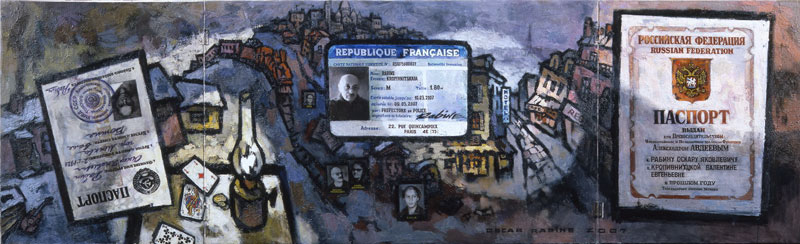
Three Passports, Triptych, 2006 Image: The Tsukanov Art Collection
Michel Ivasilevich, galleryist : there were always Russian artists in Paris, in the 20th century there were several waves of Russia who came from Russia to live and work here. Sutin, Lifshits, Tsadkin, after the War of the Poles, de Steel, Lanskaya. And there is a third wave - Oleg Tselkov, <Mikhail> Roginsky, Rabin, they did not come here of their own free will. Oscar Rabin in 1978 was actually expelled from the USSR along with his wife Valentina Kropyvnitskaya and son Alexander. In the early 1990s, an exhibition was organized in the Paris Gallery of the World of Art. Many then first met the art of Rabin. His paintings, one might say, is the same material as that of Nikol de Steel. They are material, rude as Lianozovo Earth, which he brought with him to exile.
Oscar Rabin: I see the center of Pompido from the window of my workshop on the second floor, as it is called. I have been seeing for 23 years. I am pleased, of course, that such a museum is nearby. But the fact is that I am probably monogamous. I already had when I arrived in France. I will probably be so until the end of my life. Of course, I love Paris, my real life there, outside the window. This is an eternal theater, an eternal holiday. And I myself in this theater, I take part in this play ...
Creativity every day
Michel Ivasilevich: In our house there is a picture of Rabin, in which all the strength and the mystery of his art are concentrated for me. It is called "eight kerosene lamps and eight electric lamps", it was acquired at the exhibition by my husband Mark, a collector. The wall of the hut with windows is depicted, through which the head of Rabin himself and his family members are visible. For me, this is the personification of his whole life, we see it as if outside and inside at the same time, so the artist shares with us the secret of his being ...
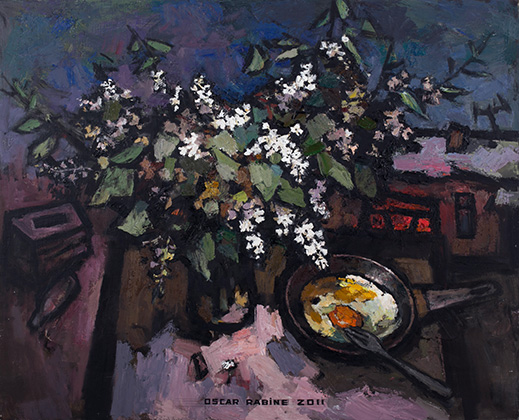
2013, canvas, oil image:
Museum of Modern Art of Erart
Kira Sapgir: What is the dear of Oscar's paintings to me - this incredible, passionate difference of fury in earthly comfort. Two wordings were given to them by their guru, Evgeny Leonidovich Kropyvnytsky: he had a series of “Egences” and there were poems “Earthly Comfort”. And this cozy lamp has Rabin ... a gray terrible human landscape around - and a gentle, encouraging orange glow. On this difference, it seems to me that the whole psychodrama of his paintings is being built.
Arkady weeks, philosopher : I called the book about him "Oscar Rabin - a drawn life." Rabin knows much more than my generation. I have not seen such an incredible originality of writing and such a perfect sensation of reality.

1965. Paper, felt -tip pen, watercolor.
Assembly of Alexander Kronik,
Moscow Source: Christies.com
Oscar Rabin: Very often, when you work on the picture, it becomes simply impossible to live. It costs the canvas and bothers you. You begin to redo it, redo it, redo it, in the end, you will embroider and completely ruin everything. Just lick everything ... It's hard to even say when something starts to work out. Sometimes you write a day, two, three. You smear it to no avail, and I can no longer be able to write everything anymore. As if he had never painted in life. I have more than 1400 paintings. And there are still moments when it does not work. Nevertheless, I work every day for a few hours. Well, how does it work? The devil knows him. Somewhere he will catch, on some piece begins to work out-and that’s all, went and went.
Oscar and Valentine
Valentina Kropyvnitskaya, artist : I somehow got to Moscow, I don’t remember what matters, and went to my dad to the studio to go home together. It was necessary to wait for the lesson to end. War, devastation, dog cold in this workshop. One child, I remember, the boy eight, sat there in a fur coat, in felt boots, in a hat, in mittens-and painted something. And the father and Oscar sat near the window and talked. I did not know that it was an Oscar. Dad often talked about a talented student who appeared in the studio. I came up and dad introduced us. I was very surprised, because I thought that Oscar Rabin is such a teenager, without parents, very difficult to live. Everything was so, of course, only he looked quite a young man. He looked at me very strictly through glasses. Well, I sat there with a book to wait for the end of the lesson. So we met, and then Oscar began to come to our house.
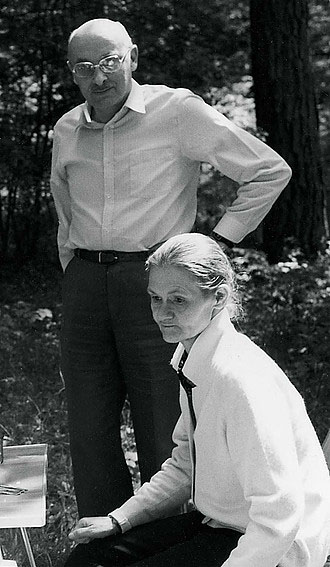
Photo: oscar-rabin.web61.server4.configcenter.info
Oscar Rabin: We made friends with Valentina. Then they began to walk together, and of course, it ended in the fact that they began to kiss. And after a while I made her an offer. I remember the scene: we walked in the park (and then she worked at the factory, did not get enough sleep, came home at about one in the morning), we returned home, Evgeny Leonidovich sits on the porch, is waiting for us. Valentina goes to bed, and Evgeny Leonidovich leads me, which means to the gate. Well, such, one might say, comedy begins. He said: “Oscar, you are such a talented artist. Is it possible to marry an artist? Of course, you can’t. You are a creative person. You will have a family, the children will go. You remember the picture of Fedotov: the old artist lies a sick, surrounded by children, and he is not to work? Keep your talent. " Then I tell him-well, well, because you got married, you have two children. “Well, you know, yes, but I have a special person’s wife, there is no such second.” When he saw that it did not work on me, he began to invent that Valentine was sick. True, he could not explain what. The walk lasted 2-3 hours. Then we returned, and never agreed. In the end, this bored with Valentine. And she says: Come on, let's go explain. We had very little money, but nevertheless we bought a bottle of champagne. I came, put a bottle on the table and said that we decided to get married. That's all. We rented some room in the village, but we did not live there for long. Then the barn was built, all summer they lived there until frost. And then ... I went to work as a ten to unload wagons on the railway, where the prisoners were unloaded, I had to earn money, and worked there for 11 years, until I received the room in Lianozovo ...
Valentina Kropyvnitskaya: Our family is all artists, father was an artist, mother of an artist. My brother and I have grown up, also began to draw. She married the artist. And our son became an artist ... When I was very small, about five or six years old, my father was fond of different new trends in art. We then had a large room, and all the walls were poured by paintings. Father often changed this exposition: it was beautiful impressionistic works in the French style, from nature; Then he did work in the style of pointerism or some other direction. All this changed, and so I knew the history of art.
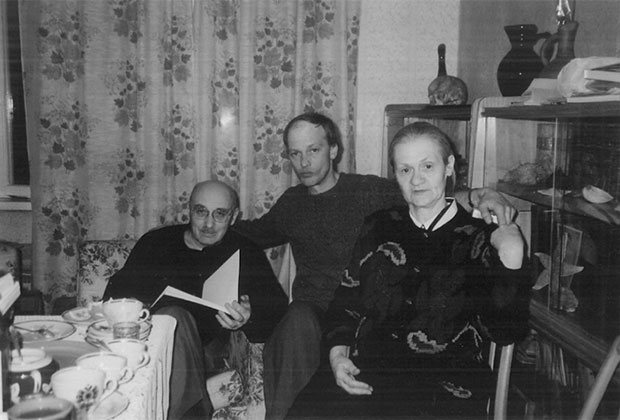
With son Sasha. Paris, 1993
Photo from the archive of Oscar Rabin
I love nature endlessly. Trees, herbs, bushes, rivers, lakes are the world that I portray, and the world that I create, because I see so. I made engravings in due time, for a long time, I wrote oil for some time, but most of all I like pencil technique. It is somehow closer to me, I can best convey the state of my feelings and the world that I portray with colored pencils.
Kira Sapgir: It was a magnificent couple, and not at all trying to look magnificent. But their hut was a palazzo, and they are in it - seniors. Seniors are completely optional to dress in gilded raincoats and fur stained caftans. And they knew this to themselves, so at the exhibition, which was in Moscow in the Tretyakov Gallery, Oscar portrayed himself and Valentine in the form of a noble medieval couple.
Vladimir Nemukhin: The Russian intelligentsia has never been happy and will not be. This is not her limit. Neither old, nor new, nor Soviet, nor anti -Soviet - it will never be happy.
Oscar Rabin: How many people live on earth, so many ideas about happiness. I have this idea more about what is not. What would you like, what you dream about, what you want throughout your life ...