
Translated material
"Symphony" of the authorities and the Russian Orthodox Church
100 years ago, a decree was adopted on the separation of the church from the state. Does Russia remain secular?
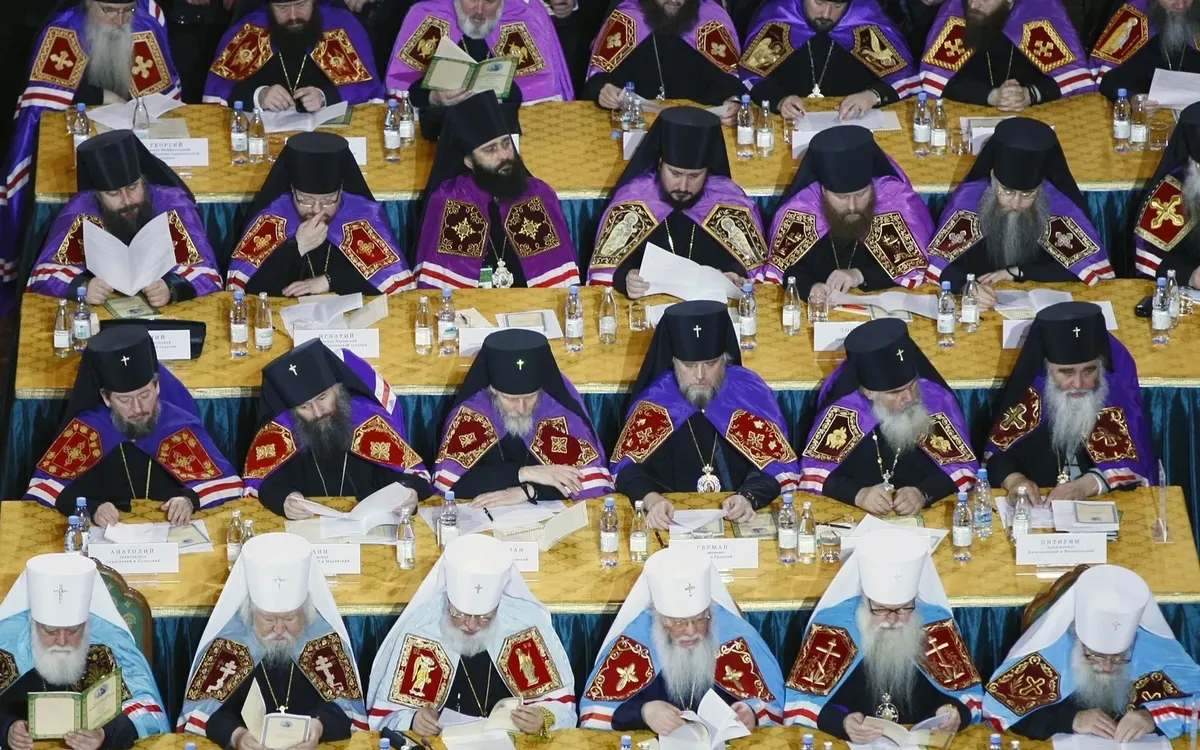
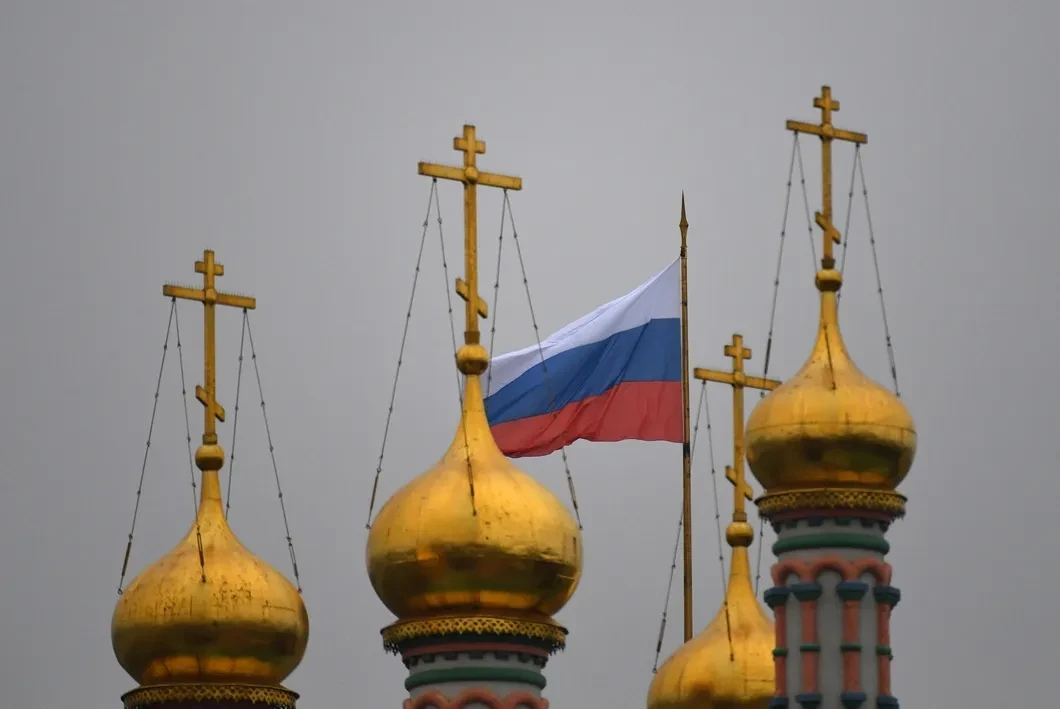
Congratulating Patriarch Kirill on the 9th anniversary of intronization, Dmitry Medvedev called the relations of the Russian authorities with the Moscow Patriarchate “Symphony” (in Greek-“Continence”, “Consent”). This statement comes into some contradiction with the constitution, which separates the church from the state and guarantees the equality of all faiths. For the first time in Russian history, such formulations appeared in the Soviet decree "On the separation of the church from the state and the school from the church", which was taken exactly 100 years ago.
From anathema to "a feeling of deep satisfaction"
The decree was officially adopted at a meeting of the Council of People's Commissars under the chairmanship of Lenin on February 2, and published it three days later. In some ways, he repeated the norms adopted by the Provisional Government in July 1917. The Law on Freedom of Conscience, which, however, was “transitional”: the church continued to remain part of the state structure, but the authorities lost the right to intervene in the life of the church. The commission on the compilation of the Soviet decree included the then quite famous Petrograd priest Mikhail Galkin (literary pseudonym - Gorev), a well -known “wrestler with obscurantism”. Later, he participated in the preparation of the instructions of the People's Commissariat (on the execution of the decree), which legally “justified” the first large -scale persecution of the Church in Soviet Russia.
So the phenomenon of the “red priest” arose at the very dawn of the revolution - later renovationism and Sergianism (which the modern Moscow Patriarchate adheres to) only historically modified it.
In anticipation of the emergence of the decree, the Local Council of the Orthodox Russian Church in December 1917 proposed his project of church-state relations in new Russia. Like the law of the Provisional Government, he was also a “transitional”, compromise. From the tsarist “symphony” of the Church and the state, the project was given the provisions on the primary status of the Church among all denominations, the coordination with the church of state laws regarding religion, the Orthodox religion of the head of state and some ministers, as well as the legal recognition of church wedding. On the other hand, from the revolution, the project got the requirements of the Independence of the Church in domestic administration, legal force behind the decrees of church power, the recognition of the church hierarchy by the state. Of course, the Bolshevitsky commissars did not read this project, and the Constituent Assembly, which was mainly addressed, was dispersed.
Literally on the eve of the adoption of the decree, on February 1, Patriarch Tikhon (Belavin) published his famous anathema to the persecutors of the Church, who renounced God, although he did not directly mention the Soviet government or the Bolsheviks in it. “The authorities, promising to put the right and truth in Rus', ensure freedom and order,” the Patriarchal Message says, “only the most unbridled self -will and continuous violence against everyone and in particular - over the Holy Church of the Orthodox.” The Local Council was not as radical as the Patriarch, but in the Decree of February 7 he recognized the decree “Act of the Open persecution” to the church.
Subsequently, the Moscow Patriarchate, reorganized by Metropolitan Sergius (on his behalf the term "Sergianism" takes place) in 1927 and officially recognized by Stalin in 1943, revised her attitude to the decree. In the message to the 30th anniversary of the “Great October Socialist Revolution”, Patriarch Alexy I wrote that the decree “gave the Church the opportunity to act freely in her characteristic spirit along the path indicated by church canons.” After another 30 years, this thought was developed by the future Patriarch Alexy II: “This decree was of great importance for the recovery of the church’s internal life ... The church as a result of the separation from the state acquired internal freedom, so necessary for the genuine implementation of its divine mission - the spiritual leadership of believers.”
The dream of the Democrats
The decree begins with the key norm of the secular state: "The church is separated from the state." Further, this norm is revealed in the categories of human rights: “Each citizen can profess any religion or not confess any. All complaints associated with the confession of any faith or non -use of any faith are canceled. ” Does this differ much from the current constitution? Article 14: “No religion can be established as state or mandatory. Religious associations are separated from the state and are equal before the law. ” Article 28: “Everyone is guaranteed freedom of conscience, freedom of religion, including the right to confess individually or together with others any religion or not to profess any.”
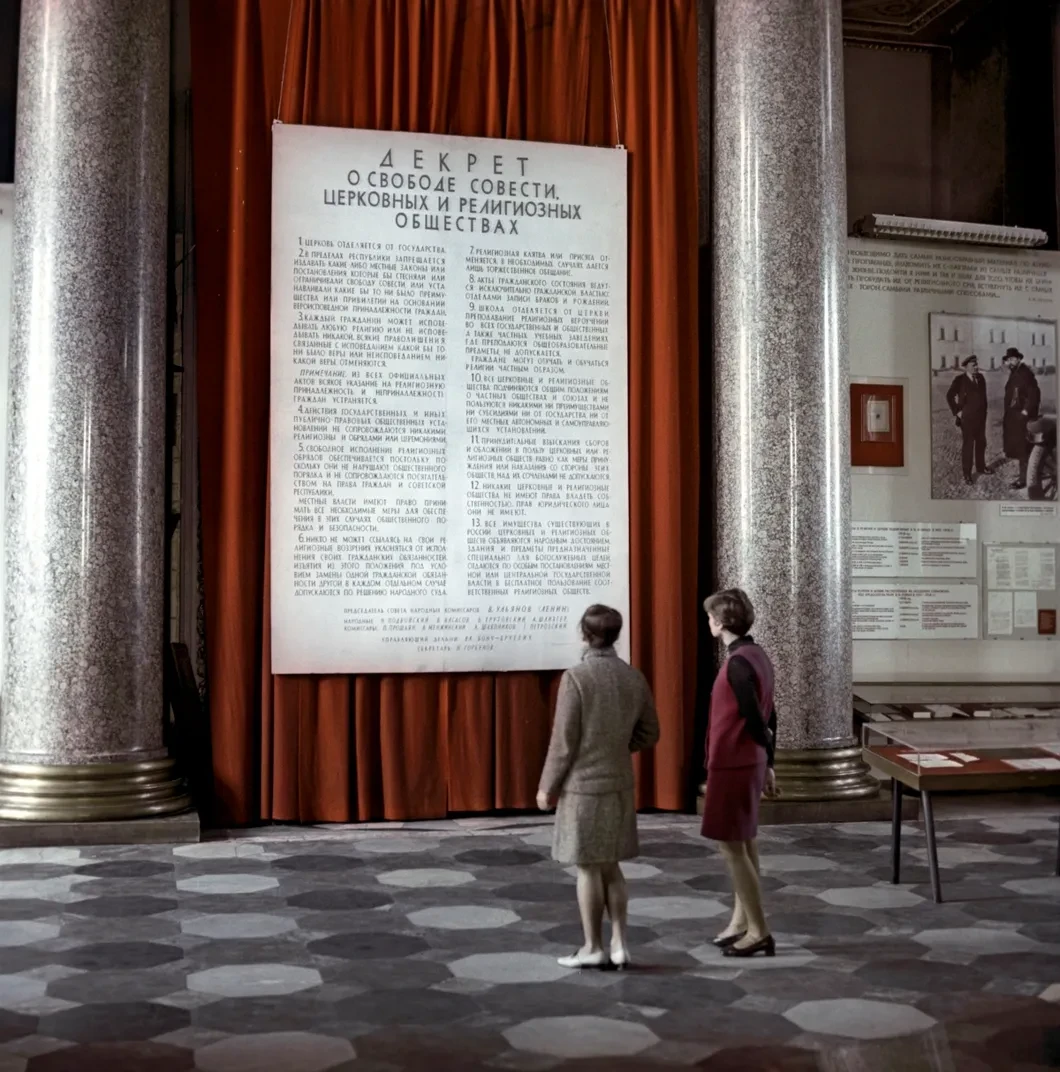
Further, the decree proclaims a rule that is very relevant for the modern Russian Federation: “The actions of state and other public law establishments are not accompanied by any religious rites or ceremonies.” Prayers in different state institutions, the consecration of military equipment and sprinkling with the holy water of the military became a commonplace phenomenon of Russian life. Another current position of the decree: "The free execution of religious rites is ensured insofar as they do not violate public order and are not accompanied by encroachments on the rights of citizens." Here, the mass protests of the townspeople against the development of courtyards and green zones are immediately recalled here, with “chambers of walking distance”, which the authorities most often ignore.
“No one can, referring to their religious views, evade the performance of their civil duties,” says the decree. Here, however, the Bolsheviks soon softened their positions, allowing some groups of believers not to serve in the army. And here are also current provisions: “Teaching religious creeds in all state and public, as well as private educational institutions where general educational subjects are taught are not allowed. <...> Forced collection of fees and attachments in favor of church and religious societies, as well as measures of coercion or punishment from these societies over their articles, are not allowed. ” The teaching of religious doctrines is shyly introduced into schools and universities of Russia under the guise of “the foundations of Orthodox culture” or “theology”, and billionth state subsidies for the maintenance of temples and monasteries transferred to the ownership of the Russian Orthodox Church have become a lady.
The nature of persecution
Most often, the decree is criticized for its last two paragraphs, the 12th and 13th: “No church and religious societies have the right to own property. They do not have the rights of a legal entity. All property of church and religious societies existing in Russia are declared a popular treasure. Buildings and items intended specifically for liturgical purposes are given, according to special decisions of local or central state power, for the free use of respective religious societies. ” True, the Decree of the All -Russian Central Executive Committee of 1929 has endowed with religious societies by separate attributes of the legal entity, and after the Stalin Concordat of 1943, they were allowed to open accounts, own buildings, lands and transport, hire employees, etc. According to the eternal Russian rule, the severity of the laws is mitigated by the optionality of their implementation ...
Professor of the St. Petersburg Theological Academy Archpriest George Mitrofanov adheres to a traditional point of view on decree as a reference point of red terror against the church. And his key argument is the same “optional performance”: “The real policy of the Bolsheviks, as a rule, was very different from the laws they adopted: according to the letter of the law on their real policy, one cannot judge. The decree actually covered the policy of the consistent struggle of the state with the church, ”Archpriest said in an interview with the“ independent newspaper ”.
Professor of the RSUSU Mikhail Babkin adheres to a different point of view. “The clergy itself gave the Bolsheviks a kind of reason to pursue themselves,” he says in an interview with “New”. - In the synodal translation of the Bible, carried out in the middle of the 19th century (in the message of the Holy Apostle Paul to the Romans), instead of the phrase “there is no power, not from God” (literally - “not power, if not from God”) representatives of the clergy were introduced: “there is no power from God”. Where and the common thesis "all power from God." And it turns out that if someone from the clergy at least “resisted” the Soviet regime, he “opposed God's command”. And if so, it rightly earned punishment from power itself. ”
On the one hand, the deprivation of the church of the rights of the legal entity and property does not fit with democratic ideas. On the other hand, the church in Russia never had such rights: it itself and all its property was before the revolution part of the Orthodox state, headed by the Orthodox emperor, revered and the head of the church organization. Monasteries and some parishes, of course, owned lands, buildings, and until 1861 and peasants, but only because they were "allotted from the treasury." The modern Russian Orthodox Church is trying to build the most clerical model of church property in the entire history of the church - according to its charter, all giant property transferred to the church is disposed of the bishop (now 226 people), which completely depends on the Patriarch and the Synod (15 people).
Such a concentration of ownership of such a narrow circle of people did not have in the history of the Russian Church.