
Translated material
Anna Tsfasman, "Dublby": "We were not going to build a network of coffee houses"
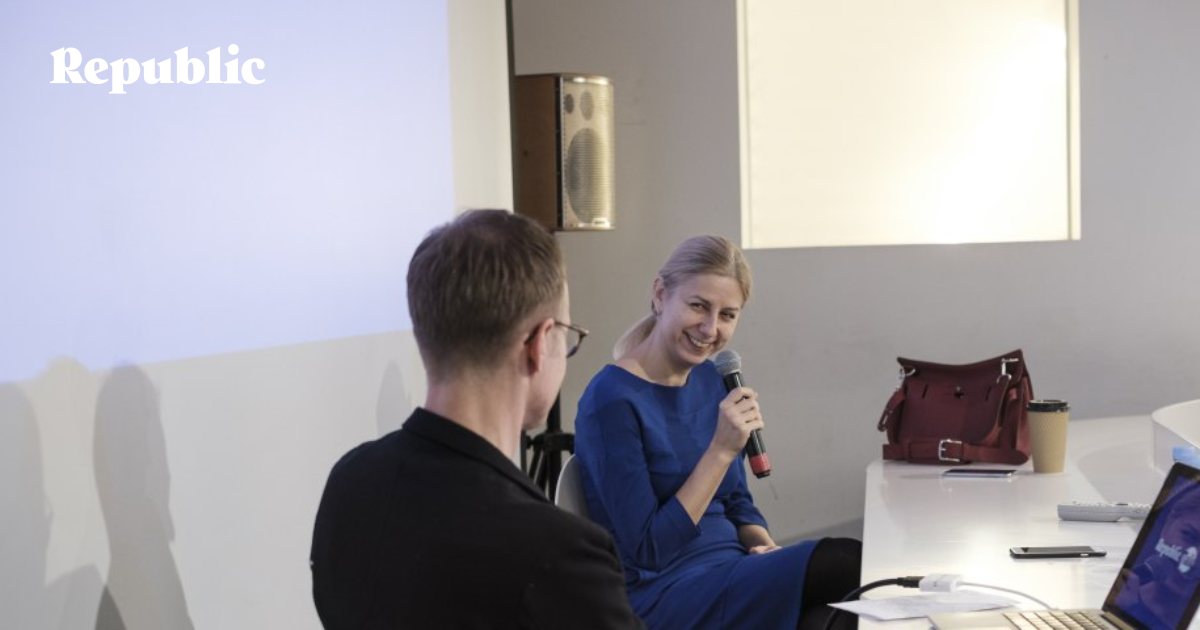
In January, we met with Anna Tsfasman , a co -founder of the Dublby Coofen network. It was one of the most amazing conversations in the REPULIC Talk series. Anna easily talked about the crisis in which the company ended up after the first year, about the problems with the buyers of the franchises, about the alarm of the growing business, which did not allow sleeping at night. I chose the most interesting fragments from a half hour conversation, accompanying them with small comments.
Help for those who are not in the know. Dabblebi appeared five years ago, when Anna Tsfasman left the leadership on the Flyn network. Initially, they and partners thought to open points for the trade in coffee beans. But in the end, a network of coffee houses - own and open in franchise grew out of the project. Now Dabblebi is working in Russia, Georgia, the Czech Republic, Spain and the UAE, there are more than 80 establishments on the network, 10 tons of coffee are sold by about 20 million rubles through them, if we count at cost. And this is one of the most striking representatives of the movement, which in the jargon is called the "third wave" of coffee.
The first wave is considered the appearance of a packaged, convenient to prepare coffee (brands like Folgers that arose back in the 19th century). The second is associated with the spread of Starbucks and their followers - they introduced new drinks of drinks and began to distinguish between coffee in countries of origin. The third wave is considered to be a response to the Commoditization of the product by these networks - the new approach copies the attitude to guilt: sellers of such coffee distinguish not only countries, but also individual farms with their special landscape and climatic conditions, try to make improvement at all stages of production - from harvesting and processing berries to the method of preparing the drink. Does it resemble religion? Yes, but this is a common phenomenon in business.
About when it is time to go to your business
I felt very well the managing director of the Flyn network, everything was very pleased with me. And in the professional community we were very respected, because then we were seriously interested in coffee - we began to popularize the product itself, say that coffee is different, began to ride [on plantation], watch, experiment. After all, when you do something deeply, you will inevitably come to the conclusion: to do everything as it should, you must do this, firstly, yourself, and secondly, from beginning to end.
But the shareholders of the "caffeine" asked at some point, why do we spend so much money [on trips, the purchase of expensive varieties]? They love us, they know us, we have a brand, and having a brand, we can sell under it what we consider necessary. This, by the way, is absolutely true and fair for almost any business. But such a layout did not suit me. Four months of negotiations did not lead to anything. My decision was absolutely forced, so I still remember everything so well. And partly, of course, I am still angry: how they did not understand then what they were losing! (Laughs.)
About a business plan
Did we have a business plan? Rather, his miserable likeness, four pages that I wrote. Later, more experienced comrades taught me the most important phrase: a business plan is a “sooning that nure happens”, and that is why people often treat the writing of a business plan as a formality that they perform incomprehensibly why-hence the corresponding result.
However, Tsfasman notes that the case of Dabblebi was not typical - from the very beginning, several investors wanted to give money from the very beginning. It was the seller’s market, not a buyer.
Which investor is correct?
Some investors, without even looking at the business plan, said: everything is suitable for us, let's start. Others suggested carefully to see the numbers. They sent a colleague who asked me the question: where is the VAT? I replied: “Do you want me to consider taxes? Do you understand?! I think conceptually, I understand the strategy, in marketing, do you have no accountant? You need - you count. ” I had about such an ingenious answer, and we must pay tribute to the person that he did not kill me; But he wrote to the investor that he does not highly recommend cooperating with us, because, obviously, we do not understand anything in the economy.
And we refused them ourselves. If they already ask so many questions at the initial stage, then what will happen then? We went with other investors, but those eating, turned out to be very stubborn: for a month they called, wrote, demanded meetings, persuaded. And in the end we sat, thought, and the decision came by itself: they refused the first to be agreed with, and decided to go with the second. Well, yes, the female is a very decision (laughs) . But it seems to have saved us.
I only then realized how lucky we were that we then made this choice. We have passed very difficult times with investors, including the period when we seriously wanted to part; There was a story with a check when investors suspected us that we lost several million rubles. But we gained tremendous experience. And most importantly, we checked our relations for strength: the foundation of these relations is now firmly cemented. It is easier to build on a good foundation.
When you do not need to take the second million
At the start we had a million dollars. Not very big money, but not three kopecks after all. However, we walked this million in the first year. We just lowered him to nowhere: we opened one unsuccessful coffee shop, did some projects, drove coffee. By the end of the year, we had one working coffee shop, a couple was built, and it was necessary to purchase coffee for large sums, because coffee was bought with an advance. And there was no more money.
Subscribe to read the whole
Make a subscription Redefine.media to read Republic
Subscribe [you can pay for a Russian or foreign card. The subscription is extended automatically. You can unsubscribe at any time.]
Where are the money subscribers going