
Translated material
Tides and access to land
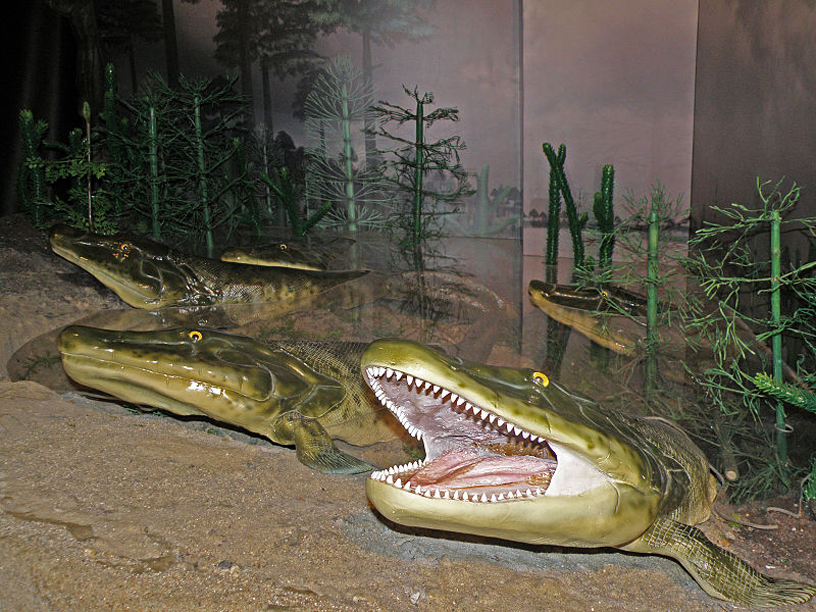
On the Portland in Portland (Oregon) of the annual oceanological conference of the American geophysical union, a group of researchers under the leadership of Hannah Byrne from the University of Uppsal's University proposed to clarify the scenario of the release of vertebrates for land. Briefly about the content of their report is told by the sites of Nature and Science magazines. According to the assumption of the authors, the transition of the ancestors of amphibians to a ground lifestyle was facilitated by increased tides. In small water pools remaining in the tidal zone during the tide, there were fish, which remained to hope that they would live to the next tide, or find the opportunity to return to the ocean on their own.
As far as the paleontologists are known, the vertebrates got out to land in the Devonian period, about 400 million years ago. Devices for a ground lifestyle, apparently, simultaneously arose in several groups of fish. Most often, among the circumstances that contributed to this, they call the appearance of shallow, abundant by the algae of lagoon. The fish that lived there should have adapted to the frequent drying out of these reservoirs during the drought, so over time they moved to a semi -water lifestyle, and their descendants completely became the inhabitants of the land.
The paleontologist from Chicago University, Professor Alfred Romer), expressed a hypothesis about the role of tidal pools in this process. In 2014, an astrophysicist from Oxford Steven Balbus (Steven Balbus) calculated that 400 million years ago the ebb was stronger, because the moon was about 10 % closer to the ground than now. The sisiegic tides that occur were especially strong when the strength of the gravity of the Sun and the Moon acts on the waters in one direction. Such tides come about once every two weeks, on the new moon and on the full moon. The minimum height of water lift occurs with a quadrature tide when the sun and moon act at right angles to each other. The difference in the height of the Syzigiye and quadrature in the Devonian period, according to Stephen Balbus, could reach four meters. Local features are also affected by the tide height and, accordingly, the chances of fish are trapped: the shape of the coastline and the depth of coastal waters.
When the water retreats in the ebb, a lot of puddles, ponds and startups cut off from the ocean remains on the exposed shore. If they formed after the sisiegic tide, then their inhabitants will have to wait for water to return for two weeks. Oceanologist Mattias Green (Mattias Green) from Bangora University in Wales says: “In a few days, food ends in such pools or you yourself become food. Pisces with developed limbs had an advantage, as they could independently get to the water. ”
Stephen Balbus, Matthias Green and their colleagues also note that in that era, land was divided into two supercontinents: Gondwan and Laurasia, separated by a relatively narrow wedge -like strip of the ocean. Such a strait between the two continents was supposed, according to Stephen Balbus, to help increase the height of the tides. Scientists simulated the shape of the coastline of the ancient continents and calculated the places in which the height of the tides was the largest. Taking into account the data on the later tecton of the plates, they determined where the corresponding deposits are now located. As shown in the report, it is in these places that a large number of “transitional” fossils of fish are found, the fins of which began to turn into the limbs of amphibians.
Such confirmations are in different places of the Earth: in Canada, in Eastern Europe, in Ireland. An example of such a find is the famous Tiktaalik ( Tiktaalik Roseae ) from the island of Elsmir in the Canadian Arctic. Or numerous prints of traces of the Central -Devonian period (397 - 395 million years), found in the Svenoksky mountains near the village of Zahelma in Poland. A little younger, petrified chains of traces on the Irish island of Valentia.
The petrified remains of Tiktaalik
Reconstruction of Tiktaalik
Reconstruction of a creature who left traces in the Sventoki mountains
It is interesting that, according to this theory, the petrified remains of fish that are on the way to turning into amphibians should be in other regions, for example, in Afghanistan and Syria, but excavations there are now impossible due to political instability.
About a year ago, scientists from the Australian National University and the University of the New South Wales considered another factor that could contribute to the exit of fish to land. Their article was published in The American Naturalist. Researchers examined the risks that fish from the Alticus clan in water and on land are exposed.
Representatives of this kind, also known as rocky jumpers, live on the coasts of the islands of Indian and Pacific Oceans, as well as Australia. They are able to breathe atmospheric air. They live in a tidal zone, feed mainly by algae and during an ebb they hide in the recesses filled with water. When the tide comes, these fish are in no hurry to be in the ocean water. On the contrary, they try to rise higher on land, into the so -called suprailitor - a zone that does not flood even during a tide. This behavior provides them with protection against predatory fish. On land these fish are also in wait for the dangers, for example, they can become a victim of birds. But, apparently, the risk of land is less than in the sea.
Representatives of the type of alticus monochrus on the island of Mauritius
Scientists decided to experimentally prove that life in the adhesive zone allows Pisces to avoid predators. They made 250 models of such fish from Latex and placed their island of Rarotong in the Cook Island Archipelag, setting part on the litter (in the zone drained during the cast), and part in Sublitorli (a miracle, where there is always water). As it turned out, the models, which were in the subhtibutali, were much more likely to be attacked by predators, about half of them were damaged during the experiment. The same models that ended up in the tidal zone suffered much less, the damage was noticeable only for nine of them. Therefore, upholstered in the tide zone, fish alticus are less at risk. Therefore, the authors of the work came to the conclusion that the pressure of the predators became one of the reasons forced some of the Devonian fish to move to the litter, taking the first steps in the development of land.