
Translated material
Memory. Peter Schmidt
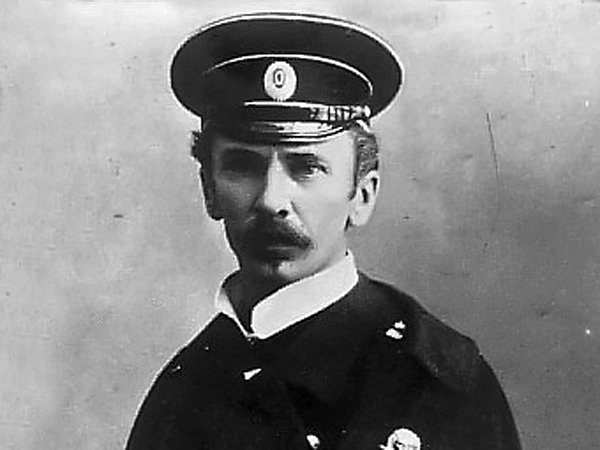
On February 17, 1867, “Red Lieutenant” Peter Schmidt was born, heading the 1905 Sevastopol Uprising
Personal business
Pyotr Petrovich Schmidt (1867-1906) was born in Odessa in a noble family. Both from his father and mother, he was from Russified Germans. His father Petr Petrovich Schmidt was a hereditary marine officer, the hero of the first defense of Sevatopol. Mother - Ekaterina Yakovlevna, was in girlhood she wore the surname von Wagner. Peter had two older sisters - Anna and Maria. Since childhood, the boy was read out by the works of Tolstoy, Korolenko and Uspensky, played the violin, studied Latin and French.
When Peter was 9 years old, his father, then bearing the title of captain of the 1st rank, was appointed mayor of Berdyansk. In the fall of the same year, he gave his son to the Berdyansk male gymnasium, which was later named in his honor. Mother died when Peter was 10 years old. It is claimed that it was from her that he adopted the ideas of democratic freedoms, which later influenced his life.
In 1880, Peter Schmidt, after the end of the gymnasium, entered the Marine Cadet Corps in St. Petersburg. Already at that time, according to the memoirs of fellow students, he periodically had attacks of a nervous disease, and he was not expelled from the corps exclusively thanks to the connections of his father and uncle Admiral. In 1886 he graduated from the cadet corps of the 53rd on the list, was carried out on the exam in the midshipman and received his appointment to the Baltic Fleet.
Since the beginning of 1887, Schmidt began the performance of official duties in the training and shooting team of the 8th naval crew, but a year later - at the end of January 1888 - he was sent on a half -year vacation "due to illness, with the subsequent transfer to the Black Sea Fleet due to the climate that was not suitable." According to some sources, the vacation was associated with the nervous seizure, according to others - with the radical political views of midshipman and frequent quarrels with personnel.
In July 1888, Schmidt was transferred from the Baltic to the Black Sea Fleet with the enrollment of his royal highness of the Duke of Edinburgh in the 2nd Black Sea Field of his Royal. However, already in December of the same year he was again “fired on vacation, due to illness, inside the empire and abroad” again.
In 1888 he was appointed to the Pacific Ocean squadron for the Bobr gunboat.
In 1889 he filed a petition for the highest name for dismissal to the reserve for health reasons: “My painful condition deprives me of the opportunity to continue the service of your imperial majesty, and therefore I ask you to dismiss me”, after which I went to be treated to the private hospital “Dr. Save-Mogilevich for nervous and mentally ill in Moscow”, where he spent two months.
In June 1889 he was fired from illness with the rank of reserve lieutenant. After dismissal, he lived in Berdyansk, Taganrog, Odessa. According to some reports, having suddenly received an inheritance after the death of aunt’s mother, A. Ya. Esther, Schmidt with his wife and little son went to Paris, where he entered the Eugene Eugene High School. Under the pseudonym Leon Aer, he tried to master flights in a balloon, but did not achieve much success in this. The family was in poverty, and at the beginning of 1892 the Schmidt moved to Poland, then Livonia, Petersburg and Kyiv followed, where Leon Arara’s flights also did not bring the desired fees. In Russia, during one of the indicative flights, Schmidt suffered an accident, which ended in a hard blow to the basket of the balloon on the ground. Because of this blow, he suffered from the rest of his life from the kidney disease. Further flights had to be stopped.
To pay off debts, a balloon along with equipment to ensure flights, I had to sell.
In March 1892, Schmidt appeals to the highest name "On admission to the naval service." In July 1892, with the former rank of Michman, he was led by a watch officer on the 1st rank “Rurik” of the Baltic Fleet. In 1894, he was transferred from the Baltic Fleet to the Siberian Navy crew, where he was appointed by the watchman of the Yanchikha destroyer, and then - the cruiser Admiral Kornilov.
In the same year, in connection with the increasing nerve seizures, Schmidt was written off ashore Nagasaki for treatment.
In December 1895, he was promoted to the rank of lieutenant and until 1897 he served as a head officer, and a senior officer of Brandvakhta. In January 1897, he was sent to the Nagasak coastal infirmary "for the treatment of neurasthenia's disease."
In August 1897, due to frequent quarrels with senior officers and due to refusing to participate in the suppression of the strike, he was first sent for three weeks to guardhouse, and then written off ashore. The year served the Vakhtniy Head on the Brandvakt of the Vladivostok raid. In August 1898, after the conflict with the commander of the Pacific Ocean squadron, he filed a petition for dismissal and was finally dismissed with the right to service in the trading fleet.
In 1898, Schmidt entered the service of the assistant captain of the Kostroma steamer of the voluntary fleet, where he served 2 years. This fleet was created by the government for distant ocean swimming, primarily between the Western ports of Russia and the Far East. In the event of a war, high-speed transports could become auxiliary cruisers-raiders, and their captains, who have military education and the experience of long-range swimming, were supposed to lead ships to destroy enemy communications.
In 1900, Schmidt switched to the service in Ropit (Russian Shipping Company and Trade Society) Assistant to the assistant captain of the Olga ship. From 1901 to 1904 he walked the captain of the trading and passenger steamboats “Igor”, “St. Nicholas”, “useful”, “Diana”. Over the years of service in the Trade Fleet, respect among sailors and subordinates earned. In his free time, Schmidt taught sailors to literacy and navigation. “The navigators were ordered to engage in sailors at a specially appointed time for this. For classes, textbooks and educational supplies were purchased at the expense of the ship. The "teacher Petro" himself, as we called Schmidt, sat down on the Skans among the team and talked a lot "(Krasny Lieutenant Karnaukhov, 1926).
In April 1904, after the start of the Russo-Japanese War, in connection with the military situation, Schmidt was called up for the actual military service and was sent to the headquarters of the Black Sea Fleet, and a month later he departed the second Pacific squadron to the senior officer of the Irtysh coal transporter. Soon, the unprecedented transition of the squadron through three oceans began. The Irtysh was directed along the reduced path through the Suez Canal and the Red Sea. Shortly before the defeat of the squadron, the Japanese near the island of Tsushima Schmidt suddenly written off the ship for everyone in Suez. According to various information - either due to illness, or due to the expiration of the age of the service.
He returns to St. Petersburg, where an influential uncle Schmidt transferred his nephew to the Black Sea Fleet, commanded by his former pupil Vice Admiral G. Chukhnin.
In order for the patient Schmidt to serve as easily as possible, Chukhnin appoints him the commander of a small license plate No. 253, which is based in provincial Ishmael for patrolling on the Danube. In February 1905, Schmidt arrived in Izmail, and already in March of the same year he robbed the ship's cash register, taking from there 2.5 thousand gold, and left Izmail. He visited Kyiv, where he was seen at the hippodrome on horse races, then went to the Crimea. He was caught, but once again, thanks to an influential uncle, the case was heshed. Schmidt was threatened by the military court, but his uncle, who had become a senator by that time, personally contributed the amount wasted by his nephew and pressed all the possible levers, having to ensure that he would be fired from the fleet without publicity.
Schmidt turned out to be without certain classes and special prospects in Sevastopol just on the eve of revolutionary events, when the sailor “Buza” matured in coastal barracks and ships.
In the summer of 1905, Schmidt began to conduct propaganda activities in support of the revolution. He organized the Union of Officers - Friends of the People in Sevastopol, then participated in the creation of the "Odessa Society of the Mutual Use of the Sailors of the Trade Fleet." Conducting propaganda among sailors and officers, he called himself an "non -party socialist."
On October 18, 1905, Schmidt at the head of the crowd, surrounded the city prison, demanding to free prisoners of workers. Two days later, at the funeral of those who died during these riots, he made an oath, which became known as “Schmidt’s oath”: “We swear that we will never give in to anyone a single heel of human rights we have won by us.” On the same day, Schmidt was arrested for propaganda and on November 7 was dismissed.
Being under the arrest on the battleship “Three Saints” he was elected Sevastopol workers with a “lifelong deputy of the Council”. Soon, under the pressure of revolutionary masses, he was released under a recognizance not to leave.
On November 13, 1905, Peter Schmidt was elected head of the revolutionary movement of sailors and sailors. The next day, he climbed with his son to the cruiser Ochakov and led the rebellion, throwing the Admiral flag on Ochakovo and giving a signal to all the vessels in the port - “I command the fleet. Schmidt. " He acted almost certainly: the team representatives who came to him said that after the sailors began to sabotage the execution of orders, the officers left the ship in full force. Later, a telegram was sent to Nicholas II: “The glorious Black Sea Fleet, sacredly storing loyalty to his people, demands from you, the sovereign, an immediate convocation of the Constituent Assembly and will not obey your ministers.
Fleet Commander P. Schmidt. "
Having giving a signal that he commands the fleet, Schmidt sent his cruiser to the Prut minefielder in order to free the Potemkinites contained on it. No resistance was provided. The Ochakov accepted the liberated sailors aboard and went around the whole squadron with them to attract it to the uprising.
Schmidt said that on the shore, in the fortress and among the workers, “his people” are only waiting for a signal to start an armed performance. According to him, the capture of Sevastopol with his arsenals and warehouses is only the first step, after which it was necessary to go to the Perekop and build artillery batteries there, block the road to the Crimea and thereby separate the peninsula from Russia. Then he intended to move the fleet to Odessa, land the landing and take power in Odessa, Nikolaev and Kherson. As a result, the “South-Russian Socialist Republic” was supposed to form, at the head of which Schmidt saw himself.
Schmidt expected to raise a red flag on all vessels of the fleet, but besides the disarmed Panteleimon and a couple of destruction of destroyers, all vessels remained faithful to the king. According to the memoirs of one of the active participants in the uprising, a member of the Social-Democratic organization of Sevastopol Ivan Voronitsyn: “... ... the squadron that did not follow after the liberation of the arrested join the squadron deprived Schmidt of all energy. A seizure became with him, and he could no longer do anything ... ”
The red flag on Ochakovo was raised on November 15 at 9 a.m. Against the rebel cruiser, the leadership of the Black Sea Fleet immediately began military operations.
A mine transport with a complete loading of sea mines was covered from a possible attack from the shore of the “Ochakov”, putting on a mine transport - any hit in this powerful floating bomb would cause a disaster, the force of the explosion would have demolished part of the city adjacent to the sea
However, the mine transport team opened Kingstona and flooded the ship with a dangerous load, leaving the “Ochakov” under the muzzles of artillery guns.
At 3 o’clock in the afternoon, the naval battle began, and at 4 hours 45 minutes the tsarist fleet had already won a complete victory. The uprising was crushed by the fire of squadrons and coastal batteries. As a result of shelling, the cruiser received severe damage and caught fire.
When it became obvious that the rebellion failed and the “Ochakov” would be shot from the squadron's guns, Schmidt, along with a sixteen -year -old son on loaded coal and water, tried to escape to Turkey. He almost succeeded, but the destroyer was damaged by the artillery fire from the battleship Rostislav and failed to go to sea. Schmidt was found in the hold under the boards of a sailor dressed in the shape of a sailor and taken into custody.
Closed by the Naval Court, held in Ochakovo from February 7 to February 18, 1906, Schmidt, along with three associates, was sentenced to death. On March 6, the verdict was carried out on the island of Berezan.
In May 1917, the remains of Schmidt and the sailors shot with him were on the orders of the commander of the Black Sea Fleet, Vice Admiral A.V. Kolchak, on an accelerated manner, were transported to Sevastopol, where their temporary burial took place in the Pokrovsky Cathedral. In November 1923, Schmidt with his comrades was reburied in the city cemetery of Kommunarov in Sevastopol.
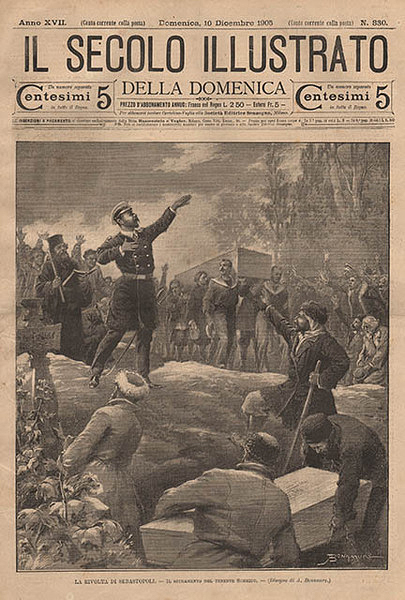 "Lieutenant Schmidt Oath" - an illustration from the Italian newspaper Il Secolo dated 10/10/1905 Antonio Bonamore/Wikimedia Commons
What is famous
The reserve lieutenant Peter Schmidt is the only naval officer who participated in the 1905-1907 revolution on the side of the socialist revolutionaries.
The deeds of Sevastopol Schmidt’s uprising decades later turned out to be almost forgotten by ordinary townsfolk, but his name is known to everyone who read the Golden Calf. Thanks to this novel by Ilf and Petrov, the expression “son of Lieutenant Schmidt” firmly entrenched in Russian as a synonym for a scam and a fraudster. The novel mentions “thirty sons and four daughters of Lieutenant Schmidt”-Samosvanta fraudsters who wander along the outback and begging material assistance among local authorities, calling themselves the children of the famous “Red Lieutenant”. The thirty -fifth descendant of Lieutenant Schmidt was the main character of Roman Ostap Bender.
Schmidt contemporaries diverging radically in assessments of his personality. Some consider him an idealist who dreamed of creating justice society in Russia, others - mentally ill, pathological false, faded for money by a person, behind the sprayed speeches hiding selfish aspirations.
It is alleged that during the eleven-day investigation, Prime Minister Witte reported to Nicholas II that "Peter Schmidt is a mentally ill person and by all his actions was led by madness." To this, the king replied that "if he is mentally ill, then this will establish an examination." However, the examination was never conducted.
What you need to know about
In 1988, Peter Schmidt married a street prostitute Dominica (Domniki) Pavlova, who had a “yellow ticket” instead of a passport. The young midshipman considered her a victim of social injustice and did it with the aim of re -education - possibly under the influence of Dostoevsky’s novels. This "immoral act" caused the indignation of the father of Schmidt, who decided that his son had a surname, and had to put an end to the Peter's military career. However, in mid -December 1888, his father died.
After the death of Peter Schmidt Sr., his uncle, a military hero, admiral and Senator Vladimir Petrovich Schmidt took care of Schmidte Jr.. He hesitated the scandal with marriage and sent his nephew to serve in the Siberian flotilla of the Pacific squadron. However, despite the concerns of the uncle, in 1889 Schmidt was resigned - not only due to illness, but also "due to violation of the Officer Code on the issue of marriage."
Schmidt failed to achieve the “correction” of his wife, although their marriage lasted more than one and a half decades. Contemporaries noted that "Schmidt's family life did not work out." It is alleged that his wife considered all his teachings to be moron, he did not put him in a penny and openly cheated on him.
A year after the wedding, the couple was born a son, who was called Eugene. After another 15 years - a daughter. In the Metric Book of the Nikolaev Admiralty Cathedral in Sevastopol, there is a record of the birth of Catherine Schmidt on December 6, 1904. Parents: 33rd naval crew, Lieutenant Petr Petrovich Schmidt and his legitimate wife Domnikiya Gavrilovna.
The fate of Catherine is unknown, perhaps she died in infancy. The son after the divorce remained with his father. He was with him on the rebeling "Ochakovo", was also arrested after the suppression of the uprising, 40 days were detained, but then was released as a minor.
He was a Socialist -Revolutionary, participated in the civil war on the side of the white movement. After the defeat of the army, Kolchak lived an emigrant in Europe, wrote memoirs about his father under the name “Schmidt-Ochakovsky”.
The only true son of Lieutenant Schmidt died in poverty in Paris in 1951.
Direct speech
About the flight with Ochakovo: “I often think that Russia will not allow me to betray the death penalty ... I will go to death calmly and joyfully, as I stood calmly and joyfully under the“ Ochakovo ”under the unprecedented in the history of wars with a hail of artillery fire. I left the “Ochakov” when a fire was covered by a fire and there was nothing to do on it, there was no one to hold from panic fear, there was no one to reassure. Strange people! How they are all afraid of death. I told them a lot that death is not terrible to us, because the truth is with us. But they did not feel it as deep as me, and therefore let them master the animal fear of death ... ".
Alexander Kuprin about the execution of Ochakovo (“Events in Sevastopol”, 1905) : “The cruiser burned silently, throwing bloody spots on black water. There were no more screams, although we still saw people on the nose and on the tower. Here in the crowd a lot was recognized. The fact that at the beginning of the fire they offered the "Ochakov" boats, and that the sailors refused. О том, что по катеру с ранеными, отвалившему от "Очакова", стреляли картечью. Что бросавшихся вплавь расстреливали пулеметами. Что людей, карабкавшихся на берег, солдаты приканчивали штыками. Последнему я не верю: солдаты были слишком потрясены, чтобы сделать и эту подлость».
Писатель-маринист Владимир Шигин о расстреле «Очакова» : «Автором версии "небывалого по жестокости обстрела" был известный писатель Александр Куприн. Любая книга о восстании на "Очакове" всегда включает в себя рассказ-ужастик Куприна. Это стало уже почти обязательным ритуалом…<…> На самом деле никакого бешеного расстрела "Очакова" не было и в помине. Даже рассуждая логически, невозможно предположить, чтобы командование Черноморским флотом горело желанием уничтожить собственный новейший крейсер. Задача Чухнина была совершенно иной: заставить мятежников прекратить огонь и спустить флаг. Едва это было исполнено, как огонь был немедленно прекращен. Согласно официальным отчетам, по крейсеру было сделано всего шесть залпов. При этом делались они с достаточно большим интервалом, так как общее время обстрела заняло двадцать пять минут. Кроме этого, трудно предположить, что расстреливаемый в упор трехсотпятимиллиметровыми снарядами неподвижный крейсер вообще мог остаться на плаву, ведь для его уничтожения хватило бы всего двух-трех попаданий, ведь промахнуться с дистанции в три-пять кабельтовых по столь большой и неподвижной цели было просто невозможно. Документы показывают, что огонь велся прежде всего орудиями малого калибра, с тем чтобы не пробить броневой пояс "Очакова", то есть не поразить его жизненно важные отсеки <…> Лучшим доказательством не слишком больших повреждений "Очакова" служит тот факт, что после окончания восстания корабль даже не отправляли на ремонт в Николаев, а ограничились местным ремонтом на маломощном Севастопольском судоремонтном заводе».
Снова, приветствуем экипажем,
На броненосцы всходил и глох,
И офицеров брал под стражу,
И уводил с собой в залог.
В смене отчаянья и отваги
Вновь, озираясь, мертвел, как холст:
Всюду суда тасовали флаги.
Стяг государства за красным полз.
По возвращеньи же на "Очаков",
Искрой надежды еще согрет,
За волоса хватаясь, заплакал,
Как на ладони увидев рейд.
"Эх, — простонал, — подвели канальи! "
...........................................................
Натиском зарев рдела вода.
Все закружилось так, что в финале
Обморок сшиб его без труда...
(Борис Пастернак, поэма «Лейтенант Шмидт», 1926-1927)
7 фактов о Петре Шмидте
- Практически все мужчины рода Шмидтов посвятили себя службе на флоте. Отец и полный тёзка будущего революционера Пётр Петрович Шмидт дослужился до звания контр-адмирала, был начальником Бердянского порта. Дядя, Владимир Петрович Шмидт, носил чин полного адмирала, являлся кавалером всех российских орденов, был старшим флагманом Балтийского флота. Два его сводных брата от второго брака отца также стали морскими офицерами.
- Сводный брат Владимир Петрович Шмидт, также морской офицер, после расстрела Петра изменил свою фамилию на Шмитт до конца жизни.
- По воспоминаниям сослуживцев, Петр Шмидт хорошо играл на виолончели.
- Психическая болезнь Шмидта выражалась в неожиданных приступах раздражительности, переходящей в ярость, за чем следовала истерика с судорогами и катанием по полу. Зрелище это было настолько тяжелое, что маленький Евгений, ставший свидетелем внезапного приступа отца, так испугался, что остался заикой на всю жизнь.
- В советские годы общепринятой была версия, что расстрелом Шмидта командовал его товарищ детства и сокурсник по училищу, сидевший с ним за одной партой Михаил Ставраки, расстрелянный за это советской властью в 1923 году. Однако сам Ставраки на суде вины своей в казни Шмидта не признал, заявив, что он присутствовал при казни только как офицер связи, а командовал ею командир транспорта «Прут» капитан 2-го ранга Радецкий.
- Памятник на могиле Шмидта был сделан из камня, ранее стоявшего на могиле командира броненосца «Князь Потемкин − Таврический», капитана 1-го ранга Е. Н. Голикова, убитого матросами в ходе восстания в 1905 году. Для постамента использовали гранит, оставшийся после возведения памятника Ленину
- Именем лейтенанта Шмидта названы улицы, парки и бульвары многих городов постсоветского пространства: Астрахань, Винница, Вологда, Вязьма, Бердянск, Тверь (бульвар), Владивосток, Ейск, Днепропетровск, Донецк, Казань, Мурманск, Бобруйск, Нижний Тагил, Новороссийск, Одесса, Первомайск, Очаков, Самара, Севастополь и Симферополь.
Материалы о Петре Шмидте
Отец всех «сыновей». Подлинная история революционного лейтенанта Шмидта. АиФ, 24.11.2014
Лейтенант Шмидт и его дети
Владимир Шигин Неизвестный лейтенант Шмидт
Шмидт, Петр Петрович. Biography.
Статья о Петре Шмидте в Википедии