
Translated material
The Tatars stood for the tongue
In Tatarstan, the first rally was held in defense of the mandatory study of the Tatar language. The system of its training in the republic was almost destroyed after last year's instruction of Vladimir Putin
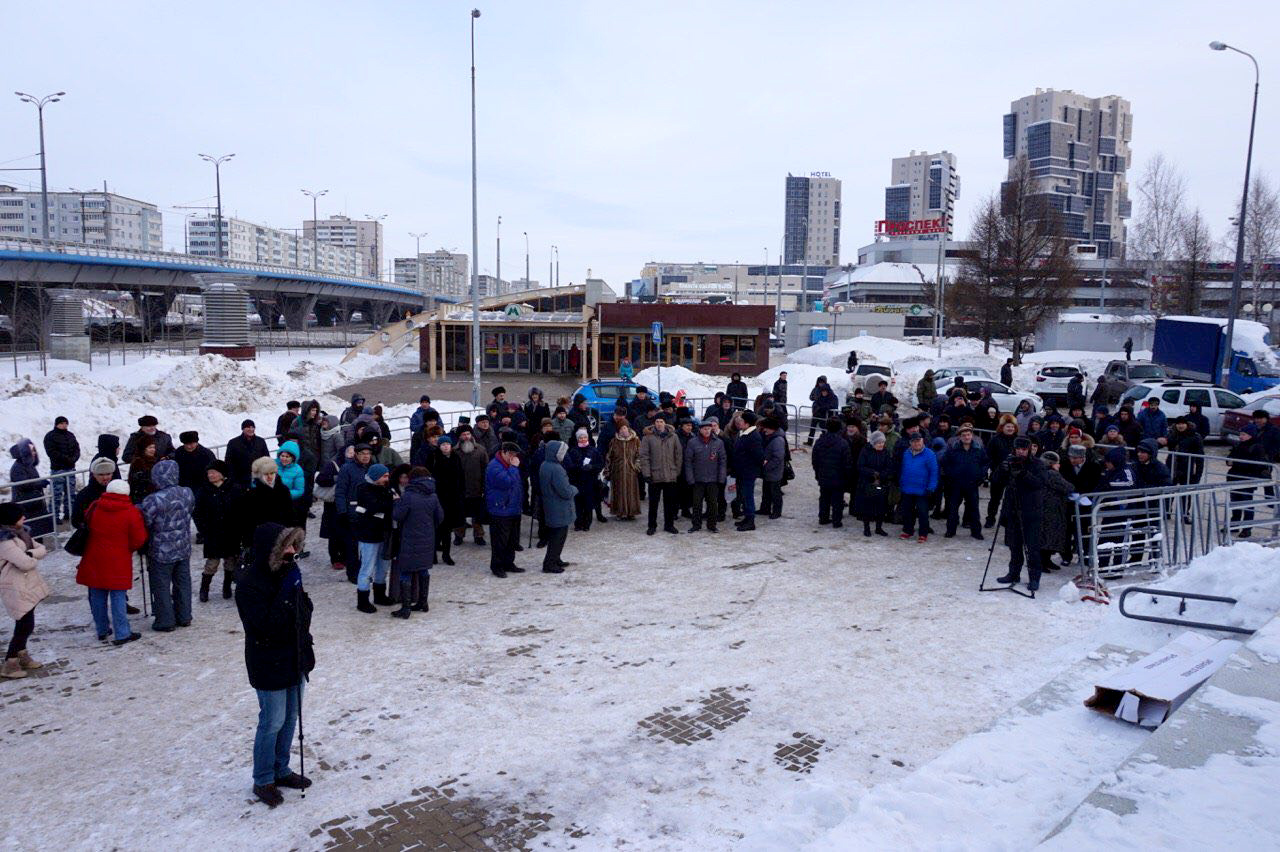
Photo by the author
"Stop infringing on the Tatars!"
On Sunday in Kazan, a rally was held in defense of compulsory teaching in Tatar language schools. This is the first rally, after his teaching was actually banned from Moscow at the end of last year.
About 150 people came to the square of the glory where the action took place. They demanded to return the mandatory teaching of the Tatar language in the schools of the republic, open the Tatar University and ratify the European Charter about regional languages.
On the posters of the protesters it was drawn: “officials, stop infringing on the Tatars and their language”, “Tatars against the policy of assimilation”, “Minister of Education Vasiliev! We demand the passage of the exam in the Tatar language ”and other slogans in defense of the language.
The prevailing number of protesters are elderly people who come from year to year to Tatar nationalists. But this time there were those who came for the first time. Activists and Tatar artists performed from the scene with speeches. All of them said that this action was not to be held, but by the authorities of the republic. And the prosecutor’s office, which opposed the Tatar, was supposed to defend him, the audience insisted.
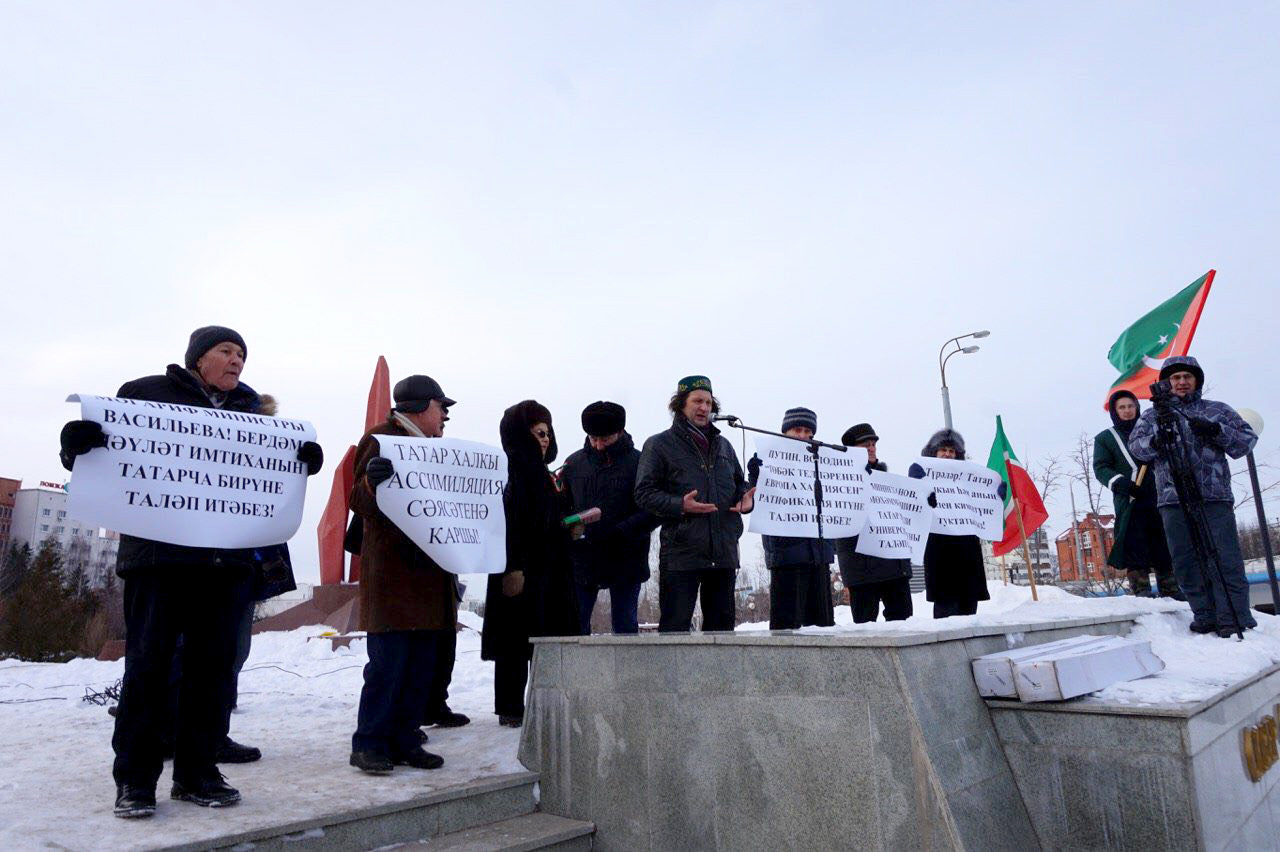
Photo by the author
Coriffi of linguistics
On July 20 of last year, President Vladimir Putin, speaking at Yoshkar-Ola at a meeting of the Council on Interethnic Relations, said that "to force a person to learn a language that is not relative to him is as unacceptable as to reduce the level of teaching of Russian." Putin instructed the General Prosecutor's Office to conduct an audit: whether in the republics they are forced to study the national languages of those who do not want to study them. In other words, find out where the teaching of such a language is mandatory.
According to the Constitution of Tatarstan, in the republic there are two state languages - Russian and Tatar. Since the beginning of the 1990s, they have been studied in schools in equal volumes. However, already in October last year, the director of Tatarstan schools began to receive representations of the prosecutor's office with a demand to exclude the Tatar language from the obligatory program and increase the hours of teaching Russian.
Prior to this, in some schools, the Tatar language and literature sometimes overtook the Russian language in the number of hours, in most schools - the clock of these items were approximately the same. As a rule, the Tatar language is not needed for entering the university or for hiring. There are only two positions in the republic, except for the teachers of the Tatar, where his knowledge is mandatory - the president and Minister of Education of Tatarstan.
Since the beginning of the 1990s, they have been studied in schools in equal volumes. However, already in October last year, the director of Tatarstan schools began to receive representations of the prosecutor's office demanding that the Tatar language be excluded from the mandatory program and increase the hours of teaching Russian
According to the 2010 census, 3.9 million people live in Tatarstan. There are 53.2% of them - Tatars. In buses, all stops are announced in three languages - Tatar, Russian and English. Signs with houses addresses also look. In Tatarstan there is media, theater and literature in the national language.
The situation is special on the periphery. Of the 43 regions of the republic, more than 80% of the Tatars live in nine. The population there almost always communicates only in Tatar, and some are embarrassed to speak Russian, since they believe that they do it badly.
Before Putin ordered to deal with the languages, the issue of the mandatory teaching of Tatar in schools the majority of the population of the republic did not worry.
Moscow position: no concessions
After Putin’s speech in Tatarstan, seething began, but the regional authorities remained silent. None of the deputies, officials and large leaders of official national organizations spoke out on the topic. This is not surprising - in the Republican elite it is not customary to speak publicly on acute issues.
The first statement was made on October 26 at a session of the Tatarstan parliament, President of the Republic Rustam Minnikhanov: “How can a language be voluntary? Nowhere in the world there is no such thing. ” He urged to agree with the Federal Ministry of Education, and also asked the prosecutor’s office not to double school principals. "Or is it specially done so that in Tatarstan it was bad in relation to our President Putin?" - asked the President of Tatarstan.
After that, the Ministry of Education and Science of Tatarstan prepared new "methodological recommendations with approximate options for curricula." In them, the Tatar language remained mandatory, but in a significantly abbreviated form - two hours a week for grades 1–9. That is, about two times less than before. They laid two or three hours of tongue and literature optionally. In grades 10–11, the study was completely proposed to be made voluntary.
In response, the prosecutor's office said that "establishing as mandatory for studying the state language of the republic at the time of publication of recommendations does not comply with the law." And demandedto withdraw “recommendations” , as well as bring to disciplinary liability of their authors.
Already in the morning of the next day, the Ministry of Education and Science of the Republic had backward, saying that these “recommendations” are recommended and no one intends to apply them until the changes are made to federal legislation.
On November 8, Minnikhanov stated that the issue was resolved with the federal center. And the proposals of the Republican Ministry of Education and Science - about the mandatory two hours of Tatar, and the rest - optionally - will soon be submitted to state educational standards. On the eve of the Minister of Education and Science of Tatarstan, Engel Fattakhov met with a colleague from the federal department Olga Vasilyeva, and they agreed on everything. “Olga Vasilieva yesterday, November 7, confirmed the readiness to coordinate this compromise decision,” Fattakhov said.
However, on November 15, information leaked to the media that in this matter Moscow would not make concessions either to Tatarstan or any other region. On November 29, the Tatarstan parliament finished considering the language issue. At the session, the prosecutor of the Republic Ildus Nafikov briefly and clearly stated: "Voluntarily, on the basis of the written consent of his parents, up to two hours a week."
The story with the prohibition of the obligatory Tatar language ended by December. Then the Minister of Education of the Republic was resigned. Tatar teachers were sent for retraining, now they will teach Russian, geography, OBZh and other subjects.
In schoolchildren, the Tatar language was replaced by local history and rhetoric. There were reports that some children have not yet come up with classes and they spend time in the corridors. Pupils and their parents were given the opportunity to decide what kind of language to them, and to teach him exactly him. As a result, 69% of schoolchildren will study the Tatar language, 30% of students will be Russian, and 1% - other languages if a group of more than 8 people set.
Against the backdrop of all this, the spiritual department of Muslims of Tatarstan and Kazan University launched free Tatar language courses for everyone.
The election effect
Immediately after the July statement of Putin in Tatarstan, as in other national republics, the verbal battles of supporters and opponents of the mandatory study of the local language began. They took place, however, mainly in social networks (and in some cases ended in criminal cases of inciting interethnic growth). Supporters of cancellation were especially activated - parents of Russian -speaking children. A rather large group appeared in Tatarstan (now it has more than 11 thousand people) a group on VKontakte , which became the main bridgehead of opponents of teaching. There you can download applications templates for complaints to all kinds of departments about "coercion" to study the Tatar language.
In Kazan, a stock dedicated to the memory of those who fell during the capture of the city by the troops of Ivan the Terrible was called to maintain the obligatory teaching of the Tatar language. The police fined the organizers for the deviation from the topic of the rally
The Union of Tatar Youth "Azatlyk" (in Tatar-"Freedom") and the All-Tatar Public Center arranged several single pickets. They filed more than 20 statements for a full -fledged rally, but the City Hall of Kazan denied each time. Activists, in particular, tried to raise the topic of protecting the Tatar language in the annual action of the memory of the fallen by Kazan by the troops of Ivan the Terrible. The police responded - it opened an administrative case of violation of the declared topic of the rally. The organizer was fined 10 thousand rubles.
On October 14, at the Constituent Assembly of the Coordinating Council of the peoples of the Volga region and the Urals, the Tatar writer, the founder of the Tatar Party of National Independence “Ittifak” Fausia Bayramova called not to vote on March 18 for Vladimir Putin: “Once Putin gave an order to cancel national languages, the Russian non -Russian peoples call not to choose such a president.”
“Once Putin gave an order to cancel national languages, the non -Russian peoples of Russia urge not to choose such a president,” said Fausia Bayramova, founder of the Tatar Party of National Independence “Ittifak”
Unlike Tatarstan, in other national republics, the inhabitants were much more active in protecting their interests and entered the shares. They took place in Ossetia, Yakutia, Bashkortostan. Ufa distinguished itself several times. There, activists of the national movement gathered several thousand people at unauthorized rallies. The shares ended with detentions and courts. However, this has not changed anything.