
Translated material
Yuri Krasavin: "The letter ended with a hand"
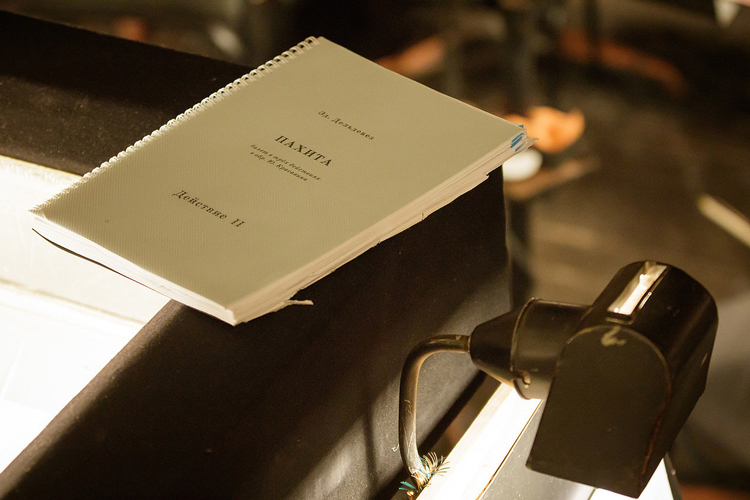
The conversation about the new Yekaterinburg Pakhita is continued by the outstanding St. Petersburg composer Yuri Krasavin , the author of the “free transcription” of the score of Eduar Deldevese and Ludwig Minkus. Krasavin’s conversation with Dmitry Renansky, prepared specifically for the Pakhita premiere and published by Colta.ru with the kind permission of the Yekaterinburg Opera and Ballet Theater, is the first in recent years a great interview with one of the most original (and most unrecognized) heroes of the modern Russian composer scene.
- How did you work on Pakhita?
- I cursed myself a hundred times for accepting this order. The volume is simply implausible - 780 pages of the score. I write notes by hand, and as a result, my right one looks like this (shows the fingers of my right hand with giant corns) . Here it is necessary to take into account that “Pakhita” is the same type of major music, the pace is mostly fast and writings, therefore, more. Everything about everything took a minor break for a year and a half.
- What task was set for you?
- Maximize this rather knitting music.
- What do you mean when you are talking about actualization?
- So that this music is obeyed as today. So that, as a listener, it would be interesting for me to listen to her from the hall. It sounds, of course, quite abstract, but you can’t say otherwise. I will explain “from the nasty”: when I watched the video “Pakhits” staged in Munich, I was extremely uninteresting in the warm ballet snot that flowed from the orchestral pit. So it became clear what to avoid as much as possible.
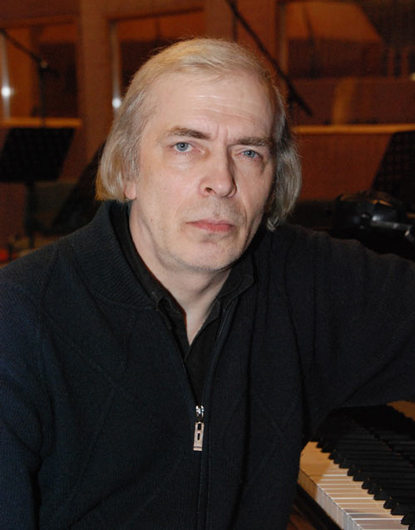 Yuri Krasavin
- What did you see the score of Deldevese - Minkus?
- I worked with a handwritten partner, very smallly written, I had to mess with a magnifying glass. Whose production it is unknown, it is obvious that this is not an author’s score, but some Russian orchestration belonging to a certain K. Lyadov (he had nothing to do with Anatoly Konstantinovich, just a namesake). From a professional point of view, the scores are terrible, written by the left foot. At first, I thought that something from the original orchestration could be preserved, but when I plunged into work deeper, it became clear that it was necessary to redo everything completely.
- What exactly did not suit you in the score?
-Firstly, a very fat presentation-throughout all three acts. The unfortunate girl dances Solo, asks the owner to make her work less - and three thrombons with a tube play in the pit, who have nothing to do with this girl. And so - all the way. Why such an orchestration was needed-I don’t understand that the only possible explanation was that the ballet audience of the late 19th century was very noisy and a similar presentation was required so that at least something could be heard in the hall. Now the viewer is behaving more humbly, and there is no need to thunder. Secondly, the quality of the musical material itself. Deldysez dance numbers-and his music in Pachita is eighty percent-are written pale, but still acceptable, but the dramatic episodes are simply terrible.
-Did you find something interesting for yourself in the music of Pakhita?
- In that part of the score that belongs to Minkus, - of course. He is a completely masterpiece author. I knew this before, but when I ran into his music closely, I realized that Mingus is Zatsepin of the 19th century, a composer with a huge drive, with luxuriously driven topics. When I was busy with Deldevez, sometimes I sat over one number all day, and the next morning I could not remember a line - these are so common places. But in principle, it is impossible to get rid of the Ministry of Milling, just a “Caucasian captive” is some kind of: sits in the ears-and that’s all, you won’t throw it out. Deldeus, I must say, was very lucky - if it had not happened so historically that Mingus wrote part of the music of Pakhita, this score would not have a chance for life. By the way, a few more composers, from Adan to Drigo, had a hand, we decided to especially not advertise them - this is a nightmare, a complete bullshit.
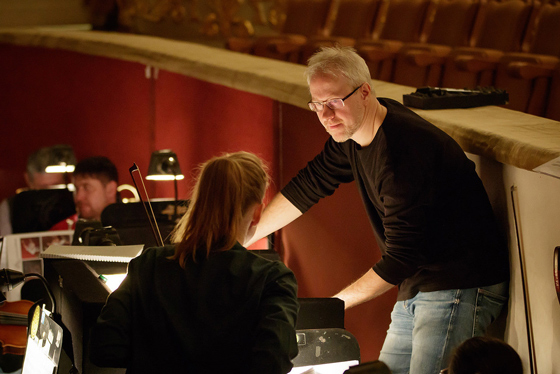 © Yekaterinburg Opera and Ballet Theater Orchestra rehearsal "Pakhita"
- How was the order for work with the Pakhita party party party, what did you expect from you?
- It was about the fact that three acts of the performance were resolved in three non -unlike musical aesthetics. But it was impossible to realize this idea on the material of Deldevesez - Minkus: I tried to scoop the second act as much as possible, and the extreme ones make it lighter - and nothing more. “Pakhita” is quite just a arranged homophone music, without any second plan, from it you can’t make three different things.
- Did the degree of your freedom in relations with the original have been stipulated - and if not, what degree of freedom did you consider for yourself permissible?
- For myself, I decided that I would work with the author’s structure, that I will maintain the original number of tactes. For some reason, for some reason, [non-drater] semi-ore mileage for reduced septaccords-of course, I could not leave them, but [the overall contour of movement] retained, like the seven-stroke structure itself.
- How would you describe the fundamental difference between your score and the original?
- A fundamentally different approach to the orchestra - it very often turns into our chamber, has increased the role of Solo , absent in the original as a class. The composition itself has also changed: two saxophons appeared, a huge battery of drums, a piano, an accordion, and with them-and some kind of spirit of Montmartre. Melos in the score is mainly French ...
The original score is arranged according to the organ principle - the louder the music, the more people play. For example, the very beginning of the ballet: rather banal major music, Fortissimo , sounds, of course, Tutti . I removed all this - only strings play me, which immediately refers to Stravinsky, to Apollo Musaget, or even earlier - to Lully, to the “violins of the king”, but by no means by the 19th century. Perhaps this will not be read by ear, but a certain application in the score is present.
I generally like to mess with other people's material.
-Only re-registration was expected from you-or is it still implied that it is usually accepted to designate how to record in the spirit of Luciano Berio or Hans of the Center?
- For the poster, I called my work “free transcription”, although, of course, this is a pure reception.
- In addition to the Mozartonia, based on the Beethoven material, using the Mozart idioms of the play “Amadeus” for a flute and a chamber orchestra, you have a number of works built on a dialogue with a particular musical tradition. "Pachita" adjoins him or, rather, stands apart?
- I generally like to mess with other people's material. In this case, I, rather, was embarrassed by the framework of the original score-if I were offered to make a squeeze, the Deldevese-Minkus music digest, I would have thrown out sixty percent, and this would have decorated the Pachit greatly. And so I had a god know how to refine-the music is still very similar: in the ballet, for example, there are four exactly the same bolero.
- Do you include Pakhita in the corps of your author's works?
- I myself brazenly consider it to be my composition.
- “ Did Eliot and I myself have tried to repair the old ships, while the other side - Joyce, Schenberg - was looking for new modes of transport? Of course, it seemed that we - Eliot and I - clearly violate continuity, create an art of cut off organs - quotes from other poets and composers, links to previous styles <...>. But we <...> did not apply for the invention of new conveyors or communications. The real case of the artist is the repair of old ships. He can repeat in his own way only what has already been said , ” Stravinsky postulated in the“ dialogues ”. “Pakhita” Yuri Krasavin is “repair of old ships”?
- Of course, in its purest form. The Pachita is a decrepit ship that I tried to put into the water.
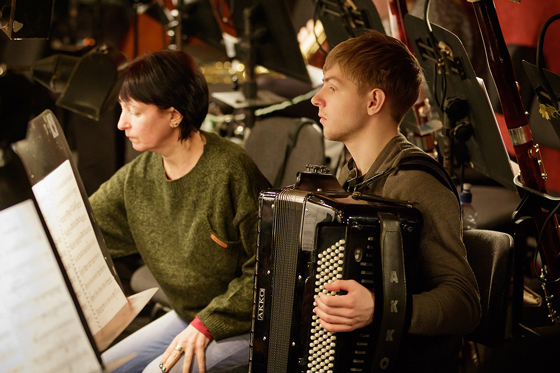 © Yekaterinburg Opera and Ballet Theater Orchestra rehearsal "Pakhita"
- After “Magrittomania” and “Hero of our time” “Pachita”, your third ballet. Do you focus on any features of this art when you work on a party party?
- I admit: I still do not understand anything in the ballet. Of course, I saw something, but even my spectator experience is very small. Answering your question: I do not like amorphous structures characteristic of modern music, and always quite actively rhythmic - not only in ballet music, which seems to mean. It was quite easy to write for the ballet - although it is not easy for me to generalize, because “Magrittomania” arose from movie music, and the “hero of our time” was not put.
- You write a lot for the cinema and first created music for the series “Hero of our time”, and then - to the same plot, narrative ballet ...
- ... Yuri Posokhov, by the way, asked me to use topics from the soundtrack in it.
-Is the composer's work in the cinema and in the ballet theater something similar?
- In the cinema, the tracks are much shorter, the ballet requires broader breathing. There is no fundamental difference in the composition of the musical language - except in recent years, composing for cinema, I have to avoid sharp consonants: the producers are terribly afraid of them.
- Do you feel part of the so -called St. Petersburg composer school?
- No. However, I do not oppose myself to her. There is simply no St. Petersburg school - it existed only in the 19th century. Who could form it in the twentieth century?
- Pupils of Shostakovich?
- All my teachers were students of Shostakovich, but they did not affect me. Influenced anything, but not teachers.
The Soviet musical avant -garde had an extremely weak musical motivation, summarized by the formula “spite”.
- What then formed you as a composer?
- Much. So you can’t answer right away. Rodion Shchedrin had a terrible influence in my youth - the time of the second piano concert, Anna Karenina and Dead Souls.
-Even a cursory glance at the catalog of your works is enough to understand that from the more radical composer language of the late 80s-early 90s you evolved towards more moderate aesthetics, tonal music. Why did it happen?
- The Soviet musical avant -garde had an extremely weak musical motivation, summarized by the formula “spite”, as, in fact, from any avant -garde. The Western avant -garde existed in spite of the philistines, the Soviet - in spite of the Kremlin. At some point, this motivation discovered its strutty-and everything disappeared: the gnar sobs that look extremely naively naive today about what bastards are sitting behind the Kremlin wall, in an instant lost all meaning. As for tonal music, I always loved her.
-Do you yourself somehow fit your music into the context of the domestic music scene?
- Perhaps not - and this is not required, especially since I began to work a lot in the cinema. Rodion Konstantinovich Shchedrin knew one composer in Germany, who was very poor all his life. He wrote to Clavirtyuki, quartets - and then composed a musical, got rich, bought a house, but paid for this success by the fact that his name licked his name from the academic posters as a cow with his tongue. So, it turns out, it happens throughout the world - and I thought that only here: since my film career began, in the Union of Composers I have stopped playing in any form. It is believed, apparently that everything is fine with me.
- In the work of the composer in the film industry, to one degree or another, the reduction of individuality is inevitable. Do not yearn for the social role of the artist with a capital letter, on the conditional poster of the author’s concert in the large hall of the Philharmonic?
- A similar situation is quite happy with me. I have long been living and wrote out the magazine “Soviet Music”, where thousands of composers appeared without exaggeration. The eighth symphony of the composer caused a violent polemic-where is this composer today, what remains of his symphonies? In addition to Shostakovich, only Schnittke, Gavrilin and Shchedrin survived from post -war Soviet music.
The rest disappeared, as if they were not there - excluding the authors who worked in the cinema. I recently watched on the network one Soviet film with rather decent music and climbed into the network to look for at least some data about its author. It turned out that the composer Lebedinsky has a Gamlet ballet, it was published. But the story did not give Lebedinsky a chance to remain for us something more than the author of music for the 1960 film detective.
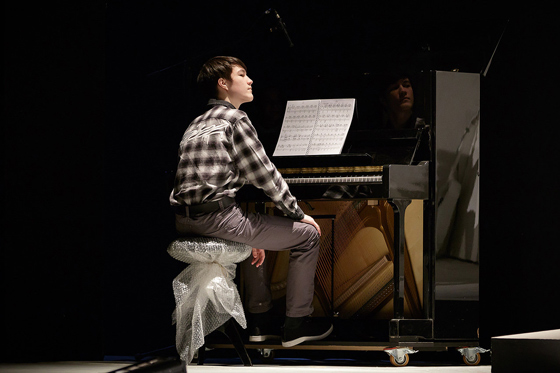 © Yekaterinburg Opera and Ballet Theater Orchestra rehearsal "Pakhita"
- Composer Yuri Krasavin leads a secluded life in Zelenogorsk on the shores of the Gulf of Finland, practically without appearing in public and as if without participating in the life of a professional community (or, more precisely, mimicing the social group for it) ...
- ... but at the same time existing exclusively on creative income. It’s convenient for me to live like that - I don’t know why. I am an unsociable person and leave the house in rare cases. If Mikhail Pletnev arrives in St. Petersburg with Clawirabend, I, of course, come down-but it’s unlikely that something will be interested in me, especially when there is the Internet at hand. Moreover, I do not like our time too much and I try to touch more often with its manifestations. Once, for example, I walked along Isaacievskaya Square and came across a procession-I am annoyed by the very possibility of such meetings.
- With this invasion of the privat, I only wanted to draw a parallel between your Modus Vivendi and your music, which, in fact, is a presentation of private composer life. A similar art strategy unites several authors of your generation into a community - Leonid Tetratnikov, Viktor Kopytko, Anatoly Korolev.
- At the Leningrad Conservatory, we all studied sideways - unless Korolev was a little older. It is interesting that in Moscow there is not a single composer whom I could attribute to this group.
-Work with the model, a game with tradition, the type of consciousness that your colleague Boris Filanovsky once determined as follows: “The creator-bis, who creates from the already created,”-where does all come from?
- It all came from the Soviet era. Apparently, something like this was worn in the air if so different people were engaged in similar things. Where exactly - it’s hard to say. Obviously, this has nothing to do with the polystilism by Schnitsky: the shnita is sobbing with bloody tears, but we do not. I have this, most likely, from Stravinsky, my most beloved author in the twentieth century.
No matter how trite it sounds, but everything is already written. The letter ended with the hand. All that remains for us today is the same “repair of old ships”, but it gradually leaves, because it is now not the most fashionable lesson, and there are less and less professionals capable of doing it every year.