
Translated material
"They listen to scientists more and more"
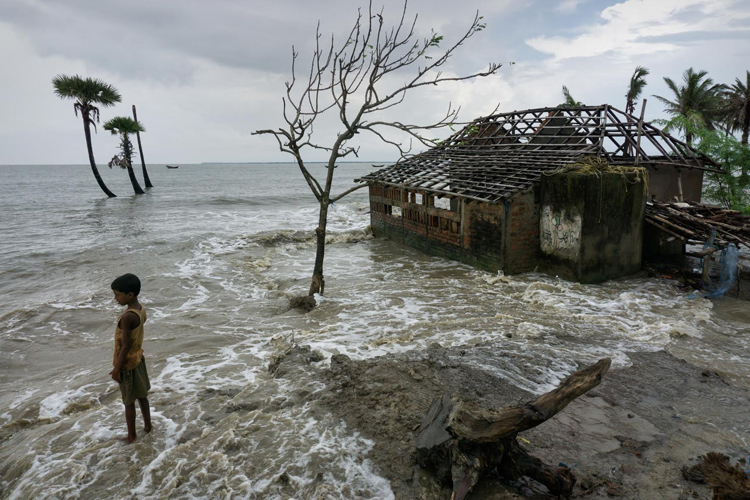
The text continues the project on the Ecology "Variable" .
Yukka Kyuyukhko, a professor at the Department of Geography and Geology of the University of Turku, is part of the Coordinating Council of the National Committee for the Study of Global Changes, which combines the efforts of Finnish scientists from different fields of science and presents Finland in the international program of the UNESCO Future Earth . After the defense of the doctoral dissertation about the eolical forms of the relief in subarctic phencanda (that is, the sandy dunes born in the northern regions of Finland-yes, they have been hiding the forest, but they are there) Kyuyukhko has been dealing with global climate change for the second ten years. His last scientific work concerned problems in the life of Sami-Olevodes, which they face due to changes in tundra vegetation due to global warming.
- How serious is the climate change?
- Climate change was, is and remains an extremely serious problem. The change in itself occurs globally-on the scale of the entire planet, but at the same time very differently in different regions. Therefore, the consequences of these changes are very diverse and at times can be positive, for example, from the point of view of agriculture. However, any climate changes, even potentially positive ones, are stress factors both for natural ecosystems and for society, therefore, in general, the influence of climate change can be evaluated as negative.
In addition, this is possible even more significant - climate change has consequences that are incredibly difficult to predict: preparation for changes, fear, adaptive measures and methods of taking the situation can provoke forces leading to emergency situations, and the significance, direction and strength of such public elements in the future is almost impossible to evaluate.
- How thoroughly this problem has been studied?
- Climate change as a physical, climatic phenomenon is quite well studied. Already the first report of the intergovernmental group of climate experts (MGEIK) from 1990 contained forecasts identical to those that we have in the last report. Cleanings may concern territorial and temporary nuances, but the lack of knowledge is definitely not an obstacle to taking measures.
In order to influence the situation, people have no need to wait for new discoveries of scientists in climatology: after all, the main points are already known, and a lot depends on the attitude of people to the problem - making certain decisions daily, we influence the state of the planet. But, of course, in regions where people are forced to survive in terrible sanitary and hygienic conditions, where they lack food or armed conflicts continue, there is neither the time nor for the concern for the global state of the planet. Therefore, efforts to protect human rights, women, children in such regions, to increase the standard of living in them, are also indirectly measures to combat climate changes.
The painfully unpleasant property of scientific knowledge lies in the fact that it gradually becomes obsolete and updated, so its use in decision -making requires the courage and willingness to take risks from politicians.
- Where would you advise you to go to personally make sure that climate change is a fact?
- You see, since the climate is, by and large, the average weather at a large time interval is not easy to find a “changed climate”: it all depends on the temporary segment with which we will compare our observations. But in principle, it is not necessary to go anywhere. Unusually soft weather in January of this year is, although a variant of natural fluctuations, but strongly “seasoned” with climatic changes. If you want more specific evidence, you can see how the edges of the mountain glaciers moved away, rapidly declining due to warming. You can pay attention to the increase in the level of the oceans: the island states due to global warming in the future will simply go under water, although-paradoxically-the climate in those regions will not change.
- How difficult is it to refute the statement about the decisive role of a person’s activity in increasing the natural greenhouse effect?
- The role of mankind in increasing temperature on the globe is undeniably proven and absolutely confirmed! The main mechanism of influence is the emission of greenhouse gases and the change in Albedo (reflecting the properties of the surface of the earth due to melting ice, deforestation). You can argue about the causes of regional changes: is it precisely this change in the consequence of the global climate change or not.
- What are the main arguments of scientists who deny climate change and/or the role of a person in it?
- Most often, such scientists are amateurs regarding the understanding of processes underlying climate change, and their arguments are deprived of a serious scientific base. There are fewer such scientists. The famous Finnish “neglect” includes the ecologist Antero Yarvinen, a marine specialist Boris Winterhalter and economist Yarl Albek.
In a political sense, Russia behaves quite passively - first of all, probably due to the oil dependence of the economy.
- How strong is the voice of scientists in society?
- They listen to scientists more and more. Persons who make political decisions realized the weight of scientific knowledge (excluding Donald Trump). The painfully unpleasant property of scientific knowledge lies in the fact that it gradually becomes obsolete and updated, therefore, its use in decision -making practical order requires the courage and willingness to take risks.
- Do Russia and Finland relate to the number of countries that make a significant contribution to the study of climate change?
- Due to the fact that Finland is a member of the European Union, Finnish researchers involved in climate problems are part of the group of scientists who occupy the leading position in this field of science, all the more now, after the General Secretary of the World Meteorological Organization became the Finnish meteorologist Peteri Taalas. However, Finland is a small country, and this affects research; The exception is perhaps the study of atmospheric aerosols under the leadership of Markka Kulmala, a professor from the University of Helsinki. I know very little about Russia, since scientific works remain with the language barrier. In a political sense, Russia behaves quite passively - first of all, probably due to the oil dependence of the economy.
- Which country occupies a leading position in the study of climate change and taking appropriate measures?
-The United States has lost a leading position because of Donald Trump, and France as a country, a member of the European Union, on the contrary, strengthened its position with Emmanuel Macron. Time will tell who will be the first to surrender: the United States or supporters of the Paris Agreement.