
Translated material
"The effect of combustion is laid down in the tradition of Gothic architecture"
Art critic and curator Victor Misiano-about the sculpture of Nikolai Polisky, burned in Nikola-Lenivts
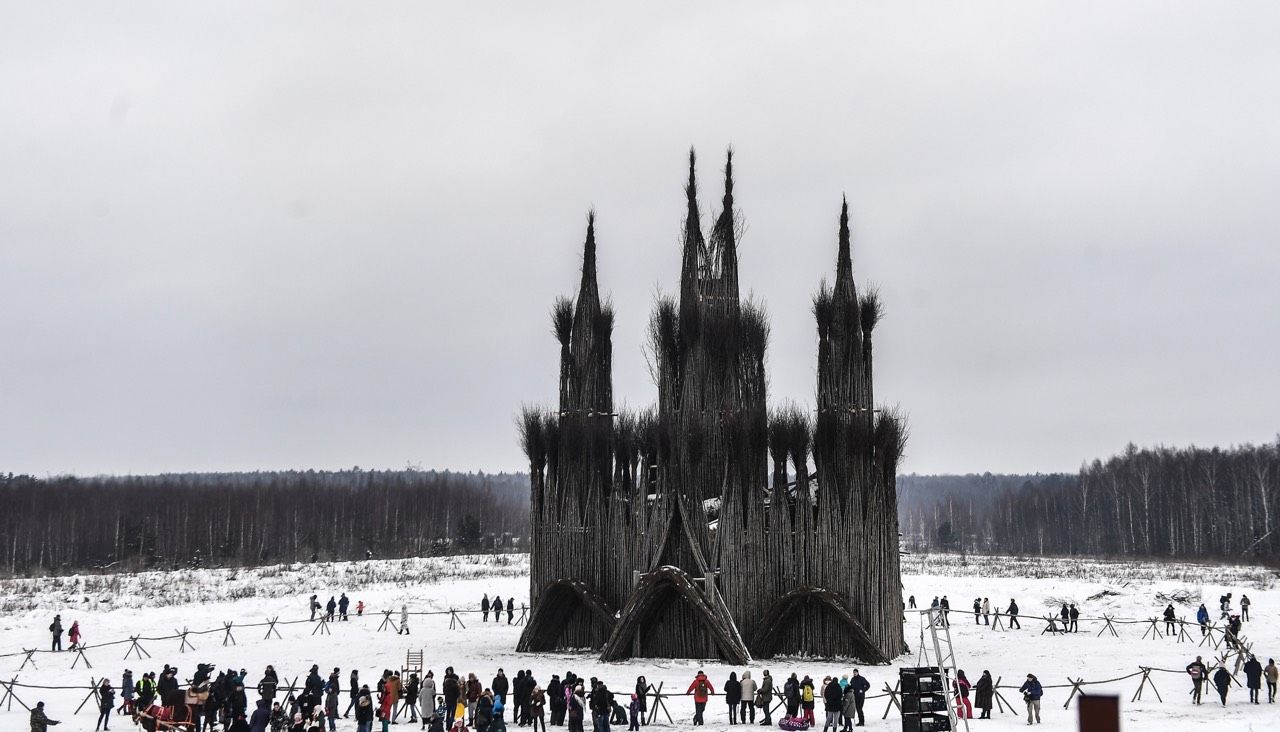
On February 17, a 30-meter art object of Nikolai Polisye Gothic was burned in the Nikola-Lenivtsi Art Park in the Kaluga Region, a 30-meter art object of Nikolai Polisye Gothic, a construction of branches and garbage in the form of a Gothic building. Medusa asked the historian of art and curator Viktor Misiano to tell about the meaning of the “Flaming Gothic” action - and explain why unprepared spectators did not catch this meaning.
The art object of Nicholas Polis resembled the Gothic cathedral; In an interview with the artist on The Village, the object was once called the “Church”, but later it turned out that it was about the “stake”. On February 18, Nikolai Polissky wrote on Facebook that he did not set the goal to create a copy of any existing cult structure or imitation of the temple. However, photographs of a burning art object published on the Internet caused an ambiguous reaction; For example, the representative of the Synodal Department of the Moscow Patriarchate of Vakhtang Kipshidze promised to check the action, outwardly reminiscent of the “burning of the temple”. The spokeswoman for the Roman Catholic Archbishop of the Mother of God Kirill Gorbunov said that the feelings of the Catholics believers were offended by the burning of an object similar to the church. On February 20, Polis once again stated that he wanted his art to serve the world and agreement in society, and asked to stop the publication of photographs of the “burning Gothic fire”.
Victor Misiano
art critic, curator, editor -in -chief of "Art Journal"
Recently, this or that events that take place in the territory of art are constantly on the media often find themselves on a different, wider, territory - and lose the entire system of meanings and meanings that were originally laid in them. It must be borne in mind that art always acts, following its language, its tradition, has an internal system of references - but not all these references are easily read by people “from the outside”. This happened with the work of Nikolai Polis.
I sympathize with those who felt offended-as our liberals, who saw in the “flaming Gothic” an insult to Western values, and to the radio-laws for the dogmas of Orthodoxy, but, in my opinion, we must learn to look at things more multi-sized.
Of course, Nikolai Polis is a very bright and important artist, with his history and reputation. There is every reason to say that in his person we are dealing with the fact of art. And what he has been doing in Nicholas-Lenivts ( since 2000, Nikolai Polis has been creating sculptures and installations on the territory of the Nikola-Lenivtsa art park-approx. Medusa )-these are interesting pages in the history of art of Russia over the past 15-20 years. In order to say something about his last work, one must have an idea of the language and method of work of this artist. If we are talking about the act of burning an object, then it must be understood that their burning for a policeman is already a tradition, this was not the first time.
If now someone drew attention to the fact that the burning object had the outlines of some kind of cult Christian institution, then it used to be not so-before in the objects burned there were other motives. This is a whole story, and in this case I would not focus on the fact that this object can be associated with the history of the church, with the history of the cult, - rather, I would pay attention to how it is connected with the history of art. The very name of the work of reference art stories, “Flaming Gothic” is the name of the popular style of Gothic architecture in Europe.
The outlines of the cathedral that this design have is sent to the Gothic temples, which are an openwork veil of the structure, all covered with stained glass windows - and they “burn” in the light. This effect of combustion is laid down in the very tradition of Gothic architecture - through this festive, but slightly alarming light effect, a religious sense of medieval masters and their customers, that is, the then fathers of the Church, was expressed.
There is still a very important point for understanding this work - burning occurs in Shrovetide. I would not in a hurry to attribute Shrovetide to the Orthodox holidays-this is a pagan holiday, and it is no coincidence that it was on Shrovetide in Nikola-Lenivtsa that the tradition of burning something arose, because jumping through a fire, burning objects, legend of fire always accompanied the pagan sacredness of this holiday. The pagan meaning of burning, destruction in fire is also associated with the idea of “eternal return” characteristic of a myth and folklore, if we use the term Nietzsche, who just used this concept, speaking of a myth. Something is destroyed in order to then return in the same form, but updated.
And then, this is not just about destruction. If we recall that the fire means in the Christian tradition, then a huge abyss of meanings and meanings also opens here: glow, light created by fire, in Christianity and many other religions - this is one of the carriers of the Divine, remember at least the Far Light described in the New Testament at the time of the transformation of Christ. I do not exclude that some of these meanings were quite taken into account by the artist. In this work there is nothing that can cause a feeling of reproach and, moreover, profanity-on the contrary, the artistic statement of the Polis touches the foundations of something secret, sacred in culture in its most primary sense and being.
Alexandra Mirror