
Translated material
Spots and scratches of memory
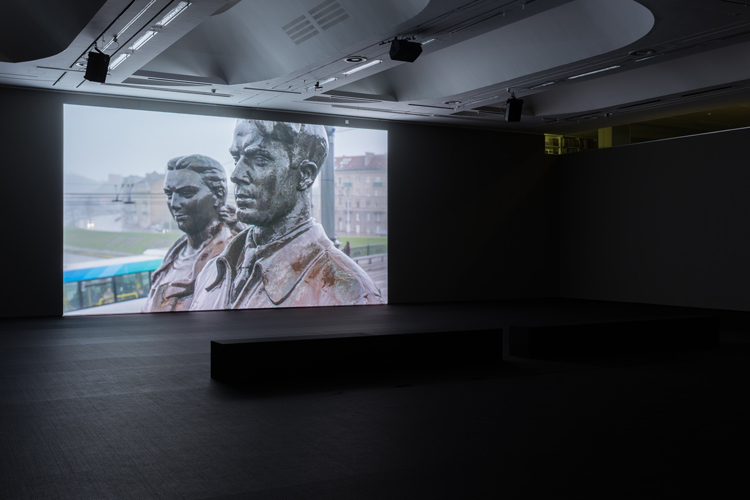
You descend into the space of the exhibition hall of the National Gallery of Art of Lithuania : the darkness, illuminated only by flashes of light from huge screens and beating on the ears of the sudden musical “Tyms-Tsets”, immediately creates a sense of total immersion in the atmosphere of what is happening below the action. It’s as if you don’t really want to enter it - what awaits at the foot of the stairs?
The Gallery building itself on the Constitution Avenue is perfectly suitable for a new exhibition: designed at the end of the sixties and built in the 1980 for the Museum of the Revolution, it was transferred to the exposition of Lithuanian art of the 20th and 21st centuries in 1991, after the country's exit from the USSR. In addition, the new films of the famous artist, a participant in international Biennale, show in the year of the century of independence of Lithuania, and in December, a conference on revolution and revolutionary in art was almost simultaneously with the vernissage. Sharp switches between historical eras are smoothed out in the main exposition and a sense of a meeting of several cultures - Lithuanian, Polish, Russian, Jewish, Belarusian, Soviet, and thoughtful general narrative, binding the unexplored rural scenes, bravuric rushing of a person of labor and postmodern irony against the Soviet ideology. But if you go upstairs in the halls in full daylight, in the traditional museum of the manner of a slightly bored visual flaer, which the curators lead by the hand, then a huge space for temporary exhibitions in the basement, rather, resembles a submarine, which will not be able to run away immediately. Everything is done so as to tighten the viewer into the consisting of short, 10-20-minute, films Universe of the Narkeavichus with its traces, layers and fragments of the past, which are in a fanciful way, encountering, germinating into each other, but by no means always creating a sense of connectedness. To do the work of memory for you, chew on its pieces, giving out a slurry of unambiguous meaning, as it seems, no one is going to do this work on your own.
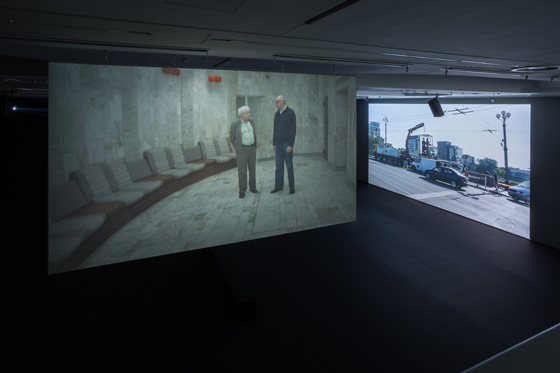
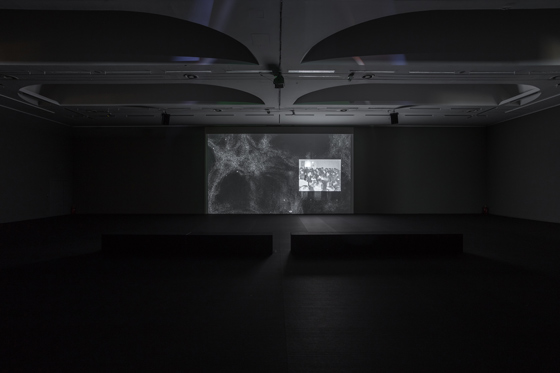
New videos are shown on huge screens located slightly at a distance from each other on perpendicular walls and separated by rooms, where older films are more modestly demonstrated. Some of them were shot on a 16- and 35-mm film, and the other on a video camera: a mixture of new digital technologies and film archaic, as well as cinema, photographs, drawings and other types of art and means of registering reality are very bizarre. On one screen is the premiere of the film “Spots and scratches”, dedicated to the amateur production of the rock opera “Jesus Christ-Superstar” made by Vilnius students in the early 1970s (naturally underground). The other shows a movie called "07.20.2015" - the date of dismantling of Soviet sculptures on the Green Bridge. To view everyone, you need to put on special glasses that will make a voluminous picture from a vague and double image, allowing it to some extent to focus on the shown. Small rooms that are already well -known in the middle of the hall also contribute to the contemplative detachment, which are already well -known things of the Narkeavicius - the films “The effect of the unexploded bomb” (“ The Dud Effect” , 2008), “Returning to Solaris” (“ Revisiting Solaris” , 2007) and 2007) and 2007) "Compatriot" ( "Countryman" , 2002). However, it is not possible to concentrate to the end: the sound of “spots and scratches” at times interrupts everything else, making this film the main theme of the exposition, a focus that seems to be assembled together - not through discourse or a sequential story, but through the feeling. However, should it?
 © Andrej Vasilenko / National Gallery of Art, Vilnius
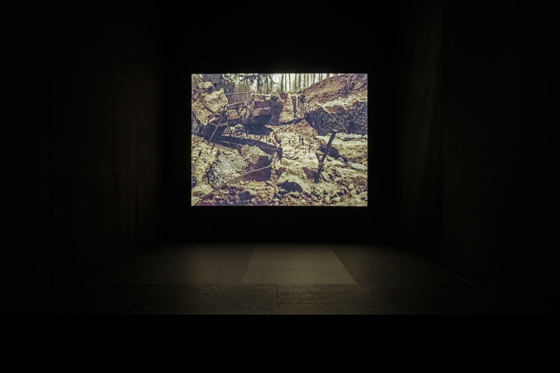
“Spots and scratches” are not only the newest, but also the least narrative of the Narkeavicius films shown in the exposition of films, and so that the linearness of the narrative does not differ in the usual mass audience. But if in his other videos there are at least some hint of the development of the plot-the demolition of the statues and the television portion about it, the reconstruction on the screen is never removed by the head of the Lemovsky Solaris, the story of the sculptor about working on the monument to the leader of the anti-Soviet movement or a staging of the missile and a response impact (thank God, and not there) “Spots and scratches” is not there. A square frame-sector wandering over the screen grabs the face of the public listening to the rock opera from the darkness of the face of the face, and almost all the time. Sometimes loud music begins to sound, which gradually subsides, a couple of times we see quotes. That, in fact, is all. This video with its chaotic temporal bulge and the simultaneous drawing of the viewer inside himself than the rest at the exhibition recalls that Narkevichyus studied at the sculptor and still calls his work “digital sculpture”. Its goal is to awaken sensations and create a sense of compaction of time, at least in that version of the presentation of video installations, which was invented by the curator of the exhibition Lolita Yablonsken. The design of the exposition recalls the now popular “affective museum”, but the emerging emotions cannot be reduced to a single denominator.
It so happened that I walked around the exhibition and discussed it with students of the European Humanitarian University, mainly Belarusian, then reading their reviews, and before that I listened to the version of the exposure of the exposure by vilnya friends, who, or even a couple of generations older than the current twenty and thirty years. And the feelings of these spectators, finally nailed by the words (and almost all of them spoke at first about the ambiguity of the meaning), were strikingly different. If many people of my generation, who still found a late Soviet time, this work of Narkevichiyus more often seemed shallow or walking in a circle of non -obsolete injury, then the students spoke completely different. Apologizing for the lack of dramatic experience, as well as the ignorance of some Lithuanian realities, many of them mentioned the inconsistency of sensations, but still distinguished the sense of freedom as the main one, and the film was called the most interesting in the exposition. The frame in this interpretation did not so much separate the experience of the past from them or hinted at lack of freedom, as if it allowed those creative daredevils to penetrate in our time, sharing with the modern audience the energy of creation and resistance moved by them. The comparison of the experience of life in different post -Soviet spaces was also important. These reviews raise the question of how important knowledge of historical realities and Background Knowledge.
Narkyavichyus does not give an answer. The feelings of neophyte, not wounded to the core of a traumatic political experience, are equally important in his space as the sensations of the one who was then in the thick of the events. And all these interpretations, often competing, are laid in the work themselves. They create only a frame for experiencing and searching for meanings, which are often tightened from the past and the present without the participation of the author. The metaphor of work with difficult experience, which is so beloved by psychologists, which, like a bow - a layer by a layer, carefully remove the husk and cry, does not work here. In the "spots and scratches" there is an injury endlessly, and going beyond it, and a dreary, aching sense of unsafe, and the joy of liberation. There is no single, correct vector “how to feel”, a line approved by a particular party - there is an emotional polyphony.
 © Andrej Vasilenko / National Gallery of Art, Vilnius
Others demonstrated at the exhibition of Narkeavicius films shown at the exhibition. In "07.20.2015" you can see existential longing or sadness from how few people are on the bridge on the day of demolition of sculptures. But how to evaluate this lack of curiosity - as a symptom of indifference to the past or the sign of finally farewell to Soviet scars, the path along which Lithuania clearly went further than us? And the Vilnius recall that in fact there was a violent discussion in the society, whether monuments with the speaking names “on guard of the world”, “student of youth”, “construction and industry” and “agriculture” by ideological agitation are or should be appreciated as outstanding monuments made by the best Lithuanian sculptors of the era. There was no money for their conservation and restoration in the city hall, and the authorities replaced as a result of the elections decided to completely remove it from the bridge for ideological reasons, or for better preservation, but to leave cultural values in the register. By the time of dismantling, everyone was deadly tired of the debate, in which it was not possible to understand who is right and who is not, and therefore did not come. In addition, everything happened late at night. Is it possible to consider this lack of victory at the cost of the throat, which was chopped by the opponent of the true democracy or the continued viscous decay of the destroyed system?
In the “Compatriot”, Vitalyus Lukoshaitis with enthusiasm tells how, in his youth, twenty years ago, he made a monument to the hero-attic to Jonas Zhamaitisu-vitoutas , but we do not see his face, but look at the monument itself. Then, suddenly, the sculptor himself turns out to be a drawn figure, and the tonality of the narrative changes sharply: then, they say, all the ideals were clear, but what we came to now, we are engaged in survival, and whether to leave the country at all? The rage of resistance, allowing me to forget about the existential longing for life in poor stability, retreats to the traction of our time. And then a young girl from the screen confesses to feelings for Lithuania, because the words “I love you” can be felt only in her native language, and this reminds not only that almost a quarter of the population left Lithuania, but also about those who returned because they are best suited for the local peaceful leisurely. And then we see the frames of old Vilnius to the accompaniment of completely inconsistent with all this young romance, sweet antiquity and the charms of wilting the rumbling music of Wagner. Why is it suddenly “LoEngrin”, is there a reference to the Film of the 1999 Narkyavichyus “The implementation of the legend” with the story of the Jewish ghetto in Vilnius (extremely difficult for modern Lithuania) or is it just an attempt to push two moods that do not correspond to each other? The name of the film, by the way, is also not easy to translate into Russian: here is the “compatriot”, and “provincial”, and “rural resident”.
In the “effect of an unexploded bomb” shown in the room opposite, we are first demonstrated by pictures of the Soviet missile base. Then we see the everyday work of a middle-aged officer who gives some orders, and then, apparently, the R-14 missile and a return flash are followed. And then, until the end of the tape, the camera goes in a dull rhythm along a dull landscape, enters the dilapidated base and demonstrates a rusted bomb compartment. However, the question of whether the world has died in this conflict staged in the spirit of a conflict that is happening before our eyes with such frightening everyday life, or are it still the ruins of Soviet experience, causing some sadness, others have anger, and the fourth nostalgia and the “desire to repeat” and remains unresolved. The household, bodily and affective experience of the Soviet era, translated from the screen, with its modest interiors and dull colors seems so far, not like modernity, and surprisingly close, continuing to this day. He simultaneously repels and adds to himself. Although the film is a response to work for a long time in Vilnius of the British director and starer of reality Peter Watkins-an interview with him is also included in the earlier film by Narkyavichyus “The Role of Life” (2003)-he will remind the Soviet child of the eighties about the hysterical and ideological struggle for the world, the song “The Sunny World-Yes, yes, yes, yes, yes, yes, yes, yes, yes, yes, yes, yes, yes, yes, yes, yes, yes, yes, yes, yes, yes, yes, yes, yes, yes, yes, yes, yes, yes, yes, yes, yes, yes, yes, yes, yes, yes, yes, yes, yes, yes, yes, yes, yes, yes, yes, yes, yes, yes, yes, yes, yes, yes, yes, yes, yes, yes, yes, yes, yes?” Nuclear explosion - no, no, no, ”about the terrible cartoon“ There will be affectionate rain ”of 1984, Nazim Tulyadzhaev on the post -apocalyptic of Ray Bradbury, but also about the hopes of Gorbachevsky disarmament, and about the children of the world of Katya Lycheva and Samantha Smith. However, whether the artist himself remembers a lot of this is a big question: after all, he himself is one more generation older. In any case, for the Russian viewer, who has recently been accustomed to the idea of modern Russia as the heiress of the USSR, a film with its complex distance in relation to the past, with switching between modes of private memory and collective perception under the influence of injury and propaganda can be both traumatic and therapeutic.
 © Andrej Vasilenko / National Gallery of Art, Vilnius
Finally, in “Returning to Solaris”, Narkyavichyus “Drings” the film by Tarkovsky with an episode according to the last chapter of the book Lem. The action, however, takes place in the decorations of the real building of the KGB of Lithuania (now the Museum of the victims of the genocide) and the television center-the reference to the Stalinist repressions, and to the January events of 1991 in Vilnius, and to the incomprehensible story with the “recruiting” of Donatas Banionis, which became known in Lithuania in 2018 from the back number of special services of the journal 1987 years, but casually mentioned by the actor himself in an earlier interview with the Russian press . Banionis himself plays either the aged Chris Kelvin, or his vision-ten, sent to the audience with a cunning living planet-research and encountering his young version-the Narkevichus himself. Pictures of Anapa at the beginning of the 20th century represent the landscapes of Solaris, to which, following Lemus, but not Tarkovsky, Kelvin returns. The artist believes that these pictures create a feeling of “endless spaciousness and unlimited time”, but, as if contradicting themselves, immediately noures the point in time up to a specific year: the work was made by Mikaloyus Konstantinas Cürlenis in 1905, and the waves of the Black Sea in 1971 were also shot in the same way that Tarkovsky was trying to simulate the Solyarisovsky Ocean. In another interview, he says that in his youth he did not understand “Solaris” at all, but continued to watch him until he reached thirty, and he finally liked the film: perhaps because he began to lose people . Strange interruptions and aberration of meaning, bizarre fantasies about the past, false memory, visions of the departed and changes in perception with a change in the vector to the opposite, I think, are familiar to everyone. But it is responsible for them by no means studying the reactions of earthlings of Solaris. A person needs a person, albeit beating over the contact.
As if emphasizing the difficulties of understanding, “returning to Solaris” is shown at the exhibition on the screen right by the stairs, and it is impossible to really crawl for it - you need to watch the film from the upper span. In addition, he goes to Lithuanian, unlike other films without subtitles. This controversial move makes the viewer a feeling of irritating inconvenience - “The best film at the exhibition is really not to be seen,” but extends perception beyond the exhibition, to home screens, in discussion in kitchens and in messengers, finally leading to the desire to reconsider Tarkovsky. It was possible to evaluate the importance of the context at the Catherine Culture Fund “House with Ghosts” -the third part of the “Medical District” project: in the topic “Trauma, memory, oblivion, knowledge”, the old-new “Solaris” Narkyavichyus fit next to the visualization of the fragility of the film illusion of Paci, the video report on survivors of survivors Deportations of Chechens and Ingushs Aslan Gaysumov, a family saga about the past of Katrina Neuburg and a phantasmagoric vision of the Stalinist time of William Kentridge.
And yet, despite all the inconsistency of our sensations and on the multidirection of memory strata, the films of Narkyavici and the new exhibition in Vilnius do not belong to the tradition of postmodern relativism. Before us, of course, is already a completely different era with the name not yet found (metamodern? Digital -modified?), With its conversation about feelings, injuries and affects and with the desire to feel like a part of the community, drawing the viewer into experiences. And the fascination with ideas and intoxication with a quick action, replaced by bitter regret or dreary indifference, do not ruin some basic things that can be leaning on in life. Yes, the memory is unstable, and the psyche fails, but there is always a rod that is clearly felt in the work of Narkevichi. This thread of Ariadne in the duration and lengths of time with decades, ranks, countries - the search for internal and external freedom, the possibility of the reflection of all stripes uncontrolled by tyrants and politicians, a humane attitude to the point of view of another and a protest against prison cynicism, militarism and ideological shorts. They are simply located not where it was thought before: not in splitting into black and white, not in the sharpness of fluctuations between the surge of euphoria and the abyss of the Black Melancholy itself, not in the decay through the poles of ideologies, but in the ability to keep the difficulty of what is happening in the head and reduce different memory spaces together. In the dynamic balance and its search, in the dialogue and comparison of experience. In a fragile synthesis, which cannot be found once and for all - and therefore it is constantly that you have to reassess values, without ceasing to be a person.