
Translated material
If there is no water in the tap
The text continues the project on the Ecology "Variable" .
In the large Cape Town, taking into account its long suburbs - 3.5 million inhabitants: a little more than in Novosibirsk and Yekaterinburg combined. In 2014, the second largest metropolis South Africa received the C40 international community for the best water resource management system. How did it happen that on Monday, July 9, 2018, Cape Town can be left without water?
“African legends say: from time to time there are droughts“ killing cattle ”, and about once every ten years there are droughts“ killing goats ”, and once in the generation there are droughts“ killing a person ”,”writes hydrologist Peter Volski from a local university. Scientists follow precipitation in the Cape Town area of the last century: according to their calculations, it turns out that the drought of the current scale occurs every 325 years. According to Volski, in a sense, the designers of the water supply system of the city are not to blame for anything: they planned with the usual reliability of 97%for such projects, and this time it took 99.9%.
Colleague of Volski, Doctor of Sciences in the field of environmental protection, Kevin Winter, notes that the authorities and residents of Cape Town for several years were procrastinations and did not try to avoid drought. “The rainy period has shifted. In the 70s, the rains began in April, and now only in July, ”the scientist notes. Winter believes that inaction in Cape Town at the most critical moment, when it was necessary to change the water supply system, was replaced by “blindness”: people refused to believe in climatic changes and new living conditions. “This behavior is characteristic not only of South Africa. The same thing happened in Australia and California when they were faced with long droughts, ”the researcher says.
In a sense, the designers of the water supply system of the city are not to blame for anything: they planned with the usual reliability of 97%for such projects, and 99.9%needed.
The authorities patted the holes: for example, they fought with water leaks from pipes. On average, in the world, such leaks are 30-40%. Cape Town engineers managed to reduce them half, but it turned out that it was like extinguishing a fire with buckets when the whole house was blazing.
While the water crisis in the Cape Town does not kill people, but complicates their lives. “I used to think that water is an inexhaustible resource. Now I live, realizing that water can end, ”says whether he says. He looks about 30 years old, he has children and a house in one of the best areas of Cape House Bay. Lee starred in the video for the city channel on You T Ube . He merges in the toilet with a bucket, covers the pool with a film so that the water does not evaporate, installed collectors for collecting rain water and dew. Lee collected water uses for watering.
Lee - “Warrior of Water”, Water Warrior , as it appears in the signature to the video. His combat comrade Sam shares other ways of saving water. For example, he drains water into the basin after he takes a shower or wash the dishes in the dishwasher. Sam uses this water for watering plants in the garden.
“If each of the four million inhabitants will save one liter, it will already be four million liters. Yes, I believe that everyone can do something, ”says Sam, who now takes a shower for no more than two minutes.
Women-“warriors” use the water collected after the shower not for watering plants, but to clean the house. But Andisva is closest to all the Russian spirit: she bathes a small child once a day, and then, adding a boiling water kettle, and she takes a bath.
Not all citizens reached the war path: the representative of the international public organization Climate Action Network Turn Guz told Colta.ru that she lives closer to the mountains and so far does not feel problems with water. In her opinion, it is extremely difficult to meet 50 liters of water per day. However, if the situation is aggravated, then this will have to be done. According to her, some areas of Cape Town have already encountered a lack of water.
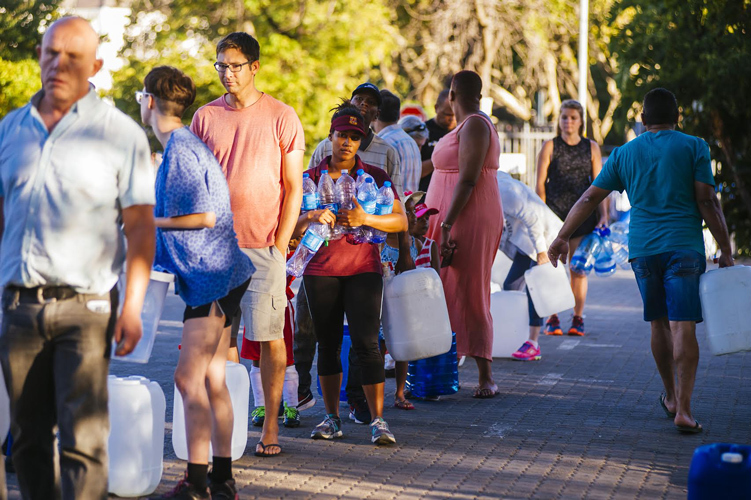
Actually, the “zero day”, when residents have to line up in line for water and receive it on cards, had to come in mid-April. However, collective efforts were able to push him back first to May, and then on July 9.
A map of hostilities to preserve water and survival can be considered the water map of the city. It is available online, and any resident can see how many liters of water per month spend in the household neighbors. The houses of Sam and Lee are marked with a dark green color, that is, here they spend less than 6,000 liters of water per month --200 liters, or about one bath, a day. Light green is indicated by houses that spend more, gray-even more, but at home, where more than 10.5 thousand liters of water are used monthly on the map (apparently, for reasons of humanity). The authorities do not publicize the data on water transjures, but present them with preliminary letters. In August last year, 175 households, which spend more than 10 thousand liters of water per month, received such warnings.
Meanwhile, no matter how the South African authorities the need to save water, in January 2018, the mayor of the city of Patricia de Lila admitted: 60% of citizens ignore the recommendations and continue to spend 50 liters per day in excess.
Opinions about how difficult the situation is in the city, on a popular resource for independent travelers Couchsurfing.com are divided. “Cape Town is now experiencing an extreme water crisis. If you have already booked tickets, I would still recommend transferring the trip until the end of the crisis, ”writes to me an active user of the site, doctor of science in the field of theoretical physics, John Shock. If tickets cannot be changed, he offers not to stop in Cape Town, but to follow in the direction of Durban.
“There really is a water crisis, but it did not affect our lives noticeably. We know that the water level in the dams is low and that it would be better to save water. In my gym, a sauna and a steam room were closed, people try not to stand under the shower for more than 60 seconds. People changed their minds about water. I think that when the crisis is over, they will no longer think differently. I believe that life will work out in the winter when the rainy season begins, ”the urban planning engineer answered me in correspondence, also the active coachiser Christo. According to him, there are no water police in the city, but water meters are installed on each house, and the authorities introduce systems of automatic disconnecting of water during an overrun.
Each Muscovite theoretically can safely spend 11.6 thousand liters of water per month, while Sam and Lee are washed away from the Cape Town in the toilet from the bucket.
Actually, the “zero day”, when residents have to line up in line for water and receive it “on cards”, had to come in mid-April. However, collective efforts were able to push him back first to May, and then on July 9 . How far it will be completely avoided is still unclear. Previously, 90% of the water need was satisfied by the dams system, which are filled with rains. However, for three years, dams and toned tanks have not been filled by more than 50%, and in the summer of 2017 their level fell to a mark of 31.1%.
“Since 1996, there have become twice as many inhabitants in the city, and water reserves have remained the same. In 2005, we began to limit water consumption, in 2016 these measures were strengthened. Without this, the city would have long been without water, but the drought, which we encountered, was the most prolonged in history. We must approach the risks and climate change in a new way. The new water supply plan for the New Normal Cape Town suggests that the drought will never end, ”Mayor de Lille said in August last year.
Firstly, the city plans to reduce water consumption to 500 million liters per day, although back in 2016 the goal was 800 million liters per day. Secondly, the authorities intend to use new sources of water supply: underground sources should give 100 million liters of water per day, new capacities for desalination of water-another 350 million liters. Another 50 million liters will be given by a system of re -use of water. About $ 2.8 billion will spend on the introduction of these technologies.
Experts interviewed by VOX see political motives that the government reacted too slowly to the water crisis. “Cape Town and its West Kapsky province are ruled by the Democratic Alliance party. But the national government obeys another party - the African National Congress. Analysts believe that intra -party disagreements could lay the basis for the late reaction of Cape Town to drought in the early stages and made it difficult for the local and national governments emergency measures after the lack of water became obvious, ”the newspaper writes .
By the way, the norms of water flow per person per month in Moscow are still 6.9 thousand liters of cold water and 4.7 thousand liters of hot - this is how you will pay for water if you do not have a counter. Therefore, each Muscovite theoretically can safely spend 11.6 thousand liters of water per month, while Sam and whether they wash off in the toilet from a bucket.
Not like houses - even the apartments of Russians would not have been applied to the Cape Town water map.