
Translated material
"Putin's regime" exists
Why in the dispute of the Russian and American Permanent Representatives to the UN law of the American. Nothing personal, only political science
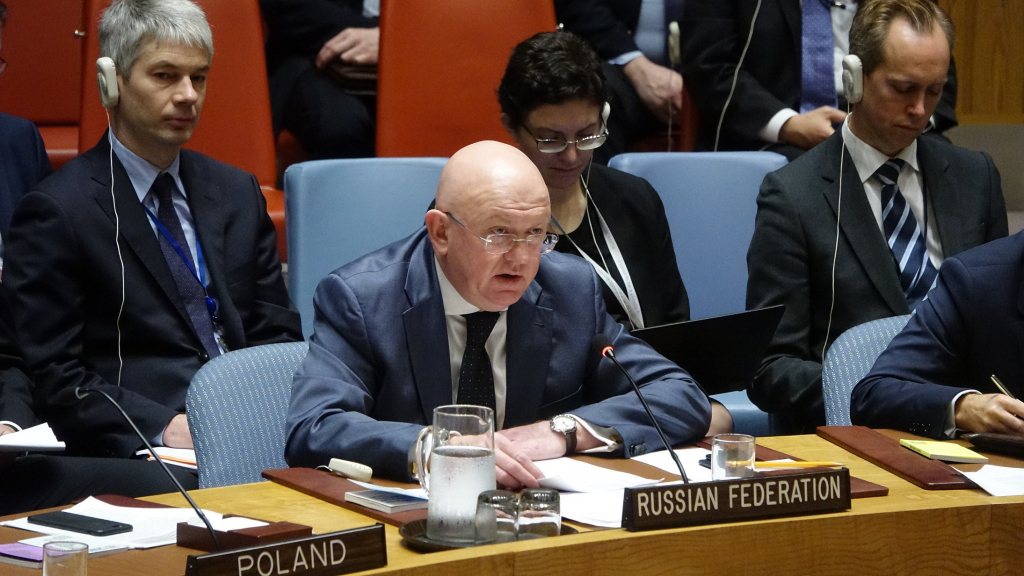
The Permanent Representative of Russia at the United Nations Vasily Nevenzha photo: Russiaun.ru
At a meeting of the UN Security Council, the Russian Permanent Representative of the United Nations, Vasily Nevornya, asked his American colleague Nikki Haley to “observe diplomatic decency” - not to use the term “Putin’s regime”, since “a legally elected president and a appointed government in Russia”.
It can be understood by the Russian diplomat: he does his job, although it is in Russian diplomacy that recently there are less and less diplomacy and more and more rhetorical exercises of varying degrees of success, and the most successful and went to the people can be considered the statement of the Minister of Foreign Affairs of the Russian Federation Sergey Lavrov: “morons, ... this is a universal formula, subjected to any difficult cases from life.
However, this is not the point, but that the political system that has developed in Russia over the past 18 years is indeed a regime, and indeed, Putin.
The regime is banal, as a trite political behavior of the Russian leader himself, who did not find the strength and courage to leave his post in 2018
A very benevolent dictator
Yes, of course, the concept of "regime" semantically does not contain anything good. But is Nikki Haley to blame for this? Putin’s regime with all the fact that he is very stately, corrupt, repressive, but is not something unique, something specifically Russian. He is banal, as a trite political behavior of the Russian leader, who did not find the strength and courage to leave his post in 2018 and again arranged a classic performance for this type of authoritarian regimes with an attempt to observe constitutional procedures.
You can call Putin’s regime a fashionable term invented by the American political scientist Farid Zakaria, “non -liberal democracy”. In the sense that not liberals come to power, delicately expressed, but democratically - through elections. I have serious objections against the term. Democratically - with the help of elections - many not just autocrats, but dictators came to power. Many of them were truly loved by the majority, which is usually mistakenly called the "people." But none of them then ruled by democratic methods, each of them - depending on the characteristics of the era or restraining factors - either immediately discarded democratic decency, or gradually dismantled or profanated democratic institutions for the folk good or in the name of this democracy. The most banal examples of recent times are Poland and Hungary. Yaroslav Kachinsky and Andgea Duda turned the Constitutional Court of Poland into a controlled structure, slowly, as if democratically, squeeze out an independent press from the information field, the atmosphere in the country contributes to the spread of nationalism and xenophobia. The same thing happens with the Victor Orban regime. However, these countries have restraining anchors - membership in international structures and, above all, in the European Union.
Putin's regime does not have such restraining anchors. Not to mention the fact that free elections have long been not the strongest side of the Russian political system.
Such regimes are often called “competitive authoritarianism”, “electoral authoritarianism”, “hybrid authoritarianism”, and the leader click “a benevolent dictator”. However, over time, the main boss is becoming less and less benevolent (and there are no exceptions to this rule), and authoritarianism itself is an increasingly less hybrid (that is, the elements of democracy, and not just authoritarianism), are increasingly competitive, all less electoral - in the sense of profanity of elections. A characteristic example of this kind of recent, literally tragic stories for the peoples of the world, is the regime of the favorite of the common people of Chavez.
By the way, it was not for nothing that Nikki Haley spoke about the speculation of the regimes that she had so incredible in one row - Kim, Assad, Putin - on the concept of sovereignty. Autocrats are moved in sovereignty and rave them. But the sovereignty in their understanding is not a legal constitutional concept. They mean the inviolability of their regimes and their personal impunity to the detriment of the country and its citizens **. This is generally a property of autocracies - leaders confuse their regime with the country. They demand from citizens to protect the country, but actually mean themselves - several hundred families who concentrate in their hands most of the national wealth (according to the last report of Credit Swiss about world wealth, in Russia, the indicator of the concentration of wealth in the upper decile - the richest tenth of the population - reaches 77%) ***.
Autocrats are moved in sovereignty. They mean the inviolability of their regimes and their personal impunity
How democracies die
The old formula of domestic literary criticism - “typical heroes in typical circumstances” - works the best in the stories of autocrats and their regimes. Professor of Harvard University Stephen Levitsky, co -author (together with the university professor Toronto Lukan Way) that has become relatively popular in Russia, the books “Competitive Authoritarism. Hybrid regimes after the Cold War, ”and popular precisely because we had to somehow call the regime that had developed under Putin, had just published a new job in co-authorship with another Harvard professor, Daniel Tsiblatt. It is called “how democracy is dying” (How Democracies Die) ****. Putin there is not the main character at all - he, as a banal autocrat, is just one of the names among other autocrats. It is precisely that the "typical hero in typical circumstances." Levitsky and Tsiblatt offer a simple matrix that can be applied to any political system to determine whether we are dealing with the authoritarian regime or not.
A very simple sign. The first is "denial (or weak support) of the democratic rules of the game." The second is "denial of the legitimacy of political opponents." Third - "tolerance to the promotion of violence." The fourth is "a willingness to infringe on the civil freedoms of opponents, including media."
Put this scheme on numerous, too numerous events, well, at least starting in May 2012, and you will realize that the “legally elected president and the appointed government” (according to the non-suppress formula) ideally correspond to the Levitsky-Tsiblatt matrix. This is a regime. Authoritarian regime.
Two professors are talking about another thing. There is such a thing, they write as ForboeRance. It can be translated into Russian as "abstinence." This is when leaders, leaders, presidents stop themselves in order to maintain democracy. Not for the sake of yourself, but for the good of the people. In particular, they do not go to the third term. George Washington in 1797 deliberately did not go for a third term. So it has been in the USA since then - well, it is indecent to rule more than two terms. Not in a row, but in principle.
Franklin Roosevelt violated this rule, and by the way, it turned out that he ruled to his death. The most popular president in the history of the United States (in 1936 he was elected 61% of the vote) was inclined to expand his power, but each time he came across the resistance of the institutions of democracy and the corresponding political culture - the Supreme Court torpedoed this kind of Roosevelt initiative. And then the president followed the path that numerous autocrats later walked - from Peron and Chavez to Duda and Orban: decided to change the composition of the Supreme Court, in his case - by expanding the number of judges. To get "their" judges. And he left the appropriate legislative initiative. And this initiative - within the framework of ForboeRance - was destroyed by Congress, where the Roosevelt party, Democrats, had a majority. “Even in the midst of such a deep crisis as the Great Depression, the system of checks and counterweights worked,” the authors of the book “How Democracy die”.
By the way, they have noted more than once in their work that modern democracies die slowly and almost imperceptibly, gradually. Each time, the future authoritarian ruler finds a reason to narrow the field of freedom - either the circumstances of the emergency, then the enemy at the gate, then for the good of the people the country needs to freeze a little. And at the exit, mature authoritarianism is obtained with a seemingly acting democratic constitution.
In general, there is nothing more banal than authoritarian regimes today. Legally elected. Well, that is, formally legal, and informally, with some violations. Recognized insignificant - in full accordance with the laws.
So democracies die.
* Permanent Columnist NT, head of the Moscow Center program of Carnegie
The author’s opinion may not coincide with the opinion of the editorial office
** The Catholic philosopher Jacques Mariten, one of the authors of the Universal Declaration of Human Rights of 1948, wrote, referring to the experience of some regimes of the middle of the 20th century: “Two concepts -“ sovereignty ”and“ absolutism ” - are picked together on one anvil. And both should be discarded "
*** http: //publications.credit-suisse.com/tasks/render/file/index.cfm