
Translated material
Frost Pandora
The text continues the project on the Ecology "Variable" .
Eternal permafrost is covered with 35 million square kilometers - about a quarter of the land of the entire planet. The temperature of this part of the earth's crust did not increase to zero degrees how much time - with the exception of a thin active layer subject to seasonal changes. The gradual warming of the climate affects permafrost in the most direct way: it melts. And the fact that thousands of years remained frozen in it suddenly enters the general biological cycle of the planet.
The current pace of warming has no analogues in the previous eras, for which data are available to us, for example, from ice cores. Therefore, it is not surprising that several years ago they began to call permafrost a “carbon bomb” or “pandora freezer”-and wait for it to melt and throw into the air so many greenhouse gases that will instantly warm up the earth to unprecedented temperatures. Of course, these forecasts, of course, did not foresee anything good for the inhabitants of the planet.
In permafrost, large volumes of carbon are really mothballed - up to 1300 billion tons, half of the total carbon in the soils of the globe. Carbon is the basis of two greenhouse gases of the planet, around which so many conversations have been conducted in recent years. Particular attention is paid to methane: its greenhouse activity is higher than that of carbon dioxide, and with significant emissions, the role of methane could become fatal. Not for the planet-it didn’t see this: for example, scientists believe that it was the sharp release of a giant amount of SN 4 that could suddenly warm up a whole frozen planet about 650 million years ago. But for the population of the Earth, such heating certainly does not promise anything good.
The minimum amount of methane in the atmosphere was the last time in the era of the previous glaciation - more than 11,000 years ago. Since then, this value constantly fluctuates, but grows steadily. Sources of methane can be natural objects and human activities (for example, the spread of agriculture or coal mining). The natural emissions of methane, according to modern estimates, make up about half of their total volume. However, it is this part that can significantly grow with further warming of the climate.
For Russia, the issue of disappearance of permafrost is relevant as for no one else. More than 60% of the country's territory costs permafrost - mainly the north of Western and Eastern Siberia, the Subarctic and the Arctic itself. These are gigantic spaces that seriously affect the state of the atmosphere of the planet. And at the same time, according to the intergovernmental group of experts on climate change (MGEIK), the most significant changes occur here due to a warming climate. Let's try to figure out whether our fears are justified before melting permafrost and secrets that she hid for millennia.
Western Siberia: drowned in swamps
Assessments of the amount of methane, which natural sources are thrown into the atmosphere, differ by an order of magnitude - from 26 to 345 million tons per year. However, what all scientists agree in is that wet ecosystems - jungle and especially swamps make the maximum contribution to this process. Gas in them is produced by methanegens, microorganisms that digest organics (more organics-more methane). The world's largest massifs are in Western Siberia: it is more than 700,000 square kilometers, and almost half of the territory is in permafrost.
How much methane is the swamp ecosystems of Western Siberia? The scatter of opinions is significant - from 1.6 to 22.7 million tons per year. For such a heterogeneous and large -scale territory, it is difficult to give an accurate assessment, but, in general, Russian researchers converge on an average number - about 5 million tons annually. Swamps in this region are found at all latitudes - from Kazakhstan to the Arctic. And in the context of global warming, we are interested in specifically the northern swamps. Their total area is 42% of the area of all West Siberian swamps. And there is an opinion that it is the northern swamps standing on the eternal permafrost that can throw a huge amount of methane into the atmosphere in the next hundred years. But researchers from the Institute of Physics of Atmosphere named after A.M. Obukhov is sure that no disaster will happen here.
- For several years we worked in the tundra of Western Siberia, trying to understand the volume of modern emissions of “biological” (derivative of organicism) methane from the northern swampy territories. As a result, they came to the fact that these indicators are not as radical as it could be. Even spring emissions, when the ice leaves the lakes and the methane accumulated over the winter is released - these are just tens of kilograms from one lake. In general, for a year about 800,000 tons (up to 1.4 million tons of maximum). Tenth stakes of a percent of the annual world emission SN 4, ”says Vladimir Kazantsev from the A.M. Obukhov RAS.
However, those first frightening grades played a positive role: they forced other researchers to pay attention to the problem.
But the climate is changing, freezing melts, and with the expected warming, the process of biogenic discharge of methane is intensified-there is no doubt. Kazantsev is convinced that the amount of methane will grow, but still will remain insignificant in the scale of world emissions. The maximum growth in the most negative option in the next decades will be about 40%. That is, by the end of the century, emissions have reached volumes of 1 million tons of methane per year. Still comparable to the error in calculations.
More than a third of all northern West Siberian swamp landscapes are occupied by thermocarste lakes. These are reservoirs that appear where the soil sags due to melting permafrost. At the bottom of the lake, a nutrient biomass accumulates for bacteria, they produce methane. Studies say that small, that is, young, lakes distinguish a relatively larger amount of methane than large ones. But at the same time, a huge number of these small reservoirs with an area of up to ten square meters are not taken into account when calculating the annual emission of SN 4: small lakes are simply not visible in the pictures from the satellite, they are, as it were, they are not. A few years ago, this problem greatly puzzled scientists.
-Indeed, young lakes emit more methane, and this is mainly due to the fact that they still have a lot of organic matter that bacteria can digest. In large lakes, the bottom is much poorer than organic, microorganisms have nothing to consume and process in methane. According to our estimates, the role of thermocarst lakes in the annual emission from the northern territories of Western Siberia turned out to be, in principle, small, therefore, it seems to me that you can not make amendments to the size of reservoirs. Even with the most rigid scenario of climate change in the future, thermocarst lakes will not significantly affect methane emissions into the atmosphere, ”says Vladimir Kazantsev.
Eastern Siberia: Ice underground
In the mid-2000s, the articles of the international team of scientists were published in Nature and Science magazines that gigantic volumes of carbon are “stored” in the eternal permafrost in the north of Eastern Siberia. The authors of the articles reported that the amount of methane secreted, for example, previously underestimated five times: in fact, it, according to them, is about 4 million tons annually. Moreover, with climate warming, this indicator will grow, because the so -called ease of eternal permafrost, consisting of ice cores and similar to the sand sand, is irreversibly melted and destroyed.
A prying can be found not only in Siberia, but also in Alaska, in the north of Canada. Strictly speaking, the edition is a type of landscape, a plain with areas destroyed by thermocarst and erosion (land plots seemed to be eaten by someone, hence the name-the name of the edition). Under the thin layer of soil, it hides that which is more correct to call a peremose retinue or an ice complex. Ice veins permeate ground deposits to a depth of 40 meters. They are located both vertically and horizontally, forming on the surface a semblance of a grille with recesses of a width of up to six meters.
- In this thickness, the ice occupies more than 50% of the volume. This type of permafrost was formed by the entire Pleistocene, from 60,000 to 10,000 years ago. Most likely, this happened due to the cracking of the soil. Summer in Eastern Siberia in that era was, apparently, quite hot, and winter, on the contrary, was very cold. Frosts come sharply, the soil is destroyed, water falls into the cracks and freezes. So the ice core is laid. At first it does not exceed three to five meters, but for centuries the surface grows up, and an ice wedge grows with it, ”says Denis Shmelev from the Institute of Physico-Chemical and Biological Problems of the RAS Soil, a researcher of the East Siberian permafrost.
- Now we understand that for the catastrophe that our colleagues predicted, an incredible combination of circumstances is needed: a sharp increase in average annual temperature, and high humidity, and significant human intervention.
In the Pleistocene, the Siberian north was a tundra -steppe, along which mammoths and woolly rhinos walked. There was a lot of vegetation, and not all of it managed to overheat, turning early into permafrost early. Therefore, the reserves of organics in the unit complexes make up about 2%, almost like in Chernozem in the south. And no biological processes in permafrost go until the permafrost is warming up: then bacteria will literally instantly turn the thawed organic into greenhouse gases. Ancient carbon will be irreversibly involved in modern natural cycles, and this will have a serious impact on the climate.
In this way, the eternal turned in the lips of the researchers, and then journalists into a “carbon bomb”. It was predicted that with the sharp warming that we are now observing on Earth, the Extrom would begin to collapse and millions of tons of carbon will break into the atmosphere, violating the natural course of things. Mobilization of carbon from permafrost will increase and with further warming the climate, in turn, even more heating the earth.
Scientists of IFHBPP RAS have long been studying the UPS along with foreign colleagues. Their data is said that in the early 2000s, the assessment of carbon reserves in the strata of Eastern Siberia was still high as an order of magnitude: in the first works, scientists incorrectly considered the areas of these deposits, took smaller ice volumes and so on. However, those first frightening grades played a positive role: they forced other researchers to pay attention to the problem. And thanks to this, the study of eternal permafrost in Eastern Siberia began to actively develop.
- Obviously, they reached their maximum unit complexes 11,000 years ago, when the last ice age ended on the planet. Since then, slow degradation of these structures has been taking place. For ten years we have been watching the unit and understand that this is not a period for her. In a geological sense, this moment for which no serious changes can happen. Over the years, the melting of the ethmodes has not intensified, but our knowledge about it has significantly increased. And now we understand that for the catastrophe that our colleagues predicted, an incredible combination of circumstances is needed: a sharp increase in average annual temperature, and high humidity, and significant human intervention. At least in the next hundred years - and this is confirmed by experts of the MGAIK - such conditions are not expected, - promises Shmelev.
How terrible the devil is
As a result, not all scientists are sure that the continental “methane bomb” is so terrible. And even with warming, the volume of carbon, which is released into the atmosphere from these huge territories, will not exceed what the person himself produces, burning organic fuel. The processes occurring in permafrost are not directly dependent on climate warming, the dynamics of atmospheric precipitation is much more important: they lead to erosion of the slopes, thereby accelerating the destruction of eternal permafrost. And at the same time, the vegetation cover is actively developing in a warmer and moist years, which serves as natural thermal insulation for permafrost and at the same time absorbs carbon from the atmosphere.
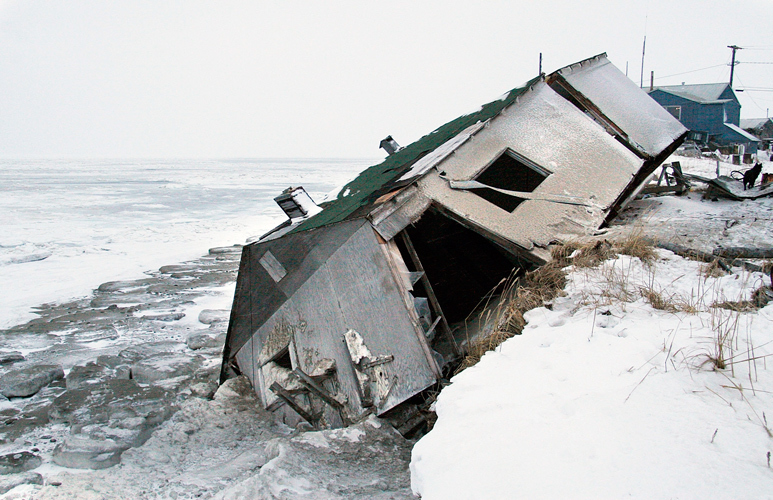
But the melting of permafrost leads to other consequences that negatively affect the nature and life of mankind. This is not only the destruction of buildings and infrastructure: the faulty soil changes landscapes to recognition, so a person has to look for construction technologies that will take into account this scenario.
So far, scientists know very little about what potentially viruses and bacteria are hidden in permafrost. Let us recall the last year’s outbreak of Siberian ulcer in Yakutia: it is believed that the microbes “thawed” precisely because of the warm winter. Local residents talk about the frequent fires: the thawed land ceases to hold moisture, and the dry northern steppes easily become the extraction of fire.
But the melting permafrost and positive aspects have. Where humus is available for bacteria, the soil becomes fertile. Plants that settled on it absorb carbon dioxide from the atmosphere, returning carbon to the ground. And thermocarst lakes are a powerful source of fresh water, the lack of which today leads to serious conflicts in the hotter regions of the Earth.