
Translated material
The widow of Litvinenko called the UK unsafe for political refugees from Russia after the poisoning of Skripal
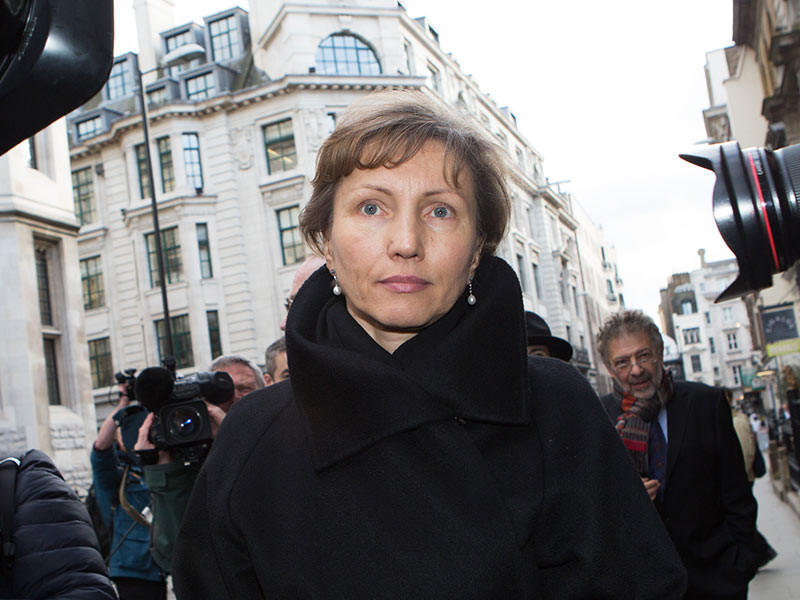
The widow of the former FSB officer Alexander Litvinenko, who died in 2006 from Polonium poisoning in London, called Great Britain an unsafe country for Russians seeking political asylum. Marina Litvinenko reported this in an interview with CNN .
She pointed to the parallels between the death of her husband and the poisoning of ex-colonel of the GRU Sergei Skripal, in particular, the "similarity of the method of murder", but added that it was too early to draw any conclusions. According to Litvinenko, the British authorities had to do more after the death of her spouse: not only to “expel” Russian intelligence officers from their land, but also to ban people involved in crimes in Russia and having “dirty money”, come to Britain and spend this money there.
“And what do we see now? If we talk about protection, about security, then Britain seems to not provide them. And now this is a big problem,” Litvinenko said. She noted that there are many political refugees in the UK, and after what happened to the Skripal, they should feel "only helpless and very defenseless."
The widow of Litvinenko urged the government of the United Kingdom after the United States and the European Union to introduce targeted sanctions against individuals in Russia if it wants to influence those who are involved in corruption and achieve changes.
Litvinenko also warned that it was not worth taking to faith the reaction of the Russian authorities, denying accusations of involvement in the poisoning of Skripal. She turned to her own experience after the death of her husband and noted that the Russian authorities "not only deny, but also say that they would be happy to cooperate."
On Friday, the Russian Foreign Minister Sergei Lavrov called the parallels between the poisoning of Sergei Skripal and Alexander Litvinenko. He recalled that the death of the ex-employee of the FSB, "who was also dumped on the Russian Federation, was not yet investigated."
"We have not heard a single fact, we are only watching reports on television, where with serious faces your colleagues with Paphos say that if it is Russia, then the answer will be one that Russia will remember forever. It is not serious, this is pure promoting and the injection of hysteria ," the minister said.
Lavrov also noted that Russia is ready to help in the investigation of any question, including cases of Sergei Skripal's poisoning, when applying through professional channels.
Recall, on March 4, Skripal, convicted in Russia for the Stateismman and Spying in favor of the British intelligence services, and his daughter Julia were discovered in an unconscious state on a bench next to the shopping center in Salisbury. According to the British police, they were poisoned by a neuro-paralytic substance . The investigation qualifies this as an attempt on murder.
Skripal and his daughter are in the hospital in a coma . In serious condition, an officer of the police was hospitalized, who arrived first at the scene. On March 8, it was reported that he came into consciousness and spoke. In addition, the hospital in Salisbury took 21 patients in connection with the poisoning of Skripal. Some of them passed a blood test and went through inpatient treatment.
According to the British media, the MI5 counterintelligence check the version that the poisoning of Skripal and his daughter was an attempt by Russia to eliminate the former spy . As The Times wrote, the first signs indicate the attempt with the support of the state.
Alternative versions are also not excluded: the desire of a competing group to slander Russia and undermine the regime of Vladimir Putin or a personal dispute. British Foreign Minister Boris Johnson threatened the consequences of the Russian authorities if Moscow’s involvement in Skripal poisoning was proved.