
Translated material
Winter of Ukraine
Ukrainians, unlike us, their killed in the war are buried openly and with honors
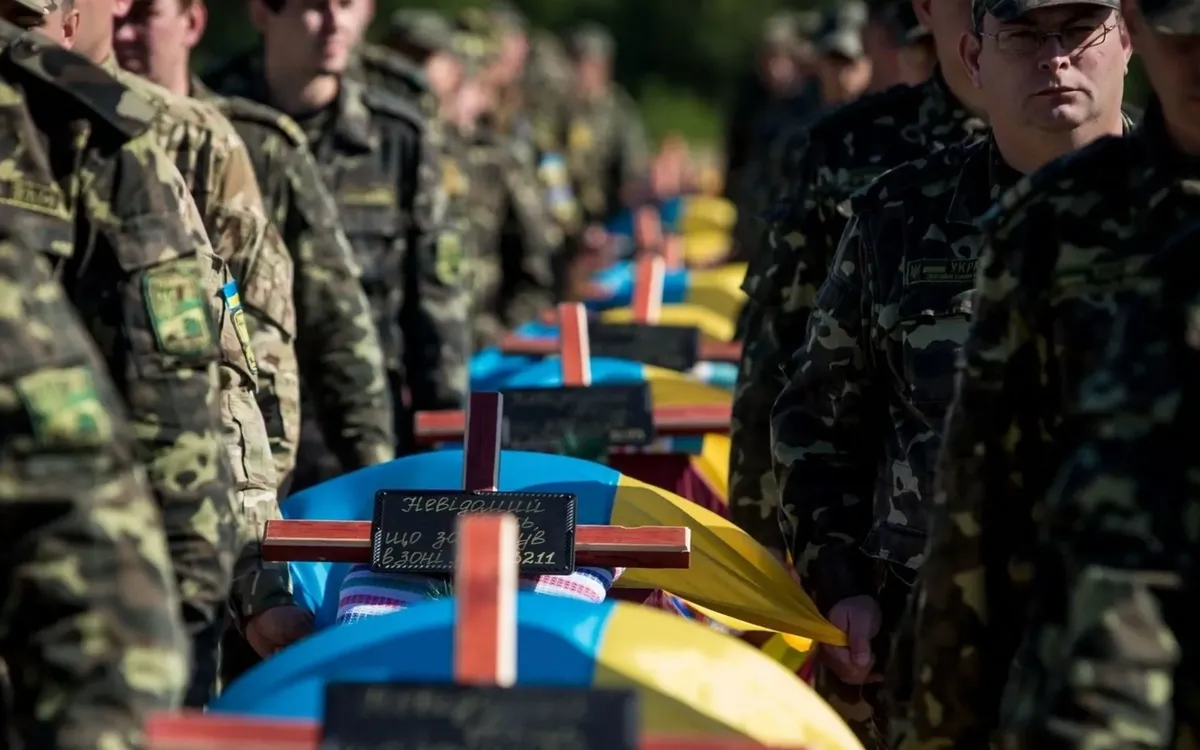
At first the murdered has no name and surname. Just killed. Everything is very short, sparing. A few words in the summary of another day lasting the fourth year of the war, another unit in the statistics of irrevocable losses, another blurry, fuzzy figure in thick winter uniforms lying in the snow on the outskirts of Avdeevka or Novotoretsky. And nothing else is known.
Then the name, surname and few details of the already terminated human life appear. They are reported by the military registration and enlistment office, or the regional administration, or the brigade in which he served: born ... studied ... worked ... city ... village ... military unit ... photography. All of them, captured in these unprepared amateur photographs, knew that they were killed in war, but according to the usual human habit not to believe in their own death did not think that they would be killed. The dead were about to survive the war and live happily and therefore in the photographs they smile, laugh, shyly look at the lens, posing in the summer field, at their home, sometimes with relatives, sometimes with friends.
Very little remains of them, because they are usually young and unknown.
On March 2, Vadim Sapescu died. Born in the village of Chernaya near Odessa. In the photo in the Adidas sports jacket and a ski cap, there is, with his hands in his pockets, against the background of an Orthodox church with golden domes. It looks younger than its thirty -three years. Probably was a believer.
Alexander Sivko died on February 25. Twenty years, by profession, an electrician. Lived in the village of Peskovka, Kyiv region. A volunteer came to the military registration and enlistment office. In the photo in the body armor, for the strap of which a small flower stuck. The body armor did not help, the flower did not take death.
On February 23, Sabina Galitskaya, a military nurse, died. Twenty -three years, before the army, she worked as a midwife in a rural hospital. She died in a car when she was traveling with medicines to provide medical assistance to the civilian population. A beautiful girl in a camouflage T -shirt and a baseball cap, who can not hide her light light hair, is looking at the photo.
On January 30, Artyom Skopeiko died, twenty -two years, who lived in the village of Gornostaevka, Kherson region before the war. Of the twenty -two years of his life, he served in the army for five years, fought for the last two years.
On December 21, Artem Goltsko, twenty -five years old, from Zhytomyr, - a tall, stately guy in military uniform, with a vest in a section of a shirt, in a blue beret, in high berets. The same vests, berets, berets wear the same tall, stately, confident guys in our army.
I do not call all Ukrainians who died this winter it is impossible to call everyone in one text. There are weeks when they die every day, there are two or three days, when no one is dying, and then again the uniform, monotonous, everyday murder begins.
Be sure to report when and where there will be a funeral. For the most part, they are buried in villages, in villages, in small cities. From there these guys. But there are from Kyiv, Kharkov, Zhytomyr, Odessa. At the places of funeral, you can study the geography of Ukraine. Once I visited there, I remember huge fields with sunflower, white stones in gardens, a soft southern dialect of hospitable people, blue domes of churches, comfortably peering out of green crowns. Now, buses with flashes on the roofs and black ribbons on the handles of doors are rushing past blue domes and huge fields, and people come to the side of the road and kneel.
Hundreds of meters and kilometers stretch chains of people standing on the knees. So Ukrainians say goodbye to their killed.
Men remove hats, caps. The men are on their knees, thirty years older than a boy who is driven in a coffin, women in unpaved coats and shawls are on their knees, children of school years are on their knees and see how, without slowing down, this terrible bus rushes past them with formidable and solemn swiftness.
Entire villages and towns in full force go out onto the streets to meet a arriving bus with a coffin. Healthy men in camouflage and with bandages on the sleeve take a coffin from the back door and carry it. It seems how do we know all the details and details of the funeral, how do we know how they have it there, in this suddenly distant machine guns and muzzles of tanks, exhausted, poor, bloodied, suffering from Ukraine? But in the age of continuous communications and the open Internet, nothing can be hidden. We see everything if we want to see: a strip of fabric with prayers on the forehead of the young sergeant lying in the coffin, and the concentrated faces of the military, carrying icons, on which pure white towels are thrown, and a brown cross raised above the mourning procession, on the crossbar of which the initial letters of the name of the one who gave their lives for people and bright flowers are written in frost, and bright flowers and bright flowers and bright flowers and bright flowers and bright flowers and bright flowers. The Ukrainian flag laid on the coffin.
Farewell occurs in poor rooms with yellow wallpaper, with white tiles, with planed painted floors. The coffins stand on stools, and women with red tearful eyes in a trance mutter prayers. They speak quietly, but whoever wants to hear, he hears this stubborn, tireless, polyphonic prayer muttering of Ukrainian women, conveying to Moscow from the Snow of the Volyn villages, Kyiv villages, villages near Zhytomyr, cities on the Dnieper. He who wants to see, he sees how Sabina’s mother Galitskaya strokes her white inanimate hand. Yes, everything, everything can be seen and heard in our time, and no Roskomascur can prevent this.
Our dead in this war is buried quietly, secretly. Lev Schlosberg revealed the secret and received a brick on the head. And what to hide Ukrainians? They didn’t start a war, they didn’t come up with it, they didn’t invade a foreign country, they were attacked, they defend themselves, what to hide? They bury their dead openly.
Military orchestras enter. Under their pain, a familiar, languid, pulling nerves of sound, frantically clutching his hands to the mouths, pressing with crying, with wet faces, go behind the coffins on a woman who was broken by hundreds of legs in black scarves and cheap steams purchased in rural stores, go, crossed on sick legs, covered with warm rates, old women with owls. Wreaths in their hands, there are hefty men with jackets open on their chests - Ukrainian artisans, able to build well at home, put a stove, lay water pipelines, arrange wells. Peaceful good -natured Ukrainian men, I know them phlegm, their humor. And from straw baskets under their feet, on the snow, girls pour red petals of living roses.
In morgues and churches, on tables covered with scarves with embroidered patterns, tall, magnificent, round Ukrainian bread freeze in the cold. In glasses, yellow church candles are hardened on a light frost. With portraits with a black ribbon pulled with a black ribbon, serious, calm and now forever unchanged faces of those who killed a sniper, or burned a projectile under the Katerinovka, or turned a mine into a bloody porridge in a naming field under Lugansk.
Terrible, wild scenes tear the heart. The screaming mother of Maxim Pepilitsa, who died on November 25 last year, rushes to the coffin. He is buried on his birthday. “God, I am the boulah of the boule of the mate of 27 Rocks to that ... Kudi mi is carried out to you, Sinochka?” How painful, how defenseless is her Ukrainian speech.
Why did her son kill? Who killed? Who arranged this vile war? Who takes revenge on Ukraine and its people for their choice, for their courage, for their freedom, for their Maidan?
The father’s hand straightens the paper icon on the chest of the son lying in the grave of his son.
The fourth year of the war is going on. One after another they flicker, jump, the pictures of a beautiful, bright, stylish modern life rush: Mask missiles, Hollywood films, Olympics, medals, NHL, KHL, #Metoo ... In the news of the news, in media noise, shots are not heard in the information cod. They are somewhere far away, not where we are. But this winter, as well as in all previous times of the year, Ukrainians kill every day or every other day, habitually, routinely, as if they sacrifice a cruel idol in a meaningless sadistic ritual. In the trampled snow, between fences and picket fences, past poor houses and snowy roofs, past the fences with gloomy faces of hardwork with naked heads, past women in dark shapeless caps, pressing tears, go to the cemeteries of the procession with coffins.
PS
After the material was written, died:
March 6 Vladislav Kozchenko, 20 years old, from Poltava.
On March 9, Yuri Lugovsky, 23 years old, went to the war as a volunteer, lived in the Chervonograd of the Lviv region.