
Translated material
Pigs near London
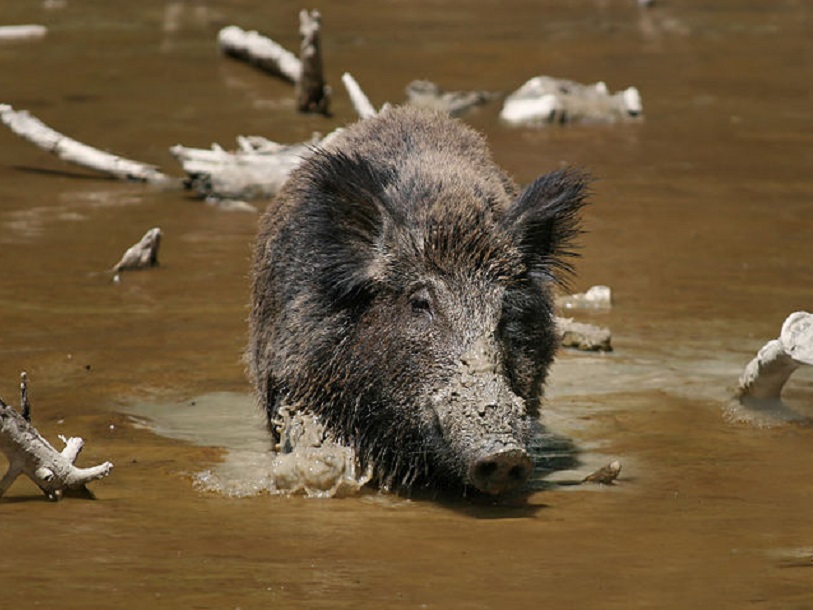
An important part of the plot of the novel Nila Gaiman Neverwhere (in Russian translations “Avtverier” or “Nikoges”) is the Great London Beast, which has been living in deep tunnels near London for hundreds of years. The fight with him awaits the protagonist of Richard Mayheu.
We quote the description of the beast using the translation of Anna Komarinets. “The beast is huge. His carcass fills all the vent of the tunnel: the head is lowered, from the mouth and from the bristling sides, the pairs whitish in the frozen air are blown. This is some kind of boar, he thinks at first, and then understands what nonsense it is: there are no such huge boars. The monster is the size of a bull, with a tiger, with a light car ”,“ He was approaching so slowly, so heavy that for a split second, Richard thought that he was old, sick, maybe even at the last outrage. This was the first thing that came to mind. And then he noticed how much he covers, how much dirt and rotten water sprinkles, and realized how mistaken he was, considering him clumsy. Thirty feet from them the beast slowed down and, grunting, stopped. Steam was falling from his sides. He roared - triumphantly and, as it were, calling them to the duel. His sides, back and scruff were bristling with broken spears, crumpled swords and rusty daggers. ”
One of the characters tells about the history of the great London beast like this: “They say, for a long time-during the first king of Charles, the one who gave himself his head to chop off, foolishly, even before the fire and plague, at a large moat, where they then built a prison, lived a butcher and held some unfortunate creature that fed for Christmas. (Some say, it was a pig, others - they say, at all, and the third - I consider myself - that it was generally unknown who was at all.) One December at night the beast escaped, hit the flows of the moat and disappeared in sewage. He ate scrapings and grew up ... and grew up ... and grew up ... became more and more dangerous. From time to time, the detachments of hunters were sent down to deal with him. ”
Was this story a whole fruit of the fantasy of Neil Gaiman or he relied on some folklore beliefs about the inhabitants of London dungeons? It turns out in the middle of the 19th century, about pigs living in the sewage of London, there really were rumors. The short editorial article of the Daily Telegraph, published on October 10, 1859, says that they live in Hembsted - at that time a suburbs, and now one of the most expensive areas of the city. The article described a special breed of black pigs that live in tunnels among the "scalis feces." The note ended with a brief apocalyptic prediction that someday the pigs would multiply, their ferocious muzzles would uproot the buildings of people, and London will be filled with unbearable grunts. Recall that the text was written a year after the great stench, so that any mention of the London sewage easily caused thoughts of catastrophic consequences.
The connection of this story with the work of Gaiman is confirmed by the fact that the study of the legends of pigs in the sewer paid attention to Henry Mayheu (1812 - 1887), who gave his last name to the chief hero of the “Actover”. He was a journalist, writer and public figure, who went down in history thanks to the three -volume work of London Labor and the London Poor, where he investigated the life of the poor layers of the population of London.
According to legend, the pig once penetrated the sewer and did not find the road out. In the dungeon, she fed waste, brought offspring and became the ancestor of sewer pigs, which differ both in large numbers and ferocity. Henry Maikhey noted that the appearance of the legend may be caused by the fact that the workers who descended into the tunnels of the sewage system for their cleaning (Flushermen) usually missed a little rum. In the personal conversations of Maikheu with these people, they talked about frogs, ducks, turtles, rats “the size of a good cat” and even snakes met in the dungeons, but they didn’t come across pigs.
But pigs from London legends really really existing analogues. Only they lived not in the 19th century, and not even under Charles I, but much earlier. Then there was no underground sewer, but the city had many waste ditches, where there were always enough food waste to feed fertilized dogs and pigs.
The pigs were breeding, snooping the streets, looking for food where they could. In May 1322, a wild pig made her way into the shop and bit the head of the one -month -old girl left unattended, so that the child died. London's court archives also contain accusations against pies, which allegedly used the meat of dead pigs from the streets to fill their pies. The London authorities have repeatedly tried to lime street pigs, but these attempts were poorly experienced. Progress began only when in the XIV century the position of city hunters on pigs was introduced, which paid four pence for each pig.
Ironically in the English forests, wild boars have disappeared due to hunting by the end of the 13th century. Therefore, the aristocrats in their estates resumed their populations artificially, importing from France and Germany. There were many wild pigs in London, but the nobles were not seduced by hunting on narrow city streets.
The Pigs of ST. Anthony, or in the colloquial of Tantony Pigs) used a special status. The hospital of St. Anthony was founded in London in 1242 and existed before the great fire of 1666. The monks of the Hospital Brotherhood of St. Anthony were engaged in the healing of various skin diseases, known under the general name “Antonov Fire”. Old recipes from such ailments often turned on pork lard. Therefore, to sacrifice St. Anthony’s hospital, the pig was considered a benevolent act. As a result, at the hospital there was a whole herd of pigs, which was contained on a free grazing. To indicate the hospital belonging of pigs, bells were tied on their neck. “The Pigs of St. Anthony” were known for their readiness to follow any person who will feed them, so the expression of Tantony Pigs began to be used in relation to people who easily adjoining any patron. There were similar pigs in other cities of Europe, where there were communities of the Hospital Brotherhood of St. Anthony.
The pig of St. Anthony, depicted on the wall of the church in Murau (Austria) around 1300. In London, they looked the same.