
Translated material
How Novosibirsk is being built. Part 2
The Novosibirsk region is on the verge of the complete collapse of the construction market and the most massive protests of the “deceived equity holders”. How did such a situation be, where we quietly crossed the line, and are there any ways out of the situation? Opinion of the general director of the real estate agency "Republic" Dmitry Kholyavchenko.
In the first part, we examined the history of the construction market of Novosibirsk and the mistakes of state regulation of market processes. Now we will find out what the construction companies themselves are, in what atmosphere they exist.
As builders became hostages of power and law
The construction industry is called system -forming for the regional economy. This, indeed, is in many ways true. Novosibirsk is trade, services, logistics and construction. But it would be a huge mistake to believe that developers are able to dictate the rules of the game in their own sphere. And no less mistake would be considered their fascination with hell and the only creators of the catastrophe.
I am ready to vouch that after the famous and created not without intrusive protection of the then regional and municipal authorities of the “social initiative” at the start of any construction, not a single builder planned direct fraud.
The Social Initiative and Company Partnership appeared in Moscow in 2000. It was headed by the ex-head of the department of the military economy of the Academy named after Zhukovsky Nikolai Karasev. In 2009, he was sentenced to 10 years in a maximum security colony, and the company launched a bankruptcy procedure. More than 20 thousand people throughout the country suffered from the partnership’s actions.
139251
Of course, in 15 years there have been many small and large-scale cases of fraud, the withdrawal of capital, man-made bankruptcy, but they still did not take place at the very early stage of raising funds. Almost all future scammers, I am sure, initially did not plan to become them. At the start of the projects, they were anyone - adventurers who planned to catch a market wave, with the nonsense, who lived one day, altruists who hoped to save the company and save people, just fools who were not able to calculate their benefits - but not criminals. Then what caused the problems, except that the average Novosibirsk developer does not have its own capital, sufficient to complete at least one house?
The roots lie in federal legislation, in the peculiarities of the provision of land for development and in their corruption component. Entrepreneurs-manufacturers can tell me as much as they like that it is the hardest thing for them in Russia due to constant checks, raider seizures, obsolete fire and sanitary requirements. But I am sure that the company that creates the maximum number of jobs is proportional to its own turnover, the volume of non -productive expenses. The Russian state did everything so that the creation of workplaces was unprofitable, so that the employee’s hiring to be accompanied by huge risks and that the implementation of the law would take the maximum number of man-hours. Construction creates a huge number of jobs, all the more complex, that some of them are occupied by migrant workers. Well, and the only possible “gray salary” in Russia does not simplify.
The second side of senseless state regulation concerns the requirements for financial statements. The developer orders a lot of building materials, equipment, contracting, which is complicated by the requirements for accounting, based on the reporting before the tax inspectorate and extra -budgetary funds. It is clear that the normal accounting, based on real business processes, and not from reporting, goes in parallel, and, often, generally coincides with official accounting and requires additional time, effort and expenses. It should also be borne in mind that such features of doing business also require enhanced legal support of all processes.
In the head office of any developer, you see not a sales department, work management or design, but half-story accounting
Therefore, when you get into the head office of any developer, you first of all see not a sales department, work management or design, but half-story accounting, department of personnel, lawyers and other employees who are mainly engaged in the implementation of meaningless requirements of federal legislation. Any business in Russia carries similar costs, but I can assure you that in the case of a construction company, the scale of this insanity is especially large.
The most serious costs, which are not directly related to the construction of the house and the sale of future apartments, fall on the developer due to the prevailing format of providing a land plot. Most of the territories that are being built in Novosibirsk are leased without communications.
The lease will eventually enter the price of the property rights sold under the guise of a “apartments in a new building”. Moreover, it would seem, a simple thing associated with a decrease in these costs for most companies - especially large ones - is not so obvious. Yes, a decrease in construction time reduces the costs and risks associated with the exchange rate, a decrease in sales in the market, a change in laws and growth of taxes. But the acceleration of construction, associated with the use of people to work, the purchase of additional equipment and equipment, building more rigid logistics, entails risks, the reduction of which is directly related to a constant increase in sales.
135736
It is the choice of the risks that the developer is ready to go to, and determines the two options for the crisis of construction companies. In one case, we get a small company that did not strive to accelerate the rate of construction, with a drop in sales volumes, which quickly lowered all the money to maintain current processes, which violated all the terms of delivery of the house and living from the transaction to the transaction. In the second case, this is a large developer who will either pull the pyramid for as long as possible, investing in aggressive advertising, increasing the commissions unscrupulous realtors, or will try to withdraw the remaining funds and thereby ensure the emergence of thousands of deceived equity holders. The implementation of the mass scenario according to the second option is still ahead.
The situation with communicating communications is even more serious. Those who dealt with the “natural monopolies” of the city and regional shirts know very well that conducting communications not only very expensive, but also for a long time. Moreover, “long” in practice turns into an indefinite period of time. Especially complicated with heat and electricity. If anyone has illusions that in the case of apartment buildings, everything happens somehow differently, then you need to get rid of these illusions.
I know many cases when the connection to communications at the necessary time was carried out for a bribe. I know the situation where it suddenly became easier for a large developer to build his own gas boiler room and connect houses with thousands of apartments from half a dozen of houses to it. I know the situation where the developer delayed the delivery of dozens of apartment buildings for more than a year only because I could not connect completely ready-made houses to the heating main. In the latter case, the most wild, of course, is the beginning of the construction of a huge residential massif, in fact, with the hope of random, without any understanding of the structure of future communications.
And the most wild history of local policy, confirming the thesis about the corruption component in the cost of construction, which cannot be mentioned, this is the story of the “1,500 apartments” of the time of the mayor Vladimir Gorodetsky. I think when, presumably, about several corruption billions, which, of course, were compensated by developers at the expense of investors, unnecessary comments.
How the city was crippled by construction
The man -made problems of our problems and more serious problems of future generations are confirmed not only by corruption, but also by a more terrible ignoring of urban planning tasks. This is a conversation about how and due to which developers “optimize” expenses.
Novosibirsk is characterized by two main construction options - point development in the center and large arrays on the outskirts. Let's look at them separately:
1. Pointing in the center is a scourge of many Soviet cities. There are many reasons: the destruction of historical quarters, the “cutting” of the city with large highways, the violation of pedestrian connectedness, the inability to solve a whole range of issues with the railway-from the inclusion of trains in the system of city public transport and to the impossibility of agreeing punctures under the railway embankment, which is why everything that is behind the line becomes a separate city. To this is added the disregard for the city authorities towards the green zones and the imaginary presence of “no -shaped” and groomed land in the courtyards. It is the latter that becomes the main temptation for point development. Another temptation is the opportunity to save greatly on the summarizing of communications, because, although not organically, it fits into existing networks.
I am not a categorical opponent of point development. It should also be borne in mind that almost all point buildings are carried out on the ground, which is owned by the developer, and I respect the right of private property. However, in what form and with what costs it is held in Novosibirsk, it categorically does not suit me. All the manipulations and abuse that construction companies operate in the center are simply impossible to list, but the main ones are necessary.
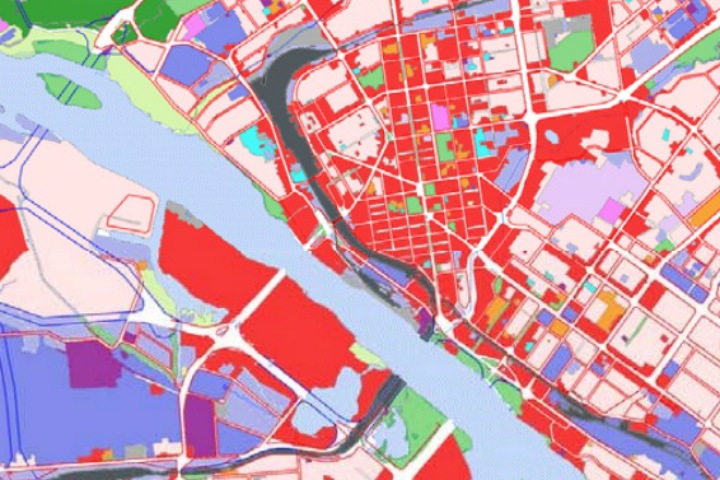
(Red color-the OD-1 zone)
Firstly, number of storeys. In any European city, a high density of development is common, but it is unlikely that anyone will be allowed to build a living tower in the historical center. We have a planning zone of OD-1 on most of the city center, which allows you to build, in fact, any objects of residential, business, social and commercial purposes with a number of storeys several times higher than the prevailing height of the development. A preventive change in zoning is rare and occurs only with the active initiative of the public.
Secondly, fraud with privatization of sites that were especially large until 2014 and are associated with the use of the so-called act of choice for the construction of social facilities. It looked as follows. At first, a certain person turned to the city hall with an act of choice of a specific land plot with the OD-1 zone, which is in municipal property, with the declared intention to build a social object there: a sports center, a pool, a house of creativity, parking. Then a certain building was built on this site, put it-often for a bribe-into operation, privatized on this basis the plot, demolished the initial structure and sold land at a commercial value to the developer, which then erected a 25-story house. Fortunately, the zone allows, and the land is in its ownership.
Thirdly, manipulations with the boundaries of development and with a number of requirements, the main of which was the norm in the number of parking lots. Part of the parameters - the area of development of the site, the indentation from its borders - can change individually and it is enough to look through any release of the “municipal ballot” to understand that this phenomenon is massive and, in fact, put on the stream. As for the main problem of the center - parking lots, there were various minimum requirements for the number of parking lots that could depend on the number of apartments, their area and development area. In addition, practice was widespread when some of the necessary parking lots could be compensated by providing information about the availability of parking spaces in nearby public parking lots, the costs of the developer were significantly reduced, and the problems of the residents of the center increased significantly. It is especially funny to see when the same places in public parking were “attributed” simultaneously to several new high -rise buildings.
2. Despite all the horror of point development, large housing estates on the outskirts of the consequences are much worse. For many years, the authorities of all levels - from the president to small officials of the city hall - completely cynically and irresponsibly broadcast the idea of the unconditional social significance of the construction of large housing estates with relatively cheap prices for apartments. Any criticism from the Novosibirsk public, the architectural and urban environment, representatives of the media and realtors were perceived in bayonets.
Over the past 15 years, we have received large massifs of new buildings on the outskirts. With a high population density, without jobs, without social infrastructure, with terrifying transport accessibility and without understanding future development. Moreover, residents, due to remoteness and young children (a significant part of buyers-young families) are three times loading existing transport communications that lagged behind development for decades, because first they are forced to take the children to kindergarten or school, and then go to work. Such a situation not only is at a standstill of the development of public transport (without his car, children to a school or clinic at such a distance often won’t take it), but also makes the life of the Novosibirsk residents who live in the zone of average remoteness, just between the center and the new massifs. They suddenly received as a gift scored public transport and crazy traffic jams at any time and in all directions.
Why did it become possible? Lobbying by developers, corruption, lack of planning in the development of the city and fantastic urban planning documentation that allows the urgent city manipulations.
139203
There are certain norms of how much housing can be built at a certain power of communications and the road network, as well as indicators of their throughput. In Novosibirsk, there is a urban planning plan, which, in my opinion, is absolutely fantastic. By 2030, there should be about 50 metro stations in the city, and the necessary annual investment in the development of only a road network is comparable to the size of the city budget.
When at the federal level, including the President, they constantly broadcast the idea that the more housing is built, the better, try to hint about more important than uncontrolled buildings, things: the lords of the city, respect for a person, the urban environment, the quality of life, transport accessibility, and the dangers of the ghetto.
Thirdly, the absence at the level of urban planning policy of understanding that Novosibirsk is not a full-fledged city, and in fact it is a spontaneous agglomeration of 20-30 cities, torn by degrading industrial zones and the private sector, entails a number of problems. There are no city or regional policy to resettle the private sector and restructuring the industrial industry. Therefore, a paradoxical situation develops when very often the population density falls from the center to the zone of medium remoteness, and then almost to zero in the industrial zone, and then dramatically jumps on the outskirts. It is clear that in such conditions the city cannot develop.
Fourth, very quickly at the city and regional levels there was an understanding that the construction business of large outskirts is still a pyramid. And that the only chance to delay the collapse is to continue the policy that provides for the constant increase in volumes and ignore the problems of the urban environment, public transport and the availability of social infrastructure.
The construction industry of the city in conspiracy with irresponsible officials not only fragmentarily destroy the urban environment, but create a system in which the constant destruction of the urban environment looks almost as the only alternative to the mass protests of deceived equity holders who spilled out due to the fact that the construction flywheel can no longer rotate with the necessary acceleration.
A dead pink or as a state saves equity holders
The type of thinking of the official is quite primitive: if “their boys”, who have an understandable “topic”, experience a cash gap, then they need to throw money. If I am not mistaken, for the first time in our region direct subsidies (only slightly disguised) to developers were applied to the crisis of 2008-2009. I must say that that crisis was not ours, but American, but hooked us quite strongly. Revenues fell, real estate prices fell. On the “secondary” prices fell to such an extent that ready -made apartments began to directly compete with under construction. And the people who “invested” in new buildings for resales dropped prices, and buying directly from the developer became stupidity.
The main initiative to save the “most important sector of the economy” was proposed by ex-governor Viktor Tolokonsky. The regional administration made great efforts to restructure bank loans to some developers. Власти приняли программу, по которой в случае покупки имущественного права требования по договору долевого участия (то есть, квартиры в новостройке) у застройщика, подрядчика или поставщика стройматериалов, инвестор получал либо 300 тыс. рублей на первоначальный взнос, либо существенное субсидирование процентной ставки по ипотеке.
Я оставлю за скобками то, в какое сложное положение поставила эта программа предыдущих инвесторов, так как их шансы в условиях падающего спроса своевременно избавиться от сомнительного вложения резко уменьшились, однако то, что в большинстве случаев введение этой программы просто привело к увеличению цены предложения от застройщика на те же 300 тыс. рублей, это факт.
127500
Следующей серьезной формой господдержки стала уже федеральная программа субсидирования процентной ставки по ипотеке, под знаком которой работал весь рынок новостроек в первой половине 2010-х. О том, чем на самом деле являются российские банки, мы поговорим позднее, но с высоты своего опыта и как человек, ставший одним из первых в городе ипотечных брокеров, я теперь с полной уверенностью могу сказать: ипотека на новостройки должна быть запрещена.
Логика ставок по ипотечному кредиту предусматривает прямую и безусловную зависимость размера процентной ставки от уровня риска. Если не учитывать того, что сам по себе ипотечный кредит в России это большой риск, то процентная ставка должна зависеть от рисков, связанных как с заемщиком, так и с предметом залога. По абсолютно всем мировым стандартам ипотечный кредит под залог приобретаемых прав требования — это кредит с крайне высоким уровнем риска и, если бы российские банки были заинтересованы в адекватной оценке своих рисков по ипотеке, то ставки на новостройки были бы настолько высоки, что их никто бы не брал. И это было бы безусловным благом.
Ипотечный кредит — это риск. Покупка новостройки это очень большой риск. Безумие складывать два настолько мощных объективных риска в один кредитный продукт. А субсидировать процентную ставку по таким продуктам, чем годами занималось федеральное правительство — это предательство собственного народа, сделанное в страхе перед массовым появлением обманутых дольщиков и ради спасения фальшивого бизнеса, который при нормальных условиях не имел бы никакого шанса на дальнейшее существование в этом формате.
Тем не менее, понимание того, что даже сохранение текущего спроса на новостройки становится невозможным, а строительные компании не пытаются выйти из замкнутого круга, спровоцировало в 2014 году попытку введения страхования ответственности. Но хотели как лучше, а получилось как всегда. Были аккредитованы страховые компании — конечно, только маленькие, потому что реальный страховой бизнес понимает суть застройщиков и что ни доверять им, ни страховать их ответственность ни при каких обстоятельствах нельзя. Потом эти страховые компании собрали миллиарды рублей и либо прекратили существование, либо смогли выстроить бизнес таким образом, что даже в случае наступления страхового случая ни одной выплаты до сих пор не произведено. Надо отдать должное застройщикам и всем участникам рынка недвижимости — с самого начала ни у кого никаких иллюзий по поводу этого проекта не было, и все просто восприняли программу как еще один безумный сбор, выдуманный безумным государством в интересах определенного узкого круга лиц.
139197
Провал программы страхования сподвиг федеральную власть на более радикальный формат стабилизации рынка — компенсационный фонд, формируемый из весьма существенных отчислений застройщиков, организованный по модели Агентства по страхованию вкладов в банковской сфере. Самым большим вопросом стало то, для какой доли строительных компаний в текущих экономических условиях предусмотренный законом размер отчислений может привести к банкротству. Но впервые за долгое время эта, хоть и полумера, действительно способна уменьшить риски строительного рынка в долгосрочной перспективе.
В следующий раз мы поговорим о банках как о дестабилизирующем факторе строительного рынка, о деловой культуре девелоперов и о схемах привлечения средств инвесторов, которые практикуются в нашем городе.
To be continued