
Translated material
It is huge and crafty, unshakable and contradictory
Anton Dolin - Oleg Tabakov's memory
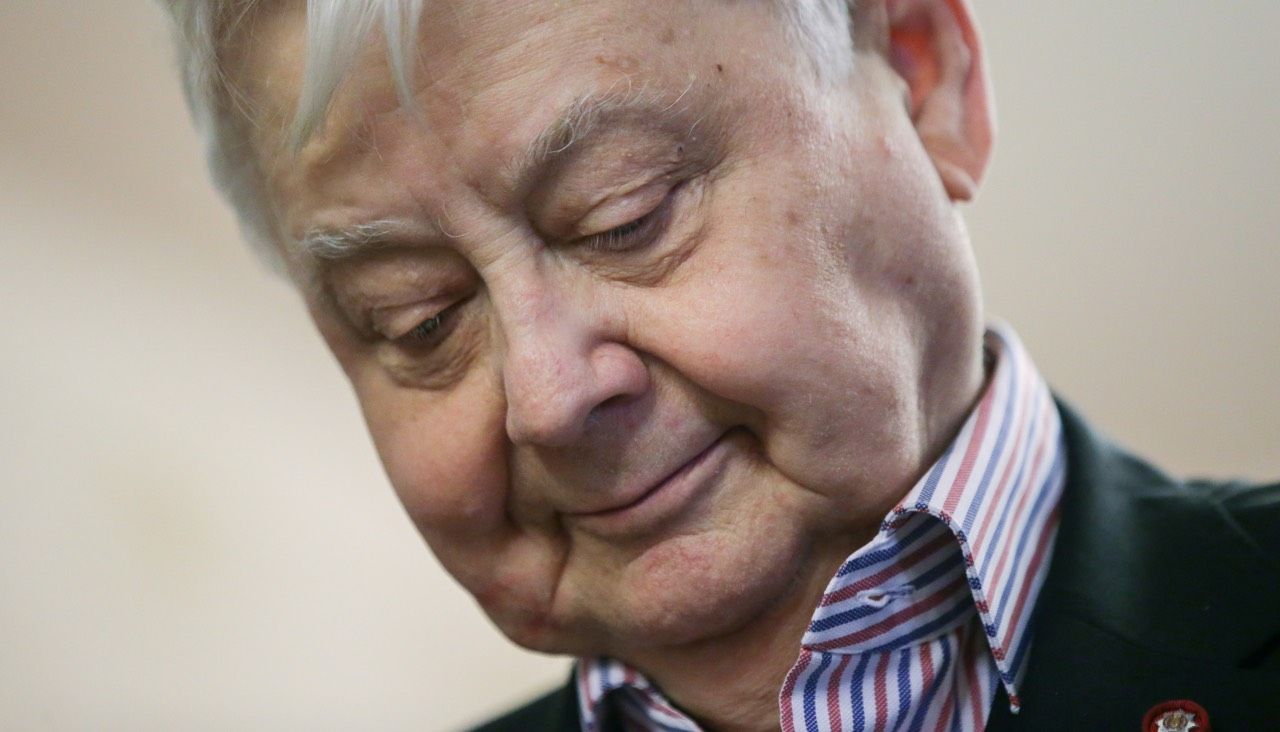
On March 12, Oleg Tabakov died - a sign figure in Russian culture of the last fifty years. An outstanding actor, director, manager, artistic director, theater builder, master, teacher of several dozen of the most successful modern Russian actors - Oleg Tabakov was and will forever remain truly People's Artist. Oleg Tabakova recalls the film critic of "Medusa" Anton Dolin.
Oleg Tabakov is that rare artist to whom it is easy to apply a praise and, it seems, is always the extra epithet “great”. What else? The career lasted 60 years, and for no year Tabakov ceased to be the most important component of the cultural landscape, all multiplying his hypostasis. The era left with him? No, there are several different eras at once, each of which could become different without it. Equally the person of the theater and cinema, director and culturer, teacher and artist. Without it, it is impossible to imagine that old “contemporary” who, already half a century ago, became part of the story. But after all, the most relevant modern theatrical directors received carte blanche from Tabakov-the heads of the current Moscow Art Theater, transformed by his efforts: Evgeny Pisarev and Yuri Butusov, Kirill Serebrennikov and Konstantin Bogomolov.
The beginning of Tabakov’s career is associated with the names of Mikhail Schweitzer, Oleg Efremov, Grigory Chuhrai, Galina Volchek. He played his last roles in two performances of Bogomolov-the anniversary, in fact, and the deceptive-visible “jeweler of the jeweler” and the piercing “dragon”: he did not go out onto the stage, he was taken out, and the hall exploded with a ovation, so inappropriately interrupting the ultra-modern production. The role of Tabakov in the Bogomolovsky film defeat will become posthumous-“The year when I was not born” (there is a chance that the picture will see the light until the end of 2018). And the last lifetime will remain work in two full -length “kitchens”. Yes, Tabakov from the very beginning was and until the last days remained truly a national artist. You can’t come up with folk.
Only for one year he could withdraw in the radical experiment of Kira Muratova “Eternal Return” (their third joint work after “three stories” and “melodies for a barman”) - and, possibly, the most shameful of the “blockbuster” of Sarik Andreasyan “that still Carloson”. Tabakov was so huge and crafty, unshakable and contradictory that he was in his place wherever he was.
What is a "great artist"? Probably, the one who managed to combine two acting fates is to be a protrusion that changes beyond recognition at the whim of the director, and create his own stable role, which the viewer does not confuse with anyone. Tabakov did. His slightly cracked purring voice, his soft smile, in which the share of the mockery was always read, the features of his face - beautiful and at the same time simple -minded, “folk type” - national value that is not dependent on the framing. The image, if not for centuries, then certainly for decades.
But the main roles of Tabakov in the cinema - it is films that give popular fame, not the theater - it was not enough for the offensive. First of all, the fiery outrage in the romantic-revolutionary fantasy of Alexander Mitta “Gori, Gori, My Star” (1969) and, of course, “A few days from the life of I. I. Oblomov” (1979) Nikita Mikhalkov, where Tabakov turned out to be the ideal clamp, the most delicate, funny and tragic hero of classical Russian literature.
They looked at Tabakov with different eyes after the epic “war and peace” by Sergei Bondarchuk, where he played one of the main roles - Nikolai Rostov. He was also Alexander Adyoev in “Ordinary History”, on stage and in a television test: Obviously, Goncharov’s prose with her quiet paradoxes and lyrical irony somehow especially coincided with the gift of Tabakov. But he with which material coincided no less impeccably. The adventure "Home of the Republic" and the analytical and detective "seventeen moments of spring"; frivolous “Leo Gurych Sinichkin” - and Gogolevsky Ivan Fedorovich Shponka in the film of the same name; Charming Alhen from “12 chairs” - and Bersenev from the thin and underestimated “Biryuk” Roman Balayan. Truly, a people's artist - there is no title to confirm this fact: Tabakov was the hero of “Dural and Three Musketeers” and “Moscow does not believe in tears”, “Mary Poppins, Goodbye” and “Man from the Kapuzin Boulevard”. He was an artist-festival, and it seemed that no television hit could truly develop without his participation.
Well, as without cartoons. “Bobik visiting Barbos” is an ideal animated comedy of positions, a kind of social parable for the smallest; Cat Matroskin in the cycle of Prostokvashino - anarchist utopia according to the tale of Edward Uspensky; A beautiful -minded teacher in a charming “wolf and a calf”.
Only after hearing, they recognized Tabakov immediately, unmistakably. They were born with him, learned to walk and speak, laugh and cry. He was our dog. Our cat. Our wolf. He is no longer there, but there will be paintings, performances, cartoons. There will be a voice.
Anton Dolin