
Translated material
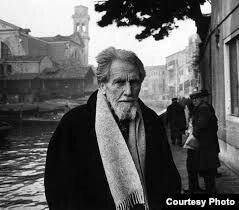
Ezra Pound, genius and villainy
In the topic of the day
Genis: Another biography of a completely different author recently appeared on the book market. This book of Daniel Swift with the defiant name “The madhouse. The policy and madness of the Ezra Pound”. This essay studies in detail the case of the famous poet who spent more than 10 years in the Washington Psychiatric Clinic, and came out of there in 1958, just 60 years ago, without repenting of his fascist views.
With all his wild views, he praised Mussolini and called Roosevelt, not otherwise than “Jewish Jank”, the Pound was undoubtedly one of the leading poets of the twentieth century, the founder of the Anglo-American modernism and the author of the grand epic of our time “Cantos”.
History is the main character “Cantos”, but before reflected in the mirror of poetry, she should have been resurrected. The innovation of the Pound was not in the invention of the new one (he considered futurism a superficial course), but in the revitalization of the old poetic tradition, who was dead under the cold hands of philologists. The Pound pursued one goal - to "make the old new" - and, as he dreamed, was eternal. He wanted to rebuild, streamline and combine countless fragments into a common nervous system that serves the entire human culture. This was more like a neurosurgical operation than literary craft.
Despite the immensely huge and diverse material, which included in Kantos, they are all arranged the same. Their complex dynamics forms a vortex movement of poems around the plot rods connecting a number of songs into cycles. Driving space and time, these archetypal axes rhyme with each other, forming and unfolding the theme. Each word here has its own historical memory, which it does not lose, becoming part of the whole.
This grandiose mechanism vaguely resembles a multidimensional cubic collage. The complexity of such poetry was explained by the fact that the Pound turned to the "superconsciousness" of the reader, which, in fact, was supposed to be born in the process of perception of the poem.
This is not to say that this project was successful. The poem of the Pound is painfully difficult to read. But its role is enormous as an unprecedented experience in synthesis.
It is all the more important that the grandiose cantos was recently released in Russian Andrei Bronnikov. In this 1000-page folio there is a magnificent outline of the life and work of the Pound, detailed notes, and other scientific apparatus. It is hard to believe that this is the work of one person. I myself translated the 13th cantos, and I know how difficult it is to work with this text. More than one generation of readers will have to master the Russian Panund. But in order to demonstrate the work of the translator, I will quote a small, not requiring comments from the Pisan cantos. Written in the camp where the American authorities put him, these verses have earned the most prestigious Bollingen Prize in the world of poetry. The best - 81st cantos - serves as a kind of result or afterword to the entire epos.
What I loved will remain forever.
Everything else is unnecessary slag.
What I fell in love with it not to take it away.
What has loved and is your inheritance.
Whose world is this? My? Their?
Or nobody?
At first only visible, then tangible
Elysius, even in the labyrinths of hell.
Talking about the casus of the Pound, Brodsky said:
To keep a poet, no matter what beliefs he is, in a crazy house - this does not climb into any gate. Oden said that if the great poet committed a crime, apparently should act like this: first give him a bonus, then hang him.
Alexander Genis: Ironically, Brodsky’s body in the Venetian cemetery lies a stone's throw from the grave of Ezra Pound. When I was last there, fresh flowers lay on both tombstones. Brodsky, however, had more.
(Music)
Alexander Genis: I remembered the Pound case also because the campaign in the audit of history has unfolded in America today. The war was declared a war on the monuments of the idols, like Columbus, who go for their misconduct. Naturally, this movement with a new acuteness raised the question of geniuses and villainy, which is so clearly illustrated by the figure of Ezra Pound.
Ach has already turned to this plot, and today, in the framework of our heading “On the topic of the day”, I offer an excerpt from our conversation with a wonderful poet and regular participant in these programs Vladimir Gandelsman.
“A genius and villainy -
Two things are incompatible. Isn't it true? "
Pushkin Mozart raised the question that we, our entire culture, could not give either the final or even convincing answer.
But, we admit with the shame that sometimes the flaws of idols are not disgusted, but joy, they give people pleasure. For example, I, not without gloating, guard the great Purist Nabokov Language Blooms. In his novel “Dar”, the girl produces “light clatter”, and cars are refueling on “chainsaw”.
Vladimir Gandelsman: Yes, we will be frank, sometimes they experience not only pleasure, but also gloating. Pushkin answered them in a letter to Vyazemsky, these words also became textbooks: “The crowd eagerly reads confession, notes by etc, because in his meanness rejoices at humiliation of the high, weaknesses of the one who could. At the opening of any abomination, she is in admiration. He is small, like us, he is vile, like us! Lying, scoundrels: he is small and vile - not like you, differently. ”The question will arise:“ Was Pushkin wrong? ” By the way, the situation with celebrities was remarkably parodyed by Harms in his jokes.
Alexander Genis: Well, what about: Pushkin loved to throw stones. As he sees the stones, he will begin to throw them ...
Vladimir Gandelsman: Sometimes it will be so dispersed that it costs all red, waves his hands, throws stones, just horror! Or: Pushkin had four sons and all idiots.
Alexander Genis: You see, Volodya, the poet and small and the vile is not like us. Still, we do not so often see a person rushing stones, except in Palestine.
Vladimir Gandelsman: By the way, Dovlatov also parody the situation of famous writers. You can recall the story of how the Rhine urgently eats sausage and drinks a bottle when he sees the window that the girl goes to him accompanied by Seryozha Wolf, and not one. There were 400 grams of hard -smoked sausage ...
Alexander Genis: Dovlatov made an exception only for Chekhov. He wrote that “one can revere the mind of Tolstoy. Admire the grace of Pushkin. Appreciate the moral searches of Dostoevsky. Gogol's humor. And so on. However, I want to be similar only to Chekhov. ”
Vladimir Gandelsman: I'm afraid he did not read any book like “Czechs without gloss” ...
But let's finally solve this issue “Genius and Athletes”. I think it's time. You and I, Sasha, have been concerned more than once in our programs, and the time has come to deal with him. Here is the appropriate certificate: “In ancient Rome, a genius was called a good spirit, a supernatural being, guarding a person throughout his life. Even the birthday of the Roman was considered the holiday of his genius. It turns out that for the Romans to hang on a person a sign with the inscription “genius” would be absurd, because man and genius are completely different creatures. In addition, everyone has their own genius, and there is no exceptionality in this and cannot be. But when the creations and deeds of man exceeded what could be expected or thought, most likely, they used the epithet “brilliant”, thereby showing that it was not a person who did, but some higher spirit that acted through him, using a person as an instrument. ”
Alexander Genis: That is, a genius, at least in those moments when he is a genius, is a slave of the force that took possession of him and his enterring. “Finds,” as Pushkin wrote, explaining the nature of inspiration in “Egyptian nights”.
Vladimir Gandelsman: Undoubtedly. My friend Valery Cherry once wrote to me the following:
“Simona Weil has a wonderful article about the Iliad, dedicated, just by the consideration of this phenomenon of the winning force. Here is what she writes about the people that this force masters: "The presence of other people does not oblige them to make pauses in their movements, of which only our attention comes to their own kind." That is, they are at such moments - a spontaneous phenomenon and are not subject to a moral court, as we do not judge earthquakes and floods. That is the tragedy of the genius that he, falling out of a state of genius, falling into a pause, instantly becomes jarked, primarily his own trial. Perhaps the excess number of madmen and suicides among geniuses is associated with intolerance to these transitions. ”
Alexander Genis: Well, like Volodya - “Was the Creator of the Vatican a murderer?”
Vladimir Gandelsman: In the case of Michelangelo, we are not aware of anything reliable. In general, I don’t want to think so, of course. Therefore, having established the truth, we can return to romantic and noble ideas. One writer talked with Akhmatova and conveys her words: "She said to me:" Neither Pushkin, nor Lermontov, going to the duel, could kill Dantes and Martynov. " - "Why? - I speak. “After all, Pushkin was a great shooter.” “Yes, but the poet,” said Anna Andreevna, “cannot be a killer.” He can only be killed. " Understand what you want. But if Pushkin killed, then he would not be a great poet. If Lermontov killed Martynov, it would be scary, his poetry would be bloodless, “tarnished,” said Akhmatova.
Alexander Genis: I am not a poet and I do not believe it. Pushkin really wanted to kill Dantes. But let our fairy tale have a happy ending.