
Translated material
About the blockade
Know or not know - everyone chooses himself
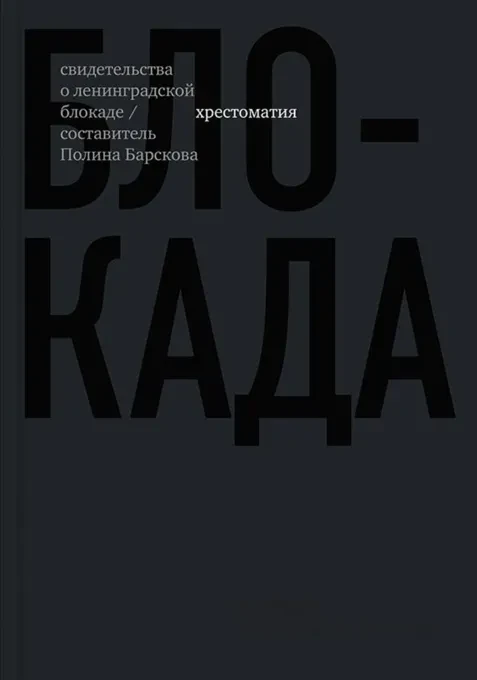
Polina Barskova - a poet, philologist, a blockade researcher - compiled this collection based on the assumption that "we will read blockade evidence with our children and students and incredibly complex questions will begin: what those who survived the blockade felt."
This is precisely the assumption. About the blockade, we are now invited to raise that it was a feat and that’s all. Do not read, do not recognize, do not think - just remember and do not grow round. The dispute in the society about which Barskova writes: “With which version of the blockade to coexist: with the version of the impeccable feat, or a humanitarian disaster, or with a multiple narrative, where human valor and human weakness constantly coexist, where collective values that were not proposed by the authorities prevail, but the history of each individual blockade” - this dispute was allowed by the opened manner Propaganda template. All the heroes: both hero city and people. We repeat the word "heroism" many times, and with this spell we remove pain, misunderstanding, distrust.
“We will read blockade certificates with the children” - this is most often remained in the zone that has not accidentally accepted for those who do not accept such a simplifying stamp. The black hook of the blockade is so dark and so, it seems to us that it is not enough to correlate at least some experience that our children can be related to, that most of us begins and ends this conversation with a historical certificate. Because you will show, for example, to your children a telephone book of the eleven -year -old Tanya Savicheva (her facsimile is given in the textbook), where grandmother dies on the letter “B”, on “c” - uncle Vasya, on “l” - on “m” - mother, and on the page with the letter “y” it means “all”, and then show - and then? Only swallow air with mouth.
Shock is multiplied by the fact that we, it seems, know how: how they died. No, the word "we know" here is wrong. What we imagine about the blockade and what she was doing with people is something between memory and oblivion, knowledge and suppression.
A sketch of eighteen -year -old Elena Martilla “Do not look” is reproduced on the title sheet of anthology (Publishing with her blockade records and drawings is in the book). A mother and daughter are walking around the cold city, a truck with a pile of dead bodies is traveling past, and mother - this is visible in the picture - obscures the girl from this spectacle, “turns away” her. This, writes Barskova (and one cannot disagree with her), the scheme of our instinctive attitude to a more or less detailed knowledge of the blockade. Because there is a choice: to know or not know. And what will change if we know approximately, in general terms, without self-and other tortures?
The Barskova reader gives an answer to this question. It was done like this: skillfully selected things - documentary and artistic, very famous and not at all, cruel and softened - all this variety of evidence precedes the text that sets the tone for everything. This is the "story of pity and cruelty" by Lydia Ginzburg. In principle, that it is her words that turn out to be the most precise that there is nothing surprising: cleansing, uncomplicity of the gaze - the poetics of any texts Ginzburg. But it is this story in this place that cancels all the convention that the reader, protecting himself, can attribute to subsequent texts. All these “it was a long time”, “this will not happen again in the modern world”, “and this is generally written in poems.” The text of Ginzburg is undoubtedly about here and now, it is impossible not to feel it.
The hero of the story recalls his relationship with a aunt. They live in blockade Leningrad, and the aunt slowly dies from dystrophy. The hero is dying - and only a feeling of guilt remains the hero: irrational (he did, everything he could). And this is even more grunting. It is obvious that before us the description of the experience of Ginzburg itself, who has a mother died in a blockade from dystrophy - an experience, which, with all the unique extraordinary of the blockade situation, is correlated with ours. Moreover, the striking skill in the “accounting” of his own feelings is clarified in our experience inherent in this author.
If just - it’s like when you sit at the bed of a dying person and seem to do everything, but obviously you do not enough, and you are terribly angry with him, and you are angry with yourself, and blame yourself, and you blame him. And then it's over - and you blame him again, and again yourself, and nothing can be done. All this is multiplied by exactly in the incomprehensible number of times in which the blocked life is different from life.
This text, placed at the beginning of the collection, sets brains, gives a direction to how to think and feel about the rest that there is in this book.
What is knowledge about the blockade for us now? It is like Borkhesovsky "Alef", but Alef pain and fear. This is a point at which the abandonment, the horror of the death of loved ones and the inability to put up with it, and the fear of our own death concentrated to incredible density. And the conversation about the blockade-the experience of unnecessary knowledge about it is a vaccine in a sense.
This book is such a vaccine.
"Blockade. Certificates of the Leningrad blockade. Reader ”(compiler Polina Barskova). Publishing project "A and B", 2017