
Translated material
It is time to take out the hut
The garbage problem that cannot be solved by populist methods can educate responsible Russians
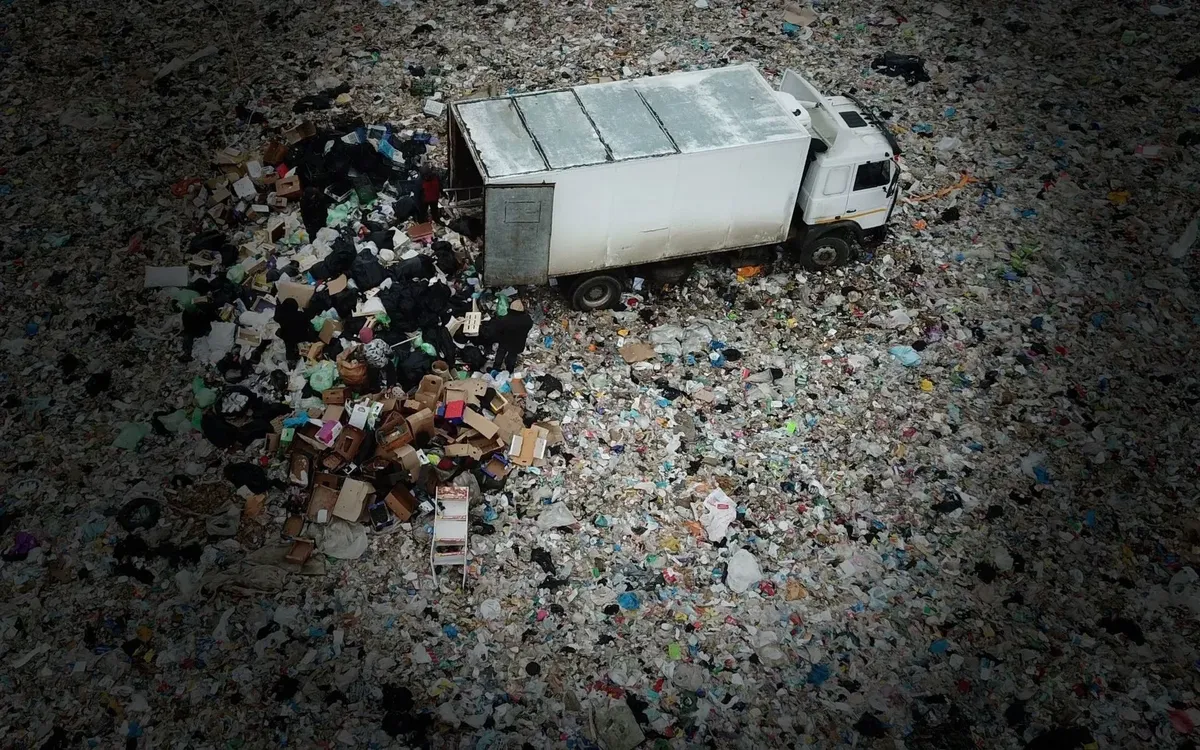
On March 21, three days after the election, 76 children turned to the Volokolamsk District Hospital. The reason is the Yadrovo garbage training ground: the landfill constantly allocates toxic substances, and even before the election, people demanded its closure. The next day, angry residents, gathering for a spontaneous rally, beat the head of the Volokolamsk municipal district Evgeny Gavrilov. By the way, the district practically did not participate in the elections - the turnout, even with possible stuffing, amounted to 44%.
Problems in Volokolamsk began after Putin was a resident of another city near Moscow - Balashikha - and complained about a monstrous stink from a local training ground. After that, the landfill in Balashikha was closed, but the garbage was not less of this. Moscow and the Moscow region produce about 8 million tons of garbage per year, and processed zero without a stick.
And this problem cannot be solved by closing the landfill in Yadrovo. The “nucleus” will close-some Kukuevo will open. From the change of place of garbage storage, its total tonnage will not change.
Garbage, in fact, is the problem on which the modern Russian model of the structure of society is “my hut with the edge”, “that public, it’s not mine”, “let the state decide” - gives a serious failure. It cannot be decided by the authorities for society and society for power.
It requires a complete review of the gaze at the garbage made by all of us - just as all Moscow motorists recently had to review the views on what is due to their cars. It requires civil liability, and only citizens are civil liability. It does not happen for the do not care and loyal.
Garbage is much more serious than global warming.
One of my very big claims to those who are arranging demonstrations with CO2 kills are just the fact that such “Fake News” is supplanting the catastrophic problem of industrial civilization, namely banal garbage deposits in front of the house.
Humanity should understand that over the past 10 years it has produced plastic more than in the previous 100, that each modern person has a ton of plastic garbage and that a giant liquid plastic garbage dump is swimming in the Pacific Ocean - Great Pasific Garbage Patch - an area of 1.3 million square meters. Miles. This is not even a Yadrovo training ground for you.
Second -
This problem is still insoluble with the help of the market. Processing of garbage in general does not pay off.
Freshly produced rubber costs 40% cheaper than rubber from recyclables. A ton of glass recyclable in the 1990s cost from 40 to 60 dollars, and pure quartz sand-about 18 dollars.
Plastic processing companies offer new recipes all the time. In Estonia, for example, since 2009, Elegro has been operating, which claims that its plastic boards made from recyclables are completely safe, environmentally friendly and are cheaper than similar products from primary raw materials. The company, which will really solve this problem, will become a billionaire and overtake Apple's capitalization.
In the meantime, if the garbage was processed profitably, then this problem would be solved by itself: at each door there would be companies that were ready to buy garbage from you, and municipalities would not have to organize services for its export, pay for burning, disassembling, processing etc.
The problem of garbage processing is a problem, expressed in high economic calm, and exterral internovers. For society as a whole, it is undoubtedly beneficial for garbage to be processed. So that crooks from under Coca-Cola did not lie along the roads, so that the ravines, fields and gorges are not filled with self-polling dumps.
But modern companies and consumers are unprofitable to limit the production of garbage. This requires non -market and non -market measures.
Garbage is the area in which not the market works, but - to a strong degree - a sense of social community, a sense of public space. Needless to say that in Russia this feeling is burned out by bellied iron? What a gate is not mine.
Human civilization has always produced garbage. Garbage is the main product of civilization. If people did not produce garbage, archaeologists would have nothing to dig out.
In the Middle East, one of the main objects of excavations is invariably “TV” - an artificial hill of up to thirty meters high, formed over millennia from waste waste. True, the main volume of these waste is incorporated clay bricks.
The settlement has been sitting in one place for two thousand years, shits under itself and grows.
On the left bank of the Tiber River, a hill 53 meters high rises. It is called Monte Testassio , i.e. The skull mountain, and consists entirely of fragments of clay amphora, imported into Rome during the Empire.
But still, there was little pre-industrial garbage. Monte Testassio is an exception confirming the rule and reminds us that Rome was civilization with a gigantic scale of production and market transport.
In the Russian language, there is a saying that very much reminds us of how little waste was: "Sora cannot be taken out of the hut."
“Failhoe -toe” could not be taken out in traditional culture because the evil sorcerer could use it in order to bring the spell on the inhabitants of the hut.
Even 30 years ago, when I lived in the country, there were no garbage tanks in the village, and no one needed them. For what?
All scraps went into a compost pile, a bucket of a garden to a peat went there, generously sprinkled with peat. Milk in the store was poured into a can, and sour cream in a jar. The sweets were poured into a paper cook, which was then thrown into the stove. For a month, our country house was produced in the form of garbage two dozen cans - not a Big Deal. Here in the city we produced garbage. And in the country - no.
In the 1990s, the volume and nature of the garbage produced by the Russian population changed radically. Paper cults, reusable banks for spill sour cream and strips have disappeared. Plastic bags, packages, boxes, foil, plastic, etc. appeared. Soviet mechanisms for collecting garbage (delivery of bottles, waste paper) disappeared. And the Western, developed, based on a careful attitude to the environment, did not appear.
Modern Russian produces 400 kg of garbage per capita per year. And this figure is only growing.
In the pre -industrial world, garbage processing was a special profession.
In Singapore, in the late 50s, “Karung Guni” acted-jackets who went around at home with carts. Some of them have become millionaires in their business.
Until Cairo, “fun” residents of special settlements, the number of which reached about 60 thousand people, lived in Cairo. Their main concern was the removal of garbage, and 90% of them were Kopta Christian. Why Christians? Because 90% of the garbage was food waste, and they fed them pigs. Now, when 90% of the garbage is plastic, the “fun” naturally bent.
The era of plastic ended with the jailers, and civilized countries began to solve the problem differently: paying huge, non-market money for the processing of garbage and convincing citizens of general responsibility.
This policy was fruit: for example, in the USA from 2007 to 2009, garbage production fell from 255 million tons to 243. The number of municipal landfills decreased from 7924 in 1988 to 1754 in 2006. The level of garbage processing in developed countries increased to 35-60%.
As a result, in the modern world, the degree of prosperity and public responsibility of a particular group of people is very clearly characterized by what it does with garbage. In Georgetown in Washington, the street in front of the house will be carefully blocked. In the same Washington, but in another area, everything will be filled. In Lebanon, you, without looking, can be identified whether you entered the Christian village or Muslim, under the control of Hezbollah. The Christian village will be pure. And in Muslim, the entire public space will be packed with plastic bottles.
Unfortunately, on the scale of human responsibility, Russia is in the same place as Hezbollah. 90% of Russian citizens do not realize the production of garbage as a serious problem, and the state does nothing to realize it.
When I still lived in our cottage (before my parents and I had to leave), constantly, every week, cleaned the garbage from the street along our house: bottles, banks, food wrappers thrown by workers from construction. I'm not boasting: I state the problem. People with low social status threw bottles and banks. They were removed by a man whose social status was higher.
I remember the picture: from a communal three -story building (on a neighboring street), a dulling man comes out and throws a bottle directly into the grass with a wide gesture - into the front garden. “Where are you throwing it? I said. “This is your home.” The remark made an amazing impression. He was not offended, did not object. On the contrary, blinked, amazed at the truth that suddenly revealed to him. "Oh, really!" - He said, picked up a bottle and carried it further.
This reaction is indicative.
The post -Soviet person does not perceive the surrounding space as a public. He perceives him as a draw.
The same problem was with cars. While there were few personal cars, they could be put on the sidelines for free. When there were a lot of cars, there was an understanding that all other citizens pay for the comfort of the owner of a personal car. And all the actions of the Moscow authorities in recent years were aimed precisely to internalize automobile externalities. So that the owner of the car pays for the public space he used. They tried to build the Moscow public space according to the Western model.
The same Moscow authorities should do the same with garbage. Garbage, like a car, can no longer be unregulated. Garbage is one of the examples that modern city infrastructure is poorly compatible with sloppiness, theft and populism.
It's not about Yadrovo. This landfill can be closed, but the garbage will not go anywhere from this. This garbage cannot be burned, because when burned, he throws into the air not only the mythical “poison” of CO2, but also the real dioxins.
And in order to process it, at least its most elementary sorting should be established. Just as paid parking appeared on the streets of Moscow, containers should appear on them for separate garbage collection.
The city authorities must take strict measures to limit the number of plastic packages - to prohibit their free extradition in supermarkets, and introduce a special excise tax on plastic. They should introduce the collateral value for glass and tins.
They should introduce many more measures that, alas, will work only if there are civil liability among the townspeople. Only then will they be perceived as participation in the public good, and not as "here are the bastards, again banned."
However, the presence of civil liability can arouse completely different instincts from people - those that the authorities just did not want to awaken.
After all, you must admit - it is impossible to behave civilly responsibly in relation to the garbage, but at the same time remain civilian irresponsible in everything else.