
Translated material
Three presidential cards
Putin won the elections not with the help of tricks, but politically, offering the country the course on which it was hooked on the needle
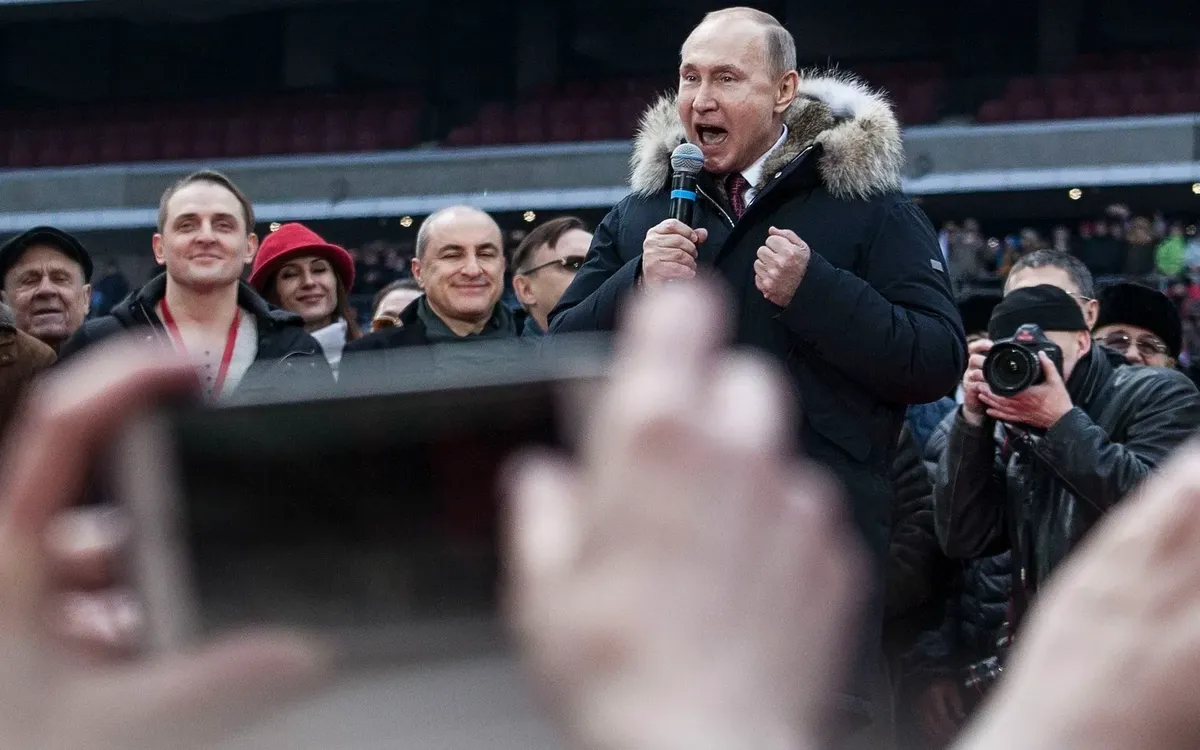
For almost twenty years of continuous government, Vladimir Putin synthesized in Russia the people corresponding to his political tastes, and then he himself took a political form, ideally compatible with the requests of this unpretentious and simple -minded people, thus recreating the almost sacred identity of the Russian leader and Russian mass. Putin, of course, could not win the elections that were not there, but at the next popular plebiscite he won a confident victory over the liberal opposition, which, however, did not accept real participation in this plebiscite either. Their correspondence duel ended in favor of Putin with a crushing score, but the final figures in ballots have nothing to do with it.
Putin won more than the elections - he won the battle for the "collective unconscious" of the Russian people.
He won not by points, but sending the enemy to the knockout, and not at all administrative, as many write and talk about it, but a purely political blow “under the breath”. Perhaps now that the Russian opposition lies, overturned by one, listening to the Countdown history, it will finally understand that politics is something else than what it did the previous quarter of a century.
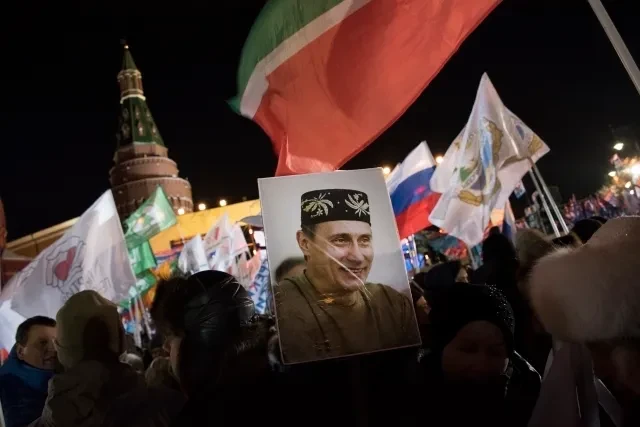
Relating the defeat means winning
Despite the fact that the whole history of post-communist Russia is a series of continuous and humiliating defeats of Russian liberalism (at least the power that declares liberal values aloud), supporters of the so-called “European choice” stubbornly do not want to admit that it was the political, and not some other inexplicable mythical defeat in Russia. They traditionally explain their eternal failures in the elections either with technological or political technological methods and only very occasionally - political reasons.
The victory was stolen
This interpretation of sad electoral statistics for liberals was very popular six to seven years ago, when the word “falsification” was the key to understanding all political processes in Russia. People sincerely believed that they stole the victory, forged the results of the vote. In this faith there was a lot of naive and good conceit. There is no doubt that falsifications of various kinds were and remain an indispensable attribute of the Russian electoral system. But to think that the victory of the party in power is based exclusively on falsifications is to be deeply mistaken. Cyca tricks are just a tuning of a political body; The political motor, with which Putin wins one race after another, does not look like that.
The victory was hidden
Over time, the realization came that the matter is not only and not so much in the falsifications of voting results. The thesis was put forward to the forefront that the mechanics of the electoral process were built on deceit. It is not the problem that in a distorted form the result of the will of the voter is presented, but in the fact that the will in itself is not free. There are no conditions for independent and based on the receipt of objective and impartial information of the opinion of the elector. The latter is an object of intensive use of various technologies of manipulation of consciousness, only a small part of which is the use of an “administrative resource”, that is, direct pressure.
A separate line with an unkind word, of course, is mentioned by the media controlled by the state, including federal television channels and even such exotic ones as the “troll factory”. Unfortunately, however, all this also does not explain the permanent electoral success of the regime. First of all, because it is possible to effectively deceive only those who themselves are glad to be deceived. A much more powerful Soviet propaganda machine did not save the USSR from collapse, the first approach to which was the election of allied deputies. So, the point here is something else.
There was no victory
The undivided truth is that Putin’s political course enjoys real support from his people. Moreover, I dare to assume that if today Putin suddenly ceased to be himself and decided to make a wide democratic gesture by allowing Navalny’s elections, allowing all the candidates to be on the air for as long as the viewer can take them out, and even having allocated them a decent budget, he would still win this election, albeit with a lower percentage, but with a greater turnout.
I am even ready to go further and assume that if during the election campaign it suddenly became clear that Putin personally gave all the most illegal orders in the world, then this would not have affected the result of voting: attitude towards Putin is a long time a matter of knowledge, including the facts discrediting it. I do not think that Putin stole a victory from the liberals or hid it from them. It’s just that this victory was never in reality, but there were illusions and conceit that prevented the situation correctly.
There is an apocrypha, the truth of which is no longer possible to verify. I witnessed Boris Nemtsov’s story about how he met with Putin about the Russian anthem. Nemtsov then handed him a petition with a request not to return the Soviet prototype. Allegedly, taking the letter in his hands, Putin asked: "Do you like music yourself?" Nemtsov said: "No." “And to me,” Putin answered. - But the people like it. And what kind of people, such and songs ... "
So Putin won this party not with the help of political technological tricks, as many would like to think, but politically, offering not in a word, but by deed of the country, on which it sat down on the needle.
While Putin’s opponents beat themselves in the chest with a fist, saying “I am a politician!”, He turned out to be practically the only one who was engaged in politics, and not just rhetoric, looking for the only and unique formula that would allow him to create a strong tandem with his people. He succeeded because he learned to sing songs that people like.
Three cards
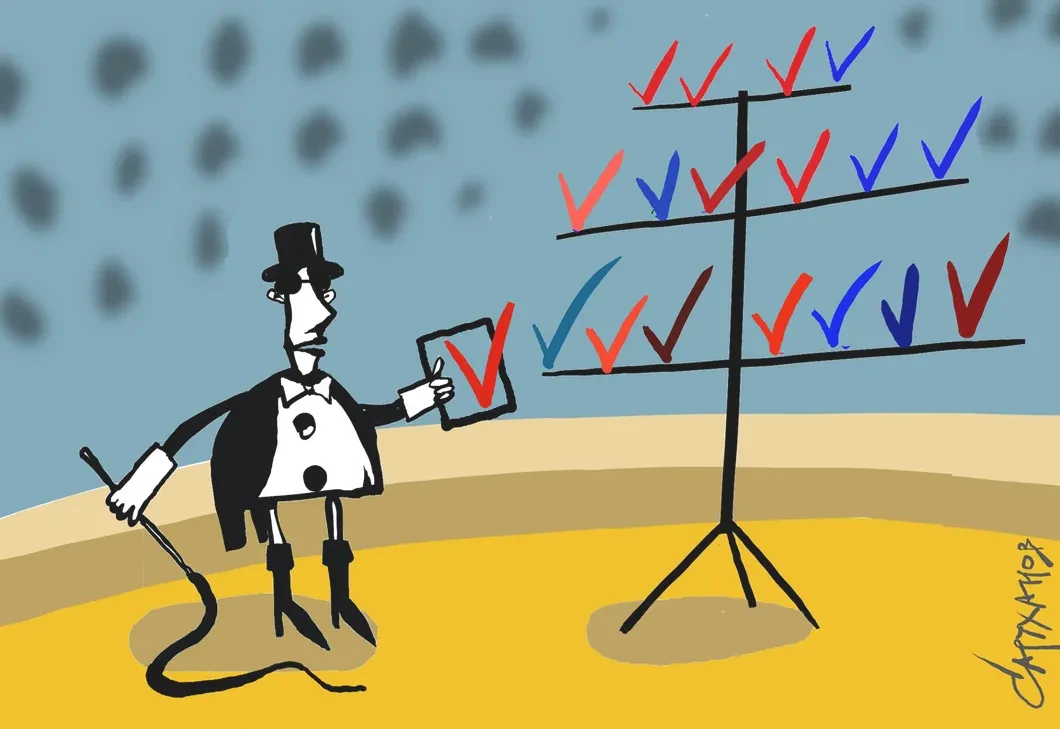
Putin’s real political program in the best Russian traditions is written not on paper, but on human skins. His real program is the image, the design of which he refers with incredible thoroughness, adjusting it to all the stereotypes of Russian thinking known to him. On this stage, he scrupulously worked for almost two decades, until, finally, he created an almost perfect mask suitable for both the temple and for the booth.
Six years ago, in response to the timid attempt to bring his rights to power to the next Russian revolution, he laid out a slaughter trump card of three cards on the political playing table and won the Jackpot Russian counter -revolution. His opponents, on the contrary, had not a single trump card in his hands. Since then, Putin has not released these three cards from his hands.
Troika
The symbolic meaning of the triple is the basis, the basis, what everything rests on. Putin’s policy rests on the “Versailles syndrome” - this is a policy of resentment. Rarely, someone knows how to pick political wounds like that. I admit, Putin knows what he does, because these wounds bleed, first of all, in his own soul. All the peoples who escaping the “Versailles syndrome” live an equally boring life, each “Versailles syndrome” diversifies the life of the chosen people in their own way.
The Russian "Versailles syndrome" sounds somehow in a special way. Here, and poured by the Orthodoxy, an eternally unsatisfied unlimited Russian messianism, and the insatiable nostalgia for the empire, and the non -healing wound from the collapse of the USSR, and the vulnerabilities of the people who lost the Cold War, and the humiliation with deception, real and fictitious, from the West, which allegedly promised not to expand, but it did not seem so much. In short, the whole bouquet gathered together. All these pains and resentments eventually compressed in one deafening force a cry of revenge.
Russia wants to be strong, cool, spreading, and it was a new variation of George the Victorious as “on order”.
Seven
The number seven symbolizes the walls, the structure, the frame around which the building is being built. The building of the new "postcrymist" course Putin is built of "Russian fears", the main of which is the fear of change. The population is equally afraid of both its future and its past. Memories of the 90s are the most important factor that determines a significant part of all these phobias. People at a subconscious level believed that any changes lead only to a deterioration, and therefore they are hypothetically clinging to the present, trying to make it endless.
The cult of stability was not invented by Putin, he only privatized him.
Ace
In the symbolic hierarchy of ace, of course, it is a designation of all the most important, the essence of the processes, their rod. Whatever Putin does, he is essentially oriented to traditional rejection by the main part of the Russian society of capitalism, bourgeois values in general and private property in particular, that is, all that fits into the concept of “European choice”. Under the influence of active pro -European (at least in words) minority, Russian society at the end of the 20th century made a breakthrough into capitalism, not very, however, successful. But the bulk of the population remained in the previous positions in captivity of traditional values. She perceives modern renationalization as a return to socialism, according to which she experiences nostalgia.
Putin for a long time intercepted the left agenda from the marginal Russian communists and successfully exploits it. This repeatedly enhances his support.
Short circuit
It is necessary to distinguish between the leitmotif of Putin’s policy and its arrangement. Repression, propaganda, falsification - this is all secondary. The primary combination of three chords is militarism, archaic and left populism. This is the melody that the people want to hear today, and no other suits it. Putin learned to masterfully perform political symphonies of any complexity with the help of these three chords. Therefore, the people will vote for Putin even in democratic elections, and no revelations are afraid of him in the near future.
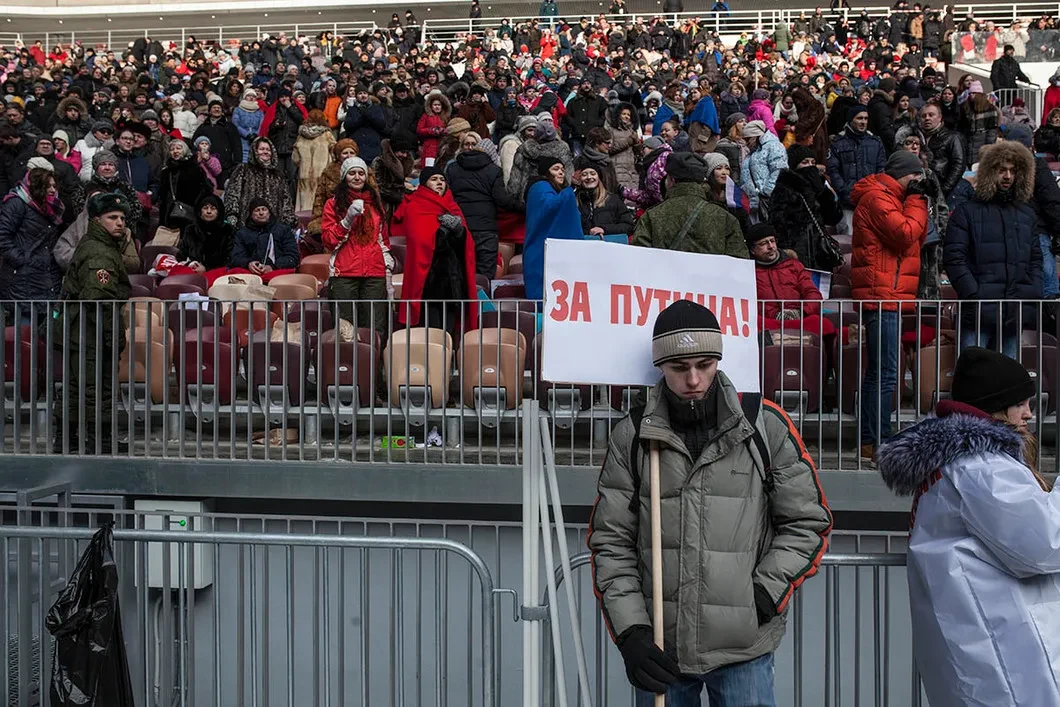
All this became possible only because Putin before the 14th year, that is, before the counter-revolutionary coup, managed to reformat the people "for himself." He crushed and subjugated the elites, turning them into an appendage of state power. Even before the "Russian spring" the elites stopped playing in Russia any independent political role. This gave Putin the opportunity to “scresh” his power “directly” to the “mass”. There was a coupling leader with a mass, which is now almost impossible to open. In this direct communication of the leader with the mass - bypassing the elites - and today lies the main secret of the stability of the regime, explaining, among other things, the record high voting figures for Putin and record low voting figures for his opponents in the March elections. This is a castle to which it is impossible to choose the keys, it can only be broken.
Theoretically, two global scenarios for the development of the situation after the elections are possible.
New songs about the old
Sooner or later, someone will learn how to play another melody on the basis of the same three chords. Notes in principle will be the same, but the layout is different. For example, an external enemy can be replaced with internal (class). Fear of the future will take a hysterical form of feverish thirst for change. The hatred of capitalism is sublimated in the desire to take away and divide everything. Something similar has already happened in Russia. Today, the people are so passionate about Putin that they do not want to listen to anyone else. But the inner ear, of course, hears and remembers everything. There is only a good shock that the remembered seditious words jump out of the subconscious, and the people picked up a new obsessive motive. When all resources are invested in preparation for war, it is difficult to exclude shocks. So after Putin, someone who looks like him can come, but who will be stronger, and, possibly, tougher him.
Old songs about the new
In the optimal scenario for Russia, which does not look very romantic and exciting, but more vegetarian, the old post -communist elite sold many times for consolidation and regains a place in politics many times. Of course, the “Semibankirshchina” was a disgusting phenomenon of Russian life, but now we know that there are things and worse - the system of “one pocket”. If the elites manage to open the chain and return themselves to the place of the intermediary between the authorities and the mass, then the society will have a field for historical maneuver and a chance to slip out of the next loop. Only elites can put a restrictive framework for the authorities (“condition”), the masses cannot do this. This is the essence of the constitutional path, which by definition is "elitist."
The 2018 election is a serious warning: Putin’s departure from politics itself (whenever it happened), with which his opponents began to associate excessive expectations recently, may not automatically lead to a change in the political regime, if the general format of the leader’s relationship and the mass remains the same. And this format will never change if the elite consolidation does not occur in order to restore its independent political role. The expectation of the "post -Putin" can be another intellectual utopia.