
Translated material
Tsar's brother in the Caucasus
Colta.ru, together with the Russian Scientific Fund, continues the project “The Island of the Empire: People and Events” .
The hero of the previous essay was the first Caucasian governor Mikhail Vorontsov, who laid the foundations of a policy that allowed the Russian Empire to conquer the Caucasus. His case was completed by the Grand Duke Mikhail Nikolaevich.
Amiran Urushadze talks about him - the author of the book “Caucasian War. Seven stories ”, the head of the RNF project“ National outskirts in the policy of the Russian Empire and Russian public thought ”.
Order of St. George
He had to be earned. It was given only to the military and almost always - for military merits. For the Patriotic War of 1812, only Mikhail Kutuzov received the first degree of George - and this despite the fact that Emperor Alexander I had George only the fourth, lower, degree. This did not cause surprise to anyone: after all, the king was only in one battle - with Austerlitz.
Grand Duke Mikhail Nikolaevich, by the time he appointed his Caucasian governor, also wore George fourth degree. He received him in the Crimean war for his presence in the Battle of Inkerman (October 24, 1854).
The tsar’s brother went to the Caucasus to the victory, which the Romanov empire was provided by the predecessor of the predecessor Alexander Baryatinsky and General Nikolai Evdokimov. They captured Imam Shamil in 1859, and a year later they adopted a plan for conquering the highlanders of the North-West Caucasus. This plan was distinguished by a fairly inhumanity. Mikhail Nikolaevich was supposed to complete the eviction of the rebellious Circassians who occupied lands in the Kuban with its tributaries and the Black Sea coast.
Adyghe, exhausted by the endless war, could no longer have strong resistance. But the Grand Duke arrived to win, and therefore was inclined to exaggerate the scale of the last battles of the Caucasian war. Military Minister Dmitry Milyutin mercilessly edited the victorious relations of Mikhail Nikolayevich, reducing their inappropriate pathos. For this, he introduced the autocratic discontent of Alexander II, who received a complaint from his younger brother.
It all ended on May 21, 1864, when the troops of the Caucasian army held a victorious parade in the tract of KBAADA (now the village of Krasnaya Polyana). Mikhail Nikolaevich hugged General Evdokimov, who owed his triumph. The modesty of the participation of the Grand Duke himself was compensated by the awards that the crowned brother showered him. Mikhail Nikolaevich received a gold saber with diamond jewelry and the inscription "For the end of the Caucasian War." And he was awarded the Order of George the second degree - in fact, for the presence in the parade. Alexander II was generally a very brave man. Five years later, he awarded himself to George (already the first degree), although he had no military merits.
The love of awards by domestic rulers is traditional.
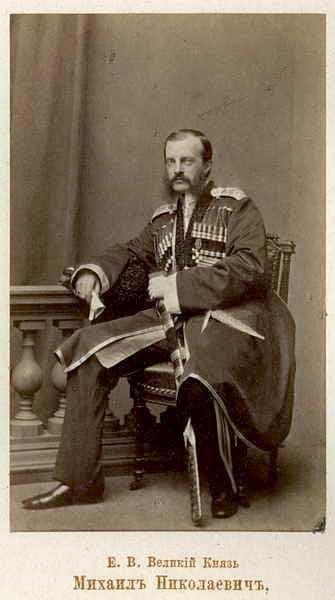 Andrey Ivanovich Day. Grand Duke Mikhail Nikolaevich. 1865
"State limited person"
Sergey Witte gave such a characteristic to Mikhail Nikolaevich in his sarcastic memoirs. The father of the gold ruble was probably not so unfair. The Grand Duke usually easily agreed with the opinions of neighboring dignitaries, entirely experienced old -timers in the Caucasus. The lack of empty tyranny, coupled with the principle of healthy gravity, turned out to be a completely successful strategy that worked throughout the nineteen years of governorship (1862-1881) - the longest of all.
Having appointed a younger brother as a governor, Alexander II acted as a wise politician. So he allocated the southern outskirts among other parts of his huge empire. In the Caucasus, such signs were always valued. Thanks to the pleasant appearance and charm of high status, Mikhail Nikolaevich played perfectly a representative role. Back in St. Petersburg, recording the characteristics of the peoples of the region entrusted to him, the Grand Duke noted "attachment to personalities." He was a completely suitable personality.
Mikhail Nikolayevich was distinguished by good disposition, patronizing attention to others and moderate ambition. During the Russo-Turkish War of 1877-1878, in which he had to command the army on the Caucasian Front, he loved to repeat: "I strongly see that it is better to be a coat than the commander in chief in wartime." Therefore, the governor entrusted the war with the Turks to General Mikhail Loris-Melikov, who was better.
He used the same style in civil affairs. Here, the main assistant to the Grand Duke was an experienced and talented baron Alexander Nikolai, who served as the first Caucasian governor Mikhail Vorontsov. Nicholas freed Georgian peasants from serfdom and introduced court charters, opened hospitals and outlined the routes of railways. Thanks to the indefatigable Nikolai, the governor was not ashamed to send reports on the management of the Caucasus to his older brother. From them it is evident how the urban population was steadily growing, the revenues of the region increased, railways were built (Rostovo-Vladimir and Poti-Tiflis).
Historians wrote down Nikolai in the informal circle of “liberal bureaucrats”, for whom legality and justice were the main values. Most of them could not maintain influence on state affairs in the reign of Alexander III. Nikolai himself was forced to resign from the post of Minister of Education, who occupied only a year (1881-1882). Mikhail Nikolaevich achieved his appointment to the Department of Laws of the State Council. The Grand Duke remembered the honest and useful service of Nikolai, who allowed the governor to devote more time to the family and home.
"We loved the Caucasus and dreamed of staying forever in Tiflis"
So wrote in the memoirs the fourth son of Mikhail Nikolayevich - Grand Duke Alexander Mikhailovich. He, like his brothers George, Sergey and Alexei, was born in the Caucasus. One of the favorite classes of the young nephews of the Russian emperor was the composition of the plans of the Caucasus Department from Russia. “Our narrow, Caucasian patriotism forced us to look with disbelief and even with contempt for the envoys of the envoys of the St. Petersburg,” recalled Alexander Mikhailovich.
Grand Duke Mikhail Nikolaevich was an exemplary family man: he loved children, respected his wife. Having entrusted the state’s affairs reliable performers, he was concerned about the improvement of the family on the distant imperial outskirts.
Already the move of the Grand Duke family to Tiflis has become an event of a state scale. Alexander II did not stir up at his brother’s needs, letting him on the road expenses 85,753 rubles and 99 kopecks. For comparison: the maintenance of the tsarist minister cost the treasury about 12,000 rubles a year. The head of the financial department was not enthusiastic. But waste was just beginning. Accompanying the Grand Duke family issued as lifting annual salaries of salary (another 15,988 rubles, or the annual content of the minister), they also appointed “reinforced” salaries. At the request of the Caucasus, at the request of Mikhail Nikolaevich, a specialist in landscape painting was sent (now they would say - design), professor of the Academy of Arts Lev Lagorio and architect Vladimir Schweier.
Mikhail Nikolaevich wanted to get in a new place with comfort, appropriate to the Grand Duke. He moved his entire yard to Tiflis not to be content with the old house of the Caucasian governor. It was decided to build a new palace in the capital of governorship, as well as a residence in Borjom.
To begin with, they announced a competition for the best project of the Palace of the Caucasian governor. Five applications were accepted for consideration. The most successful project was recognized with the motto “Ars Longa, Vita Brevis Est” (“Art is eternally, life short”) architect Otto Simonson. Two more projects received incentive cash prizes: the “Caucasus” of Anton Tsima and “Prayer for God, the service is never disappeared for the tsar” by Karl Tsigler.
It soon became clear that the construction of the palace according to the Simonson project would cost a huge amount even by princely standards - 1,100,000 rubles. The court office of Mikhail Nikolayevich tried to take a loan of 500,000 rubles from the Transcaucasian order of public charity, which engaged in schools and hospitals, as well as credit and money operations. Everything was calculated there: having occupied 500,000 rubles for fifteen years, the Grand Duke was supposed to return 704,607 rubles after a credit period. Even then, taking a loan was quite invoice.
In the spring of 1865, it became clear that there was no money to build a new palace. Mikhail Nikolaevich agreed to the restructuring of the house of the Caucasian governor. The Grand Duke Family even went to buy things that would now call a second hand. So, chandeliers and crystal canteens of candelabra, belonging to the predecessor of Mikhail Nikolayevich Alexander Baryatinsky, were acquired. Even the governor liked the old organ of the previous tenant, but the tool was faulty, and they changed his mind to buy.
Perestroika lasted more than three years. Officials released the money reluctantly, demanded the correct reporting. The director of the Department of State Property Department of the Main Directorate of the Caucasian governor Julius Witte (father of the famous reformer) was especially zealous. He always asked to explain in detail the reasons for even a slight increase in expenses. And he did not hesitate to refuse to finance new projects. This happened with the garden at the house of the governor. Witte wrote to the court office of the Grand Duke that there was little funds for the maintenance of the gardens of the Caucasus Territory, and therefore he cannot satisfy the request for the reconstruction of the governor’s garden. Autocracy by autocracy, but really the Empire rule the bureaucracy.
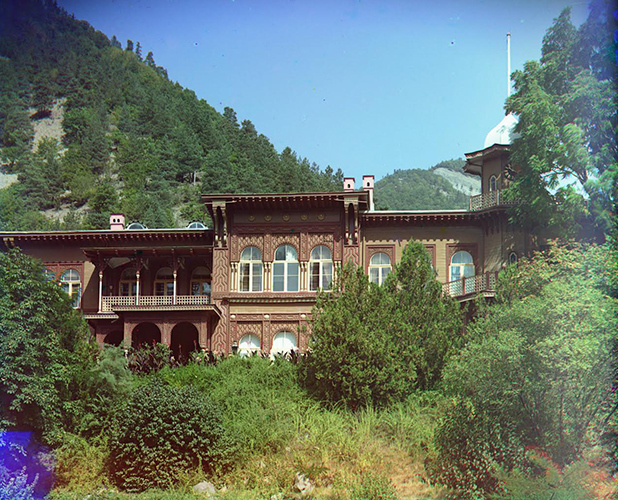
The construction of the Borzhomsky house was no less difficult, where Mikhail Nikolaevich loved to spend spring and summer. In the photograph of Sergei Prokudin-Gorsky, this house with a small turret is barely visible behind thick greenery.
What is left?
The house of Caucasian governors rebuilt by Mikhail Nikolaevich is safely in the center of Tbilisi, on Rustaveli Avenue. Now he performs the functions of the Youth Palace. The garden, which Julius Witte spared the money, has also been preserved. But the main monuments of the long governorship of Mikhail Nikolaevich were books. The Grand Duke initiated the spelling of the history of the regiments who fought in the Caucasus. Thanks to the interest of the governor, numerous volumes of the “Caucasian Collection” and “acts collected by the Caucasian Archaeographic Commission” appeared. It is these publications that are the foundation of our knowledge about the Caucasian War, about the difficult history of the accession of the Caucasus. In this annals, Mikhail Nikolayevich cannot be called the main character. But his example shows that maintaining history is sometimes more important than to do it.