
Translated material
Run chamber in the bowels of Africa

How the largest deposit of chromite ores on Earth was formed
The ore mineral chrome serves as the most important source of chromium. This metal is indispensable for the production of alloy steels and other alloys, and, therefore, for the development of the modern industry. The mechanism of the formation of deposits of chromite, however, for a long time remained a mystery to geologists. Professor Raisa Latypov and his colleagues from the school of geological sciences of the University of Vitvatersrand in Johannesburg (South Africa) managed to get closer to the clue. An article about their opening has recently been published in the journal Nature Communications 1 .
 Treasure of Africa

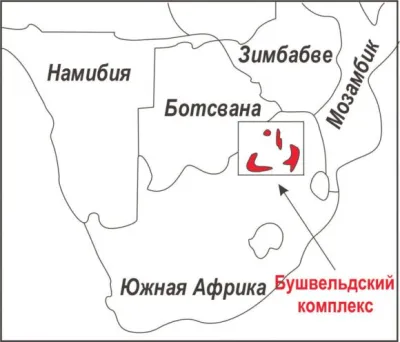
The largest chromite deposit in the world is in South Africa as part of the so -called Bushveld complex located north of the Praetory. This complex is the largest intrusive massif on our planet, comparable in area with Iceland. It is complicated by the oldest magmatic breeds, which were crossed in the depths of the earth's crust in the dokambria, about 2 billion years ago. Chromite lies in it in the form of layers with a capacity of up to several meters, which stretch for hundreds of kilometers. In addition to chromium, these layers are very rich in platinum and other elements of a platinum group. The mining and processing of the wealth of the Bushveld complex is the basis of the economy of South Africa.
Chromite deposits are in other countries. In Russia, the largest deposits of chromium ore are located in the Urals (Sarana) and on the Kola Peninsula (Monchegorsk). Nevertheless, it is the Bushveldi complex, unique in its scale and geological structure, that especially attracts the attention of geologists around the world. For Rais Latypov and his colleagues, he served as a working model who helped them find out the mechanism of the formation of deposits of chromite.
Riddle of chromite layers

So, how could the chrome be able to separate from the mantle basalt magic, rising from great depths, and harden in the form of well -expressed layers? This question has not found an answer for a long time. The fact is that mantle magicians are rich in magnesium and iron, the silicate silicate olivin mineral. It is believed that it is this mineral (possibly with small impurities of chromite) and should form during their crystallization.
The fact of the existence of chromite layers, however, required an explanation. Most geologists fell in the opinion that mantle magmas are saturated with chromitis after their arrival in a magmatic chamber at a relatively small depth (several kilometers). Different hypotheses were expressed about the mechanisms of their saturation: it was about mixing magic of different composition, contamination of magma with siliceous rocks, about increasing the content of water or oxygen in it, etc. None of these assumptions, however, could satisfyly explain all the features of the chromite layers known to geologists. At some point, it became clear that the search for a solution to the problem came to a dead end.
The original idea that Rais Latypov proposed to get out of it helped. If the chromy -forming magmas could not appear in a small magmatic chamber, then they formed on the way to it. But what can happen to the magma on the way from the mantle to the surface? The answer is quite obvious: all the magicians rising from the depths of the Earth inevitably experience decompression, that is, a significant decrease in lithostatic pressure. Therefore, to solve the problem, it was necessary to study the effect of pressure on the processes of crystallization of basalt magic.
Petrologists at work

Rais Latypov and his colleagues applied the standard set of methods used in magmatic petrology. First of all, they turned to the phase diagram of the state of melt, consisting of magnesium silicate, aluminum silicate and calcium, silica and magnesium brahromate, i.e., close in composition to basalt magma. Such a diagram shows which minerals crystallize from a liquid melt with various proportions of its components, temperature and pressure.
Researchers drew attention to a special configuration of lines on it, which they called the “chromite cavity”: it shows that, under certain conditions, a reduction in pressure can really lead to crystallization of chromite from melt. Although the phase diagram for this mixture was experimentally obtained for a long time, no one had previously paid attention to this most important feature.
To check the hunch, Rais Latypov and his colleagues turned to experimental data on more complex systems - natural basalt. It turned out that with different combinations of pressure and temperature, they behave in exactly the same way as artificial mixtures resembling them in composition. Thus, one more confirmation was obtained that decompression really helps to saturate the magmus with chromitis.
Finally, the researchers took advantage of thermodynamic modeling to theoretically calculate the conditions for the loss of chromite from basalt magma at different pressures. The MELTS computer program, which is based on this method, is widely used in magmatic petrology. It allows you to build phase diagrams for magmus of different compositions, without resorting to labor -intensive and expensive experiments. The results of thermodynamic modeling also showed that crystallization of chromite from basalt melt is associated with a decrease in pressure.
Out of the frying pan into the fire

So, three independent approaches led to the same conclusion: some (not all) basalt magicians during their decompression, i.e., as they rise from the mantle to the surface of the earth, are saturated with chromitis. No additional processes, such as mixing magmus or their contamination, are not required for this. The conclusion is important and very unexpected, but so far insufficient to explain the mechanism for the formation of long layers of chromitis.
The fact is that the content of chromium, even in a basalt magma saturated with chromium, does not exceed 0.1-0.2 of the mass percent. Consequently, the chromites should somehow stand out and concentrate from a very large amount of such magma. But how could this happen?
The model, which allowed to explain the accumulation of chromites in the Bushveld complex, was proposed by Tony Naldrett from Toronto University in Canada. According to this model, the Bushveld complex worked as a running camera. Magma, saturated with chromitis, came from a mantle or a deep focus. Chromite crystallized from it, depositing at the bottom of the camera in the form of a solid layer; The liquid phase of the magma left the camera, pouring onto the surface of the earth through volcanoes in the form of basalt lavs. Then, for many millions of years, superficial lava were destroyed by erosion, and the ore -bearing layers came to the surface. So they became available to geologists and miners.
According to Rais Latypov, a decrease in lithostatic pressure is the key to understanding the process of formation of layers of chromite not only in the Bushveld complex, but also in other intrusions of this type. The results obtained by him and his colleagues give geologists the key to solving the problem of origin and some other magmatic deposits. The study of the magmus that has undergone a decrease in lithostatic pressure seems to be a promising direction in ore and magmatic petrology, promising many interesting and unexpected discoveries.
Looking from the Urals

Interest in the origin of chromites, in which platinum nuggets are found, arose in Rais Latypov as a child. He was born in 1966 in Perm, from where the family moved to live in a small village of Kylasovo in the Kungursky district of the Perm region. Being a schoolboy, Rais was actively engaged in a circle of young geologists under the guidance of Honored Teacher Valentina Vladimirovna Novosyolova, went on geological campaigns in the Urals. It was then, at the field in the Saranas, he first saw layers of the black mineral, which is called chromite. And in the Urals Geological Museum in Sverdlovsk, Raisa was struck by the nuggets of platinum, which were found with chromites. I must say that within a hundred years (1824–1925), the Urals was the main world center for the extraction of native platinum and lost its leadership only after the opening of the deposits of the Bushveld complex.
After graduating from the Department of Mineralogy of Leningrad State University in 1991, Rais Latypov went to work on the Kola Peninsula. There, he tried to solve the riddle of the origin of the platinum deposit of the Pansky rabid massif, as well as the chromites of the Monchegorsky massif. Rais continued with the same problems at the Finnish deposits of platinum and chromite in the masses of Penitak, Kemi and Koitelain after he received his position at the University of Oulu. It was there, in Finland, that he came up with the idea of the effect of pressure on the formation of chromite deposits, but at first it was perceived as seditious.

Rais Latypov was able to check his hypothesis only in South Africa. In 2013, he became a professor of magmatic and ore petrology at the School of Geological Sciences of the University of Vitvatersrand in Johannesburg. Five years of working with Bushveld chromites allowed him to collect rich material convincingly confirming the role of changes in lithostatic pressure in the formation of chromite deposits. At least in Bushveld.
However, there are still many mysteries in this area. One of them is still unsolved mechanisms for the formation of chromic-plastic deposits of the Urals and Alaska. Now Rais Latypov, armed with new knowledge and experience, plans to work in his native Urals in the hope of understanding what natural processes ensured the glory of the world platinum mining center.
Alexey Oskolsky,
doct. Biol. Sciences, Vedas. scientific. sore. Botanical
Institute. V. L. Komarova RAS (St. Petersburg),
Senior Lecturer in the Department of Botany and Plant Biotechnology,
University of Johannesburg (South Africa)