
Translated material
Know, be able, evaluate
Wisten Hugh Oden about good books, lazy students and critics-maniacs
In 1956, the poet Wisten Hugh Oden was chosen by an honorary professor of poetry Oxford. At the inauguration ceremony, he gave a lecture to students of the university, the text of which later entered the book of his literary essay “The Hand of the Baby” entitled “Know, Be able, evaluate”. This essay opened the main building of the collection. In it, Oden shared many common and very accurate observations not only about the nature of poetic creativity, but also to the nature of criticism, which, as experience shows, has not changed at all. The poet and prose writer Gleb Schulpyakov translated this essay for the Russian -speaking edition of the “hands of the dye”, which is preparing for the exit in the “Olga Morozova Publishing House”. From a rather large text of the essay, he chose the most aphoristic and memorable fragments.When the critic says that “this book is bad or good,” it is understood that the book is good or bad for all times. However, in relation to the future of the reader, the book is good for how well it will affect this very future, which is still unknown, which makes a critical judgment about the book fundamentally impossible. The most reliable, albeit naive criterion - "like/dislike." The only thing that the reader can know for sure about his own future, no matter how unpredictable it turned out is that it will be his future. No matter how a person changes, in the future it will still be he, and not someone else. And what he likes now, even if it contradicts critical judgments, is the main sign of what is useful in the future.
* * *
Imitation is impossible without deeply possible to penetrate the nuances of someone else's diction, rhythm and feelings. By imitating the master, the student acquires a censor, because he understands, it does not matter due to this - inspiration, blind luck or painstaking work - that only one rhyme, one rhythm and one form is correct. Which does not mean true at all, since the student, although it is covered by poetic inspiration, is still far from poetry itself; While he only comprehends how she is written. The way the art of imitation plays in life as an important role will understand later, when from time to time he will be forced to imitate himself.
* * *
If the student tells the teacher that Gertrude Stein is the greatest writer of all time and peoples, or that Shakespeare is not good, in reality he wants to say that “I have not yet found what and how to write, but yesterday, when I read Gertruda Stein, it seemed to me that the key is in my hands” or that “yesterday, when I read Shakespeare, I realized that I was too far in the trouble that I was too far from being carried away rhetoric. "
* * *
In the eyes of people, the poet is one who wrote at least one good poem. In his own eyes, he is a poet only until a point is set in a new poem. While the poem is not finished, he is not yet a poet, and when the point is set, he is no longer a poet, he quit writing poetry and, possibly, threw it forever.
* * *
At some point, the novice poet discovers that there is a certain connection between the statements of “today,“ today February 21, 1926 ”, and this connection would be good to comprehend, because until the beginning, until the novice poet realizes that between the verses read, no matter how different they are, the general that all of them were once written-his own works will remain imitative. What he is able to write will not be revealed to him until he understands that he needs to write. And this is precisely the only thing that the elders cannot teach simply because they are older; Help can come only from people from their own environment, the same students with whom he is united by one common - youth.
* * *
I am infinitely grateful to the musical fashion of my youth, which until thirty years old hid the Italian opera from me, because only after thirty can I appreciate the world, how wonderful, just as alien to the culture of the country where I was born and grew up.
* * *
If the young man says that the past is the burden that you need to get rid of it as soon as possible, fear is often hidden behind this that the past itself will lose the young man from the ship of our time.
* * *
It’s not that I defended the aesthetic misconception that different topics in verses have the same value, or the fact that poetry has no topic at all and there is no difference between a great and just a good poem - a delusion that contradicts our emotions and just common sense - but I understand where this delusion comes from. There is nothing worse than a bad poem that was written as great.
* * *
My first master was Thomas Hardy, and, I think, it was a good choice. He was a good, even a great poet, but not too good. For all my love for him, even I noticed how awkward his diction is, how bad his poems are. And this gave me strength (and did not lead to despair, be an impeccable poet in his place). Hardy was a modern poet, but not modern. His world and his feelings seemed close to me also because Hardy's facial features reminded my father in a strange coincidence - so, imitating him, I did not get away from myself too far and did not approach him so much as to lose his individuality. If I looked at the world with his eyes, then at least I was aware of this. His metric diversity, his passion for complicated stanza has become an invaluable lesson for me. Finally, I am grateful to the master for not composing in a free manner, because then I would succumb to temptation to believe that free poems to write is easier than regular ones, although now I know that, on the contrary, infinitely more complicated.
* * *
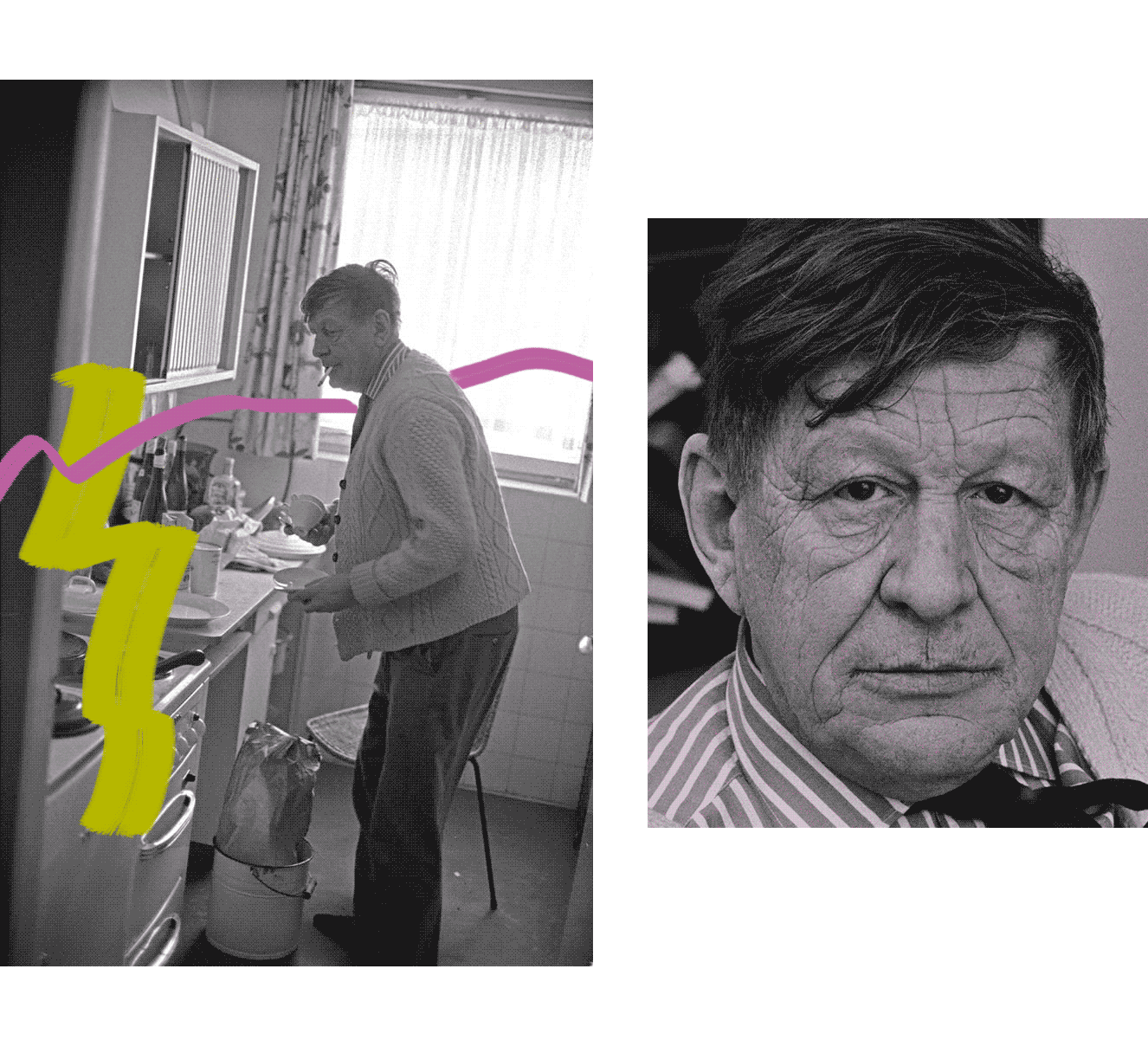
Hugh Oden
Photo: Mark B. Anstendig /anstendig.com
As for me, I consider the following the most interesting questions in a conversation about poetry. The first is the technical: "How is this poem made, how is it arranged?" The second is wider and concerns ethics: “What kind of person lives in this poem? What are his ideas about the right life? His concept of evil? What does he hide from the reader? What does he hide from himself? " Do not be surprised if the answer seems banal to you: firstly, the poet himself hardly believes that the poem can be explained; And secondly, he does not consider his poem such an important bird; I think every poet can repeat after Marianna Moore: "I don't like it too much."
* * *
Sometimes novice poets can give each other incomparably more than critics of the older generation. At this age, the poet surpasses the mastic in two virtues. After reading your manuscript, he can praise it, but only because he sincerely believes in what he says; He will never praise to simply support his comrade. Secondly, he will read your poem with the greedy attention, which the venerable critic is capable of only in relation to the masterpieces of the classics, and the poets who are held to himself. If he finds a weak place, with his critic, he will help you fix it. He really wants your poems to be better.
* * *
The advantage of the critic poet is that his ambition is already satisfied with poetry. In other words, I can not be afraid that the poet is engaged in criticism for the sake of status, or in order to criticize other critics, or to be in the role of a writer, or to realize his manic inclinations. I call the status criticism, for whom the best poem would be his own if he knew how to write poetry. A status critic would have preferred that the poem that he writes about was worse than he was.
* * *
His twin - a critic, polemicizing with other critics - does not express his grievances so frankly. At first glance, he, on the contrary, extols the poet he writes about; However, he writes much more dark and confused than his idol, as if deliberately wanting the one who has not yet met the poet’s work, never did it. I suspect, deep down, he is also grunted by resentment. He is unhappy and saddened by the fact that the poem that he writes is primary about, but his criticism is not. Such a critic sees in the poem it is not a work of art, but a document confirming his own thoughts.
* * *
The writer critic is a much more fun figure. Most often, he trains in the field of unrequited issues, especially when it comes to the author’s personal life. Since the questions that he devotes all his time and knowledge-and the writer, as a rule, is very educated-they have no answer, he is free to appease his whims without the slightest concern. And what is there to be afraid of? The Academic publication of Shakespeare's sonnets without his preface would be a boring book.
* * *
But the most funny critic is a maniac critic. To the most common type of such critic, I belong to the one who considers poetry a certain cipher (although there are other varieties, of course). My favorite critic of this kind is John Kerr, who tried to seriously prove that the English children's rhymes were written in the original in the ancient native language, however, he himself, however, invented.