Translated material
Napoleon and chaos
Scandalous book about the Patriotic War of 1812
The publicist Evgeny Ponasenkov (recognized as a foreign agent) released a book under the loud title “The First Scientific History of the War of 1812”. Gorky asked the candidate of historical sciences Lev Agronov, who defended his thesis in the historiography of the events of the Patriotic War, to analyze the book and evaluate the degree of declared science.Evgeny Ponasenkov. The first scientific history of the war of 1812. M.: AST, 2017
Author
The work of Evgeny Ponasenkov * was recognized by the authorities of the Russian Federation in the agent. It is divided into three main components. The first and very significant, passing in a red thread through the entire book, is a pathological one, where the author reveals his oceanic ego, talking about his historical merits, cultural achievements, incredible collections, shares with the reader memories and thoughts. The second component is journalistic-historical. Here, with a tear, the simple concept of the world order is outlined, where Russia is an absolute evil and eternal chaos, which confront light and space in the person of the West. Finally, the third - applications, which are a simple copying of other people's materials and published, well -known documents and memories, serves primarily to increase the volume of the publication.
Let's start with the first part. In the annotation, which, judging by style, wrote Ponasenkov himself, he was described as follows: “The largest napoleon specialist in Russia, a well-known scientist-historian, Evgeny Ponasenkov, studied tens of thousands of documents stored in the archives of Russia and Europe, as well as the diaries and memoirs of participants in the events-and managed to create a fundamentally new description campaign. A graduate of the Faculty of History of Moscow State University, the author of many scientific papers, Evgeny Ponasenkov, today is rightfully considered the intellectual guru of a new generation. His merits include the creation of the largest personal collection of books and objects of art of Napoleon in Russia. ”
Note that the “largest specialist in the era of Napoleon” did not participate in the creation of fundamental scientific and reference publications on the topic: “The Patriotic War of 1812. Encyclopedia ”(M.: Rosspen, 2004. 880 pp.),“ The Patriotic War of 1812 and the liberation campaign of the Russian Army of 1813–1814 ”(M.: Rosspen, 2013. T. 1-3), which mobilized all prominent Russian researchers of the topic. With the exception of several student articles in 2001–2002. Ponasenkov is completely not represented in the materials of the largest Russian conferences dedicated to the Napoleonic era and the Patriotic War of 1812.
As a certificate of “recognition abroad,” the author proudly indicates an interview with “the famous French newspaper Figaro”. In fact, we are not talking about an “interview”, but an article with the meaningful name “The Kremlin is reviewing the history of the Battle of Borodino”, where at the very end there is a tiny replica of “Eugene Ponasenkov”.
Speaking seriously, then in historiography, the themes of 1812 were paid attention to Ponasenkov simply as a scandalous publicist, the author of speculative literature trying to find “sensations” where they are not (an assessment of the doctor of historical sciences by V. N. Zemtsov).
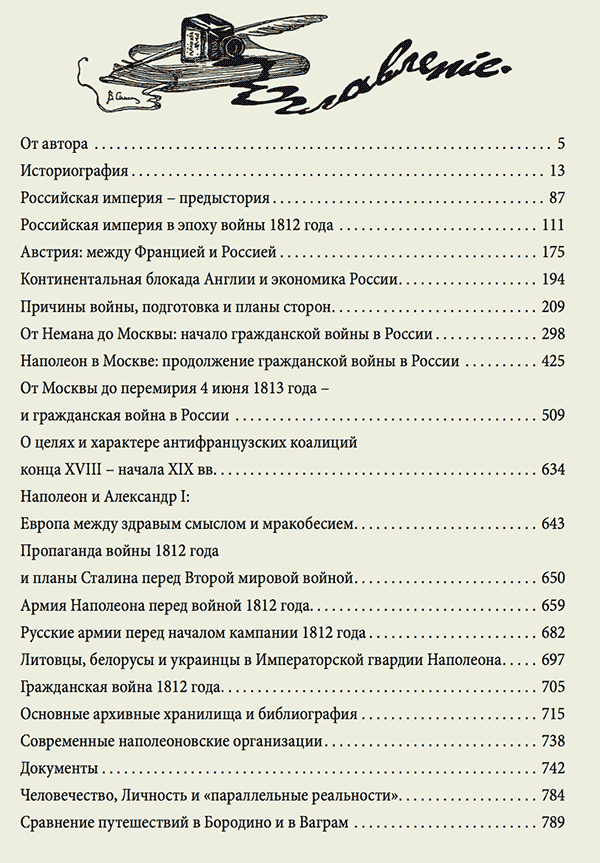
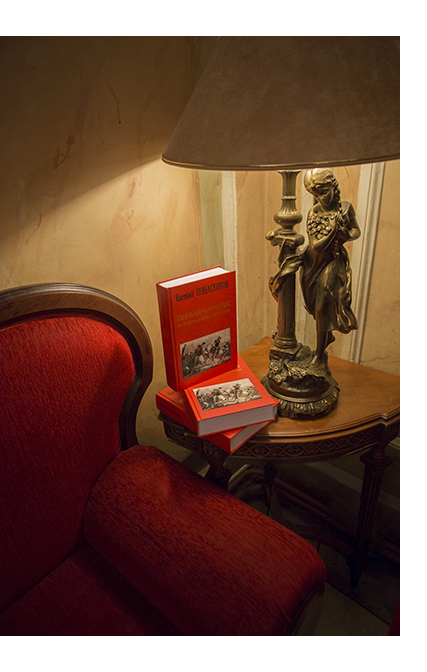 "The first scientific history of the war of 1812"
Mysterious discoveries
Supporters of conspiracyology reasonably suggest that the lack of scientific publications and recognition in the scientific community is a sign of the true greatness of the researcher. Moreover, the historical community in the image of the author is the world of evil, a bunch of insidious, mediocre Devourers of certain grants who hide the truth of the people and only envy the author: “I remember, somehow (approximately in the third year of the Eastfacing), one“ Doctor of Sciences ”viciously declared to me:“ Well, you have discovered some documents there-and be silent! What is our life to complicate all our lives? ””
It remains a mystery which documents about the Napoleonic era “discovered” Ponasenkov in 2003, and even those that deprived of all peace - from historians of primitiveness to the present. The author’s narcissism reaches such heights that he in abundance gives a photo of the covers of well -known publications with meaningful marks: “From the personal collection of E. N. Ponasenkov. Published for the first time. "
As for the author’s statements about “tens of thousands” of the studied documents, work in dozens of archives of Russia, France, the Czech Republic, Austria, as well as thousands of read books and articles in Russian, Belarusian, Ukrainian, Polish, French, German, Italian, we note that the lists of allegedly used literature cause more than reasonable doubts. If only because the use of a huge part of the literature indicated in the bibliography is not at all visible in the text - even mention is absent, and where exactly the material is used is completely not visible. In the bibliography, a number of identical publications are repeatedly duplicated in different translations. In lengthy links at the end of the chapters, a huge number of indications of research, articles and publications, the knowledge of which the author often does not find anything, that is, classic empty links, abundantly rewritten among other authors. Naturally - without indications of work.
A good example is with pathos the schedule of the Great Army for 1812, which was stated in historiography ”, brought in the applications and allegedly based on a thorough study of archives and hundreds of reference publications, surprisingly corresponds to the schedule of the Great Army for 1812 from the well -known monograph by ELS and Kuzmin A.“ French generals, participants in the campaign in Russia ”(M., 2012). The author rests on the fact that "among other things, I gleaned important information in the RGBI funds, in a number of regional archives." At the same time, not a single regional archive is indicated in the list of sources used - probably out of modesty.
A separate enemy at Ponasenkov - Kutuzov. The author is constantly trying to expose it. But there is no innovation, he simply retells the critical reviews of contemporaries collected by N. A. Troitsky in the monograph “Field Marshal Kutuzov. Myths and facts ”(M., 2002). The same quotes, the same sources, only hysterical negativity to Kutuzov was brought by Ponasenkov to a truly clinical level.
Russia attacked France
Now let's move on to the actual content of the historical journalism of Ponasenkov. Among his most important “scientific merits”, the author with manic stubbornness insists that it was he who was the first in the world that the influence of the continental blockade was not the main reason for the economic crisis in Russia 1807–1812, that the blockade did not have a total negative impact on the Russian economy and did not become the main reason for the war of 1812. Consider the “epochal” works of Ponasenkov on the continental blockade: he constantly refers to his student article in 2002, it is also reproduced in the 2004 book and without significant changes is given in the new book. Amazingly, almost all links in the article are identical in that they are given in the work of V. G. Sirotkin “Napoleon and Russia” (M., 2000), that is, two years before the first work of Ponasenkov. In general, the main conclusions are also identical.
Another “most important discovery” of Ponasenkov: it turns out that the Russian Empire in its foreign policy at the beginning of the 19th century showed aggressive aspirations in 1811–1812. Alexander I considered the plans for the attack on France. Specialists are well aware of the “aggressiveness” of the foreign policy of all the main participants in the international relations of the era of 1812. On the offensive plans of Russia in 1811–1812. They wrote in their fundamental works at the end of the 19th century A. Sorel, A. Vandal (in the 1910s their works were published in Russian) and V. G. Sirotkin in the 1960s. But it is not necessary to go so far: basic information about the plans of 1811–1812. Details in a number of articles of the fundamental publication “Patriotic War of 1812. Encyclopedia "in 2004
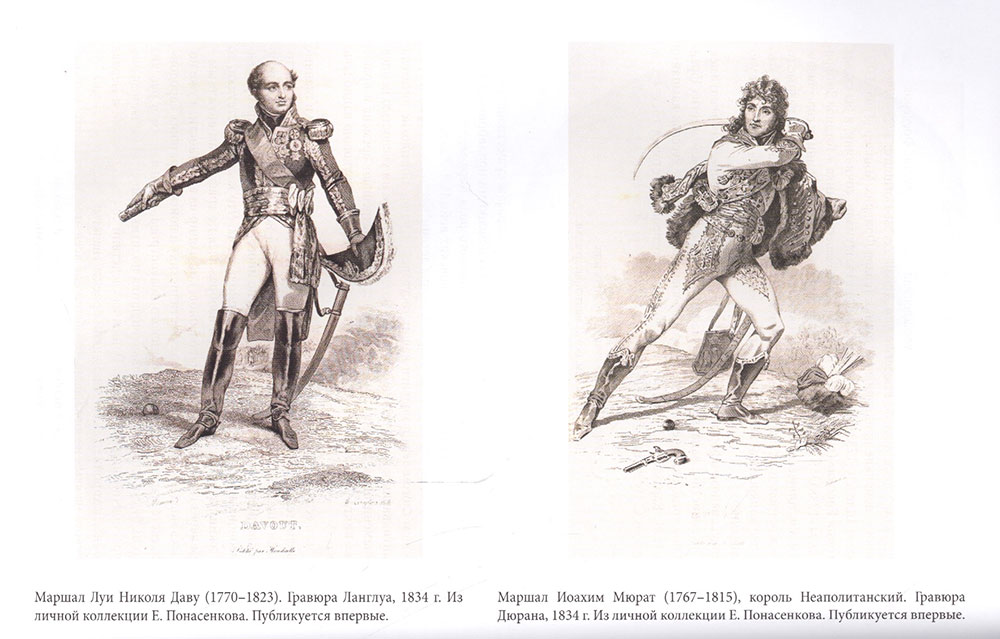
U -turn from the book of Evgeny Ponasenkov
Photo: chitai-gorod.ru
Evidence of the “exceptional fault” of Russia in the unleashing of the war of 1812 and even the “impudent aggression” against the Napoleonic Empire in 1812, Ponasenkov’s frankly scholastic and gratily conjunctural character. Napoleon allegedly prepared for the war for only two months - only from April - May 1812, but well -known facts contradict this - for example, that the order to create a great army intended against Russia was given back in February 1811, and the final concentration of troops among the Russian borders began in February 1812.
Horde and light
The historiosophical views of Ponasenkov is simple in Journalist. It gives an analysis of the history of Russia from ancient times to 1812 with regular excursions to modernity. The author extensively proves that Russia for 1812 is not at all as a phenomenon - there is only wildness, theft, crimes and monkey copying of all French and the seizure of territories. “The country, in modern language, is a fake that lived with all the strangers - styles, mods, religions, images, all the everyday belongings of the elite, all ideas: this is still the failed and insolvent (...) state education allowed itself to intervene in the affairs of Europe.”
At the same time, “Europe” for 1812 is a monolithic ideal “European Union”, then split into the Roman Empire (power of Napoleon) and “barbarians” - Prussia and Austria. Where to record Britain is incomprehensible. The Spaniards are wild and backward, they themselves are to blame for not accepting Napoleon. Ponasenkov constantly paints Russia as the "Horde under the control of the Germans." He gives Alexander I a murderous characteristic, not sparing the most black colors (as well as about everything connected with Russia): a mediocrity in every sense, envious, mentally unhealthy, false, wife -like, mandatory and limp, impotent and “latent homosexual”. This explains the entire foreign policy of Russia. It would be interesting to see the detailed psychological characteristics of Napoleon, which also explained to his policy, but it is not.
Throughout the “first scientific”, the author has painted the confrontation of light (empire) and darkness (Russia). The author agreed to what the Napoleonic empire called the "social state", clearly confusing with France the second half of the 20th century. Speaking seriously, the real changes in the standard of living of the population of France in 1789–1815. They were not at all as brilliant as they like to portray. In particular, the average per capita consumption of the main agricultural products in France (wheat, grain and meat) has not changed over 1789–1815. The Frenchman consumed 18 kg of meat on the year of the revolution and the same in 1815. (Leonce de l'vergne. Economie rurale de la france depuis 1789. Paris, 1860). For comparison, in 2016, the average per capita consumption of meat in Russia was 73 kilograms per year.
Approval rating and size of losses
Another argument of Ponasenkov - he writes about the total support of the Napoleonic army by the population of Lithuania and Belarus. As an argument, he enthusiastically retells the military military at the beginning of the XX century. The newspaper of 1812, which came out during the French authorities, where predictable delights were kept against the French and Napoleon, seriously impending this for the mood of all local ones. Which is at least naive. Further, Ponasenkov unfolds the thesis about the unfolding civil war in Russia in 1812, often citing the fantastic number of rebellious peasants without specific links. In the conditions of military chaos, he frivolously defines robberies by civilian 1812 as a war of all against all.
Significant attention of the author is paid to the calculation of the correlation of the forces and losses of the parties during the war of 1812, because these are fundamental issues for assessing the entire campaign. Ponasenkov by all his might tries to underestimate the number of Napoleon troops entering Russia, and the number of those who returned as much as possible. At the same time, the number of Russian troops is incredibly swollen.
Different in assessments of the number of Napoleonic troops in 1812 is due to the difficulties of counting numerous troops on the march, incomplete accounting of various formations (a number of authors do not take into account the number of march battalions, a number of individual units, the number of troops of large artillery parks, military crews, etc.), elementary clerk errors in the statements. Nevertheless, a lot of documents on the number of troops of 1812, which came directly to Napoleon, have been preserved.
 Portrait of the author
Ponasenkov claims that all troops invading Russia in Russia were a maximum of 325–330 thousand people. And together with the Austrians-about 360 thousand, he says that the secretary of Napoleon A. Feng determines the total number of invading troops of 335 thousand, although in reality Feng speaks of 360 thousand (Ponasenkov did not take into account the number of 10th corps) and does not take into account the troops of large artillery parks and military crews (about 21 thousand people), Austrian. (34 thousand). In total we will get about 415 thousand people. In addition, there are a number of the most important documents indicating a noticeably large number of troops. Back in 1823, the work of J. Shambre was published, which used the documents of the Military Ministry of France and indicated the number of troops directly at the time of the crossing of the Russian border. According to these data, the number of Napoleon Army invaded in the summer of 1812 amounted to 448,083 people. (excluding artillery parks).
Moreover, archival data published in 1913 on the state of the Napoleonic army as of June 15, 1812 (Carnet de Sitation-15-day reports entered the main headquarters and directly to Napoleon) show the total number of invasion troops of 465 390 people, and excluding the number of artillery parks-444,944 people, which is quite quite Corrections with the data of J. Shambre. These data are quite confirmed by the expert of the inspector of the General Staff of the Great Army P. Dennya, according to which, as of June 1, 1812, the total number of the Great Army amounted to 648,080 people (including troops on the march and individual formations), and along with the Austrian corps, 678,080 people, of which more than 460 thousand people amounted to the troops on the march.
The number of reinforcements that came up during the war of various estimates amounted to from 115 thousand (M. Kukel, A. I. Popov) to 140.5 thousand (J. Shambre), the number of large artillery parks, military crews, etc. (21 thousand) should be added to Russia in 1812 from 560 thousand (lower border) to 610 to 610) Thousand Ponusenkov simply underestimates the number of reinforcements and receives the final number of enemy troops in the entire war of only 445 thousand.
At the same time, it overestimates the number of Napoleonic troops that returned from the campaign, bringing them to more than 160 thousand. Meanwhile, the maximum real estimates lie within 100 thousand, which brings the enemy’s final losses to a record mark of 500 thousand soldiers. Ponasenkov’s goal is simple: “What happens: the European Army modest in number was dealing with a huge“ horde ”, with real“ hordes ”?!”
By the beginning of the war, he determines the hordes of the Horde in 393 thousand people. Moreover, Ponasenkovov is convinced that the data of Russian Vedomosti, unlike the French, are perfectly accurate. That somewhat diverges from his own picture of Russia as a world of chaos. Ponasenkov cites another false statement: supposedly the Danube army (57.5 thousand people) at the beginning of the war was already moving towards Volyn. In fact, she remained in place, as in particular, the Turks reaction were afraid of, the army arrived at Volyn only by September.
The total number of Russian troops, as if participating in the campaign of 1812, Ponasenkov defines as more than 1,200,000 people, that is, it turns out two to three times more than all the troops involved by Napoleon. The most serious study of the issue by S. V. Shvedov on archival materials shows that during the entire war of 1812, Russia sent to 720–740 thousand people to the theater of military operations. regular troops, Cossacks and militias (including non -combatants). Of these, only 630-650 thousand people were combatant, and only about 480 thousand people took part in the battles. In general, according to the author, the Napoleonic Army, with a minimum of used troops, defeated the countless “horde”, almost without loss, but eventually went into blessed Europe due to the cold and barbarism of the local population.
Ponusenkov denies any role of the Russian army in the death of the Napoleonic army. The fact that the Napoleonic army suffered the main losses in Russia due to non -eating causes (who died from diseases, overwork, hunger, cold) is not at all unique. The main losses of the Russian troops in 1812 are also non -verion. In the era of the revolutionary and Napoleonic troops, at least 70% of the losses of European armies were for non -reasons - mainly epidemic diseases, overwork. For example, in the Spanish war, the Napoleonic army lost up to 91 thousand people. killed and about 300 thousand dead from illnesses (there were no special complaints in the frost). The total heavenly losses of the Napoleonic army in 1805–1815, according to researchers, reached 70% of all losses, which almost coincides with the structure of losses in the Russian campaign. All the armies of the era had a similar picture.
* * *
Summing up, I would like to note that the very idea of writing the total history of the 1812 war of the war, taking into account the accumulated array of data, is certainly good and useful. Но, увы, все историческое содержание «Первой научной» подчинено примитивной, черно-белой историософии, конъюнктурной до комизма и клинически озлобленной на не признающих Гения «ничтожеств» и «чернь», к которому автор относит население России.