
Translated material
Thirty years the film "Assa"
Why did he go down in history? Explains Anton Dolin (in 10 points)
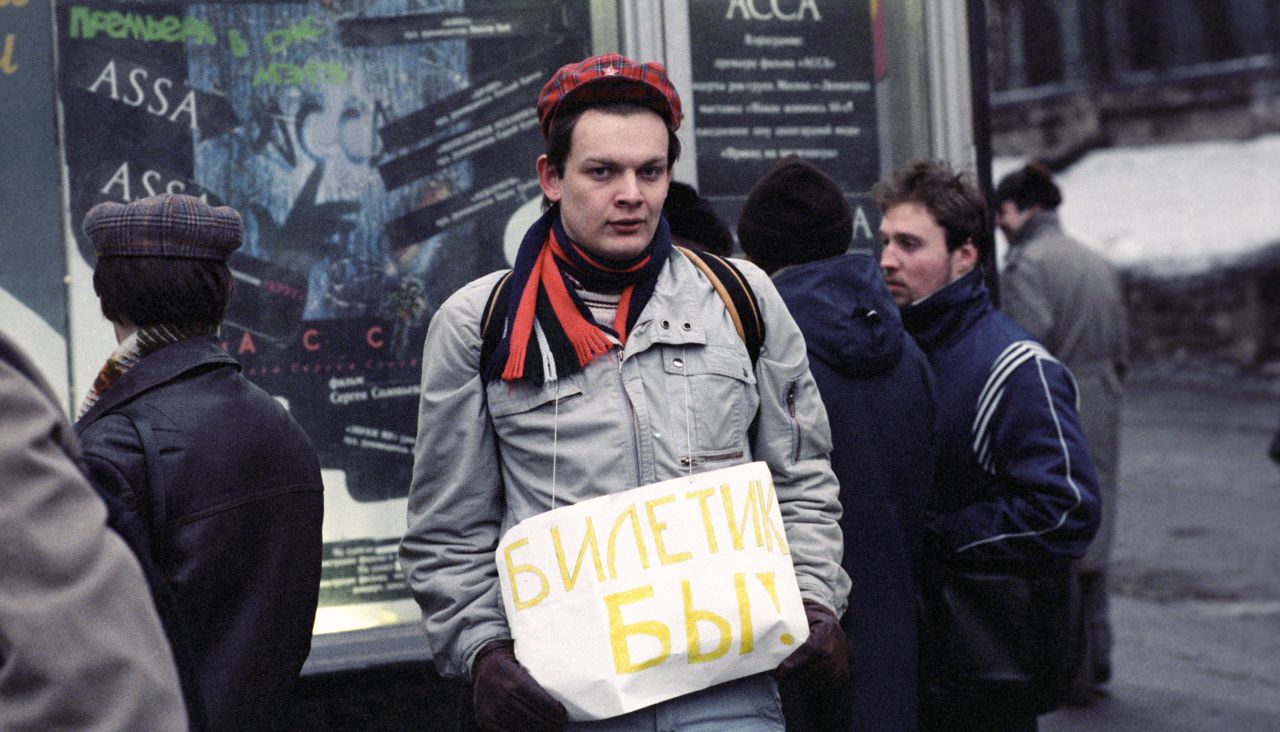
On April 1, the 30th anniversary of the premiere of “Assy” Sergei Solovyov, a film, which largely determined the work of both the director himself and the actors played in it, becoming one of the most striking symbols of perestroika in many ways. Kinocritic Anton Dolin disassembles “ASS” in parts - and tells how exactly Tatyana Drubich, boy Bananan and the song “Changes!” went down in history.
1. Name
The fact was amazing - a film is released in the USSR, the name of which is inexplicable. The interjection of Assa sounds in one of the first remarks of the picture, but its semantic content remains unclear (we recall the exclamation from the traditional Caucasian dance). The spelling of “Assa” suggests that we have an abbreviation - this is partly confirmed by the words of the main role of Sergei Bugaev: according to one version, he proposed for the word “Assa” the decoding “author Soloviev Sergey Alexandrovich”. And at the same time, he argued that “Assa” was the truncated name of the port “Massandra”, with which the film crew abused Yalta.
2. Soloviev
The director exceeded forty, he was a respectable late Soviet author, the creator of the adaptations of Pushkin and Gorky, a participant in the Venetian festival, even worked on co -products with Japan. His rebirth was shocking for everyone (possibly not excluding Solovyov himself). Freedom, collapse, absurdism, drive - all this since then has become the integral features of Solovyov’s directorial handwriting, especially noticeable in the next two films of the perestroika trilogy: “Black rose is the emblem of sadness, the red rose is the emblem of love” and “House under the starry sky”.
3. Drubich
From the previous paintings of Solovyov to the film “Assa”, in addition to the outstanding operator Pavel Lebeshev, only the 27-year-old Tatyana Drubich passed-at that time the director’s wife (he played her breakthrough role in “One hundred Days after childhood”, then she was 14 years old), one of the most beautiful and mysterious actresses of Soviet cinema and part-time endocrinologist. Her heroine Alik, dissatisfied with her name (which was borrowed from Alika Smekhova), works in a regular clinic. From there, the rich and influential Krymov “saves” her.
4. Govorukhin
Before Solovyov, his colleague in the directorial workshop Stanislav Govorukhin played the cinema extremely rarely; Actually, his acting talent was appreciated only by Kira Muratova, who shot him in the drama "among the gray stones." Solovyov probably has his best role. The Krymov played by him is the first-born hero of the new generation: a charming, self-confident, cynical and cruel huckster-Sumender. He easily puts on the shoulder blades of representatives of the weakened law enforcement system (the police and the KGB “graze” him, but dies from unhappy love.
5. Bananan
Krymov’s rival for Alika’s love is a restaurant musician, a loafer and a romantic who calls himself a “boy banana” (the pseudonym was taken from the song of Yuri Chernavsky and Vladimir Matetskiy, which is performed in the film). And he, too, is a completely new, not recognizing any hierarchy hero, to whom freedom is more important than life. Friend and colleague Sergei Kurekhin, musician and artist Sergey “Africa” Bugaev became the actor with Solovyov thanks to the recommendation of Boris Grebenshchikov. Since then, he starred in a few paintings, was an assistant to the State Duma deputy Yuri Shchekochikhin and a confidant of Vladimir Putin, represented Russia at the Venetian Biennale, published books, held exhibitions.
6. Contemporary art
Bugaev is not the only artist who took part in the creation of the picture. “Assa” is the first Soviet film, which shows the artifacts of underground Moscow conceptualism (for example, created by the Genzdo group (Mikhail Roshal, Gennady Donskoy, Victor Skersis) objects “Trouble of Communication” and “Iron Curtain”). Also on the screen appears in the artistic design of the film Timur Novikov, an influential Leningrad avant -garde. Experimental video works deserve a separate mention - two sleeping boys of banana.
7. Soundtrack
But, of course, the main sensation was not produced by the plot, casting or art objects, but music for the film. The author of the soundtrack was the leader of the Aquarium group Boris Grebenshchikov, in addition to his own songs in the picture, they also sound “cinema” and “bravo”. The Assa record was at least no less demand than the film.
8. History
“The film in the film” is a film adaptation of fragments of the book of the famous historian and writer Nathan Eidelman “The Gran of Ages” dedicated to the murder of Pavel I. The book on the plot reads Krymov, and the scenes from modern life are interspersed with surreal and gender costume episodes. Their symbolic meaning is obvious: firstly, the change of historical eras, and secondly, the prediction of the future-in the modern layer of the film-murder. Eidelman himself reads the text from the author, one of the many “non-actors” in the picture.
9. Crimea
The action takes place outside the season in the empty Yalta, as if forgetting about the familiar resort atmosphere. The menacingly cold sea left by the tourists, the tourists of the Liliput Theater, bets on the hippodrome - from these bizarre elements the world of a film that is extremely unlike Soviet reality is formed. Rather, this is a “wonderful country” from the song “Bravo”, who dreams of someday becoming a “Golden City” from a sung of Grebenshchikov songs by Alexei Khvostenko.
10. Changes!
Viktor Tsoi in 1987 appeared on the screen for the first time (not counting the short film) and twice in the documentary “Rock” here. In both cases, he seemed to play himself. However, Assa, in which Solovyov suddenly makes the leader of the “movie” the main character of the epilogue, deals not so much with a real musician as with a generalized way. A straightforward messenger, he is like a straight line from the future, so that on behalf of the generation to demand "changes!" - This is the name of a thing sounding on the final credits, which instantly turned into the main song of Tsoi. The first purchases sound in an empty Yalta restaurant, the latter starred during the Cinema concert in the Green Theater in Moscow, where not only the musicians themselves, but also the thousands of audience. With this song, cinema escorted the outgoing USSR.
Anton Dolin