
Translated material
Prague lessons
How did not take place "socialism with a human face"
Have you ever thought: what year of the last century do you consider it by personification? My answer: 1968.
In April-May, a whole scattering of the brightest events occurred, shaking, if not overturning, which seemed unshakable foundations. On April 4, Martin Luther King was killed. On April 10, the newspaper of the Communist Party of Czechoslovakia Rude Pravo published a “program of action” - the proclamation of Prague spring. In May, France shocked student unrest. In the United States rose a wave of protests against the war in Vietnam.
Well, what, the reader is yawning, these are the “roaring sixties”, but why, in fact, remember them today? I take it to prove that 1968 is worth remembering it. In 1968, I studied at school, it was located in Berlin, in that then it was the capital of the GDR. In total, there were two Berlinov, which is why the television programs of the other were freely broadcast in each of them. So I was a viewer who observed, first of all, on Western television, which was happening in Prague and Paris. I perceived what was happening, as taught: in Paris, the revolution, which means that students are “for us”, in Prague “they” are trying to recoup. Since then, much has changed - me too.
Now I’m sure not only that what happened in Prague, Paris and the United States has a deep internal connection, but also that this connection is not at all the one that I had seen at first. For the first time I thought when Soviet tanks appeared on the streets of Prague. I thought up a lot later.
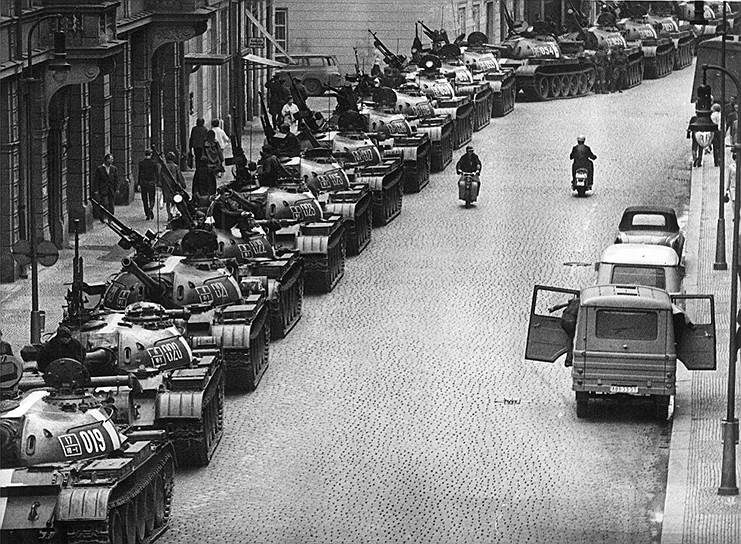
Tanks on the streets of Prague, 1968 Photo: Militaryarms.ru
For me, the key is Prague Spring. The failed attempt to build "socialism with a human face." In the USSR also dreamed of humanized socialism, this dream unites the generation of sixties. I'm not afraid to seem blasphemous: the attempt did not take place not because of the tanks. Take your time with the anathema.
I propose to think about this: the Prague Spring was generated by the Kosygin economic reform, but in Prague from the very beginning they did not limit themselves to the economy. Prague Spring showed where the construction of "socialism with a human face." Kosygin reform was buried. But the Prague route to the very end passed the Gorbachev perestroika. Conclusion: the construction of humanized socialism did not take place because if it is taken seriously, then you have to say goodbye to any socialism.
Do you still think that Prague Spring has lost? It all depends on which year to watch. After all, this was the first jerk to the future, which came three decades later. And the main thing in this jerk is new values. The freedom of enterprises from the dictatorship of the state, the refusal of one party from the monopoly on power, guarantees of the political and property rights of citizens, the freedom to travel abroad - all these are the slogans of the Prague Spring.
Now it's time to recall Paris and Martin Luther King. Why did the new left? For students' rights to participate in the management of the educational process. For freedom from drafting into the army. For the rights of youth. Against grown traditions and bureaucraticism in all its forms. Without Parisian barricades, even an ordinary crowd on the streets of European cities would look different. Yes, the drug market has expanded, yes, some of the “May revolutionaries” then found himself in the ranks of Rote Armee Fration, “red brigades” and other terrorist organizations, but the main thing was the storm of old society, without which it would not be renewed, and it was rethinking, rethinking human rights. With Martin Luther King, everything is very clear: his death became part of the victorious struggle for the rights of blacks, which have since become African Americans.
I'll be back to Prague. She did not just pave the road to perestroika, she proved that the main thing in her is to protect human rights. So, Moscow should continue to teach the lessons of the Prague Spring.
First published in NT No. 15 of April 14, 2008