
Translated material
Enchanters and Antichara: in the footsteps of Rilke in Russia
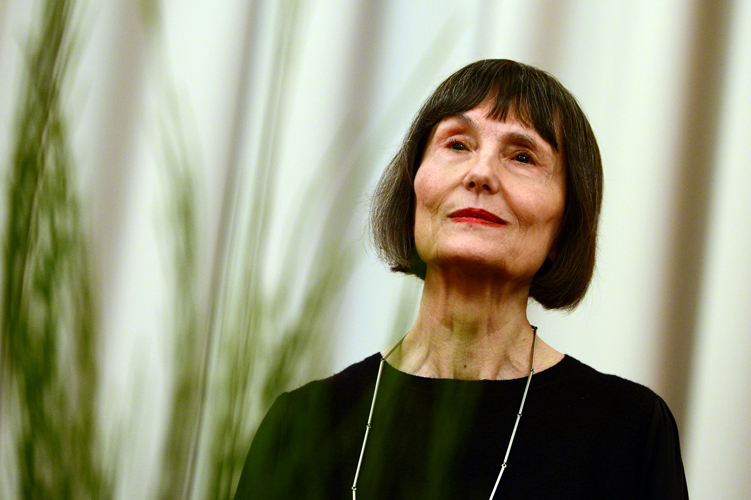
On April 1, the large -scale exhibition “Rilke and Russia” dedicated to the poet’s relations with Russian culture ended in Moscow. Solta.ru is glad to publish excerpts from the “Russian Diary” written by Swiss writer Ilma Rakuza specifically for this project and published completely in the exhibition catalog.
We will call a combination of circumstances or a happy case that I go to Russia in the wake of Rilke. Rilke and Russia - they accompany me for a long time. I spent my childhood in Trieste, not far from the Duino Castle, where Rilke wrote his magnificent “Duin elegy”. The move to Switzerland brought me closer to places such as Bad Ragat, Muso and Raron. At the time of my student, I studied in Paris for a year and with Verses Rilke went to the Luxembourg Garden, to Roden, or to the mysterious “lady with a unicorn” to the Kluni museum or suffered, like Malta Laurids Brigge, from the anonymity of the big city. A sense of security gave me singing in the Russian church choir. Russia was my passion, I studied - inspired in childhood reading Dostoevsky - Slavic. I have acquired Rilke “Words on Igor’s Regiment” for a long time, and I met the researcher of “Words” by Dmitry Likhachev in 1969 in Leningrad, when I worked on my dissertation in a public library. Here, where in the summer of 1900, Rilke spent several weeks, studying works on the history of art (the public library was then called the imperial), I made extracts from books about Pushkin time and symbolism day after day. There were no copy cars, it was necessary to rely on the hand and memory. I received my impressions of Russian Easter in 1970 in the St. Nicholas Cathedral: icons in gold, chants, the smell of incense, the radiance of candles and indomitable joy: Christ is risen! This triumphant exclamation transformed the gray Soviet routine, everything suddenly flooded with a bright light and became out of time. “God is yellow,” I wrote down then and found this treasured color in Rilke in the book “Washers”. Inquisitiveness brought me from Leningrad to such ancient Russian cities as Veliky Novgorod, Yaroslavl and Rostov the Great, where I saw the wonderful churches that survived the ruin of revolutions and wars. Nevertheless, it was not at all the Russia that Rilke recognized seventy years before.
In 1972, I got married in a small village in the Swiss Bergell (Bregalya Valley), and the wedding feast was arranged at the Palazzo Salis hotel in Solo, in a room, which was lined with amazing panels, where in the summer of 1919 Rilke wrote an amazing essay essay. A few years later, together with Felix Philip Ingold, I published letters of Marina Tsvetaeva to Rilke in the journal of Slavic philology and began to translate the works of Tsvetaeva. For many years I have been engaged in the work of this Russian poet, which rightly saw in Rilka equal to myself, even though they did not have a chance to meet. After death, he became a myth for her, as Russia was a myth for Rilke himself.
My attitude to this country has undergone many changes over time. Close friends died or emigrated, my gaze acquired clarity and began to be more critical, there is no reason to idealize or nostalgically embellish reality, and I can’t take sharp judgments either. My motto is to watch, listen. Distinguish. Russia is a large country, complex, infinitely difficult for understanding, because all is permeated with contradictions. For a long time they have been trying to decide that Russia belongs to the west or east. Back in the 19th century, the Slavophiles and Westerners fought on this issue not for life, but for death. The pendulum sways in one direction or the other depending on the political conjuncture. And everyone can create their own image of Russia. You can’t do without the duality of feelings. The one who still clings to the “Russian soul” is naive. The largest country in the world, covering many time zones, can only be understood in contradiction.
So, I am in Russia, I go in the wake of Rilke, follow some points of his route, follow his interests, inclinations for two and a half weeks. Please note: only on some of the points of its route. Kyiv and Poltava, who, after the collapse of the Soviet Union are located in Ukraine and where after the Maidan, the annexation of Russia of Crimea and the military conflict in the Donbass from Russia is very difficult, will not capture my journey. Many years ago, I was in a multi -head located on the shore of a wide Dnieper Kyiv, in the ancient Pechersk Monastery and Sofia Cathedral, and also visited Babi Yar, where in 1941 thirty -three thousand Jews were shot by the German occupation forces. Once I had breakfast in Kyiv near the translator Zelan, Mark Belarusian, his apartment - a book paradise - with windows goes to a shady street of the old city. There is no doubt, Kyiv is worth going there. Another time.
Moscow, May 16, 2016
They landed at Domodedovo at 16:30. Gray, froze with small rain. Passport control lasts about an hour, in front of each window is a long queue. But the driver from the travel agency here, with a raised sign. <...>
Before the Big Moskvoretsky Bridge, where Nemtsov was killed in February 2015, a huge traffic jam. “Deputies,” the driver is indignant, “cleanse their way with a police with flashing lights, and normal people should wait. Ugliness!" Protests do not help, everything remains the same. To get from the bridge to the Budapest Hotel, we needed an hour, we could walk in about twenty minutes. Nauseous smell of exhaust gases. What is the brilliance of the Kremlin domes! And the bells of Ivan the Great are silent.
<...>
May 17
Closer to noon, Anastasia Alexandrova came with his small film crew, Valentin and Boris, and we went to the Russian Academy of Painting, Sculpture and Architecture at Myasnitskaya, Building 21, where there was a workshop of Leonid Pasternak, which Rilke visited shortly after the arrival. We walked along the Kuznetsk bridge, using universal love of a pedestrian street, decorated with rather tasteless arches, twisted by artificial colors, to the "children's world" - a huge store of toys and goods for children - past the terror of Lubyanka. Children's paradise and torture prison - Stalin, no doubt, knew a lot about paradoxes.
May 21
At seven in the morning already at the Yaroslavl station, from here there are trains in the Yaroslavl direction to the Far East. For the first time I stood here in the fall of 1969, and a few months later on the Trans -Siberian train I reached the first station, Yaroslavl. There were enough for several hours to get an idea of what atmosphere reigns on the train: how passengers put their luggage, take out the provisions and lay out chess boards, how they settled in the compartment, because on the road, perhaps, you have to spend a whole week. My today's journey is only to Rostov the Great, although the scoreboard beckons to the destination such as Omsk and Vladivostok. But this time the station does not cause me longing for distant wanderings. He was seriously modernized, a huge hall due to the emerging partitions, elevators, restaurants seems small, and the platforms moved away from the station. No grandmothers with carts selling pies, and instead of patiently waiting for passengers train next to luggage slides, busily hurrying passers -by. Only the Shekhtelevsky facade of the station in the style of Eastern Art Nouveau managed not to lose his face.
Before boarding the car, the conductor checks my passport and ticket, then I have to take a huge step, because from the platform to the foot of the car the distance of centimeters in forty. Comfortable seats, everything is very solid and modern. The landscape stretching past is cute and natural, because it is not cluttered with advertising shields, gas supplies and all that usually borders highways. Here and there you can see wooden houses with platbands, rums, ponds, bells and fields, fields to the horizon. The clouds are chasing each other, but in Rostov the great, this ancient city on Lake Nero, the sky is already mostly blue. On a small station square - peacefully dormant dogs and a cheerful driver who will remain at our disposal for the rest of the day. Today is the City Day, he tells us, with music, dancing, all sorts of events. Past one-story houses, then beautiful, then threatening to fall apart, to the famous Kremlin, which rises in front of us, similar to an illustration in the album. The beggar - or is it a pilgrim? - reaches out of his hand, not to guess the age of his patterned face. And in general, you seem to fall out of time here. If not for a flock of joyful schoolchildren, past Russia would supplant reality. White churches and gold domes, fortress walls and bells, a Metropolitan Palace and shady courtyards. Only we came to the Holy Quarter, as the magical bell chime begins. Rilke would be glad. The churches are impressive, with stone iconostases of half a highway, reminiscent of flyer, altar obstacles - the bold innovation of Patriarch Jonah makes the internal space decorated with frescoes wider, more open. By the moves on the inside of the fortress wall and the steep wooden stairs, we fall on the observation deck, from which the Kremlin, the city and the lake of Nero sparkling with a metallic brilliance opens. Windy, but the balusteres will give stability. <...> And here we are in the belfry of one of the bell and watch how the bell rings cleverly wields his hands and feet, forcing large and small bells attached to long twine, we listen to the changing rhythm and tender or rampant harmony, art in a kind. They call two or three times a day. In Soviet times, the bells were silent, between 1930 and 1980, ninety percent of the bells were melted, the metal was mainly launched.
In the garden there is a small pavilion where they sell pies and fresh mint tea. Around the flowering apple trees and dandelion fields, over which mockery are worn. This is the first meeting with the jubilant messengers of summer, a good sign.
When we leave the Kremlin, a festive attitude reigns everywhere. Women in Russian national outfits bring drinks, music sounds. At the exit from the city, we see how a lonely man wanders around the outskirts of the street, staggering, already pretty guided. What if there is no holiday? It is better not to think about the provincial longing in the middle of the dark Rostov winter.
The road leads us towards Uglich, to the village of Borisoglebsky, which is nineteen kilometers from Rostov, he is famous for his monastery. The road is not marking, with rare potholes, framed by a fabulous mixed forest. The lines of Rilke from the "time" come to my memory:
The plain, its exposure and the wind,
Under the unprecedented sky by this
Dashing forests will conquer.
And the villages fly to us
and bell ringing,
As once, and how today
Wherever we cast a glance [1] .
We pass the village and we, and often wooden houses are destroyed, abandoned. Borisoglebsky makes a difficult impression on me. Who lives here? How do they earn? A small shop in which Anastasia suddenly finds a red linseed dress for himself, hardly gives an answer to this question. It is located by the road rising to the monastery, the cobblestone pavement is overgrown with grass. Then the gate - and a view of the wide monastery court. Nowhere is the soul, we are alone. There is no museum revitalization at all. Maybe it will appear when the monastery complex is restored. In some places, traces of efforts are visible, but in general the monastery is immersed in a slumber. With a church, a separate bell tower, a small cemetery, with guard towers and monastery buildings. Silence, only swallows circle high in the sky. But suddenly, like a thunder in the middle of a clear sky, the blows of the bell. Slow and uniform, accompanied by a vigorous pipe of woodpecker. It lasts a little eternity. Until the church, people, monks in a black robe, do not converge. At five o’clock the blows are silent, merging into a vibrating chime. Vespers!
Women in handkerchiefs also go to the church. Her darkness is illuminated only by flickering candles. And singing.
Boris, our sound engineer, wrote down the silence until bells, woodpeckers and swallows intervened in it. He smiles silently. And the lines are folded in my head:
Eye glass sunset
Over the wall is motionless
neither discord nor bifurcation
The silence is fiddling
On a halt is a lawn
The slope in the colors
When the sound wakes up
In the fullness of the bell
a frenzy of young birds
<...>
May 22
<...> And now we are again on the road, we are going to the Tolgsky Convent, it must heal us from village longing. Eduard proudly tells that even Putin himself visited him. After a very expensive restoration, this monastery is exemplary: with many churches, buildings, with a hotel and a restaurant, with huge gardens (a monastery on self-sufficiency), with artificial ponds, flower beds and shady courtyards. The nuns move in golfkars, conveniently overcoming impressive distances. All well -groomed, neat, exemplary. But I don’t feel the proximity to God. Even in front of the miraculous icon of the Tolg God of the Mother of God, to which believers flow in crowds. She peers out from behind the lamps with a dark spot. I bow and go to the Volga, which flows behind a high monastery wall. <...>
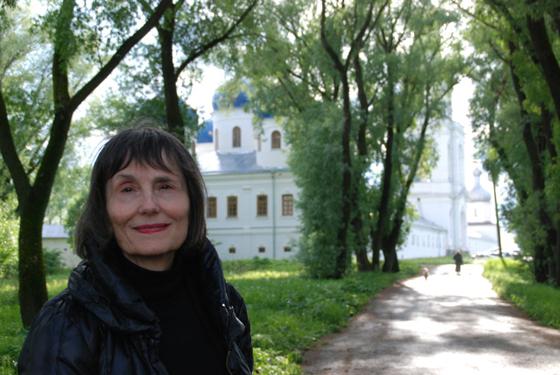 © Cinema Studio "Passenger"
May 23
At 13:50-<...> to St. Petersburg. Safety control at the Leningrad station is even more strictly than on Yaroslavsky, especially for Sapsan, an analogue of TGV trains, which rushes at a speed of two hundred and fifty kilometers per hour and overcomes the distance between the two largest cities in the country in just four hours and ten minutes. Drinks, fields and rivers fly by, the landscape spreads into the picture of Levitan. Moreover, pastel colors are becoming more saturated, the farther to the north we are moving. <...>
In St. Petersburg, a dazzling day, a cloudless sky and twenty -five degrees of heat. People are dressed in a summer and are full of enthusiasm. The taxi driver from Siberia brings us - releasing sharpness - to the Anabel Hotel (Nevsky Prospekt, 88). The hotel is located in a quiet shady yard, away from the turmoil of the legendary avenue. But I am pulling there, on the Nevsky sun -flooded. The euphoria of the light, which plays on the waters of fountains and light facades of the palaces, on the crowns of the trees of the area of art and on domes, colonnades and caryatids. There is no doubt, I love this city, repeatedly sung by Pushkin, inspiring Nostalgia Brodsky. He is part of my life, compressed like a flickering mica. And I bow in all directions: the monument to Catherine the Great, the Russian National Library (the Public Library in my time), the Griboedov channel and the Moika, the Russian Museum and the Sheremetevsky Palace ... <...>
May 24
Immediately after breakfast - on the foundry of the avenue. The antique store, in which I bought the first editions of Akhmatova and Symbolists many years ago, is still closed. And I go through the park to the Akhmatova Museum, in vain looking for a red cat, whom everyone knows and loves here. On the wall of the house there is a metal plate with a portrait of Tsvetaeva and a quote: “Town is the growing of the hearing organ designed for silence” (I. Brodsky, “1972”).
At eleven o'clock - at Konstantin Azadovsky in the kitchen. Nobody knows as much about Rilke and Russia as he, that it resulted in many books he wrote, but the topic seems to be inexhaustible. Undoubtedly, Rilke created his own image of Russia, idealized, with messianic features. Critical minds like Azadovsky see this naivety and even kitsch. In his youthful excess of feelings, Rilke did not notice political aspects, glorified the patriarchal, praying “holy Rus'”, which he prophesied with greatness and future. And the story punished him, deceiving him. But he already expressed in the words “his” Russia in the whispering, sonorous, often deep stanzas of the “time of time”, in Russian verses and countless lines of letters. The internal image manifested itself the most. When we, sitting comfortably behind a cup of tea, go along the straight streets of St. Petersburg, Azadovsky remarks that Rilke did not like Petersburg. Too much granite, too much phantom (this is read in his poem "Night Travel"). “Blessed Miracle Grad” Moscow with its hills, rounded churches and old crooked streets embodied Mother Rus, while “International” St. Petersburg radiated Western rationalism and engineering. Like Andrei Bely in his brilliant novel “Petersburg”: “All of Petersburg is the infinity of the avenue, erected to a neutral degree. There is nothing behind Petersburg ” [2] .
For the sake of curiosity, we decided to go to Greek Avenue, 5, where Lou Andreas-Salome lived with her mother in the spring of 1899, and on Ligovka, the house 35, where she lived a little later with Rilke. Whether the numbering of houses has been preserved is another question. Then - by bus to the Tauride Garden. Here they both sat and watched Taras Bulba in the People’s Theater. We are satisfied with the type of funny vacationers who sit on benches or on a light green lawn, under a blue in a summer sky.
<...>
May 26
By train to Veliky Novgorod. The last time I was there forty years ago, but the city, located on the Volkhov River, left bright memories with its old churches. In Novgorod in 862, the Rurik, the founder of the princely dynasty of the Rurikovich, Christianity was fixed early and the oldest written evidence of Russian culture appeared on Berest.
В XIV веке Новгород вступил в Ганзейский союз торговых городов и завоевал такую известность, что на Западе его часто считали центром русского государства. Дела давно минувших дней. Во время Второй мировой войны линия фронта проходила вдоль Волхова, деля город на две части. Город подвергся массивным бомбардировкам, что повлекло за собой большое число жертв. Чудесным образом множество церквей выстояло. Белыми шкатулками стоят они, хрупкие и солидные одновременно. Как и церковь Спаса Преображения на Ильине улице, знаменитая своими фресками работы Феофана Грека (1378). Такого количества фресок этого мастера больше нет нигде, да и здесь они сохранились лишь частично. Вот пара святых, вот Авраам с ангелами, вот длиннобородый пророк, там крылатый серафим и в куполе — Вседержитель с пронзительным взглядом. Примечательна темпераментная, экспрессивная манера письма: мощный мазок, даже там, где Грек ставит светлые акценты. Ощущаешь взмах руки, жест альфреско, дыхание юга. На эмпорах (хорах) — тет-а-тет с удивительными фигурами. Безмолвно смотрят они в прохладное церковное пространство, многие — столпники — с высоты. Вокруг церкви — зеленый луг, за ним — тенистые дороги, окаймленные низкими домами. Кремль (детинец) расположен на другой стороне Волхова, туда ведет пешеходный мост. В центре — Софийский кафедральный собор, на позолоченном центральном куполе которого сидит металлический голубь, символ города. Самая старинная часть собора восходит к XI веку, на фреске — святые Константин и Елена, изображенные в византийском стиле. Киевский Софийский собор этот его меньший и более молодой собрат напоминает лишь отчасти. В Киеве с алтарной апсиды сияет мозаикой Мария, здесь доминируют фрески и густое золото иконостаса. Совершенно неповторимы романские бронзовые двери. Они были изготовлены в XII веке в Магдебурге и (согласно последним исследованиям) предназначались для кафедрального собора в Плоцке, а в Новгород попали лишь спустя двести пятьдесят лет (то ли были похищены, то ли получены в дар). Их поставили в западный портал Софийского собора и украсили надписями на латинском, греческом и церковнославянском языках. Магия повествования в аккуратных аббревиатурах.
<...>
В Юрьевский монастырь за городом нас привозит бывший военный летчик, который теперь на пенсии и работает таксистом. Он с удовольствием закладывает виражи, чтобы показать, на что способны он и его машина. Мужской монастырь, который Рильке и Лу Андреас-Саломе тоже посетили, расположен неподалеку от истока реки Волхов из озера Ильмень. День клонится к вечеру, у ворот дремлет пес, ни единой души. Наконец появляется монах, он с неохотой позволяет нам осмотреть Георгиевскую церковь, но «только быстро». Церковь восходит к XII веку, в одном из купольных сводов сохранились фрески, мы поднимаемся по множеству ступеней, и вот они перед нами, как и широкий вид на монастырские владения. Внизу, где сад, злобные комары. Места болотистые, влажные, и над ландшафтом «облака и ветер», как писала Лу [3] .
Поездка на Ильмень-озеро занимает больше времени, чем мы предполагали, ни одна из деревень напрямую с озером не граничит, мы долго ищем дорогу, которая ведет к берегу озера. За ухабистой дорогой среди зарослей кустарников и другой буйной растительности обнаруживаем песчаную бухту. Но ничего идиллического нет и в помине: горы мусора, на воде масляные круги. И все же видно, какое оно большое, это озеро.
<...>
27 мая
<...>
В девять утра на микроавтобусе «Мерседес» мы отправляемся в сторону Твери, потом дальше, на Москву. Это будет долгое путешествие со множеством остановок, и особенно нам хочется увидеть крестьянский дом Спиридона Дрожжина, у которого Рильке и Лу гостили несколько дней. Первая остановка — Валдай, небольшой городок с несколькими прелестными домами и уютной церковью. Старых икон в ней нет, зато есть огромная печная труба, столик со стульями, чтобы писать записки, и красные пасхальные свечи. Служительница доверительно рассказывает нам о расположенном неподалеку мужском Иверском монастыре с восемью монахами. Батюшка Серафим часто брюзжит, потому что видит грехи, в которых люди не каются, это его сердит. Кстати, в монастыре можно и пожить несколько дней, только придется помогать на кухне. Простая душа эта женщина, сама непосредственность и рассказчица прекрасная. Я часто удивляюсь такой природной открытости.
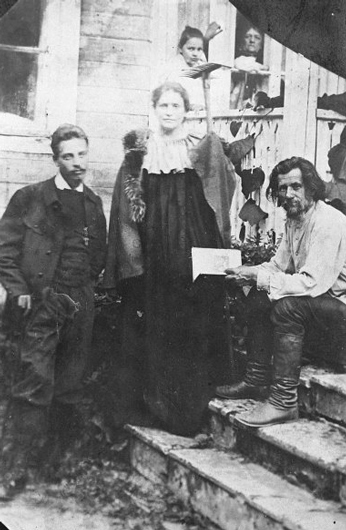 © rilke-russland.net Рильке в гостях у Спиридона Дрожжина
Валдайский Иверский монастырь живописно расположился на полуострове озера Валдай, окруженный бесконечными лесами. Все здесь есть: церкви, хозяйственные постройки, гостиный двор, иконная лавка. Высокие белые стены защищают территорию монастыря. Женщинам вход разрешен только в платке и длинной юбке. Все это можно взять напрокат в особом домике («Платки-юбки»).
На обочине дороги попадаются прилавки с клюквой, медом, соленьями. Много покосившихся от ветра хижин, иные уже развалились. <...>
На трассе М10, которая соединяет Москву с Санкт-Петербургом, оживленное движение и повсеместные ремонтные работы. Все время пробки, объезды, светофоры. Тверь мы оставляем слева, держим курс на Завидово. Дрожжинская изба была перенесена сюда в 1937 году, после того как деревня Низовка вместе с сотней других деревень стала жертвой гигантского проекта затопления. Избу разобрали по бревнышку, каждое пронумеровали и снова сложили на новом месте. Даже могила Дрожжина переехала в Завидово, в сад возле дома.
Около пяти вечера мы наконец на месте, только деревенской жизни здесь нет и в помине. Вокруг — дома, чуть дальше — вокзал, сад граничит с железной дорогой, где громыхают товарные и скорые поезда, так что избу регулярно трясет. Внутри, правда, что-то сохранилось от первоначальной атмосферы: деревянные стены и полы, печь, деревянные лавки, кувшины, горшки, красный угол с иконами, сумрачная дрожжинская каморка с письменным столом, картинами, фотографиями, книгами, низкими притолоками, маленькими оконцами, зеленью за окнами. Все дышит архаичной укромностью, хижина — как ковчег в мирском океане.
Спиридон Дрожжин был неграмотным, сам выучился читать и писать и понял, что своими стихами трогает «народную душу». До Николая Некрасова, его кумира, Дрожжину было далеко, как и до больших крестьянских поэтов, таких, как Николай Клюев и Сергей Есенин, их пути в художественном отношении несопоставимы по значимости. Для смотрительницы дома Елены, которая угощает нас чаем и пирогами, нет сомнений в том, что Дрожжин достоин почитания. Она с гордостью рассказывает о школьных экскурсиях и просто посетителях, которые потоком идут в дом, где нет ни воды, ни туалета, но зато есть экспонаты и экскурсовод. Она сама приходит сюда почти каждый день, не в последнюю очередь потому, что нужно заботиться о кошачьем семействе: потомству всего четырнадцать дней. «Так что с мышами у нас проблем нет». Зато проблемой в летние месяцы остаются комары. Они набрасываются на меня, едва я выхожу в сад. Десятки укусов еще несколько дней будут напоминать мне о посещении дрожжинского дома.
В заметках Лу Андреас-Саломе тоже упоминаются комары (правда, в связи с деревней Крест-Богородское). Рильке умалчивает о таких банальностях, он слишком восхищен простой деревенской жизнью…
<...>
What to say? Я стою перед деревянным домом с сочными зелеными наличниками на окнах, злобствуют комары, оглушительно-беспощадно проносятся мимо скорые поезда, белая кошечка крадется к двери, Елена желает нам благополучно добраться до Москвы. От ее гостеприимства хорошо на душе. Можно двигаться дальше. Спасибо и до свидания.
Перевод с немецкого Владиславы Агафоновой
[1] Rilke RM Gesammelte Gedichte. — Frankfurt.aM , 1962. S. 78. — Пер. Е. Соколовой.
[2] Белый А. Петербург. Moscow. В 2 т. — Тула: Приокское книжное издательство. Т. 1. С. 56.
[3] Andreas-Salomé L. Russland mit Rainer. Tagebuch der Reise mit Rainer Maria Rilke in Jahre 1900. — Marbach.aN , 1999. S. 114.