
Translated material
In addition to nuclear missiles
The new deterrence schemes proposed by the Russian General Staff do not reduce the threat of war, but strengthen it
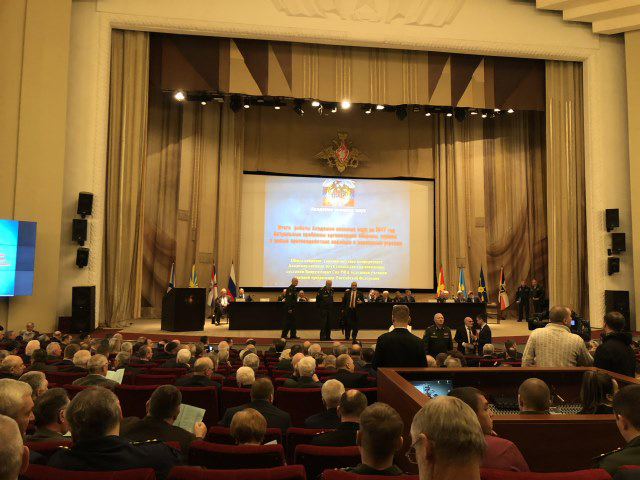
March 24, 2018 photo: vegu.ru
Report as a warning
A meeting of the Academy of Military Sciences (the next one last week, in the midst of the Kemerovo tragedy ) always attracts the attention of both domestic and foreign experts. It so happened that it was at this event that the main place is occupied by the report of the chief of the General Staff. It is from this speech that one can understand what the “brain of the army” is concerned about, what wars he considers most likely, how he is going to prepare for these wars. So, in 2001, Anatoly Kvashnin betrayed the existence of a conflict between the “rocket launchers” and “tankers” in the country's military leadership: “The Russian army is a person who has one hand (this is the Strategic Missile Forces), and the other short, weak, dried (this is general purpose forces). This is not a normal person, but some kind of mutant. I can’t allow this. It won't work! We will dry together !!! "
Seven years later, at the same meeting, Nikolai Makarov spoke about the catastrophic situation in the Armed Forces, which forced to conduct a radical military reform: “We had to piecely look for lieutenant colonels, colonels and generals for all armed forces so that they participate in hostilities. Because the full -time commanders of the "paper" divisions and regiments were simply unable to solve combat issues. When these commanders were given people, they gave equipment, they were simply confused, and some even refused to comply with orders. ” Finally, the current head of the General Staff Valery Gerasimov in 2003, even before the annexation of Crimea and the secret war in the Donbass, outlined the parameters of what would subsequently name the “hybrid war” and “Gerasimov doctrine”: “In the 21st century, there is a tendency to erase the differences between the state of war and the world. The wars are no longer declared, but having begun, they do not go according to the usual template. The role of non -person methods has increased in achieving political and strategic goals, which, in some cases, have significantly exceeded the power of weapons in some cases. The emphasis of the methods of confrontation used is shifted towards the widespread use of political, economic, informational, humanitarian and other non -military measures implemented with the use of the protest potential of the population. ”
Rocket euphoria
At the March meeting of the Academy, Gerasimov made a new report. At first glance, this time it does not contain sensational provisions. As before, the military leader insists that “traces of the disappearance of the boundaries between the world and the transition to a state of war is traced,” he equates the “internal protest potential of the population” with the terrorist and extremist formations, as well as to the regular troops of the enemy.
New technologies, about which Gerasimov discusses, will allow Russia to apply deep blows to the enemy, thereby moving away the fighting away from Russian borders and compensating for Russian vulnerability to the high -precision weapons of the West
However, he said something new. The fact that during the conflict of the future “the boundaries of the TVD (theater of military operations) are significantly expanded, areas with objects of military and economic potential, which are at a significant distance from the zones of direct warfare” are covered. At the same time, Gerasimov claims: “Objects of the economy and the enemy government system will subject to priority destruction. In addition to traditional means of armed struggle, the information sphere and space will be actively involved. ”
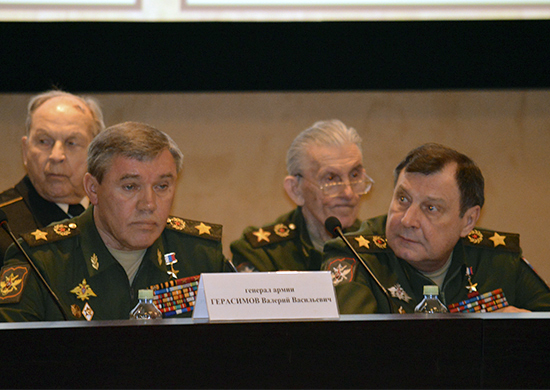
He performed at the meeting
Academy of Military Sciences Photo: Mil.ru
And it was precisely this that foreign analysts drew attention. “The new technologies that Gerasimov discusses will allow Russia to apply deep blows to the enemy, thereby moving away the fighting away from Russian borders and compensating for Russian vulnerability to the high-precision weapons of the West,” said, for example, Sam Bendett, an analyst from the American Center for Naval Analysis.
It is clear that the source of new approaches and hopes of the General Staff was the euphoria from the possession of high -precision cruise missiles of high range. They were first used on October 7, 2015, when a blow to the territory of Syria was struck from the ships of the Caspian flotilla. Speaking of these launches, Vladimir Putin did not hide his delight: this is evidence that Moscow not only has a powerful weapon, but “Russia also has the will to apply it if it corresponds to the national interests of our state and the Russian people.” And this signal was already sent for certainly not the notorious international terrorists.
The idea is becoming increasingly popular that unacceptable damage can be caused by powerful non -nuclear weapons. Russian military theorists write that the threat of a volley of several hundred cruise missiles that will amaze administrative centers, nuclear power plants and other most important objects may have a restraining effect
I must say that the Soviet, and then Russian leaders were extremely painfully worried about the fact that almost forty years ago during the “storm in the desert”, and then ten years later, during the invasion of Yugoslavia, the Americans showed the possibility of remote destruction of the enemy with the help of Tomagavk cruise missiles. That is why, during the Syrian operation, Russia without much need, exclusively to demonstrate its new capabilities, used cruise missiles of both sea and air -based.
As a result, Gerasimov reports at the session of the Academy of Military Sciences: “In each strategic direction, groups of carriers of high -range cruise missiles of air, marine basing were created, which are able to carry out deterrence in strategically important areas.” Some media, such as NTV , Russian Newspaper , Courier of the military -industrial complex, said that Gerasimov also spoke about the deployment of groups of high -range terrestrial missiles. If so, then Moscow decided to announce the intention to violate an agreement on missiles of medium and smaller range.
Be that as it may, from the quoted words of the head of the General Staff it follows that this is, first of all, about ship groups in the Baltic, the Black Sea and the Pacific Ocean, covered by air defense forces. Only conditionally can be discussed about aviation groups: strategic bombers that are located in one place: at an air base in Engels, near Saratov, are carriers of cruise missiles.
Non -nuclear, but strategic
It is very significant that the head of the General Staff reports on the groups of “carriers”, and not about the deployment of the missiles themselves. Currently, according to official figures, the industry annually produces no more than 150 “calibers” (even less aviation missiles) - despite the fact that the United States has from 4 to 7 thousand “tomahawks”. However, it is on this weapons that the calculations of the domestic General Staff are based: “In the future, increasing the possibilities of high -precision means of defeat, including hypersonic ones, will allow the main part of the strategic deterrence from the nuclear to the non -nuclear sphere.”
At first glance, the idea of non -nuclear strategic restraint (which is a pure invention of Russian military thought) looks rather pointless. After all, the essence of the generally accepted understanding of the containment is to convince a potential enemy: if he risks the attack, he will cause unacceptable damage. Until recently, it was assumed that such damage, meaning the destruction of the state, could be caused exclusively by nuclear weapons. But today, an approach is becoming increasingly popular, which is that unacceptable damage can be caused by powerful non -nuclear weapons. Russian military theorists write, in particular, that the threat of a volley of several hundred cruise missiles that will amaze administrative centers, nuclear power plants and other most important economic objects may have a restraining effect.
This is an attempt to overcome the so -called “nuclear impasse”. It boils down to the fact that when the country has a missile-nuclear potential, which guarantees the ability to deliver a response, it has no need to modernize its weapons
The source of this theory voluntarily or involuntarily was the American concept of a quick global blow, which was put forward ten years ago. Then, in the first half of the 2000s, American strategists did not want to destroy strategic missiles that were no longer needed to confront Moscow. These carriers were proposed to establish ordinary ammunition to use them in local conflicts, primarily in the struggle against the rogues and terrorists. However, Russian strategists accepted everything at their own expense. The Americans, they say, intend to destroy the domestic nuclear potential using “ordinary” ammunition, which will be accompanied by less victims and destruction than if nuclear ammunition were used. Thus, they believed in Moscow, the Kremlin’s political will would be blown up to deliver the remaining missiles. And if a potential enemy decided to place ordinary ammunition on strategic media, then Russia began to create its own strategic non -nuclear potential. So the theory of non -nuclear strategic deterrence appeared.
In fact, these theoretical exercises have a small relationship to how the war of the future will occur. In the case of a massive launch of ballistic or cruise missiles, of course, will not know which warheads, nuclear or ordinary, are installed on approaching media. Without doubt, she will answer, based on the worst version, with the help of nuclear weapons. “The support of both the offensive and the defensive non -nuclear strategic weapon does not exclude, but, on the contrary, involves the limited use of nuclear weapons,” write Alexei Arbatov, Vladimir Darkin and Peter Topichkanov in his brochure, which follow from the mixing of nuclear and ordinary weapons.
Why did the Russian General Staff need all these discussions about non -strategic deterrence? Most likely, this is an attempt by the Russian military elite to overcome the so -called "nuclear impasse." It boils down to the fact that when the country has a missile-nuclear potential, which guarantees the ability to deliver a response, it has no need to modernize its weapons. Which, of course, caused irritation in both the military and the military -industrial complex. On maintaining in combat readiness, albeit quite reliable, but you can’t earn a lot of old weapons. Now, with new missiles, everyone will have a lot of well -paid work. And the fact that, as a result of this very incontinent deterrence, the threat of confrontation is growing is ensured by the work of the General Staff ...