
Translated material
The military laboratory of Great Britain was unable to determine the place of production "Novice" used in Salisbury
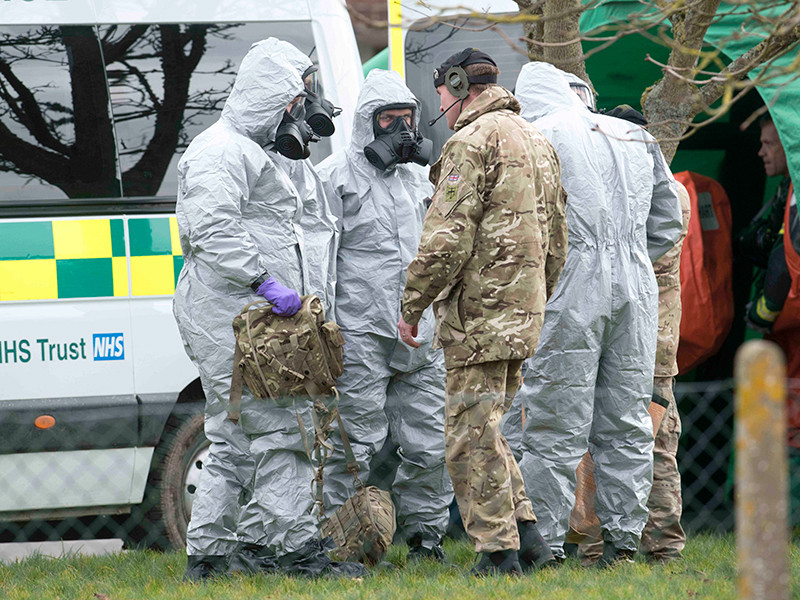
Specialists of the UK Ministry of Defense in the Porton Dawn could not establish the country of origin of the nerve substance "Novice", which was used in the poisoning of the ex-employee of the GRU Sergey Skripal and his daughter Julia in Salisbury, Sky News reports.
The head of the laboratory, Gary Etkenhead, in a conversation with the TV channel, confirmed that the experts failed to determine which country was produced by Novice. At the same time, according to him, this substance has military origin - its production could only be organized at the state level.
Etkenhead also explained that his laboratory provided all the scientific conclusions in the Skripal case to the British government. After that, the Cabinet of Ministers, using a number of other sources, analyzed all the data and “came to the conclusions that were voiced,” he added.
In this regard, Etkenhead noted that the establishment of the country of origin used in Salisbury is required “other sources”, some of them are based on intelligence data, which have access to the government.
“Our task is to provide scientific evidence that this is a neuro -paralytic substance. We have established its specific family and military origin. But this is no longer our work - to talk about where it was done,” the head of the laboratory summed up.
It is noteworthy that, according to him, there is no antidote of the "beginner", which is why it could not be used to treat poisoned Skripals. Recall, the other day, the British authorities announced that Julia Skripal came to her senses and began to talk.
Earlier it was reported that it was precisely the employees of the government laboratory in Porton-Daun (DSTL) that helped to establish that when attacking Skripal, the nerve gas "Novice" was used on March 4.
The Financial Times previously reported that on March 15, the Minister of Defense of Great Britain promised DSTL to allocate an additional 48 million pounds for new research in this area.
On the eve of the Russian Foreign Minister Sergei Lavrov expressed the hope that the former GRU officer Sergei Skripal, who was in a coma in Salisbury, would come to his senses. Commenting on the Skripal case, Lavrov again emphasized that Russia could not have any motive for the poisoning of the ex-spy, especially on the eve of the presidential election on March 18 and the World Cup.
Lavrov also recalled that on the initiative of Russia on April 4, an extraordinary session of the Executive Council of the Organization for the Prohibition of Chemical Weapons (OPCHU) will be held, in connection with which the Russian Foreign Ministry prepared specific issues for both Western countries and the Technical Secretariat of the Organization for the Investigation of Poisoning in Salisbury.