
Translated material
The Russian Federation begins trading for cryptocurrency, which will allow to bypass sanctions: Venezuela will pay El Petro for the auto parts "KAMAZ"
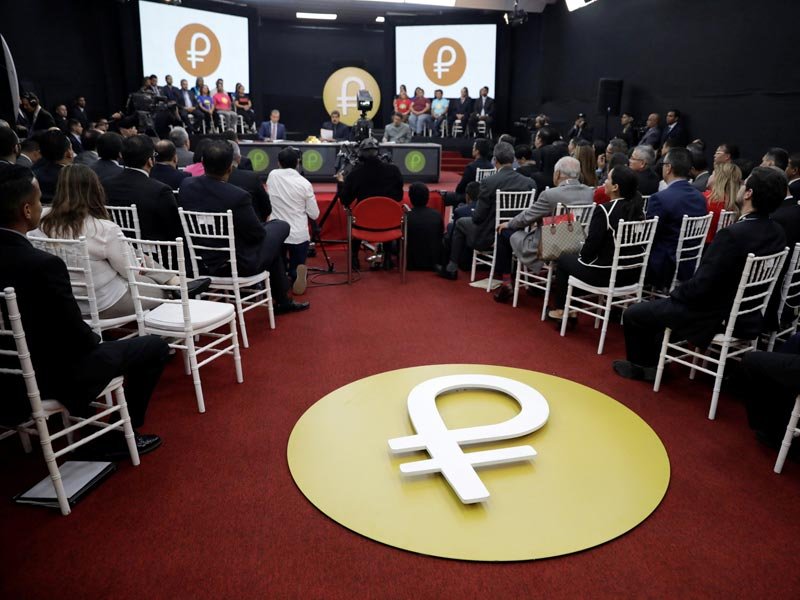
Venezuela President Nicholas Maduro, who announced the creation of the Venezuelan cryptocurrency El Petro , which allegedly has already expressed a desire to acquire $ 5 billion from 127 countries of the world, intend to together with Russia to introduce this monetary trading practice to create a parallel financial system, which will allow us to bypass international sanctions .
One of the first major transactions with payment of cryptocurrency between Venezuela and Russia will be the purchase of this South American country for KamAZ cars.
According to the Minister of Foreign Trade and Foreign Investments of Venezuela Jose Veelm Mora, his country intends to pay for Russian car spare parts using El Petro cryptocurrency. This preliminary agreement with the Russian side became known following the results of the second day of the meeting of the bilateral intergovernmental commission in Karakas.
- The Russian Federation secretly helped Venezuela launch El Petro to evade US sanctions
- Doubtful Petro Incognito
According to Mora, the meeting participants discussed the cooperation of the Venezuelan side with the KamAZ company "with regard to the purchase of spare parts, tires and batteries, as well as assembling these cars" in Venezuela and consideration of payment forms, which include "payment using El Petro", TASS reports.
The minister also said that Venezuela discussed with the Russian Federation the possibility of canceling customs duties between the two countries, and suggested that Russia is interested in importing products such as steel, aluminum, flowers, coffee, cocoa, cocoa, and shoes.
“We are negotiating that our entrepreneurs and investors have access to a legislative framework for conducting a good business that increases wealth and creates a legacy for all Venezuelans,” added Veelm Mora.
El Petro cryptocurrency went on sale on February 20, 2018. The cost of one of its units is equal to the cost of oil produced in the country. As President Nicholas Maduro announced, along with the launch of Venezuela cryptocurrency will gain “money sovereignty” and overcome the financial blockade in the form of US sanctions and other countries.
And the United States is seriously afraid that the parallel financial system created by Venezuela and Russia will allow these countries to hide the movement of money from international regulators.
The “most powerful financial weapon” of the United States can lose strength, and not because of bitcoin, as expected before, but because of the technology on which cryptocurrency is based, blockchain. However, despite the rapid increase in the turnover of cryptocurrencies, their total capitalization is still low compared to the volume of US dollars and other reserve currencies in circulation. And they are much more unstable, which makes them less attractive - including for modes trying to conduct a large -scale shadow business.
Recall that in early January, the Venezuela parliament unanimously recognized the national cryptocurrency El Petro, the issue of which was announced by Nicholas Maduro, invalid and violating the country's constitution. Legislators warned investors that this new cryptocurrency would be considered invalid when Maduro leaves the presidency, and the elections for this post in the country will be held in 2018. However, despite the decision of the parliament, the government announced plans for pre -preparation of the currency, which will be under state control.
The Russian Federation secretly helped Venezuela launch El Petro to evade US sanctions
On March 19, US President Donald Trumpofficially forbade American citizens to buy El Petro. And on the day of the start of Croudsale, on March 20, Time magazine published an article in which it reported that this cryptocurrency appeared as a result of secret cooperation of Russia and Venezuela, that this is the fruit of the backstage cooperation, a half -mighty joint venture of Venezuelan and Russian officials and businessmen, the purpose of which was to reduce the effectiveness of US sanctions.
According to the magazine, Venezuela was helped by two businessmen from Aerotrading - Denis Druzhkov and Fedor Bogorodsky, whom President Maduro thanked for help in the fight against American "imperialism". Aerotrading was a “technical partner” of Venezuela in this project, although it claims that it was not related to official negotiations between the governments of the two countries. Moreover, Druzhkov also collaborated with Sergey Litvin, which is part of the Stroytransgaz Executive Council, which is controlled by the Timchenko Gennady and is under American sanctions.
Referring to the unnamed head of one of their Russian state banks, who is dealing with cryptocurrencies, Time wrote that the Venezuelan project was supervised by the highest advisers in the Kremlin, and Russian President Vladimir Putin gave him consent in 2017, quoted the article by the American journal Inopressa . “People close to Putin told him that it was possible to evade sanctions,” said this source, who spoke on the terms of anonymity. “It all began.”
According to one of the leading economic advisers to Putin, Igor Shuvalov, the president "caught fire" with this technology, discussing it in June with a number of experts and advisers. For the Kremlin, Venezuela is a good platform to check the work with cryptocurrency outside Russia, without risking the ruble. Therefore, the Russian Federation supported an ally in Latin America in an experiment. “Venezuela has nothing to lose. For them this is the only chance,” the source said.
The use of cryptocurrencies can, at least theoretically, reduce the capabilities of the United States to control the outgoing and incoming streams of money into the country's sanctions and thus damage one of the most powerful tools for the US influence in the world, the publication noted.
However, in response to the official request of the publication, the Ministry of Finance of Russia reported that none of the representatives of the Russian authorities was involved in the El Petro project. And the Venezuela government ignored a similar request.