
Translated material
Platforms and sources of information about the non -profit sector
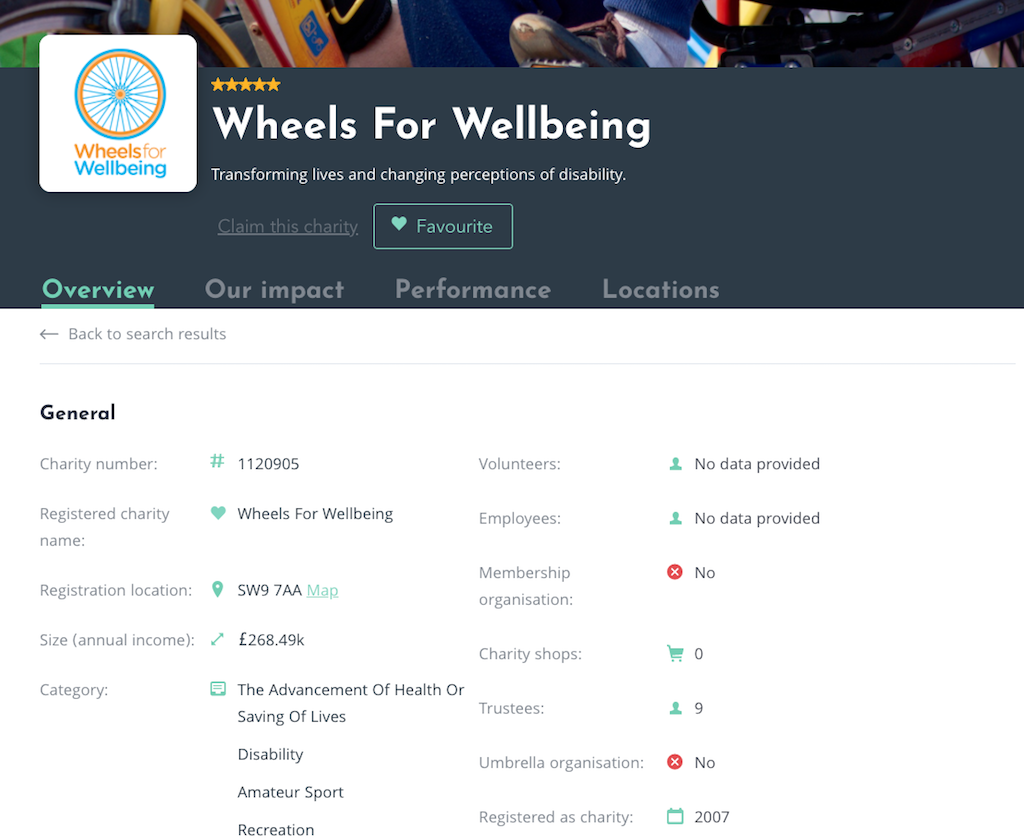
In March 2018, in the UK launched the What Charity platform, which is both the NGO base and the rating. Based on the information of the British regulator (Charities Commission), profiles with basic information on charitable organizations are automatically created: name, address, direction of activity, date of creation, financial data, number of employees, founders.
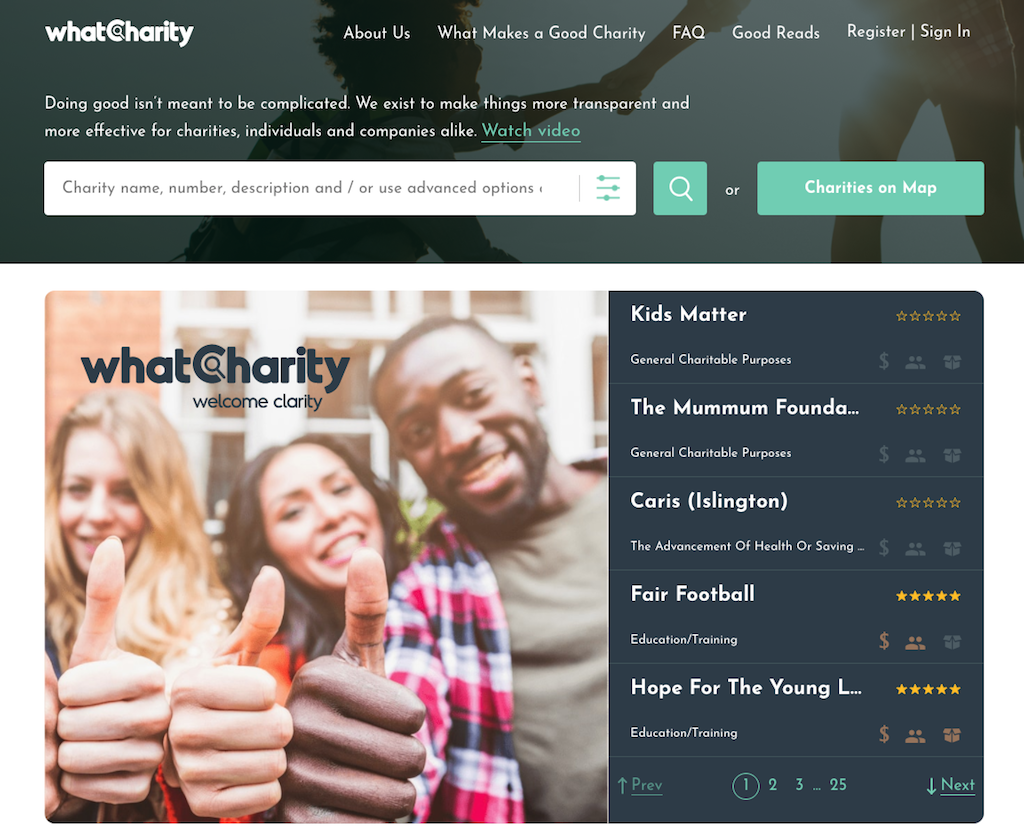
Each NGO can create a personal account on the What Charity platform and supplement the basic information - tell what plans are, what results have already been obtained, how exactly you can get involved. Perhaps not every NPO will strive to create a personal account, however, in the profile of each organization there is a button - “Request data from the organization”.
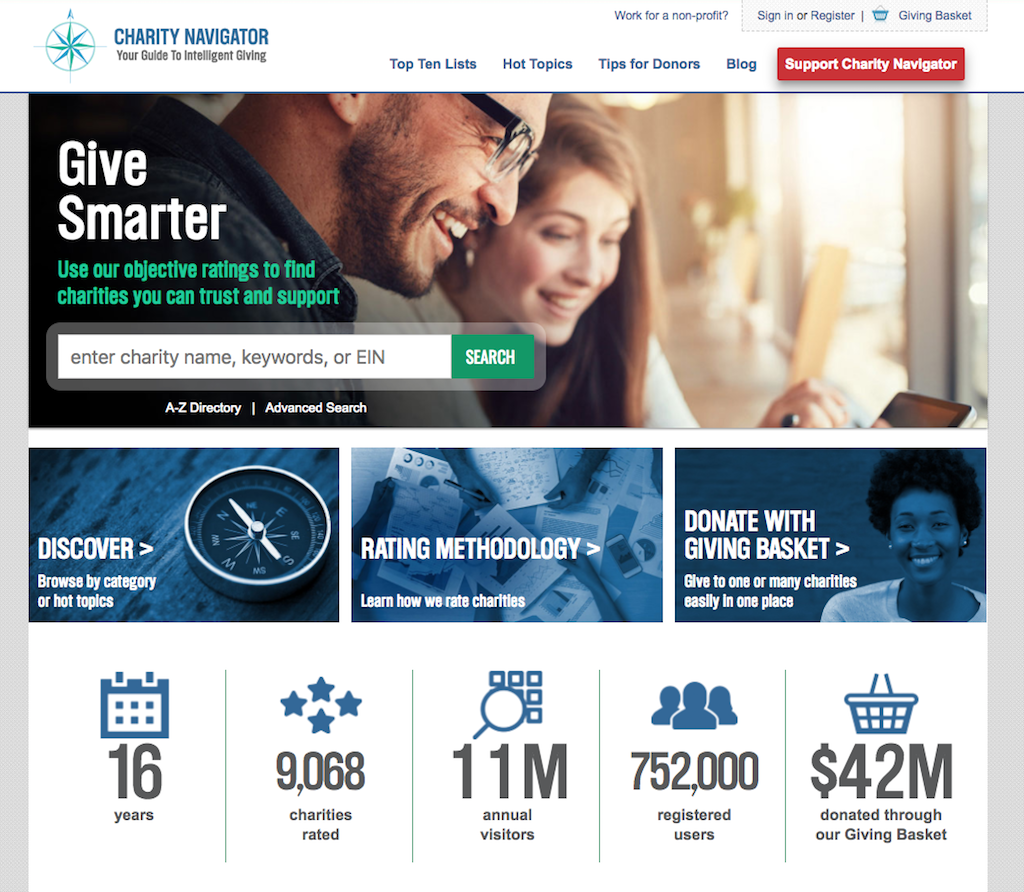
Moreover, the platform declares the creation of the NGO rating on the basis of the reviews of the well -being, employees, volunteers who are involved directly in the organization’s activities, and not on the basis of expert assessments, like the well -known rating platforms of the NPO - Charity Navigator , Guidestars .
The importance of “hearing the voice of the well -being” is increasingly, in particular, international initiatives as the Greatnonprofits platform, which also represents the NGO database with the reviews of well -being, volunteers and employees.
The Charity Navigator rating takes into account the extent to which NGO is collecting feedback from the well -being. Humanitarian Voice Index is a rating of humanitarian NGOs, compiled on the basis of feedback from recipients of international humanitarian aid.
The financial model of the What Charity platform: using the platform for NPOs for free, since May it is planned to enter paid additional services in the Digital, namely, promoting the “trust marketing” model. The amount of the monthly payment will depend on the size of the organization.
What are things in Russia? What are the sources of information about the activities of NPOs?
Currently, the main source of official information about non -profit organizations is the information portal of the Ministry of Justice of the Russian Federation, it is the NPO’s department that are obliged to submit reports on their activities annually; It is here that you can get the most complete and relevant picture of the size of the sector in quantitative terms.
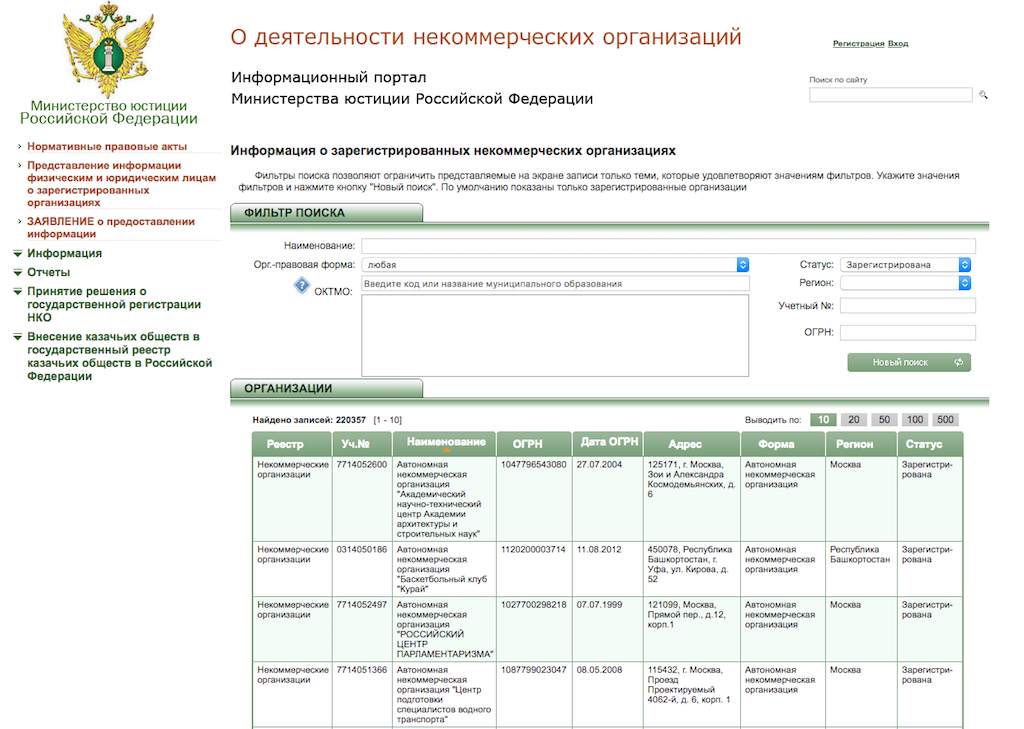
The portal presents a list of all registered NGOs and their reports.
Key restrictions on the portal of the Ministry of Justice:
- low quality data (partial lack of information, repetitions, typos, etc.);
- Data fragmentation - information for each NPO must be searched separately in different registers;
- The inaccessibility, inconvenience of using data for ordinary users and IT solutions (limited search filters, reports in “PDF” format, the absence of an open API, machine-readable format, etc.).
For example, a significant number of NPOs in the base of the Ministry of Justice is absent or incorrectly filled with the OGRN, but only by this unique number, in fact, further identification of NGOs is possible. NP "Information Culture" revealed more than 58 thousand such cases.
A lot is said about the restrictions on the Ministry of Justice’s portal, you can read the material of the greenhouse “ Anna Sakoyan: as the Committee of Civil Initiatives launched the Open NGOs project .
There are more banal things. For example, if the name of the NPO is indicated with a typo, then all its data is practically inaccessible. And typos are not uncommon, for example, the study of the register of registered NGOs allows us to conclude that there are more than 10 ways to write the phrase “Autonomous non -profit organization”.
On the portal of the Ministry of Justice, the user cannot quickly receive information for narrower requests. For example, it is impossible to find out how much in Moscow, and in Russia as a whole, charitable foundations, since the filtration of legal forms proposed by the Ministry of Justice does not coincide with the official classifier of forms.
Another difficult task when using the data of the Ministry of Justice portal is reporting analysis. It is impossible to promptly calculate how much and which NPO submitted annual reporting; Not all reports are displayed on the portal of the Ministry of Justice.
For example, reports of some NPOs that are delivered by mail or personally are not submitted ; There are also banal technical malfunctions-you can often find 2-5 exactly the same reports of NGOs sent at the same time. In the content plan, NPO reports to the Ministry of Justice are also little informative, since only the fact of submission of the report is recorded.
Inside there can be absolutely empty or opaque lines of expenses; Often in rubles there are data on expenses that need to be indicated in thousands of rubles.
The narrow register of the Ministry of Justice has its own restrictions. For example, in the register of NGOs, performing the functions of a foreign agent, only the current list of NPOs is presented. With the exclusion of it from the registry, including due to liquidation, all information disappears. Compare, for example, alternative resources that lead a kind of chronicle of NGOs recognized by “foreign agents”.
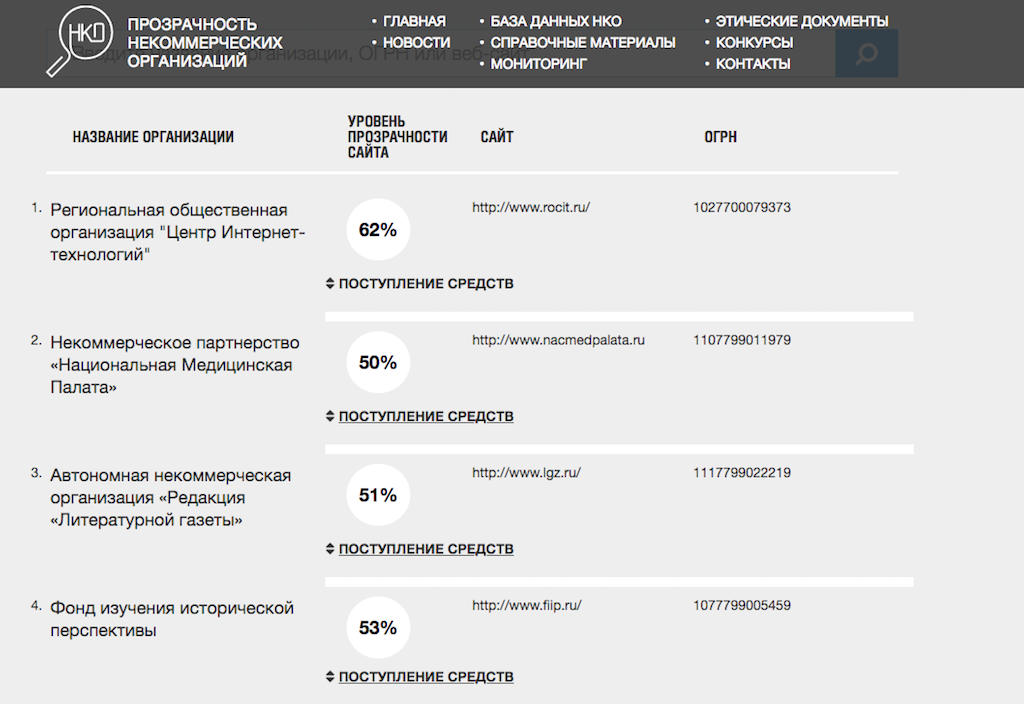
Information platforms of the NCOs, which work on data from the Ministry of Justice, are successfully coping with part of the restrictions on the portal of the Ministry of Justice. For example, in 2017, the “ Open NGOs ” (NP “Information Culture”) and “ NPO Focus ” (“Rybakov-Fund”) were launched.
Among the key advantages of platforms:
- The data is presented in the binding to a particular NGO, and not to the goals of the Ministry of Justice (separate registers);
- Data from various sources, including Craudsing possibilities. For example, the user can supplement the information or report an error;
- more substantial financial information - for example, brief information about state support - the subject of the contract, a brief description of the project;
- Data visualization.
Key restrictions on platforms launched on the basis of the portal of the Ministry of Justice of the Russian Federation
Complete and data update
So far, data renewal processes have not been debugged for any of these platforms. As a result, it is not known exactly when exactly the information about NPOs registered after the launch of the considered platforms will be available. In this case, the only source of data again remains only the portal of the Ministry of Justice.
Not for every NPO on these portals it will be possible to find all the declared basic information: for example, in the NCO-Focus database, not all NGOs have information about the date of registration, and not all NPOs indicate the site in Open NGOs.
Paying part of the problems of the Ministry of Justice base
The impossibility of finding data on NPOs due to incorrect or incomplete information. First of all, we are talking about the lack of a check for the correctness of the name of the NGOs. For example, now 34 “blessing” organizations are presented in the Focus NCO. The typo in the name of the settlement will also not allow you to find an organization in the region, etc.
On the Open NGO portal, restrictions related to the binding to the Base of the Ministry of Justice as a source of data are more fundamental. The filters use the same unsuccessful classifier of organizational and legal forms. Duplicate forms - for example, “movement” and “social movement”; Among the regions of the Russian Federation, we will still find the “Ministry of Justice”. But on the portal of the Ministry of Justice, this curiosity has already been eliminated.
Similarly, as on the portal of the Ministry of Justice, the user will find only a small share of information about the activities of NPOs.
Limited analytics opportunities for an ordinary user
An ordinary user can only find a profile of a particular organization. Find out the number of NPOs of one type or another depending on the filter. Of course, thanks to an open API, more advanced users have ample opportunities if they create solutions according to their own, narrow and complex parameters. For example, you can find out the amount of income of charitable foundations of St. Petersburg.
In the spring of 2018, NP “Information Culture” plans to launch the All -Russian Register of NPOs based on “ Standards of Information Open of NPOs ”. According to the description of the project, it is planned to voluntarily and independent placement of information by NPOs of any form.
The question of how to motivate NGOs to disclose information while open, it is discussed options in which large funds will include the presence of the NPO page on the platform as a mandatory, formal requirement for participants in grant competitions (similar to the Pador European Commission system), which is somewhat contradicting the principle of “voluntariness”.
In addition, such motivation will only work for a limited circle of NGOs applying for budget funds. Almost without affecting the notarial offices, lawyer bureaus, HOAs, garden partnerships, which are also NPOs in their legal form.
Information bases of legal entities as a source of information about NPOs
A fundamentally different source of data on non -profit organizations is information resources about the activities of any legal entities, the source of the formation of which is the Federal Tax Service.
If the base of the Ministry of Justice of the Russian Federation allows the user who has no special IT resources at the disposal of only a certain basic idea of the scale of the non-profit sector as a whole, and also individual depths-foreign agents, performers of socially useful services, then the legal entities aggregate open data for each particular organization, including non-profit ones.
In the Rusprofile database, any user can receive information about the official full and short name of the NPO, the legal address, the TIN, the OGRN, the name of the head and his position, the date of registration and liquidation of the organization, the list of founders, branches and subsidiaries, mainly and additional OKVED.
The volume of information on NPOs on the resources of the legal entities is much wider than on the resources based on the specialized portal of the Ministry of Justice. In particular, they contain the following additional information:
- the presence of licenses for conducting a particular activity;
- facts of conducting inspections and the results obtained;
- Actual organizational changes in NPO-stages of reorganization, liquidation (including date and foundation), legal organization, etc.
In two clicks, the user of the platform can receive information about the connections of NPOs and possible affiliation at the address, managers, founders and subsidiaries.
In this case, the information is updated almost in real time. As soon as NPOs registered in the Federal Tax Service, she instantly appears on the aggregators portals; Similarly, as soon as the liquidation or reorganization process is launched.
Openly presented a large number of similar resources providing the user and wider functionality. For example, for each organization you can see whether disqualified persons are part of its executive bodies; Whether there were no enforcement proceedings, arbitration cases against her; Where and how the NGOs and its leader in the media were mentioned, etc.
As you can see, the volume of current information, automatically presented in open access on legal resources on legal entities, significantly exceeds the amount of information recommended for disclosure, according to the standards of information openness of the NPO .
Highly specialized resources about the activities of NPOs
Platforms of grant competitions
Information about all applicants and winners, as well as projects submitted to the competitions of presidential grants until 2016 inclusive, can be viewed here, and since 2017 here .
Until 2016, detailed information about projects and organization, including contact information, the main areas of activity, the number of employees and volunteers on the date of filing the application, the number of persons and organizations that constantly provided services for the previous year , are presented.
Representatives of the Presidential Grants Foundation report that they are collecting large arrays of data on the activities of NPOs, which opens up wide opportunities for analytics both in a particular NGO and the sector as a whole. Another question is how this data, in addition to the publication of “black lists”, will be available to the sector, is not yet clear.
Similarly, the database of presidential grant competitions is used in conducting research and creating alternative resources. So, data on winners and supported projects are presented on the Open NPO platform, and transparency-R aggravated information about the allocated financial support in reference to specific NPO-winners, and also conducted a study of the openness of these NPOs.
On the sites of large donors, you can also find information about supported organizations and projects, as a rule, we are talking exclusively about the list of victorious organizations and the name of the project.
Regional databases of NPOs
For example, on the portal of the NPO of the city of Moscow “ Soul Moscow ”, 3741 Moscow “Organization of Good Deeds” (as of March 2018) is presented. For each of them, basic information is presented - the name, TIN, OGRN, address, site, phone, manager name, direction of activity. NPOs can create a personal account and supplement the description, list projects, release news, place vacancies and ads.
Features of the Portal Soul Moscow : personal accounts and the creation of profiles of organizations are available for unregistered volunteer associations; the possibility of unhindered changes in “official information” is the name of the NPO, address, name of the head, TIN, OGRN; the involvement of residents and volunteers - through a system of likes and winds of news, pages; Reporting on grant competitions on the portal; Providing additional information on NPOs for representatives of executive authorities.
The Rusfont. Navigator project contains information exclusively on fundraising charitable foundations that collect mass donations. The resource presents a list of such funds, filters in the areas of assistance of the fund, the amount of funds raised, software and administrative and managerial expenses.
The catalog of NGOs - providers of social services and socially useful services that conducts the National Fund for the Protection of Children from Cruelment , contains information about the services provided and NPOs, including the budget financing received. Organizations have the opportunity to post their methodological materials and exchange the experience of the provision of services.
Verified Platforms LISTINGS NGOs. For example, 135 “Honest Funds” are presented on the Fandraise platform of Dobr.mail.ru , there are lists on similar Platforms Blag and all for one . A peculiar verification is also provided by NPO associations with fairly rigid principles of membership, such as the charity collection “ All Together ”, the Association of Fandraizers .
The register of unscrupulous suppliers contains information on the causes, date of entering or excluding a legal entity from the registry. In our case, NPOs.
The unified federal register of legally significant information about the facts of the activities of legal entities, individual entrepreneurs and other subjects of economic activity: the resource helps to clarify the legal form for almost every NGO, which in some cases can be very useful when the name does not allow unambiguously identify.
For example, the organizational and legal form of the International Information Agency "Modus Vivevedi International"-a private institution; And the Oka sports and technical club is a non-profit partnership.
In the future, it is on this resource that it is planned to publish mandatory audit reports.