
Translated material
Khengis Khan's descendant in the Kremlin
In anticipation of the next inauguration of Putin, it makes sense to recall that such a long rule has become possible thanks to the “successor” operation. However, in this maneuver of GDP - not the first
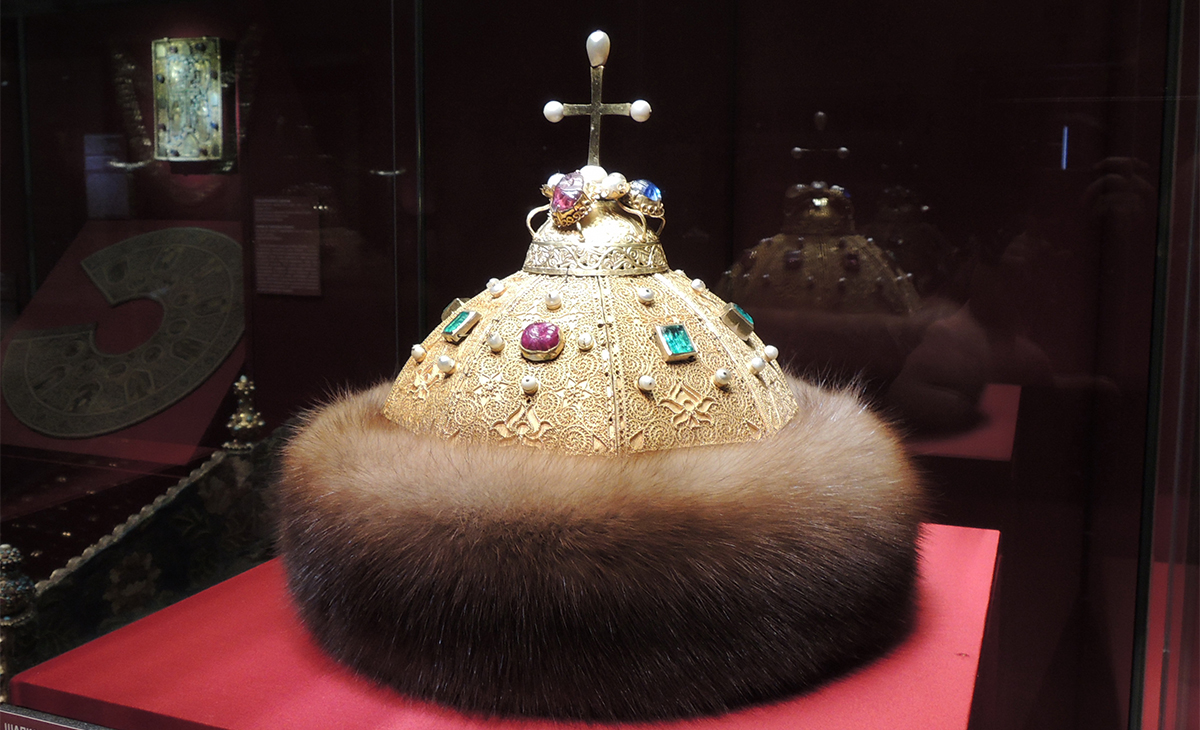
Photo: Wikimedia.org
"We have always been free to complain to our slaves ..."
Ivan the Terrible. From correspondence with Prince. Andrei Kurbsky
Russian history knows, perhaps, the only precedent of the temporary transfer of the Supreme authority in the country from the current ruler to the person chosen by him. In the 16th century, Tsar Ivan the Terrible, known to one as the creator of the centralized “vertical of power”, and the other as a bloodthirsty despot, who ruined thousands of his subjects, formally transferred the scepter and power of the Tatar prince Semen (Simeon) to Bekbulatovich, to soon return to the Kremlin “the sovereign of all Rus'”.
Blink or treachery?
In the fall of 1575, the new Grand Duke of All Rus' was solemnly crowned in the Assumption Cathedral of the Moscow Kremlin - his name was Semen Bekbulatovich. Tsar Ivan the Terrible, whose death has remained for almost a decade, became just a Moscow prince. This story still remains very mysterious: the surviving sources are not able to clarify many “white spots”. Most historians only casually mentions this incomprehensible incident - either the whim had such a formidable king, or his political insidiousness appeared, and perhaps the influence of otherworldly forces was not quite understandable.
However, today the plot completely unexpectedly gained relevance. Of course, he did not become less mysterious from this. On the contrary, it is quite possible that now the story of Semyon Bekbulatovich will become almost our main state secret. Is it a joke, it turns out that the tsarist title in Russia can be transferred for a while to a third party, not risking losing it forever and maintaining real power with a formally different head of state. The form of government does not change, and the script participants act within the framework of existing legislation, observing all the adopted rules and norms.
"Thaw" by Ivan the Terrible
Perhaps for some of the contemporaries of the 70s of the XVI century in Moscow could look like a time of relative liberalization. “Tyranism seemed tired,” says Nikolai Karamzin. Of course, only compared to the horrors of the previous decade. In the 1560s, dividing the country into a caste of a servant (oprichnin) and all the others (Zemstvina), the power in the person of Tsar Ivan, in fact, declared a civil war to its own subjects. Mass terror was carried out not only in relation to noble boyars, but also a significant part of service people and citizens. Entire cities and regions were subject to defeat. Black horsemen with dead dog heads and brooms near the saddles, which quickly turned quickly, according to historian Stepan Veselovsky, into a gang of robbers.
The end of the oprichnina is also known: the punitive detachments of the “security forces”, designed to fight mainly with the unarmed population, could not withstand the raid of the troops of the Crimean khan. In May 1571, the oprichnaya army shamefully fled from the battlefield, and the Tatars with impunity plundered and burned Moscow. Tsar Ivan himself, who for a year unsuccessfully fought Livonia, drowning Estonians and Latvians in the blood of the Earth. In 1572, disappointed in his bladion devoted and likely mediocre servants, Grozny destroyed the oprichnina. Any mention of her was prohibited under pain of cruel punishment. The guide day ended with a gloomy hangover - the country was ruined, foreign policy was failed, the capital was burned by the enemy.
For Ivan himself, difficult times came. Understanding the degree of his own responsibility for committed atrocities, he was looking for ways to, as the American historian Georgy Vernadsky writes, "to maintain power and ensure personal security." In 1572, the king wrote a will, in which he actually recognized himself as the worst tyrant “to the best of Adam” (and then his mania of greatness affected!). He commanded his sons to judge their political offenders “conscience” and show mercy. A year later, in a letter to the brethren of the Kirillo-Belozersky monastery, he called himself “an unclean and nasty arc”, declaring the opportunity to go to monks.
The exit was found after astrologers predicted that in 7084 from the creation of the world in the Byzantine era (from September 1, 1575 to August 31, 1576), the Moscow king should die. Being a good chess player, Ivan the Terrible decided on another desperate, but, as it turned out later, a right step.
The successor for a year
* He died in 1566 during a military campaign somewhere in the Baltic states
Just at this time, Ivan the Terrible had a new favorite. The Tatar young man Saina-Bulat, the son of Bek-Bulat, who moved to the Moscow kingdom around 1558*, came from a noble family. "Rod Big Hordes of Kings" led its story from Genghis Khan himself. These are the troops of his great -grandfather, who ruled the Golden Horde of Khan Akhmat, stood against the Russians on the Ugra River in 1480.
Not later than 1570, Saine-Bulat became the "king in Kasimov." The specific Kasimov Khanate has existed since the middle of the 15th century as a Muslim outpost subordinate to Moscow, the detachments of the Kasimov Tatars constituted a significant part of the army of the Moscow Grand Dukes. It is characteristic that even then, being the “king” of nominally independent education, the Saine-Bulat was simultaneously called the “servant” of the Moscow sovereign-this principle in relations with Ivan the Terrible was preserved in the future.
In 1572, during the next campaign in the Estonian lands of the Livonian Order, Saina-Bulat was appointed the first governor in the Russian army. A year later, in July, he accepted Orthodoxy, receiving the name of Semyon (Simeon) Bekbulatovich. Then the marriage was held on the princess of Anastasia Mstislavskaya, whose mother was the daughter of the baptized Kazan prince Peter and the niece of Grand Duke Vasily III, the father of Ivan the Terrible. So the descendant of the Saine-Bulat Genghisides became Semen Bekbulatovich, a relative of the Moscow Tsar and all Rurikovich. This is not to say that he was a successful military leader and statesman: in 1573, the troops headed by him suffered a crushing defeat at Loda. But apparently, there were other, more significant qualities for a career at the Moscow court.
The candidacy of the Tatar Tsarevich was ideally suited for the role of a “successor”, capable of obscuring the mistakes and crimes of Ivan the Terrible temporarily fading into the background. He switched at himself growing public dissatisfaction: one of the sources says that Grozny, putting Semyon Bekbulatovich on the throne, wanted to check, "how people will react." It is important that a baptized foreigner, relatively young, not connected with any of the boyar groups in Moscow, who did not have significant power resources, was entirely dependent on the patron of him. This gave a guarantee that the new nominal head of state “would not accept his role too seriously” and would not really rule.
However, the Grozny, known to his paranoia, was afraid of “treason” here. Not trusting the “successor”, in the fall of 1575, he secretly negotiated with Queen Elizabeth I about the possibility-in the event of a situation out of control-obtaining political asylum in England. The British, however, were in no hurry to accept the ruler who became famous throughout Europe, like a bloody Asian monster.
"Security forces" plus money ...
Ivan the Terrible began to seriously play in the “political masquerade” invented by him (as Vasily Klyuchevsky described the incident). Having simply become a “prince of Moscow”, he moved from the Kremlin to Petrovka. The chronicler reports that after the “change of profession”, Ivan Vasilievich behaved in full accordance with the court etiquette accepted in Muscovy: “Tsarovsky gave all his rank to Simeon, and he himself simply traveled like boyar, and as he would come to the king Simeon, the places are far from the king, along with the boyars.” The Grand Duke Simeon sat "in the royal place."
However, this was only in Moscow and central counties. In the lands inhabited mainly by foreigners, for example, entering the conquered Kazan Khanate, power was still carried out by the name "Tsar and Grand Duke Ivan Vasilyevich of All Rus'." Most European states, with the exception of England, did not inform about political changes in Moscow. All international affairs are still led by Ivan the Terrible.
On the eve of the entry into the throne of Semyon Bekbulatovich, the next mass executions took place in Moscow: one and a half dozen unclenched guardsmen, a former adviser and favorite of the formidable Prince Boris Tulupov, the Novgorod Archbishop Leonid - they, according to the sadistic plan of Ivan, were “sheathed with Bear”. This was called a way of execution when the victim was sewn in a bearish skin, and then they poisoned with dogs to death.
However, things were much more important. Soon, the name of the newly -made Grand Duke Semyon Bekbulatovich came a petition from now just the prince of the Moscow "Ivantz Vasiliev with his kids." The compliance was even a derogatory serving form of appeal to the king, adopted in the Kremlin office work. At the end there was a mandatory phrase: "Sovereign, have mercy, perhaps!"
The request was trifling: Grozny asked permission to choose new service people. Thus, instead of discrediting his guards, he received a new loyal army under the guise of a reorganized “princely court”. However, the powers of the new "security forces" were cut off in comparison with the Opring times. Semen Bekbulatovich took responsibility for this.
According to the English businessman Jerome Gorsey, Ivan the Terrible shifted to the new Grand Duke "responsibility in deeds and debts regarding the treasury." Semyon issued a decree that refused to recognize all the old debts of the state and canceled tax privileges, previously complained to monasteries and cities. The first thing that Grozny did, returning to the throne, was canceled the ill -fated decree.
The masquerade is over
Already at the end of January 1576, in an interview with the English messenger Daniil Sylvester, Ivan the Terrible hinted that his “successor” had not come forever. “Although we showed you the external construction of another in imperial dignity to the throne, but this construction on the throne did not mean our resignation, but rather that by our decision we can again take on this dignity and do it according to the command of God, because it was not crowned or elected, but erected by our will.”
Most likely, by this moment Grozny has already managed to update personal guards. Until the end of 7084, the prophecy about the death of the Moscow king did not come true. Eleven months after the wedding in the Assumption Cathedral, Semen Bekbulatovich was removed from the post of Grand Duke of Moscow, and already on September 2, 1576, the sovereign in the Kremlin was again Ivan Vasilievich. Times, apparently, were really more “vegetarian”. The “successor” carefully played the role of the “successor” was not all alive, but in the order of gratitude for the service they made the Grand Duke of Tversky, giving two cities - Tver and Torzhok.
The problems began later, when after the death of Grozny, the seeds of Bekbulatovich began to be considered as a probable enemy in claims to the throne. Boris Godunov deprived him of princely inheritance, leaving a small estate in the Tver village of Kushalino. The former Grand Duke blind (according to other sources, Godunov’s people blinded him) and lived in poverty. False Dmitry I first returned him to Moscow, but after a public quarrel, he tonsured the monks and, under the name of Stefan, sent to the Cyril-Belozersky monastery. And Vasily Shuisky was completely exiled to Solovki. Tsar Mikhail Fedorovich returned the elder from the disgrace, but in 1616 he died and was buried in the Simon monastery.
Thus ended the path of a man who once and forever became a hostage to his own ridiculous position.
First published in NT No. 13 dated March 31, 2008