Translated material
Joy in a bold cry of a bird
Gorky and rockets
At the folk naming competition of the latest Russian weapons, the names “Poseidon”, “Peresvet” and “Petrel” won. “Petrel”, we are sure, a literary bird, comes from the “Songs of the Petrel” by Maxim Gorky. He is returned to the actual context with the energy of public memory and became part of the new Russian triad. Evgenia Pishchikova - about the adventures of folk naming.By mid -1968, the Volzhsky Automobile Plant announced a popular competition - the choice of a name for a mass car. The future “penny” was preparing for the release - a fiat -like, half Italian, long -awaited. But there was no name “Zhiguli” yet - it was just supposed to invent it. In Soviet Russia and the magazine “At the wheel”, competitive conditions were printed; The total counted eighty -five thousand letters came.
A virtuous, conformist wave of proposals poured. Many names were appealed to the upcoming bright holiday - the centenary of the birth of V.I. Lenin. “Stoletka”, “Leninavt”, “Leninskaya Asterisk”, “Tazvil” (Togliatti Automobile Plant Vladimir Ilyich Lenin). At the same time, that is usually for the official Soviet Massquult - before us is a product of marginal innocence. Not a shadow of a grin in these names.
Following was a foreign, romantic line - Rossita, Friendship, Sophie, Itaros, Sovital, Desina (brainchild of the Soviet and Italian peoples), “Chipollino”, “Garibaldi”.
Further-a cosmic, civilian-romantic topic: “Valentine”, “satellite”, “lunnik”, “comet”. And in the end, “good” names hastened - “lark”, “swallow”, “dream”, “friend”, “song”, “violet”, “clove”.
Yes, there were also divine sentences - “Aurora” and “Venus”. If only Aurora is about dawn.
The five finalists turned out to be such - “Volzhanka”, “Friendship”, “Dream”, “Lada” and “Lada”. It’s quite a laid verbal company, a non -hustle, but cheerful message about a dream and ways to find it. A good, pure invented life shone ahead. Half of the twenty -first century. In the unit - it was necessary to stand in line for the "Zhiguli", passionately wish for goods, wait for changes.
Exactly fifty years passed. And the Russians were called to another common cause - to come up with the names for three marvelous types of new weapons: an unlimited range of an unlimited range with a nuclear engine, a combat laser complex and a unmanned submarine.
Is it possible to compare these two competitions? The car, it would seem, embodied privacy, the image of private well -being, the personal world. Own - separate and separating.
And our three weapons complexes are a joint symbolic possession that works for the production of collective fear on an industrial scale and various types (intimidation for the enemy, comfort for “their own”).
But there is a common one: the Soviet folk car grew, of course, as a community achievement. He was "scheduled" to the country. It was a typical Citroen “Goddess” by Roland Bart: “In my opinion, the car these days is a very accurate equivalent of the great Gothic cathedrals: this is a grandiose epoch -making creation created by inspired and unknown artists and consumed (in the imagination, albeit not in practice) by the whole people; It sees a purely magical object in it. ”
Actually, the main car of the Fatherland in an industrial society (how long has it ended?) And was just part of the country's symbolic capital. An important detail in the construction of the national frame of pride. A kind of emblem of statehood itself.
What then happened to the "Lada", what symbols they overgrown and, as the state -mover represented, is the following thing. At first they were a magical subject.
And here are the new magic objects of our time - fresh weapons. How is the naming work here? How has the people's personality changed? Are there any coincidences in the proposed names?
There are coincidences, oddly enough. Two pieces. The unmanned submarine was offered to name Aurora. It seems to me that in the case of the “Zhiguli” and in the case of the sea rocket, not pink -pipe EOS surfaced in the memory, but the cruiser Aurora, who made his famous shot.
And the second coincidence required a small investigation and brought pretty results. “Lada” could be called “Palmiro”, this names almost entered the final five.
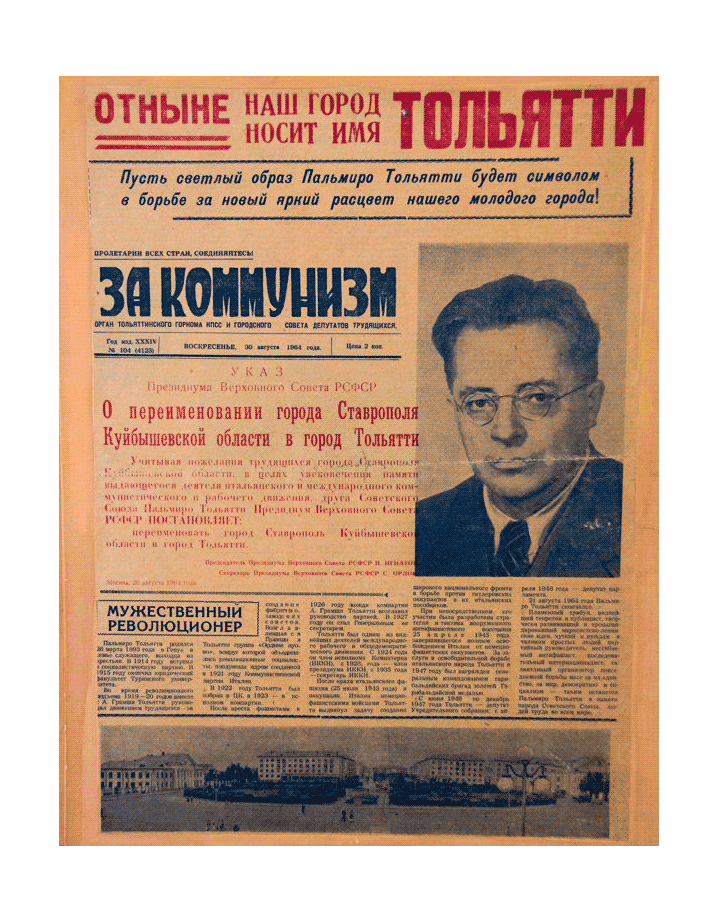
Newspaper "For Communism" of August 30, 1964
Photo: chronograph.livejournal.com
And Palmyra-in honor of the soldiers who died in Syria-suggested to name the winged rocket of Mr. Kadyrov. This option was the leader for a long time, and when the final name was still different, even a small scandal broke out. Did the Ministry of Defense (where the competition took place) on the website)?
But in the sixty -eighth year, what is Palmyra? What Syrian sadness? Palmiro Nikola Michele - that was the name of Togliatti, the Secretary General of the Italian Communist Party, who died in the Crimea in August 1964, where he was treated, and in whose honor the city was named - Zhigulina cradle. Palmyra is a city of palm trees, and the name Palmiro means “carrier palm branch” and is traditionally given to boys born on Palm Sunday. I looked at Togliatti's birthday - March 26. Born in Genoa, on a holiday, on a sunny day, when the Italian temples are similar to greenhouses, to the Primorsky promenade.
In this petty, no important detail, a life is felt, which is more fully, lighter, bizarre, more confused, meaningful than we are talking about. Three of our missiles. Which is movement, grin and repetition, not a stop and fear.
By the way, about the grin. Here is the main difference in the "People's Personality" of the contestants of 1968 and 2018.
In 1968, she, a person, is proud, touched, romantically worried. Which, of course, testifies to the complete absence of protest desires or a sense of funny in the middle sixties, but about the strict selection of sentences and a strictly defined (and tightly educated) norm of a public statement. The tone of statements is a bright hypocrisy.
But according to the hypocrisy, you can get bored, since it is part of the order. Today, the contestant does not deny himself anything. It can be assumed that the people who call rockets are amazingly funny. The names are offered such - “Cheburashka”, “aspen stake”, “sun bunny”, “peace”, “ophthalmologist”, “non -lady”, “hyperboloid”, “flyboy”, “teacher”, “jacket”, “vatnik”, “love” (“from Russia with love”), “guarantor on the ground”, “leader”, “leader”, “leader”, “leader”, “Sanction”, “Pupsik”, “For the boys”, “Cherry”, “Capitop”, “Natasha”, “American Dream” and “Arctic fox”.
Cruming over the enemy is ancient fun. But the current contestant, it seems, imagines a war as a genus of rap battles. The troops were built, and not the fighters go to the clean space between the opposing, but the youths with the dlanes put forward, and the enemy is ridiculed. Whoever has better Pitchi will win.
I can’t even figure out what kind of tradition is behind this new hero. Not a left-handed person (“Our mark on your no-ka”), not a Shchedrin man, not a Terkin, related to war with a grin persistent humility. In the comments, a special Russian character is constantly stipulated, which has the value of authenticity in through and through a formalized, fake world. Russian does not recognize other people's rules. Does not accept established hierarchies. He laughs at the terrible.
In this characteristic there is too much child to consider this character real. This is a description of an excessively young hero who does not actually believe in the existence of trouble and death, but we live in a middle -aged and tired country.
“Only we are able to call weapons floral names!”; "Only Russians can have a flamethrower system" Pinocchio "!" - So the contestants say about the traditions of bizarre names for weapons, which, indeed, are available. Weapons in Russia are called with a light. Artillery complexes are really “acacia” and “tulips”. Truly terrible - at the same time - only the names of special equipment that are at the disposal of the internal troops. The handcuffs really have the commodity name "tenderness". Shocker - "affection". This is the real joker. Real. Adult. And as for Pinocchio, why did we get that this is a truly Russian feature - to manage fear or danger with the help of a “reduced” name?
The first American bombs, dropped on Hiroshima and Nagasaki, called a “fat man” and “baby”. This is a universal story - to laugh at what scares, this is an attempt to tame evil, to create the illusion of element management, which is more complicated, more complicated and darker than the conscious.
Do you know what the three very first Soviet bombs were called? Oh, the very first one was called “Product 501” for a long time: it is interesting that the secrecy in Naming coincided with sanitary bashfulness - if we recall the famous “Products number two”.
But then the bombs received names. They called Mary, Tatyana and Natasha.
In a rough approximation, a significant triad accidentally turned out: sacred, cultural and folk. Because Tatyana is always Larina, but Natasha is not Rostova; Natasha - she is communal, mass, folk.
It is exactly that and the result of the current competition. Whether the situation was controlled on the website of the Ministry of Defense to win the most serious, “adults” options, or it itself is so - this is not important.
 But it turned out a completely clear message. The names of missiles as a story about who we are. What we carry. As a letter to aliens launched into orbit.
Actually, you can already start with the fact that the three types of weapons proposed for the name are in themselves a nuclear triad. This is an underwater projectile, a winged rocket and a ground gun. Earth, water, air. The second and third days of creation.
They are called “Poseidon”, “Peresvet” and “Petrel”. God, hero and symbol. Antiquity, Middle Ages. New time.
Poseidon is a sushi oscillator, the supreme god of the sea in ancient Greek mythology: “O Blain -haired holder of the Earth Poseidon, heed me, a horseman holding a trident in his hands, made of copper cast, you, the inhabitant of the depths of the secrets of the wide sea, a show -off, which is heavy powerfully rumbling with ramparts! O heslifting of the earth, that, lifting powerful waves, you drive the four horses in a chariot, oh you, marvelous, with a splash, explodes the salty surface in countless splashes. "
Peresvet is a warrior, who came down in front of the Kulikovo battle with the strongest fighter Chelube and defeated him at the cost of his own life.
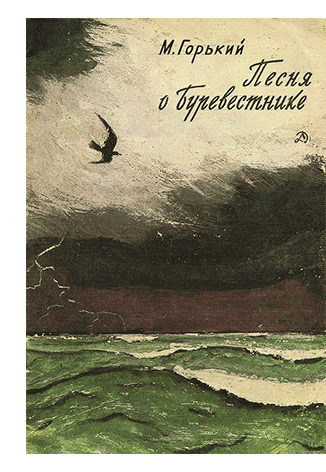
The Petrel is a symbol of the revolution and revolutionary upheavals that are accepted as joy and delight. The Song of the Petrel was written by Maxim Gorky in 1901 in response to the acceleration of the student demonstration near the Kazan Cathedral in St. Petersburg. She had extreme popularity, dispersed thousands of lists. It was recited at the gatherings and journalists of advanced youth. The girls cried, reading.
But for us and, I think, for those contestants that the naming proposed, the Petrel not so much of the revolutionary romance and mythology as the image of the Soviet. The assembly hall, the shoulders of the music teacher are tense, the powerful bapto follows; On the stage, a schoolboy-deck, who was a pause, is prepared to cry out: “Storm! A storm will run out soon! .. ” In the hall - foal teenage laughter. But the text is unforgettable. I think that if the contest for the nickname for American pro were announced, they would immediately be called "timid penguin."
The combination develops like this: the continuity of world culture, the heroization of Holy Rus', Sovietness. World. Rus. USSR.
This is made of this - and beautiful. Who would protest. The message is no worse than others. One trifle prevents the reasonable triad from rejoicing: it is written on missiles.