
Translated material
On the day of the Last Aesthetic Court
About the first book of the philosopher Georgio Agamben
The desire to evaluate works of art and books played a bad joke with Europeans: instead of just reading and watching, experiencing some experience, we endlessly criticize everything and often splash out the child with water. In any case, this is how the Italian philosopher Georgio Agamben writes in his first book “A Man without Content”: at the request of Gorky, Sergei Sdobnov talks about this work, which finally came out in Russian. Georgio Agamben. A person without content. M.: New Literary Review, 2018. Translation from Italian S. Ermakov
1970. Gaddafi headed the government of Libya, Mao Zedong accused the Soviet regime of “inveterate neocolonialism”, in Italy the underground National Front of Prince Borgheze is preparing a coup d'etat, which is destined to fail. The young lawyer writes his first book for 28 years - in Russian it will be released in 2018 under the name “Man without Contents”.
By the beginning of the seventies, Georgio Agamben had already played the Apostle Philip in Paolo Pasolini’s film “The Gospel of Matthew”, visited Heidegger seminars, made friendship with Ingeborga Bakhman, Elsa Moravia and other European intellectuals, but was not yet known to the general public. His sensational works are “coming community” (about the future without subjects) and the cycle of books “Homo Sacer” (about disrespectness in modern society) will appear at the end of the 20th century. Perhaps, the most popular biopolitical aphorism of Agamben in the 2000s: Europe is a concentration camp, and a state of emergency is a regime in which a person loses his rights and can do anything with him without looking back at the law, since the very emergency is part of the adopted system of norms. But Agamben devoted his first book to another - the role of art in modern society and the emergence of a viewer and reader, critically evaluating the works of painting, sculpture and literature.
On July 5 or 12, 1671, Madame de Sevigne, a French writer, composes a letter: “Sometimes I think where the passion for this nonsense comes from: it is almost inexplicable. You may remember to what extent a bad style is fragmented for me-after all, I still understand the good, and no one touches the charm of eloquence like me. La Kalpreneda style is terrible in thousands; huge periods, ugly words; I feel all this ... I find that the La Calpreneda style is disgusting, and, however, I can’t resist and catch his bait: the beauty of feelings and the cruelty of passions, the greatness of events and the wonderful victories of formidable fencers - all this attracts me, as if a little girl; If it were not for the consolation of Mr. Laroshfuko and Mr. Aquille, I would hang myself, at least once discovering this weakness in myself. ” In these records of the public intellectual of the New Age, two intonations are important: the author is sure that he has the right to make aesthetic judgments, understands what good and poor art is, and at the same time feels a growing craving for “easy” art (which will later often call (not) art). Madame de Sevigne is afraid of this contradiction, as if the risk of being caught by the hand during the evening viewing of the “Simpsons” instead of the “sacrifice” of Tarkovsky. Agamben also explains our craving for Radi-Madya, Kitschu, pop art: “The whole vast zone of the external world and our sensuality, which the critical judgment has expelled into the underworld of non-art, begins to realize its own necessity and dialectical function and, rebuilding against the tyranny of a good taste, now leads its rights.”
 Madame de Sevigne. Portrait of Claude Lefera
A contemptuous attitude (while still at the level of vague unrest of the soul) to high art depicts, for example, Robert Muzil in sketches to his famous novel “A man without properties” (Agamben’s title refers to his name): “Ulrich (also appearing under the name Anders) enters the room where Agatha plays on the piano, and feels the vague and uncontrollable in itself. The impulse, prompting it to shoot him several times from a pistol into a tool, from which such an “inconsolably beautiful harmony is spreading around the house.” Following Nietzsche, Agamben calls “the most terrible of all guests” nihilism: “value” of art can be measured only against the background of “depreciation of all values”. The hero of Muzil lives on the border of the two worlds of dying pre -war Europe and the future, in which he will have to shoot more often than to talk. In order to survive in this spreading world, the hero is trying to understand that around and inside him can still be called alive. Agamben notes that the art in the grip of “good taste” seems to lose all its value, emasculates and turns out to be as far from the viewer and, paradoxically, from the artist: “The more thinly his taste becomes, the more his soul spontaneously attracts everything that the good taste can only reject, as if in the depths of a good taste there is a desire to pervert into its own opposite.”
The emergence of a good taste is primarily associated with the very need to “speak out”. Critical thinking is so much in a person, Agamben remarks, probably referring to his environment, “that, faced with a work of art, we are not so much trying to penetrate into his secret vitality and identify with it as we represent him in a critical frame of aesthetic judgment.” The new exhibition of Pepperstein or the film Zvyagintsev force the viewer to immediately speak out about them, and often the experience itself is lost. Agamben compares the viewer with a medical student who looks at the patient's pulsating organs, but does not see a person in front of him: “Our understanding of nature has become so vague-and the human presence in nature has grown so much-that, meeting with the landscape, we are increasingly unpronounceingly compare him with his shadow, asking ourselves, it is excellent or ugly, and we become ugly, and we become an ugly-and we become we becomes ugly. It is increasingly difficult to distinguish from the work of a fragment of a stone or a piece of wood, gnawed and trimmed with a chemical effect of time. ” The tyranny of judgment penetrates into all spheres of our lives - in fact, controls our emotional experience: we evaluate our vacation and weekend, and how the book that we was given to us is published.
Together with the degeneration of our non -critical experience, “man without content” finds himself in the power of mediocre judgments about art: “As if for a whole century, the rule has dominated that a good critic should make mistakes against a good writer: Wilman polemicized with Chateobrian, Bruneter rejected Stoldal and Flobert, Lemeter - Verlene and Mallarm, Croce - Croce. Disqualifies Rimbae and Mallarm. " If you continue the logic of the philosopher, then the profession of the observer itself is most often focused on momentary books, exhibitions, films - for example, you can open a book heading in Guardian, articles there often begins with the phrase “Bestseller, 1,000,000 copies have already been sold in the world”, and then there is a slight retelling that does not end there. Agamben, with examples from past centuries, shows that due to the emasculation of a critical judgment, the reader becomes a victim of linguistic violence-the judgment begins to form his vision of the world. (We note in brackets that Agamben’s writer's manner is terrifying: he illustrates each of his thought with a few examples, jumping from the art of Hellas to Rimba’s torment, and in order not to fly outside his text, you need to constantly participate in the game in the classics).
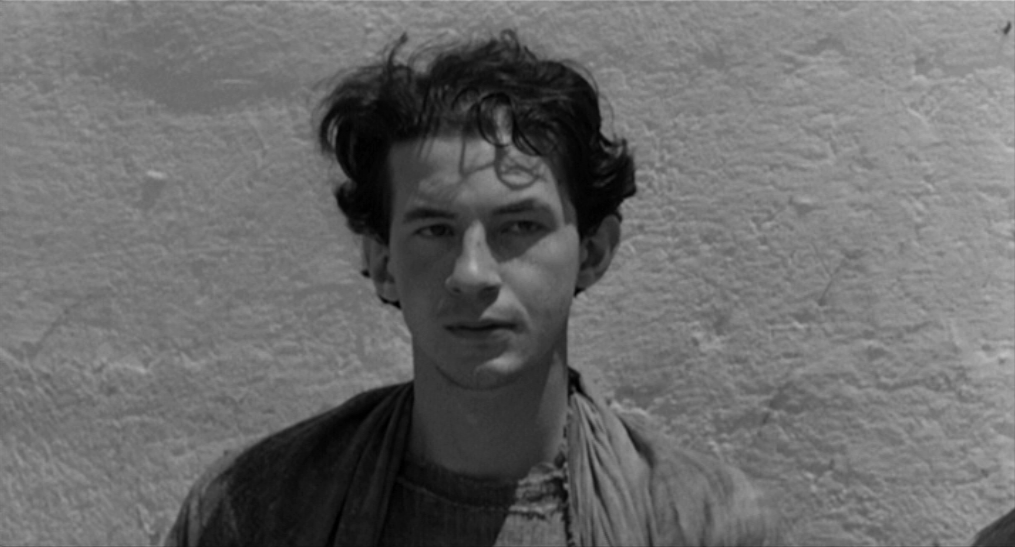
Georgio Agamben as the Apostle Philip in Paolo Pasolini's film “The Gospel of Matthew”
Photo: Libcom.org
In addition to accusations of the human race of aesthetic weakness and craving for quick sensations from "simple" art, Agamben answers an almost ontological question: why is art needed today? The version of the Italian philosopher was born, most likely, in the process of editing the Italian publication of the works of Walter Benjamin, who noted: "Cittees in my work are similar to robbers that jump out onto the road with weapons in their hands and take away convictions from an idle passerby." The author of this phrase, perhaps, was the first to realize the fundamental change that occurred with the very transmitted culture: for Benjamin, a special power of the quote does not arise because it revives and conveys the past, but, on the contrary, from the ability to “shake out, tore out of context, destroy”. Agamben already in the first book demonstrates its crown method - it questions obvious knowledge. So, a quote for a philosopher becomes not evidence of a particular time, but an independent phenomenon - in fact, the weapons of critics, in the ranks of which other professionals involuntarily fall: “The collector in the same way“ quotes ”the subject outside its context and thereby destroys the order within which the object has gained its value and its own meaning.”
If the author of the “work of art in the era of its technical reproduction” was responsible for the spirit of the time, an angel of history from the picture of Klee, an angel’s assistants from the engines, “melancholy”, always directed forward from the picture of Klee. In the Messianic stop-frame, he looks at the objects in front of him-the millstones, rubbings, nails, hammer, ruler, forceps, saw-and they turn into the emblems of something inexpressible, torn from the context and deprived of the story: “The deliverance, which the angel of melancholy offers the past, citing it in such a way that it appears outside the terrible aesthetic court. The real context, there is nothing but his death (or rather, the inability to die) in the Museum of Aesthetics. And the Angel's melancholy is the consciousness that he has turned the extraction into his own world, as well as nostalgia for reality, which he cannot have otherwise than making it irreal. ”
A person without content is not a specific human type, but rather a diagnosis that young Agamben makes the era of modern and its offspring, modern artists and spectators trying to maintain their connection with the elusive past in a work of art.
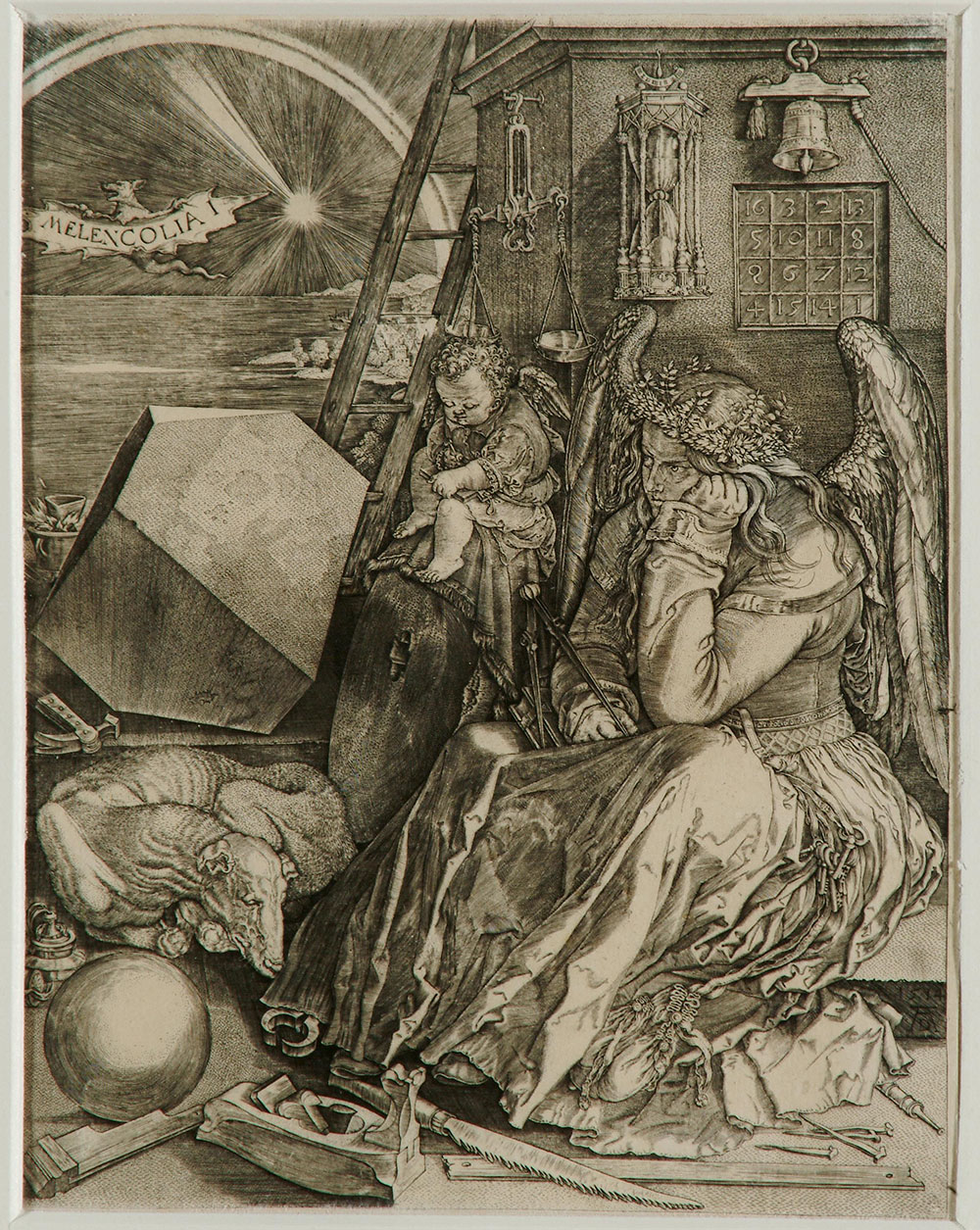
Albrecht Durer. Melancholy I. 1514, engraving
Photo: Public Domain