
Translated material
Person of Medea
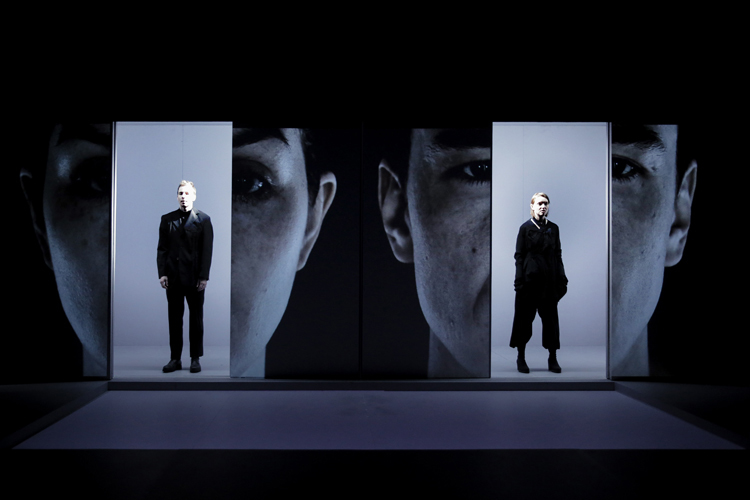
The directorial fate of Evgenia Safonova seems to be unable to begin. Not a single performance, released in almost ten years of practice - even highly appreciated, benevolently accepted by the public and won awards - still does not guarantee the young director of a sustainable position and a stable career.
Perhaps this is the highest form of recognition.
While her colleagues-people put small, cute (for sure), intimate and creative-possessive performances for relevant domestic plays, while others enjoy various experiments in the field of post-dramatic homeopathy, Evgenia Safonova chooses the myth, scale, scope, rhythm, calculation, expanse, structure, structure, structure, structure, structure, structure, structure, structure, structure Geometry, pathos ("in the good sense of the word", that is, in the original). In those days when the “classic” theater calmly calls the matinee in the small one (even if the matinees do not play there), this harsh young woman does not resemble that “classic” is, first of all, the ancient Greek. In those days when the “horizontal” theater is included in fashion (for many highly moraine reasons), it luggs into the theater the most “vertical”: at the top of Olympus, below the Hades, in the middle of yourself, you know what, of course, the sea.
On the small stage of Alexandrin, she released the "kings" of Cortasar; The scene was small, but the labyrinth was endless and the minotaur - the present, not to mention Ariadne and the choir. In the “Comedian shelter” she made “brothers” (Karamazovs) - the bodies of the obsessed people every minutely shook inhuman fever, in the final in the most shocking way explaining its infernal nature. In the “Face of the Earth” - the educational of the Tuzov’s performance about the protection of ecology - was impressive not only by the scale of the conversation, but also by the bitterness of the restrained “superhuman” stoicism: “Here is another planet dies ... What do you think about it, Kronos?” It is clear that in the end, the most caressed performance of Safonova turned out to be “two poor Romanians speaking in Polish”-everything was, as it should be, witty and on two chairs.
 © Anastasia Blur
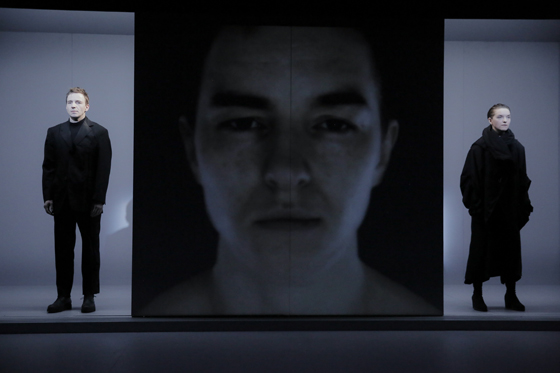
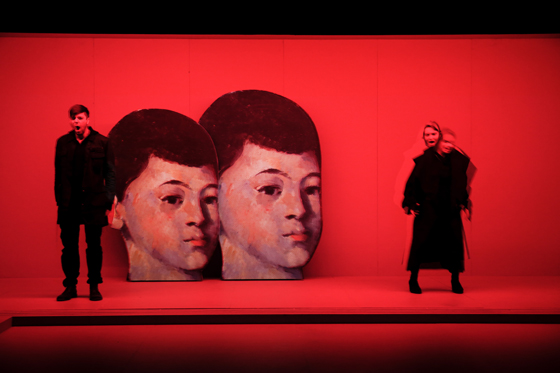
But Evgenia Safonova did not change her calling to cut the chthonic elements into the right rectangles. In its unifying texts of Euripides, Seneca and Hayner Müller “Medee” (where she is the director and artist) the sea splashes on white mobile shirts, rapidly shining space. Two children's heads cut out of cardboard set the scale: they are more human height, more choir, Jason and Medea itself. White panels are either connecting or disconnected by the heroes, but each of them exists closely, almost motionless. This statue is deceiving - no one is trying to hide the extreme internal tension, the energy of a forbidden gesture. At the very beginning, the choir is plastically reproduced by a feverish concussion, familiar from the “brothers”: a little more-and, as it should be at the time of such a storm, the flesh of that and look blowing off the bones. A simple and spectacular device testifies: the choir will have to report on deeds and events, the human being. Medea, too, will also bent in half once, as if from a strong blow to the stomach, but it will straighten, it will straighten.
Medea - what she was conceived by Evgenia Safonova and played by Sofia Nikiforova - is strictly according to Seneca, “... the sea is worse, worthy of the Mazda for the first ship”, the divine reckoning for the male conquest of space, a woman without borders, including moral. The pronounced negative charm of the actress and her undoubted scenation give a curious effect: a woman in black appears on the stage as an irresistible - literally - winner. Not because there somehow it was especially successful in the Corinth, but because the viewer is doomed to look at her without disclosure. This is her play. This woman knows exactly who she is. Medea seems to smile.
Evgenia Safonova chooses a myth, scale, scope, rhythm, calculation, expanse, structure, geometry, pathos (“in the good sense of the word”, that is, in the initial one).
Nikiforova impeccably leads a role, easily obeying the director's decision: “Barbarka” Medea pronounces his text with a voice, only remotely reminiscent of human speech, switching to a cross or quiet formidable howl, in each vowel, a moan of the savage “Yyyyy” is heard, the alleged animal fangs interfere with the articulation of consonants, and no, and no, and no, and no, and no, and no, and no, and no, and no It seems to be a more complex and strange word in someone else's dialect than the word “love”, which is ready to get stuck, like a bone in the throat.
This, of course, is impressive and impressive much more if the director did not stretch a successful reception to the whole performance. Safonova, despite all his rebellious old -school and innovative archaism, is not alien to his favorite mistake, so common in its directorial generation: too often a reception is taken as a method, and the whole performance is subordinated to the only local decision. But any monotony has an expiration date - and is exhausted long before the end of the performance. So it was with the “brothers”, this happened with Medea-rare bursts of phonetic humility (when the actress said in a “normal” voice) “refreshed” the speech of Varvarka-Colduna, but did not solve anything. The performance of the formation of the monster and the loss of human identity would be interesting precisely by the details, stages of the process (outside of any psychology), especially since the text drop from Seneca to Euripides, and from that to Hineer Muller and back allowed to play a lot of truly terrible games.
 © Anastasia Blur
The loss of identity is not only about Medee. The heroine of Euripides accuses the wrong husband of her crimes-and the director, along with the video artist, find a simple and expressive equivalent to ancient curses: large plans of Medea and Jason, stretched to the full height of the screen panels, suddenly begin to swim, erode and, superimposed and transformed, combine in a double exposition. Who is this "person"? It’s no longer Medea and not Jason, not a woman and not a man, not a killer mother and not a father, but they are all together, criminal, guilty and lost. Wine and crime - classical inheritance, loss - the gift of modernity. Medea, approaching the tragic denouement, forgets more and more who she is. Jason mixed with her to the indistinguishability in an attempt to free herself, it seems, for the first time trying to determine who he is.
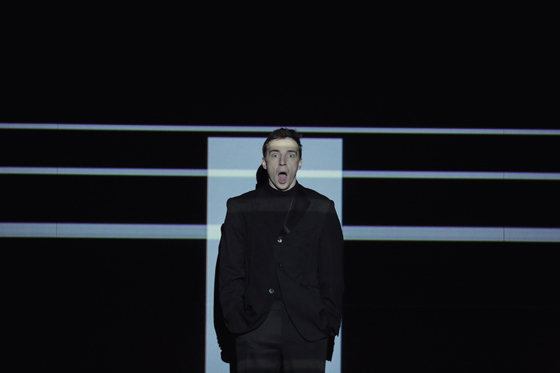
In addition to ordinary dialogues, Jason is given to Jason in this performance. Grigory Chaban exists according to other principles than a partner: his hero, a “civilized person”, is not a barbarian, is already weighing not to the ritual, but to the epos. Jason’s attempt to maintain his own personality from decay is a monologue from the “cement” of Hayner Muller about Prometheus: “Prometheus could easily free himself, if, unarmed and exhausted for millennia, he was not afraid of the eagle” (the translation of Alexander Filippov-Chekhov). He also belongs to the final lines of the “landscape with the Argonauts”: “I talk about myself, who / about whom / I am talking about me, who is I” (translation by Anara Imanova). Medee will get a flight on the dragon (a heroine played by Nikiforova, this cannot be avoided, although she dissolves in the blood-red light of the scene), a modern text falls on the share of the yazon. Which of this is more cruel, monstrous and merciless is another question.
 © Anastasia Blur
It is interesting that the “golden rune” of the performance remains almost invisible: the novel by Kocherzhevsky, playing the messenger and choir, has four important lines that he needs to repeat three times: “What did the children do to you? / Are they responsible for their father? What you are about / you are anger for children! / I'm afraid for your fate, children! " The vote of the messenger does not even sings the vote of the messenger from the “earthly” emotions - it mechanically rings, over and over again in each line, returning to the same high note. The actor, falling into it, each time manages to fleetingly evaluate the resulting sound and make the viewer a witness to the extremeness of his effort. The messenger pronounces impossible words, faced with the threat of an impossible, unthinkable act. Visual (through assessments, through undisguised dissatisfaction with the result) the resistance of the human body inhuman work is the technique of the great Karmelo Bene. Invented in the performance of Evgenia Safonova again, because it was just very necessary. By the way, if the descendants had an idea of the predecessors, then the legacy of Bene would also answer questions about the possibilities and diversity of voice techniques in the image of wild, animal, tragic and fantastic characters. But for this, the authors of the performance would have to answer the argonaut’s question themselves: “Who is I?”