
Translated material
Novelties non-fiction. April
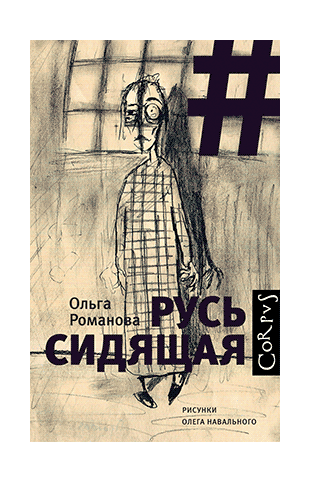 Olga Romanova * recognized in Russia by a foreign agent . Rus sitting. Corpus, 2018. Illustrations of Oleg Navalny
The book is not so much about prison and sideltsa as about life in Russia, in which, under various pretexts, the universe of the penitentiary system intervenes every now and then. Romanova, the head of the book of the Movement of the Rus Sitting Movement, builds a gallery of several dozen of the heroes dissimilar to each other, describes their winding life paths in detail, illustrating the thought of a simple, but invariably zero -to -end: prison, along with the school and the army, one of the main Russian institutions, ours.
Outwardly, the “sitting Rus'” is arranged as a set of tanks and anecdotal near -priest stories - for example, about how a beggar innocently condemned for the murder, during the imprisonment, turned into a human rights activist; as academicians who spent the night after protests at the police department, debated with thieves about Putin; Like a girl from Brazil, who transported heroin in her stomach, mittens knitted to all a pre -trial detention center. Between the case, Romanova conducts a tour of the world of Russian prison: he explains who the Krudun is and how he differs from the thief; how to relate to HIV zone; how they are deceiving "correspondence" (women corresponding to prisoners); Gives prison argo lessons.
However, the most remarkable in all these stories is not their documentary at all, which is to a large extent conditional here, but, on the contrary, their diligent art processing. Romanova tries to get used to every hero, she writes convexly, flowedly, reproducing the stupid intonation of an experienced prose writer: numerous “pot-bellied horizons”, “volunteers”, “invisible virgins”, “lutechi”, “male sons” give the text a practically fabulous species. The “sitting Rus'” balances between the essays and stories, and its author is between the position of an observer, describing the surrounding types and characters and a demiurge writer, for whom real people turn into conditional “Tanechek”, “Kostikov”, “Ilush” and “Ilyush”.
At the same time, there is no place in the book for any kind of didactism: the prison here is not the citadel of evil and, of course, not purgatory - rather, a self -sufficient world, which fall bad and good people, the rules in which are determined by the same people, good and bad. Therefore, the format of the fuse looks justified -
“Once”, “Once upon a time”, “But there was another case.”
 Ian Stuart. Cosmos mathematics: how modern science deciphens the universe. Alpina Non-Fix, 2018. Translation from English Natalia Lisova
“Cosmos mathematics” is similar to ideal school lessons in astronomy, and its author is the same teacher, after communication with whom children glue their room with stellar sky cards and ask their parents to buy a telescope. At the same time, Ian Stuart, a professor at the University of War from the University, writes a fascinating cosmic scientific science in the language of mathematical formulas, which makes the task, you see, is somewhat more complicated.
Actually, it was mathematics that was and remains the most effective way to study the universe. Where did the moon come from, why the planets are located just as the asteroid belt behaves, where the comets come from, which the star consist of - all this can and should be argued about, the author is sure, but more constructively, this is mathematically calculated, the benefit and tools are: from the law of the universal gravitation to differential calculus and the theory of chaos. At the same time, Stewart writes intelligibly and ironically, explains even the most basic things and dilutes mathematical examples with professorship jokes: the behavior of thermodynamic gas compares with the party, Saturn's rings likely like a pizza with Switzerland, and the universe - a foam in a basin.
The most attractive in reading “Cosmos mathematics” is an arising sense of intellectual independence. Stewart does not interpret, but offers to join his thoughts, constantly emphasizing that the Universe consists of riddles, and that is why you should not ignore alternative hypotheses and make even the most traditional decisions on faith. And even if without a mathematical education behind the author’s thought it is not always easy to keep track of, the book is still the desired effect: instead of experiencing sacred trepidation before the news about the Adron Collider and Dark Matter, it makes sense to begin to understand at least why the apple falls, and the moon is not.
 Amy Dampsi. Modernism and contemporary art. M.: A+A, 2018. Translation from English Ekaterina Kurova
A clear guide for visual arts from the British art critic Amy Dampsi. The history of the art of the last one and a half centuries is given here through a description of more than fifty art schools - from impressionism to neoexpressionism. A chance if you do not love the avant -garde and contemporary art, then at least stop being afraid of them. Damping gives a minimum of information (the main techniques, names, collections), but embeds them into the cultural context of the era and connects the styles among themselves-in fact, these ligaments allow us to perceive the history of the latest art not as the annals of experiments with Latin prefixes (“neo-”, “post-”, “trans-”, “hyper-”), but as a living process of movement of human thought.
On such a petty scale, it is interesting to look at the directions themselves, but the large trends formed by them-for example, how the visual arts more decisively leave the borders of the canvas, inventing all kinds of videos, a land and sound arts, or how, over time, the boundaries of artistic styles are more and more noticeable, discrediting the very principle of any categorization. Observation of how art, like a pendulum, moves from the statement of one visual code to the opposite and vice versa, makes an almost lulling effect.
In addition, the division into schools, albeit rather conditional in places, helps to go beyond the canonical list of famous artists: it is useful to remember that we have not only Paul Gauguin, but also synthetists Emil Shuffenecker and Emil Bernard; Next to the symbolist Edward Munk are Odilon Redon and James Enter; In addition to Jackson Pollock and Mark Rotko, there is also Barnett Newman. Everyone knows Gustav Klimt, but much fewer people know what the Viennese secession is. It is such a simple institutionalization that makes a conversation about art from an amateur ghetto “Like/Do not like” to the region much more pragmatic and promising - “I understand/I don't understand”.
The systematization of general knowledge and their convenient packaging today seems especially in demand. The same AD Marginem publishing house not so long ago had an intelligent “brief history of thought” by Luke Ferry, where the author in his own words tells about the most basic philosophical ideas, neglecting the already built classification and academic terms. Damping, unlike Ferry, holds on the terms tightly, and in vain: without tiring Latin prefixes, the book would still look fresh.