
Translated material
"A good book is therapy"
Reading biography of the writer Guzeli Yakhina
On April 14, another total dictation will be held. This year, the text for him was written by the winner of the Big Book and Yasnaya Polyana Prizes Guzel Yakhin. The writer’s new novel “My Children”, which will be released in May 2018, will dictate. Gorky talked with Yakhina about her reader biography. Guzel Yakhin will perform at the Irkutsk International International Book Festival (May 18-20) which is organized by the Free Form and the Interregional Federation of Reading."The bookcase caused me awe"
Grandmother on her mother’s side, Raisa Shakirovna, was a teacher and very early taught me to read, write and count. She worked as a Russian language teacher in the elementary school of the Tatar school - she taught the Russian language children who did not speak Russian before the first grade at all - and was an excellent didactic. I was born that year when my grandmother retired, so she directed all her huge pedagogical fervor at me. I even finished the school a year earlier - I jumped through the second grade, simply because my grandmother had already passed with me even before admitting almost all of the primary school. By the way, this is the same grandmother whose fate inspired me to write the first novel.
In all the houses where I was in childhood, there were a lot of books, so I grew up a completely book child. In the house of grandparents on the mother’s side there was a huge closet, full of everything that can be imagined: from art magazines and ending with culinary books. It was possible to come up and get the necessary in the mood: O'Genry’s novels, or the historical novel Nurikhan Fattah, “Itil-river flowing” in the Tatar, or a collection of caricatures of Kherluf Bidstrupa.
At home, the parents of the book rack completely occupied the wall of the only living room in the apartment. Mom and dad fought all the time. Mom placed numerous books so that it was beautiful: the most beautiful signatures - to the most prominent places, and volumes more modest - under the ceiling or to the floor itself. Dad wanted it to be right, according to the alphabet. There was a real struggle around the books.
In the third house, grandparents from my father’s side, a very serious library was also stored. These were old books, deserved, large collected works of the publication of the 1950s: all Jules Verne, all Mark Twain, Dumas, Mine Reed, Pushkin, Lermontov ... and all Lenin, and also Marx and Engels. Before this cabinet, I really trembled: for some reason it seemed that when I grow up, I would have to read everything that was in it-and it became scary at the thought that all these thick volumes would have to be overcome. I treated this closet with particular caution and respectfulness.
"Parents were worried that I was reading too many fairy tales"
I read a lot and completely indiscriminately. Maybe this is not bad - no one developed the program of my education through books. I just approached the bookcase and took everything that I liked: whether it was the “golden donkey” of Apuley, or Nabokov, or Nietzsche, or Freud, or Bergholz’s poems, or the subscription of the “Seeker”, or “Theory of Games”, or some detectives-one-days ... I decided to read and when, often adhered to books for a long time. In middle and senior school age, these were “Count Monte Cristo” and “Three Musketeers”, Ilf and Petrov, Edgar Allan PO. And also the "Letter of the Stranger" by Andre Morua. These books became loved for several years, and I could re -read them endlessly.
My parents were worried that I was reading too many fairy tales. They believed that I was already an adult enough to read serious books, and fairy tales were not serious. Therefore, my tales were taken away and hid somewhere away, in a wardrobe or a refrigerator, but I found and read again. O'Genry’s short stories have made my life for two years - a countless number of times read this book. As in due time and the "scarecrow" of Zheleznikov. And “myths and legends of ancient Greece” Kun. And in high school she seriously fell ill with a cinema and switched to books about cinema.
"In our family, no one was engaged in cinema and literature"
My hobby for cinema began with acquaintance with one good person who raved about the cinema. Having talked with him, I soon realized that I was also “infected” - I began to read about the cinema everything that could be found at that time in the district and city libraries: memories of Tarkovsky, biographies of Soviet film stations, “Actor of Stanislavsky”, Eisenstein's articles on the art of installation, the magazine “Soviet screen”. She began to look for scripts - they were printed by the magazine "The Art of Cinema". Watch more films-in the nineties, the classics were shown at night, and I had to stay up to two or three after midnight to watch the “road” of Fellini or the “seventh stamp” of Bergman.
In 1993, when I graduated from school, my parents were horrified by my desire to leave Kazan and study incomprehensible: in our family no one was engaged in film and literature. My mother is a doctor, many relatives too, and dad is an engineer. Then, in the early 1990s, to study cinema seemed a completely empty imagination: it was a very difficult time and everyone was not up to the movie. Therefore, in the course of long family discussions, it was decided that after all, I, the eldest child, would go to study in the footsteps of my grandfather-foreign languages. So I graduated from the Faculty of Foreign Languages, and then I started working in the field of marketing-and left for some time the dream of cinema. But she has not gone anywhere.
"Outside Russia, Shukshin feel in a special way"
I remember with warmth my studies in the Kazan Pedagogical - it was fun and for pleasure. But first of all, it was a strong language school, so during my studies I for the most part read German and German books. For some there was a real hunt: at the beginning of the nineties, “snatch” in a store or somewhere on a bookster (on the “croup” in St. Petersburg, for example) Dictionary of the colloquial vocabulary of Devkin or the etymological dictionary of Duden was indescribable happiness.
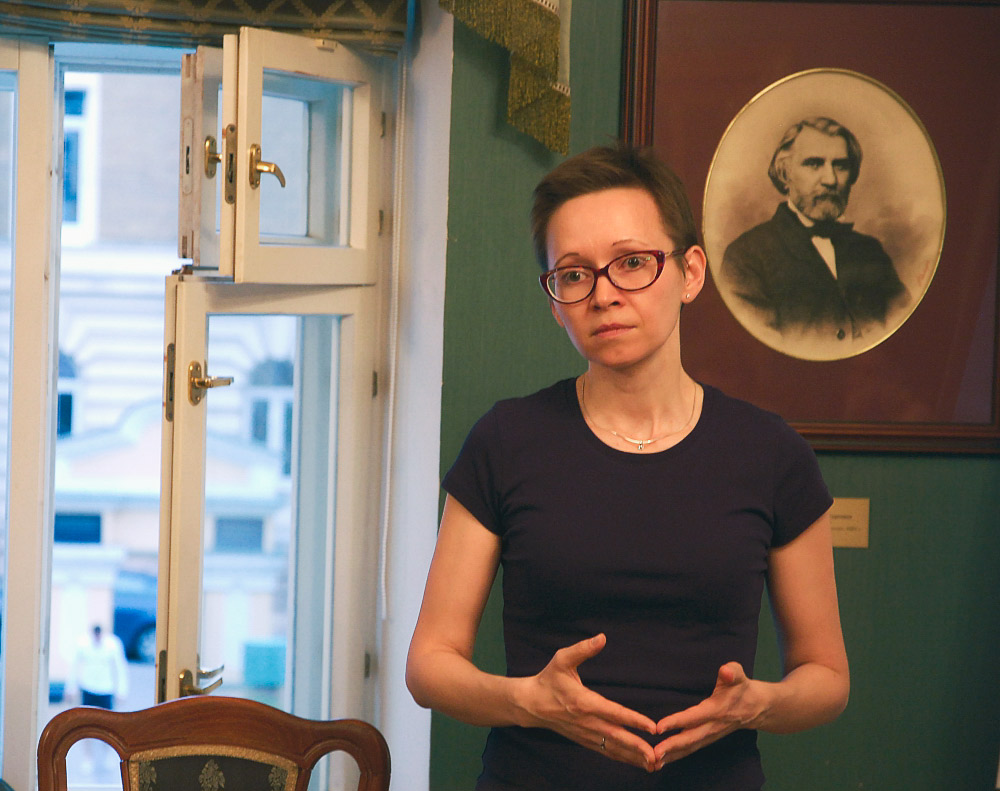
Guzel Yakhin in the workshop of Prose Creative Writing School, 2015
Photo: Litschool.pro
In the third year of the institute, I won the competition of the scholarship of the German Academic Exchange Service and went to study in Germany for one semester, at the University of Bonn Friedrich Wilhelms. Being in a foreign language and cultural environment, I soon began to nostalgia - and rushed to re -read my favorite things: Shukshin, Pushkin, Bulgakov, Dostoevsky. The University Library had a very good collection of books in Russian. Still, when you are nostalgic, you become much more sentimental, respond more sensitively to the text: for example, you read Shukshin and feel it in a completely special way ... For those six months it seemed to me that in linguistic isolation it is useful to read Russian texts: you perceive them and feel differently.
I loved the German language, but cinema education still remained my dream. After graduating from the institute, I worked for a year in Kazan, then moved to Moscow - and here it was not up to dreams: it was necessary to equip a life, earn money for bread, find my place in this city. It was a practical experience, also very interesting, but there was very little art in it.
"I could not get out of the zone of Zuleikha for a very long time"
Once-I was already over thirty then-I thought that it was worth learning what I really wanted: just for the sake of the process, not for the sake of the result. I did this - and all two years of study at the script faculty of the School of Cinema enjoyed every day, every lecture. As a result, the script “Zuleikha opens his eyes” was written first, and on his basis the already novel of the same name. Readers' great interest in this book prompted me to write the second - the novel “My Children” about the fate of the German autonomy on the Volga.
In the theme of the Germans of the Volga region, two important things for me came together - the Volga and the German language. I am a Volzhanka: we had a cottage on the Volga Island, I did not get out of the Volga all my childhood. And for me, the Volga is a very specific natural essence: I know its taste and smell, and what sunsets are on it, and how it is covered with ice. Back at the cinema school, I wrote a diploma scenario “German Teacher” - about the Tatar boy who falls into the family of the Germans of the Volga region and grows in it. Later, she decided to make a novel out of this script. However, the attraction of the first novel turned out to be too strong: everything that I wrote was very similar to Zuleikh - it actually absorbed me, and it was wrong.
I tried to write something else for a very long time-and made several attempts to enter history from different points, at different times and with different heroes. As a result, she abandoned the Tatar boy (now he is Kyrgyz and appears in history closer to the end), and the main character I made a Russian German named Jacob Ivanovich Bach: I changed the hero of the hero, age, religion, nationality, language ... as a result of torment that lasted almost a year, I managed to jump out of the zuyleha's attraction. How much is about this, of course, to judge the reader.
"Material for the new book I read for a whole year"
In the novel “My Children”, I really wanted to take not just a wealthy picture of the German Republic in 1916, but to cast a look through the years, to create a voluminous picture - about the people, its mentality, history, and culture. Therefore, at the stage of preparation, I read a lot: newspapers of the 1920s-1930s, books in German, the work and scientific works of modern historians, textbooks from the sphere of cinema ... Requesting the material went about a year, then there were attempts to write and again read-until the structure was groped for, a bunch of those that I want to talk about. For many times I re -read books on the art of creating stories that have recently been published: “Anatomy of History” by John Trubi, the texts of his lectures; “Myth and life in the cinema” by Alexander Talala (by the way, he was also my master at the cinema school); "Dramaturgy of the film" Neskhoroshev.
Almost by heart I learned the fairy tales of the Grimm brothers: in the novel “My Children”, German mythology plays a key role. The main character has a very rich imagination - and the reader will have to determine what things happen in reality and which are the fruit of the fantasies of Jacob Ivanovich Bach.
I read a hundred book by Leonid Lerd once the Tales of the Germans of the Volga region. These texts, published in 1935, the author allegedly recorded from the words of peasants, Soviet collective farmers of non -public, who themselves invented them. The plots of these "folk" fairy tales are impressive: for example, a meeting of Stalin with giants who want to participate in social media. Or the dialogue of a party worker with the last feature on the Soviet land - as a result, the devil dies in torment, unable to withstand the ideological dispute. Or the plot about the girl Lenheen, who finds a magic mirror - in it she sees a bright future and Comrade Stalin.
"For the past two years I have been living in the Republic of the Volga region"
I strove to ensure that the fantasy canvas of the novel “My Children” was composed of pieces of real life. At the same time, all the smallest details - starting from the curses that the Volga Germans use, the drawings of the painting of their chests or beds, the colors of the platbands, the rim of fur coats and to more serious things (historical dates, facts, quotes of the resolutions of the Central Committee ...) - all these details are true. For the past two years, reading has occupied most of my time: I lived physically here in Moscow, and mentally in the Saratov Volga region, in the German Republic.
My table book during this period was “German autonomy on the Volga (1918–1941)” Arkady Adolfovich German, a historian who is engaged in the Germans of the Volga region and lives in Saratov - this is an extensive work that describes the life of German autonomy in detail.
I read the books of the Germans of the Volga region-this is an emigrant memoir literature on the events of the 1918-1920s. These books were published from 1920 to 1935 in German, printed by Gothic font. I found some of them in the storage facilities of Leninka, and some had to be ordered from the inter -bibliotic subscription from Vienna and Munich. Their authors emigrated at different times after the revolution and later described their experience. One woman, Anna Yanke, fled from the Volga region on the Perenniye, reached Ukraine, spent a lot of time in different refugee camps and eventually managed to stay in Germany. Several scenes in my novel are inspired by her book “The Volga-German Fate”: for example, a scene of the slaughter of cows, when they get the unnecessary calves that are not yet born from the womb of the killed animals and throw it into a separate pile, not daring to add the fruits to useful meat ...
Another interesting block of literature - books written by the Germans of the Volga region in pre -revolutionary times, they are also printed by Gothic font. For example, the historical novel of Hieronimus “Stefan Hindl” (about the relocation of German peasants in the Volga region during the time of Catherine the Great). Or sentimental tales about the Volga Ferdinand von Valberg. Or his own novel "Lily Zultaneh." Or the play of Hunger "Kyrgyzenmichel." The last two books are based on the Volga-School epic, on the prevailing archetype of the relationship between the Volga Germans and Kyrgyz-Kaisakov: this is a love story of Romeo and Juliet-immigrants from these two peoples-which, however, ends happily. I certainly wanted to include this archetypal plot in the novel “My Children”. As a result, the daughter of the protagonist, a girl named Ancha, becomes the love of his whole life for the Kyrgyz boy, Vaska's homeless man. Anche and Vaska - this is Bach's children. He calls them “my children”.
"I understand little about other people's books"
In the film, we were told about such a dilemma: when an experienced screenwriter (either the director, or the operator, or editor) watches the film, he easily switches to the professional register and begins to track the scene, sound, construction of the frame - but the ability to surrender at the same time disappears. In the same way with books. It seems to me that it is important to maintain the reader - unprofessional - attitude to texts. My attitude towards reading is not professional, but completely reader. I understand everything about my novel, I can protect every comma in it, but I understand very little about other people's books. I read them precisely as a reader: I open a page, the second, the third - and if I coincide with the text, then I read on and enjoy it.
There is only one book in which I forced myself to plunge through “I can’t” - “School of Fools” by Sasha Sokolov. This is a very interesting text, but it took me a lot of time to understand it and coincide: when this happened, I got great inspiration.
In my house, books do not accumulate. All the books that I need and my husband, we have already translated into an electronic form. I must say, the ability to read texts in electronic form required a certain violence against me: the habit of reading a paper book was already formed, and for switching to reading electronic texts, I forbade myself to touch ordinary books for several months. But now I almost completely switched to reading from the tablet, and I really like it. I am signed by the MyBook library and find a lot of what is interesting to me. But in general, I read a little and very selectively. Reading is that which is always near, on an airplane and at any free time.
In the office where I work, I keep either donated books, or those that I really wanted to have in print, make notes in them, glue the bookmarks, so that at any moment to resort to them is a source of inspiration, reassurance and strength, if something suddenly does not work. And I also have a “beautiful” cabinet: it stores different editions of “Zuleikhs ...”. The book has already been published in 20 languages, another 9 in the process, an English version should soon appear.
"I want to believe that my daughter will read"
My husband and I compiled a list of reading for our daughter - we leave these books in a prominent place so that she inadvertently discovers them and became interested in herself. She is already 13 years old, and she does not always perceive direct advice well. And, of course, she reads only paper books: we always try to buy her publications that we read in childhood. The Wizard of the Emerald City with illustrations of Vladimir, all six volumes. Aleksin’s story, Books of Samuella Fingaret, Eugene Onegin, dilogy Ilf and Petrov, Bulgakov, Dead Souls, the Scarecrow of Zheleznikov (a very important book of my childhood, and I wanted the daughter to read it precisely in the publication in which I read). On the daughter of the daughter, the books lie in random layers in which she rummages and always pulls something out. We allow her a mess on the book shelves, this is her personal mess. He wants - to arrange.
Our generation has already been formed, but those who were born after 2000, in the era of the Internet, have a completely different perception: this generation is visual-it needs short texts, and not so much reading as video content, images. I want to believe that my daughter is used to reading and will read. But how everything turns out, we do not know: the influence of the environment is huge, and it is impossible to completely reduce it to home education.
"Both writing and reading are therapy"
When you write a long history, it turns into a certain substance in my head - and you already answer before it: it cannot be started, for example, and then move and forget it, she will not forgive this. С романом живешь долго, по нескольку месяцев и лет — и выходишь из написания романа немного другим человеком. Это процесс взаимного влияния: ты влияешь на историю, создаешь ее, лепишь — но и она при этом влияет на тебя. Автор не только взрослеет или обогащается: он серьезно меняется под воздействием всего прочитанного, впитанного, причем необязательно в лучшую сторону.
«Зулейха…» очень повлияла на меня. И «Дети мои» тоже, даже сильнее. В процессе работы над второй книгой я осознала большое количество собственных страхов: страх внимания, страх сравнения с «Зулейхой…». И уже когда я почти закончила текст второго романа, то поняла, что именно тема страха сшивает его в единое целое. Там есть разные сюжетные линии, но психологическая — это именно страх и его преодоление.
Любая хорошая книга — это терапия. Так можно сказать и про того, кто пишет, и про того, кто читает. Процессы написания и чтения — это терапия. В одних случаях, если вы читаете легкие книги — это ненавязчивая терапия. В других — очень серьезная: через шок, стресс, сопереживание, узнавание себя или родных, откровение и о себе или близких людях. Но в любом случае это терапевтический опыт.
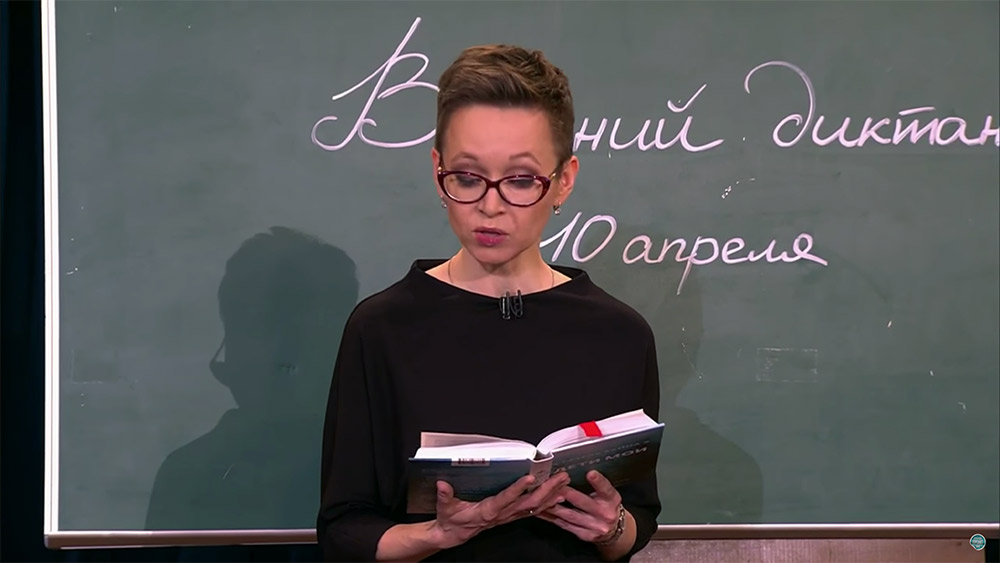
Гузель Яхина в программе «Вечерний Ургант»
Фото: www.youtube.com/user/1tv