
Translated material
A person in a pursuit of freedom
Anton Dolin is the memory of Milos Forman, the director “Flying over the cuckoo's nest” and “Amadeus”
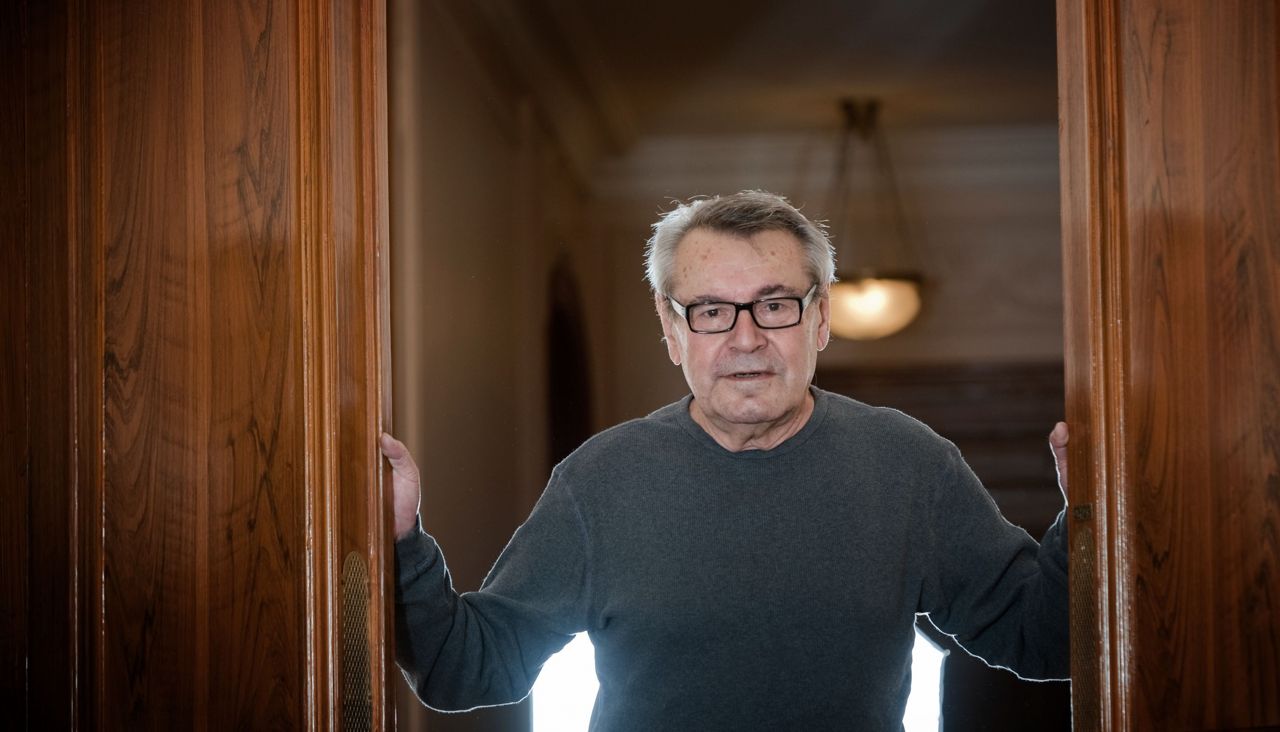
On April 14, Milos Forman, a Czech director who has been working in the United States, died in America in America. The author of “Pluting the Nest of the Cuckoo” according to the novel of the same name Ken Kizi, “The people against Larry Flint”, “Amadeus” and many other films, Forman was successful both among the audience and among colleagues and critics; He twice received Oscars for the best film of the year and was a laureate of almost all key European film festivals. At the request of Medusa, Anton Dolin talks about the life of one of the main directors of the twentieth century - and about how his cinema was.
Milos Forman lived a long life in which there were more victories than defeats. What other director from Eastern Europe could boast of the two “Oscars” for the best film of the year (“Flying over the cuckoo’s nest” in 1976 and “Amadeus” in 1985), not to mention trifles such as the Grand Prix Locarno (“Black Peter”, 1964), Grand Prix of Cannes (“Get of Golden”, 1971 and “The Golden Bear” of Berlinale (“The People of the People Against Larry Flint ", 1996)? He was not deprived of the public love; In the native Czech Republic, the phrases from the forman’s paintings became winged, and the images from his American films are still recognizable so far.
Nevertheless, there is also a feeling of underestimation. Forman shot only 12 full -length paintings in 86 years of life - relatively few. Many of his works were not appreciated on time, mercilessly criticized, encountered censorship both in Czechoslovakia and in the USA. The number of its incomplete projects is also large.
The most offensive is that 90% of the audience associate a forman with the only film - “Flying over the cuckoo’s nest”, still severely (and unfairly) criticized as a simplified and populist film adaptation of a great novel. This is actually an incredible movie that charges with each special electricity at every view. The strongest acting work of Jack Nicholson and Louise Fletcher - probably the best for both - and the first bright appearance in the cinema for an entire galaxy of artists: Brad Duriff, Christopher Lloyd, Danny de Vito. The atmosphere of the terrible anti -utopia (without deviations from realism), supported by Jack Nietzsche claustrophobic music. An impeccable model of the confrontation of the impudent loner with a repressive system, voluntarily accepted by most repressive. And, of course, the spirit of the very sixtieth illusions that once made a phenomenal cinema of the early forman-and the destruction of which forced him to leave his homeland and leave for the States.
Of course, there would be no “nest”, “Amadeus” or “Ragtaym” (for these three films, in this order, Forman knew in the USSR), if not for the amazing “Czechoslovak” period-four paintings shot in the 1960s. For cinema, he made no less than Milan Cunder for Czech literature; Forman was embodied by Prague Spring, although by 1968 he was already in Western Europe and did not return to Prague. As if naive and crafty “competition” (documentary, mid -meter) and “Black Peter” were already a powerful application for the main voice of the generation. “Blonde's love affairs” and “Gori, my dear” (we looked at him under the name “Ball of Firefighters”) - full -fledged masterpieces in which some frivolity of the form camouflage the revolutionary content of the content. The first of these paintings is a universal metaphor for human existence in a totalitarian society, as well as attempts to free himself from him through love. The second is a model of existence in the world, according to its global tasks and concreteness of plastic expression, comparable to the best Braigel canvases or Hashek's prose.
Then there was an emigration, and immediately - a stunning “gap”, which seemed to American society too freely: who is this case to judge us so much? It is amazing that in these circumstances, the beginning producer Michael Douglas entrusted the film adaptation of the sensational counteratuscript of the bestseller Keny Kizi. The choice turned out to be sniper accurate: it was this director that was able to find a cinematic analogue of a unique text and replace the visionary visionary clarity of the ironic clarity of screen images. So was born "flying over the cuckoo nest." The material was a stranger, but for those who knew the films the forman seemed almost autobiographical. Played by Nikolson McMurfi is not an ideologist and not a rebel, he is just a small recidivist who accidentally found himself in a psychiatric hospital and refused to humble himself with her rules. And at the same time - a titan that is capable of the impossible: to find a point of support and turn the ground over, knocking out a grille on the window. “At least I tried” - this is about the forman too.
His pictures and his heroes are very different. They have one common feature, she is the leitmotif of the whole work of the forman. They all crave and achieve, sometimes at the cost of their own life, one: freedom. For a forman, this is not an abstract dogma, not a symbol, not a slogan, but a specific set of actions of a person who sees a clear goal and for the sake of it ready for any sacrifice. We can talk about the right not to obey parents or not obey the authorities, wear long hair and flared trousers, include “too many notes” in your music or joke on risky topics, replicate pornography, and not believe in God. About anything, which fits into the concept of "freedom".
About this-a free-thinking rock-opera “Hair”, the anti-radio “ragtime”, the human rights “People against Larry Flint” are three films in which Forman tells his own version of American history. About this the heartbreaking “Amadeus”, the exquisite “Valmon” and the harsh “ghosts of Goya” are another involuntary trilogy dedicated to the illusions and victories of European education. In each of these paintings, humanity looks like a fire brigade, which decided to arrange a lottery and a beauty contest, not noticing that a fire began. And the lone hero is at Randla McMurfi, who, contrary to everyone, hopes to deceive reality and win a hopeless basketball match.
Anton Dolin