
Translated material
The landfills of the garbage war
What to do with dumps near Moscow?
- In Russia there is no policy leading to zero waste management to a cyclic economy, although it is registered in Federal Law 89.
- The garbage dump cannot be eliminated, but it can be reduced to zero its impact on the environment.
- Russian companies that win state contracts for garbage collection are not interested in reducing the amount of waste: they receive payment for how much they took to the training ground.
- Separate garbage collection partially helps to solve environmental problems in big cities.
- In order to call yourself a great power, you must first learn to sort your garbage.
Sergey Medvedev: The future has come in the city of Volokolamsk in the form of hydrogen sulfide. The names of garbage training grounds become the names of the people's war - "Yadrovo", "Timokhovo", "Torbeevo", "Alekseevsky quarry". I want to talk about what is waiting for Moscow, surrounded by a ring of such landfills, and what are the prospects of separate sorting and disposal of garbage. Details in the plot of our correspondent Anton Smirnov .
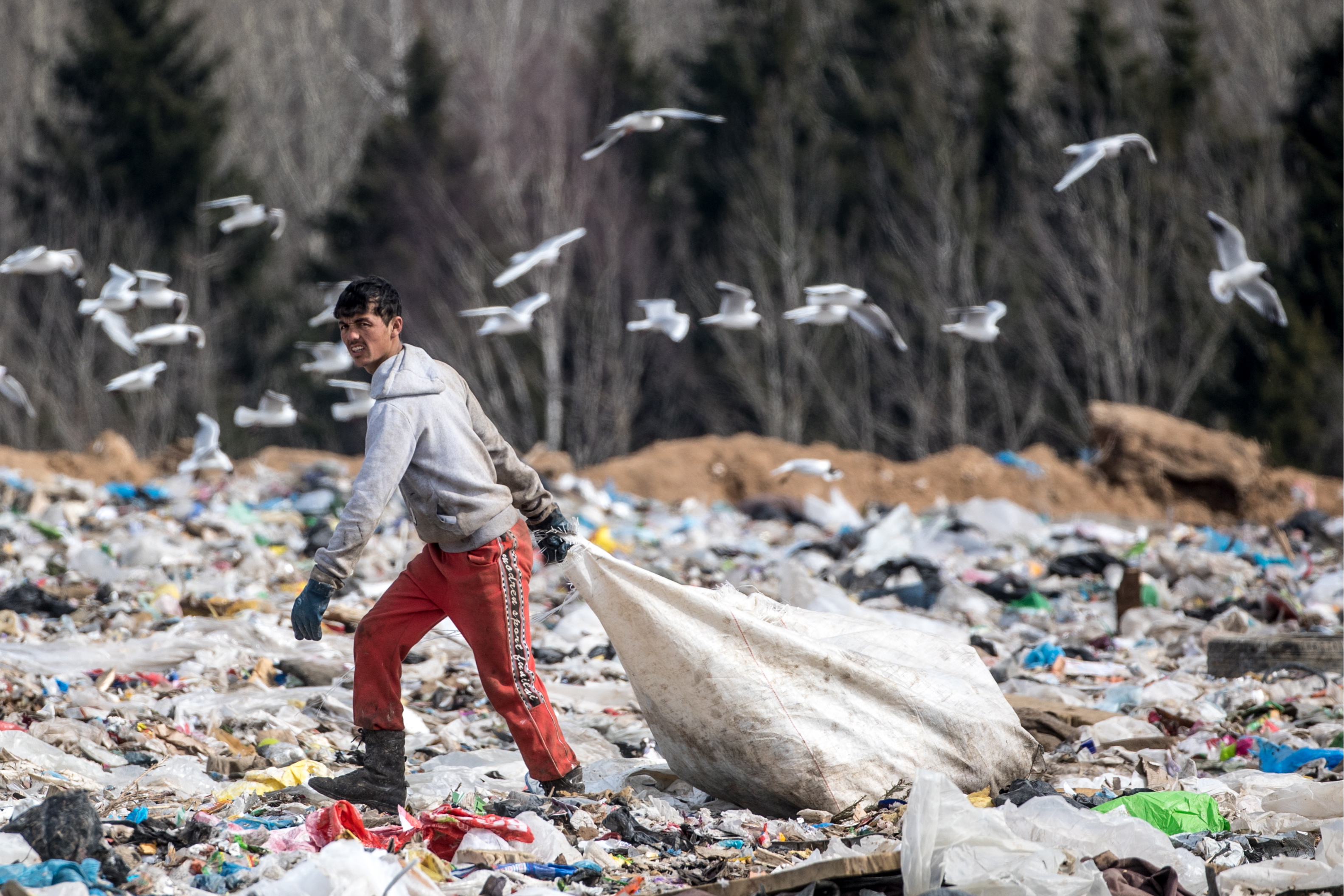
Anton Smirnov: We live in an era of consumer abundance. What is not on the shelves in modern stores! We rarely think about what our purchases are made of, we just throw them away when they cease to be necessary, although only one packaging of more than seven species. And all these are different types of plastic that can poison the soil for centuries.
We rarely think about what our purchases are made of, just throw them away when they cease to be necessary
Environmental illiteracy led Russia to collapse: we all ended up on one large garbage. Together with Volokolamsk, where people protest against the creation of a huge landfill. Together with Kolomna, where the townspeople burn the road to the landfill with garbage trucks.
The state and business are in no hurry to solve the problem, preferring to burrow waste in the ground. If power and society do not find a way out of the situation, then we will find ourselves on the territory of the largest garbage training ground on the planet.
Sergey Medvedev: We guest from Aleksey Kiselev , head of the Greenpeace Russia toxic program, and Valeria Korostelev , organizer of the Ecological Movement "Separate Collection" . Is this not only a Moscow problem?
Alexey Kiselev: We have more than 30 thousand such training grounds in the country.
Sergey Medvedev: That is, the Nucadrovsky training ground is far from the largest?
Alexei Kiselev: There is much more, including the famous landfill near Dzerzhinsky, as well as “Timokhovo near Noginsky-it is considered the largest in Europe. It is clear that humanity is unlikely to create something more than the Losashelessian, but this is large.
Sergey Medvedev: What is happening with a Losasheles dump?
Alexey Kiselev: There is the world's largest landfill in Los Angeles, it is perfectly equipped, certain work is underway there. California puts an order in the field of waste management, reaches zero waste by 2025, but they have a Losasheles landfill. And where to put her? The landfill cannot be eliminated, it can be strongly isolated, you can reduce its effect to zero, you can make a golf club on it, as in Vienna, for example, but it will always be with us.
Sergey Medvedev: The problem was named in the plot: we want to consume, as in the first world, and engage in utilization, as in the fourth.
Valeria Korosteleva: We have no policy leading to zero waste management, that is, to a cyclic economy, although it is registered in Federal Law 89: a reduction in waste formation should first of all be at the federal level. But there is no social advertising, no propaganda of the use of reusable goods. In Europe, for example, in most food courts, normal ceramic dishes are used, and waste is not formed. If there were economic and legislative stimulants, we would also work for us.
Sergey Medvedev: How does the authorities begin to listen to the protest that has risen now? Or is it a dialogue at the level of the riot police?
Valeria Korosteleva: The dialogue is built very strange. For example, with us, with a public movement, with NGOs, the authorities almost do not make contact. They sometimes invite us to some round tables for a look: they put a checkmark, and then no cooperation is at all. When protests begin, they come like knights in armor: we will decide everything, a girl to Holland, here the respirators are distributed, send children to the camp, do something else, or if they see that people do not perceive gifts, they begin to send riot police. In general, they are trying to somehow agree that the public resolves and does not touch the transfusion of money from one place to another.
Sergey Medvedev: Will they just redirect these trucks with waste from one landfill to another?
Alexey Kiselev: Obviously, yes. And on the 18th, the protests in Yaroslavl, where Moscow trucks went.
Sergey Medvedev: Will they just take further?
Alexey Kiselev: Of course. Obviously, they are ready to do nothing, to lose a little on the transport shoulder: it seems to them that it will be cheaper than solving the problem. And the problem of the landfill near Moscow is not at all in the suburbs, but in Moscow. It is strange to see how Moscow, having all the infrastructure, so as not to take anything out of the city, is still lucky.
Sergey Medvedev: Moscow has the entire infrastructure in order not to throw its garbage?
Alexey Kiselev: Yes. This is an extremely simple, elegant system. At one time, even under Yuri Luzhkov, experiments began on the use of organics for the production of climatically neutral energy based on biogas, a product of fermentation and river structures. We have at the Kuryanovsky, Lyubertsy treatment facilities that clean each of Moscow in half of Moscow, there are these energy plants. They take all the organics that comes through the pipes from the city, and a biogas, methane, the same landfill that smells. It is cleaned from sulfur, and after that it is burned; The turbine is spinning, heat is produced, electricity sold by Mosgazsbyt.
Mosvodokanal considered that if all of Moscow begins to use water disposal systems, to dump all the organics formed in the city through the sink, firstly, the nets will cope, secondly, the mosvodokanal will cope, and most importantly, there will be 40% less garbage in the garbage engineer. As soon as you removed the organic matter, you get dry secondary raw materials, and organics went to gas, and we have 432 enterprises in the Moscow region that lack secondary raw materials. It seems to me that the problem is solved.
Sergey Medvedev: Why is it blocked? The garbage complex, which needs large volumes, masters budget funds? Is the state interested in garbage?
Valeria Korosteleva: Rather, not a state, but some kind of person close to the state. As we know, five multi -billion dollar companies that won long -term state contracts for garbage collection, sorting, and the introduction of separate collection in nine districts of Moscow are not interested in reducing the amount of waste because they receive payment for how much they took to the landfill. They are not interested in the introduction of separate gathering, because they have no similar indicators by which they should report. They put containers for the box, but in some places we find out that they are exported to the same landfills. In nine huge districts of Moscow, a lot of money is divided between the son of the Seagull and the rest. And in the Moscow region the same story. It is also unprofitable for the owners of the training grounds that they will not be taken to them, because they receive money for each raising of the barrier.
As soon as the state intervenes in something with its contracts, budgets and subsidies, it turns out that it is not clear on what a mechanism, that is, it is not a free market economy, where there is competition and everyone is fighting for the quality of products and services to the consumer: here you just got 22 billion, and all-for the next 15 years you do not care about the quality of the service or competition.
Alexei Kiselev: You need to study the waste management to Saransk, where Svetlana Begsa works. She works with schools, with people, with the media. Purely, order, everything is fine.
Sergey Medvedev: Is there a separate collection of garbage?
Alexey Kiselev: Including. And sales and everything works.
Sergey Medvedev: Not "Zero Wast" (zero waste) there?
Alexei Kiselev: Zero Weist does not depend on the garbage company, but depends on the governor and the federal government: on how, for example, the federal government will change the rules of trade. Here we were surprised to find that 21 thousand tons of plastic bags were leaving for a dump in a year - this is a lot.
Sergey Medvedev: I read that in the third world countries (Rwanda, Kenya) for the use of a plastic package give a large prison time.
Alexey Kiselev: They don’t give time, plastic bags are prohibited, but they were replaced not by paper, but by reusable bags. We have a crazy idea with which we have been going from the seller to the seller for 20 years: why are you making plastic discount cards? Make a reusable bag with a barcode, and it will work like a discount card: a person came with his bag, did not take a package, and he was given a discount. Today it is in Indonesia, and in Russia - only in one store: it is a chain of meat stores.
Sergey Medvedev: The question is that 90% of garbage even in Moscow (and in Russia, probably even more), just stupidly falls into the training grounds? What next? Is this a purely transaction cost that just remains in nature in the centuries?
Now everything that is going to the training grounds is thrown out the planet resources
Valeria Korosteleva: In fact, yes. Now everything that goes to the training grounds is the thrown out the planet’s resources. God forbid, someday there will be super technologies that will allow it to be processed in some new materials.
Sergey Medvedev: And now the training grounds cannot be somehow processed?
Alexey Kiselev: You can’t. The landfill is a layer pie. Inside, a landfill body is for many years accumulated layers of garbage, sprinkled with soil, which live some kind of their lives at a temperature of 40–60, and maybe 80 degrees. Cross processes are underway there, gas formation, moisture passes, something is leaching, a landfill filtrate appears.
Sergey Medvedev: Are they not isolated from below?
Alexey Kiselev: Soviet, of course, is not. The new ones that are being built now are isolated, but in 40 years, isolation, perhaps, will also become unusable. Your task is to make sure that this landfill, when you stop using it, have no impact on the environment. For this, very simple things are done: you must select the gas (90 percent you take away, and lose 10% to the atmosphere) and collect the entire filtrate that comes out near the base of the landfill, and close it in such a way that nothing goes outside. The soil is falling asleep, shrubs and trees are planted, and after that you follow this for 40 years. It turns out a green mound-put there a ski resort or, like crowns, a golf club, and have fun.
Sergey Medvedev: The word Gennady Burstein, coordinator of the eco -moving "Separate collection".
Gennady Burshtein: In our area there is no separate collection infrastructure yet, so we, as we could, organized such an opportunity for ourselves, feasible means. I help nature get rid of a heavy burden, because these fractions are not processed for one hundred and two hundred years: there are no microorganisms in the Earth that can process them.
The second is work with human capital. I give people the opportunity to participate in this. Three years ago, this story migrated to us from St. Petersburg. Two girls, inspired by the experience and example of St. Petersburg, decided in Moscow to organize a shared monthly campaign for separate collection of garbage. After that, very serious changes occurred, the infrastructure of a separate fee organized by the state appeared on 80% of the territories of Moscow, but in our district it is not yet. In order to participate in this action, a person must derive the garbage from garbage within a month, prepare it.
I really hope this is the last action. 20 addresses have already been selected in this area, where there will be nets for a separate collection of at least plastic. The business drew attention to our area, although the state has not yet created proper infrastructure for this. Business and the state can cooperate in this matter, but working models must be developed.
Sergey Medvedev: And how many percent of the population are you ready to wash garbage?
Valeria Korosteleva: We must not wash, but just rinse the container, which is stained with organic matter, if you have a container in the yard. The latest surveys say that half of the population is definitely ready. The figure ranges from 50 to almost 80–90%.
Alexei Kiselev: Now the counting chamber has made a survey - there is generally 98%.
Valeria Korosteleva: The point is that it is generally separated by recyclables from organics. This requires infrastructure and export.
Sergey Medvedev: Do you are engaged in some private companies?
Valeria Korosteleva: This is the action of our movement.
Sergey Medvedev: Where is the sorted plastic, aluminum jars go?
Valeria Korosteleva: We specifically look for procurers who completely compress our sorted, and then they will accumulate wholesale parties and sell to the processor factor.
Sergey Medvedev: Until a large state business will intervene, this can be a way out?
Alexey Kiselev: In Russia, it always starts with this. In Izhevsk, a separate collection business began, simply because the green steam locomotive volunteer movement was formed. It gives a start, but if the sorting stations do not come there, transport will not appear, they will not work with people ... but in the end we get the most famous import substitution, replace our polymer of the Chinese polymer, for which we pay expensive currency.
Sergey Medvedev: And then, with such a collection of garbage, 100%is disposed of?
Alexei Kiselev: No, naturally there, there will be, screening. And then it all depends on you. I know in Russia a couple of entrepreneurs who calculate each gram simply because they invested their own money, and they do not have a friend in the administration who, in which case, will cover falling income. They are engaged in a PET bottle, everything is sold for them, including the label. The label is a big problem, because it can be a heat-assembly polyvinyl chloride, it can be plastic, and it may be paper, and he somehow learned to separate all this in the bathroom and all this is sold simply because he invested all his own. For him, every kilogram for a landfill is a loss. Every kilogram for sale - it survives.
Valeria Korosteleva: These are still local stories, but they begin to launch the process. We are well aware that we are often perceived as urban crazy people, but we create a precedent, create a media, so that people at least hear about it.
Sergey Medvedev: The problem is the absence of institutional incentives, tax benefits, tariffs for utilization? Who should pay for garbage disposal - manufacturer, consumer or seller, intermediary?
Alexey Kiselev: We have an institution of expanded liability of the manufacturer, according to forecasts, he will collect 2.3 billion rubles this year. The packaging manufacturer pays for this because he launched it on the market and should bear responsibility for it. He must pay for disposal, that is, it is the processing of everything. The population pays for export, and then pays the budget-for the burial or for something else, the environmental payment, and so on. Accordingly, the money somehow walks and no one has no interest at all.
And about all this money there is a very funny story. Now it is said that all this must be paid five to seven times more, burning is expensive. Entrepreneurs say that "if they gave a Poltarifa, who are asking people to burn, we would just have carried it out of every apartment with our hands." But this all goes to another place, they do not solve the problem. There is one -on -one business with people: thank God, people and business agree. This is a unique Russian phenomenon.
Valeria Korosteleva: If in Izhevsk or in other cities of Russia they do not interfere, if the administration or some dark businesses does not interfere, then they work perfectly there.
Sergey Medvedev: The legal structure for separate collection and disposal exists, it just does not work?
Those who were at Bali probably never take a plastic tube in their lives again
Alexey Kiselev: It existed since 1993, when we had the first law on environmental protection, we only had to take and do, and not say beautiful words. The 89th Federal Law is now excellent in that they themselves, without expecting it, recorded there the famous thing that we call the "priorities of state policy" (all over the world it is called "Hierarchy of methods of waste management", but the essence does not change). The Russian Federation announced to everyone that "our highest priority is a decrease in waste formation." If we cannot achieve this, we must re -use them, through the same, for example, collateral value. It is not possible to re -use - let's process. И как только мы пройдем три верхних приоритетных метода, давайте обсуждать, что мы делаем дальше.
А дальше у нас идет уничтожение и захоронение. Но к этому, то есть к заводу по сжиганию или к "Ядрово", мы имеем право вернуться только тогда, когда прошли первые три способа и знаем, что достигли в них потолка, больше ничего не можем сделать.
Сергей Медведев: А есть какое-то давление на производителей: не производить или хотя бы брать ответственность за те упаковки, которые ты производишь?
Алексей Киселев: В России – нет, а в мире по этому поводу идут огромные переговоры. Те, кто был на Бали, наверное, больше никогда в жизни не возьмут пластиковую трубочку. Понятно, что никому этого не хочется: 30 лет вы клепали эту банку или бутылку, у вас налажены связи, контракты на много лет вперед, вы таким образом снижаете цену – купил подешевле, продаешь подороже. И тут вдруг приходят какие-то и говорят: все, так жить не получается. Поэтому все идет тяжело.
И в России есть возможности для решения проблемы. Две-три недели назад была замечательная дискуссия в РИА Новости: что же лучше – пластиковый пакет или бумажный. И пришли к выводу, что лучше всего многоразовая холщовая сумка. Там сидел человек из правительства, и ему кто-то написал на телефон в момент дискуссии: посмотри, в Голландии открылся магазин без упаковки. Тут зал хохотнул, потому что в Голландии он открылся, а в Петрозаводске уже год существует.
Сергей Медведев: Это как рынок, только без этих пакетиков?
Валерия Коростелева: В "Ашане" есть очень большой отдел на развес: печеньки, попкорн, орехи, сухофрукты, макароны, конфеты – это очень удобно. До того, как пошла мода на экомешочки, я ходила туда просто с пластиковыми.
Сергей Медведев: А что такое экомешочек?
Алексей Киселев: Это то, что шили раньше бабушки на Руси: холщовый, льняной мешочек со шнурочком. Вся страна теперь шьет эти экомешочки, многоразовые экобахилы. А если у тебя нет никакой сумки, но ты любую вещь будешь использовать больше, чем один раз, это все равно снижение экоследа.
Алексей Киселев: Сейчас появился бизнес, который зарабатывает именно на снижении образования отходов.
Сергей Медведев: То есть современная потребительская цивилизация, которая, по сути, является цивилизацией упаковки, будет постепенно избавляться от нее?
Алексей Киселев: Очевидно, да. И не только упаковки: наверное, будет полностью просчитываться экологический след.
Сергей Медведев: Экологические издержки закладываются в цену?
Алексей Киселев: Очевидно, да. На самом деле продукт должен стоить столько, сколько он стоит, плюс какая-то разумная налоговая прибыль. Как только вы налаживаете контроль над потоками материалов, вы снижаете свои издержки, и продукт у вас должен подешеветь. Экономика замкнутого цикла: в Европе считается, что это снижение в итоге произойдет для всех и повысит качество жизни.
Сергей Медведев: Это и есть концепция нулевых отходов – экономика замкнутого цикла?
Валерия Коростелева: Это ее часть.
Алексей Киселев: Ваша задача – разделить потоки отходов сначала на две части: органические питательные вещества и технологические питательные вещества. С органическими мы уже сегодня знаем, что делать, а технологических питательных веществ намного больше. Мы берем контроль над этими потоками материалов и дальше смотрим: кому-то еще нужна коробка – раздробили, продали. Например, я производитель лампочки, я начинаю продавать свет в люменах, а не продавать лампочку как набор материалов. Это достаточно сложная цепочка. В Европе она покрывается шестью директивами, и они ждут 2050 года, когда эти директивы полностью заработают.
Сергей Медведев: Люди на весеннем дворе разбирают мусор – это же не только экологическое, но и просветительское действо, из которого формируется социальный капитал: уничтожая транзакционные и экологические издержки, мы его формируем. Для того, чтобы называть себя великой державой, надо научиться сортировать свой мусор.