
Translated material
"We live inside total installation"
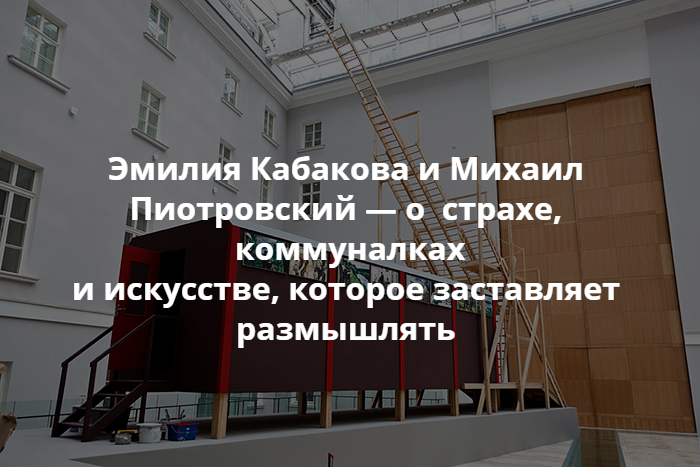
In St. Petersburg, on April 21, the exhibition “ not all will take into the future ” will open ”Ilya and Emilia Kabakov-Soviet and American conceptual artists who created the genre of total installation. The main headquarters of the Hermitage will show their “red car” and other world -famous works dedicated to Soviet life.
What to do if you don't like the exhibition in the museum, why is it difficult to understand installations and how does contemporary art develop tolerance? "Paper" publishes fragments of the conversation of Emilia Kabakova and Mikhail Piotrovsky.
How the work of the Kabakovs ended up in the Hermitage
Mikhail Piotrovsky: We are very proud that the Kabakovs returned to Russia through the Hermitage. The Red Lagon is the main symbol of the museum today. Speaking about contemporary art, we can say that we have everything: “composition No. 6” of Kandinsky, “dance” of Matisse, “black square” of Malevich and “Red car” [Kabakovs]. We also had [installations] “in the closet” and “toilet in the corner”.
Emilia Kabakova: Almost 45 years ago, when I left the Soviet Union, I suddenly realized that I had never seen the Hermitage. And before leaving I spent three days here. When I returned to Russia in the 94th year, we were offered exhibitions in the Tretyakov Gallery-but we did not want to, refused. And other museums offered - even for a lot of money. But for some reason it so happened that we were exhibited in the Hermitage. Why? Because for us this is a storage of art and culture, which are very few in the world. This is the Shtedel Museum, the National Gallery in England and the Hermitage.
For Ilya [Kabakova], the museum has always been the place in which he was saved from ordinary life: life, misfortune, problems. In galleries, we are often reproached for being difficult to sell: they calculate whether customers will like work or not. We calculate completely different things.
We represent the wall of the museum, and on it - all that was before us, that which we have already taken to the future. In order to take you to the future, you must withstand the level, the bar that the museum set. If your work on the wall looks worse, not to be in this future.
Why are installations needed and how they look like paintings
MP: The dream of an archaeologist is a garbage heap. Just because there are many [very different] things. This is a picture of that world.
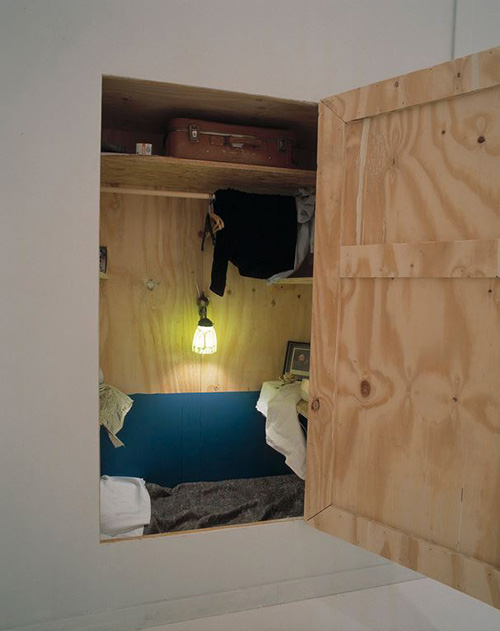
EK: There are different angles. It makes sense of the household, which we calmly discard. And there is a meaning associated with some memories. Those installations that we put - about the toilet or about the communal appartment - the metaphorical presentation of our lives. This is a fantasy about our fears, desires, dreams. About what we do not allow ourselves to do.
Our installations are not only about the USSR. They affect a huge number of philosophical and everyday issues. We have a “monument of the disappeared civilization” about the structural system of the USSR. By the way, she also belongs to the Hermitage. If it is exposed, it will be possible to say how different generations relate to the Soviet Union. We exhibited it in Germany, in other countries, in Russia, including in Moscow. And the youth said: "This is a textbook for us, we first realized what the USSR is."
I'll tell you a small episode about the Red Wagon. In the 90s, when perestroika began, the “Red Wagon” was exhibited in Austria. The Director of the Vienna Museum invited the Russian delegation of directors of museums to enter the Red Carriage. They got up, went in. They wanted to go out, but I got up in the doorway and said: “Sorry, this is a total installation. It requires great attention. So quickly you will not understand anything. Please sit down. "
They sat down. The sentimental Soviet music of the 60s began to play. One person says: “What a great time was. What romantics we were, pure people. We never thought about life. We all dreamed of an elevated one. ” Another replies: “What are you talking about? Do you know how many people killed? The color of Russia was destroyed. ” They were silent. The third says: “Why are we going to swear? Let's dance! " And they all began to dance.
MP: How is the installation a sculpture?
EK: Installation is a picture. You go to the museum, look at the picture, dream and imagine what is happening inside it. And the installation is a three -dimensional picture. We still do not know how to look at her, we have no experience: neither critics, nor journalists, nor from the audience. This is purchased over the years. The picture still has existed for a very long time, and the installation is not. Although we can say that total installation has existed for a long time: this is our world created by God. We live inside total installation.
The museum is also a total installation. The place where you come to the temple. And our task is to create a special atmosphere. You lose the feeling of time, space. This is a place in which you fall into another reality.
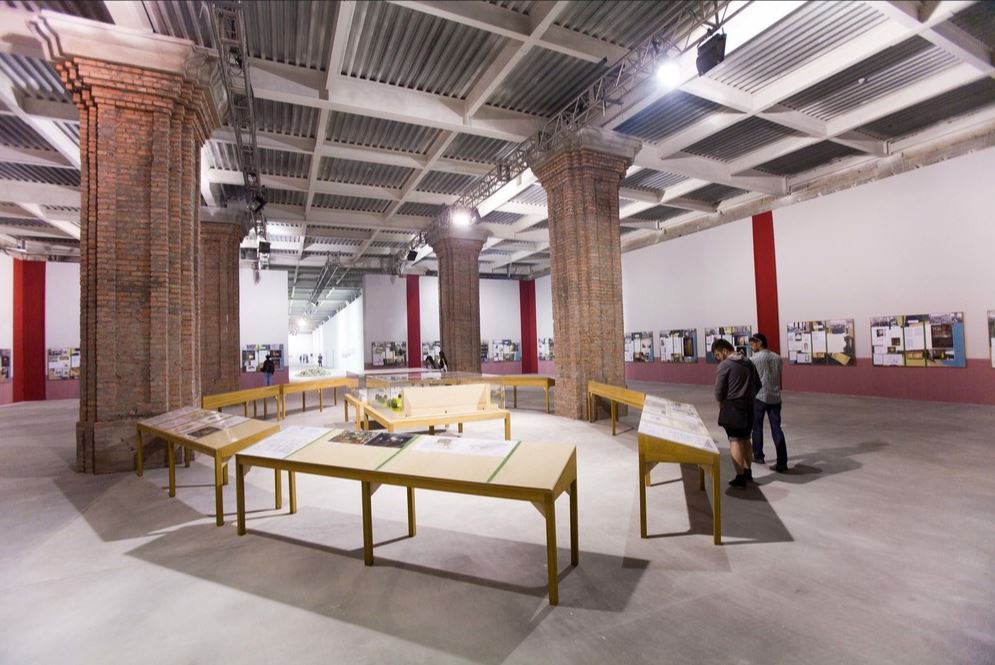
Should the artist focus on the public and how the museum selects works of art
MP: You made people return to the texts. Many people are already reading only from the screen, and slow reading is completely forgotten - although it is necessary to do this just like that, calmly, with pleasure.
EK: The consequences of Russian education. In Russia, narrative and literature play a huge role. Sometimes even more than visual art. Especially among contemporary artists in the 70s: their work was also built on a narrative, a discussion of opinions.
MP: Does the Western world perceive the text or enjoy the visual component?
EK: Text is always part of the picture. But, of course, it is incredibly important. The Western viewer reads in all countries. Do they understand the context? Question. Our entire visual context is associated with history and our culture. They understand this differently, of course. And this is international.
We are often reproached with the fact that we are of interest precisely because we make installations about long-suffering people in the communal appartment. But this is absolute nonsense: many artists use national suffering, and no one exposes them anywhere. What we do is built at many levels. I believe that good art is a multifaceted art. One line is something completely primitive. In this case, we have a huge number of associations and references for each person: for criticism, for a philosopher, for an art critic, for a simple viewer. People remain people in all countries.
MP: Should the artist think about the public and react to it? Change for her?
EK: The artist, sorry, is not a prostitute, he should not change for the sake of the public. You can’t like everyone. We work for people with a certain cultural level. [It is important to understand] whether these works are a cultural phenomenon, as far as they fit into the museum or violate certain traditions, become a breakthrough. We cannot say that everyone liked Picasso. Nobody liked Picasso when he started. 45 years ago I met with his contemporaries in France. They said: "It was not clear how such rubbish can be hung in our great museum, although now we are ashamed to remember that we scolded it."
The museum lives, we are changing. Our horizons are expanding - or narrows depending on the situation. Now Ilya, for example, when she draws, mixes the classics of a Soviet picture drawn with a photo, and baroque. It would seem incompatible things.
We must remember that our cultural development continues. It is impossible to limit it to medieval concepts of control and censorship. Of course, a person needs restrictions - but they must relate to our social behavior: this is respect for others, a personal distance.
If the museum shows us something, this means that we should think. What we see, we may like or not like, but we must think wider. Especially - in the Museum of Contemporary Art. In my opinion, the task of contemporary art is to expand the framework and boundaries. It is very comfortable to live in the space that we are used to. But just like we love to travel physically, we must love to travel visually.
Why fear is important for the artist and what is distinguished by good art
EC: Of course, at some level, the artist does not differ from the rest of the people. He loves, suffers, hates, is afraid in the same way. Someone is afraid of death, someone is afraid of life. The main engine is fear. We are afraid of everything, but learn to overcome it. Fear is a huge engine for Ilya. We are all faced with fear from childhood: the child is afraid to take a step, but overcomes this fear. I practically have no sense of fear. I don't know why. But there are very few people who are not afraid.
A sign of good art: when you leave the museum, you are experiencing a huge number of conflicting sensations. You must give yourself time to think about why you liked or did not like it [what you saw]. Reflection is incredibly important. If she is not, you need to learn her.
Ilya and I do not live in reality. We live in the world of art, in the world of utopia. In our house, no one ever talks about reality: the issues of politics or art are mainly discussed. The people who come to us are mostly associated with art. And even when we called the police because of the fire, they began to talk about art.
What is a “ship of tolerance” and how can you solve social problems through art
EC: We are talking with children from different countries about what tolerance is and how to change this world for the better (“Ship of Tolerance” - the project of Ilya and Emilia Kabakovs: in different countries they install wooden ships with sails from children's drawings - approx. “Papers” ). Since they are the builders of the future, we suggest that they think what they can do. Children offer beautiful and very touching projects. For example, one girl solved the problems of tolerance so: all people of all colors should be married - and then everyone will be the same color.
We worked with children who never saw a pencil and made their first drawings. Art allows people to communicate where politics fails: they understand this very well. Unfortunately, better than many adults. Even if you do not know the language, art creates a background for collaboration.
Children draw, and the proceeds go to children's programs. It is not the drawings themselves that are important for us, but what children think about the future. I traveled 12 countries and I believe that our greatest achievement is the “ship” in Cuba in 2011. For six months I have achieved permission from the American government to bring American children to Cuba, where they could speak.
Cubans are very good, very kind. They can sit without clothes and food, but at the same time frankly have fun: life is beautiful and good. They are incredibly proud: when I offered money to one student who drove me, he refused. Then we loaded the ship with things that we distributed in Cuba.
Half of the population speaks in Russian perfectly, they recall studies in Leningrad with great enthusiasm: “How good it was ... what beautiful girls were ...” One Kuban has prepared me food, which he ate during the students of the student: sausage with potatoes. It was impossible to eat, but he believed that he made me happy.
We also conduct such a program as a “table of tolerance”: we plant men at the table of men of different religions and suggest talking. Once there was even such that they fought. But then still somehow agreed.