
Translated material
Metaphysics of Euromaidan
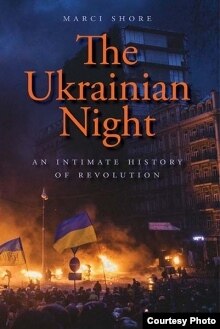
Guest "American hour" - culturalist of Marsi Schore
Alexander Genis: Associate Professor of Yale University of Martius Shor, and, by the way, the wife of the historian Timothy Snider, famous now and in Russia, wrote a book about Euromaidan. It is called "Ukrainian Night". The author sets himself the task of exploring the metaphysical essence of such a phenomenon as a revolution, on the example of specific events that occurred in Kyiv in the fall and winter of 2013-2014.
The deep meaning of the revolution consists in the confrontation of arbitrariness and cynicism, the author concludes, the confrontation that often arises spontaneously and unpredictably. The Shore writes: “The revolution is the rare case of transforming everyday policy into an existential protest. I saw how my friends, acquaintances, colleagues in Ukraine, whom I knew for many years and who considered a prominent priority, unexpectedly made decisions that found the ability to self -sacrifice, the presence of which I did not suspect.”
Our colleague Evgeny Aronov is talking with Professor Shor.
Evgeny Aronov: In addition to the metaphysical Mars of Mars, Shor raises in his book quite topical political issues: how to create a national state in the era of globalism? Is a multinational, multilingual state capable of making rational strategic decisions? How to evaluate progress in the field of state construction in the era of value relativism and the conflict of conflicting groups with their own version of the truth for each?
How to create a national state in the era of globalism?
The author borrowed the epigraph from the book from Mayakovsky. His poem of 1926 "Debt Ukraine" begins with the words "Do you know the Ukrainian night? No, you do not know the Ukrainian night! Here the sky from smoke becomes black ..."
I asked Shor who was addressed to the epigraph: people in the West or in Russia?
Marsi Shor: I write in English, so my main readers are English -speaking people. But I really want my book to be read in Russia; It seems to me that there are enough people in the country, even if they constitute a minority that will treat with interest an attempt by a Western historian to look at the Ukrainian "revolution of dignity" through the eyes of a benevolent observer.
Nevertheless, the Russian -speaking audience is far from the main thing for me. I am addressed primarily to the Americans and, secondly, in a broader plan, to the reading English public. It was her that I meant, putting an epigraph to the book Quote from Mayakovsky: "Do you know the Ukrainian night?" In English translation. With a high probability, the audience does not know her, and my task as a culturologist is to disrupt the cover of secrets from this "night". To conduct a reader on the labyrinths of culture, not enough for him. Or maybe even unknown. But I remembered both the Russian reader, and for the English translation of the epigraph I immediately give the Russian original.
Evgeny Aronov: Euromaidan hooked you very much not only as a historian, but also personally.
Marsi Shor: Very strong. Very emotionally. My Ukrainian friends and colleagues were deeply saddened by how little attention is given to the outside world. How badly he understands her. And almost does not value what its participants do. And I thought: why shouldn't I use my cultural skills to explain the meaning of a phenomenon that is very distant from it both geographically and spiritually?
Evgeny Aronov: Mayakovsky "No, you do not know the Ukrainian night" sounds like a rebuke. You have as a call to find out. Did you find out in the course of work on the book, at what exactly the active part of the Ukrainian people decided that she would not tolerate the humiliating arbitrariness and cynicism of the authorities anymore? Did this happen when Yanukovych, having accepted cash handouts from Moscow, finally refused to sign an association agreement with the European Union?
Marsi Shor: Political scientists are trying to establish the exact causal relationships of events at the theoretical level. But the historian cannot do it: he cannot accurately, as in the laboratory, recreate all the initial conditions of the event and then, in the order of a controlled experiment, find out which one decisively affected its outcome. Intuitively, I feel that there were several such fateful moments, and in the absence of at least one of them the revolution might not have been. For example, if Yanukovych had not abandoned the agreement with the EU so brazenly and suddenly when everything was already ready for the signing ceremony. Or if Mustafa Nayim did not place Facebook on November 2013, a call to Ukrainians to go to the Small of Nemism. Say, it's time to act, "likes are not counted." This incendiary phrase “likes are not considered”, the motto of revolutions of the 21st century, could appear only in the era of social networks, and without this historical accident in Kyiv there could also be.
This incendiary phrase “likes are not considered” itself, the motto of the XXI century revolutions could appear only in the era of social networks
Evgeny Aronov: The final point of non -return of Marsi Shor considers the reprisal of the “Berkutovites” over the peaceful demonstrators that occurred on November 30. It seemed to Yanukovych that the brutal beatings of the demonstrators would be enough to force their parents to take their rebellious sons and daughters home. The intercoral split will resolve the situation, because the revolutions in history often turned out to be protests by young people against the elders: fathers and children, conservatives and overthrows. But in Kyiv this plot was not realized, and nonresident parents, rushing to the capital, did not drag the children home, but joined them.
When different generations cease to conflict and begin to cooperate? When is fear losing the function of a restraining factor? When do members of society overcome mutual distrust and gain the ability to collective actions? Professor Shor signs all these questions in his book. Issues of undoubted interest for both Russian liberals and the Kremlin.
Martsy Shor: I do not think that someone in Ukraine in November of the 13th could have foreseen what would happen in January-February of the 14th. On revolutions, there is always a seal of unpredictability. This is a consequence of phase transitions, developing quantitative changes in qualitative ones. They constitute the very essence of large -scale social metamorphoses. But who is able to predict them? The attractiveness of Euromaidan to me to a large extent and was how he, in an unexpected, literally miraculous way, transformed people and forced himself to behave with the audacity of despair, which, as I thought, were not capable of, and participate in the events from which, it seemed, they had to run ...
Before giving the book to the publishing house, I decided to go to Russia, where I was not for many years. At the peak of Kyiv events, I felt that my Russian friends in correspondence with me are censored. I did not know why: maybe because of fear, perhaps because of antipathy to what Ukrainians did. I could not understand at a distance of what moved them. It was necessary at least a short time to sit with them at the same table and look in their eyes.
In St. Petersburg, I realized how heterogeneous the liberal Russian intelligentsia is in its attitude to actions containing an element of risk. One friend of mine openly expressed admiration for Ukraine, others did not dare to do this publicly. And without readiness to risk transformational collective achievements are inconceivable.
In addition, it is not at all easy to understand the reasons that determine such public passivity: does its objective reality dictate, that is, the scale of potential damage that a brave man can bear, or are they subjective, do not depend on external conditions and root in the character of the individual?
I remember that at one open event dedicated to the situation in Ukraine, the famous Russian liberal, with whom I was familiar, performed. He had something to lose. Psychologically, he felt very badly: he could not tell the truth, but he could not even lie on the reckless. Throughout the performance, he blessed and turned around like an eel in a pan. He was disgusting to himself, and at the same time like -minded people were disgusted to him, in whose eyes he looked like a coward. What overcoming the mistrust between members of the oppositional part of society is generally permissible to talk about? Although everyone is well aware that if you do not get rid of distrust, you can’t weld a “protest porridge”.
The story with my acquaintance had a dramatic continuation. Despite all his caution, two weeks after speaking to him came from the FSB and confiscated a personal computer to check. After which he was charged with embezzlement. It was a signal, but not to protest, but to departure. Which he did, moving with his family to Latvia.