
Translated material
Voices in the rooms
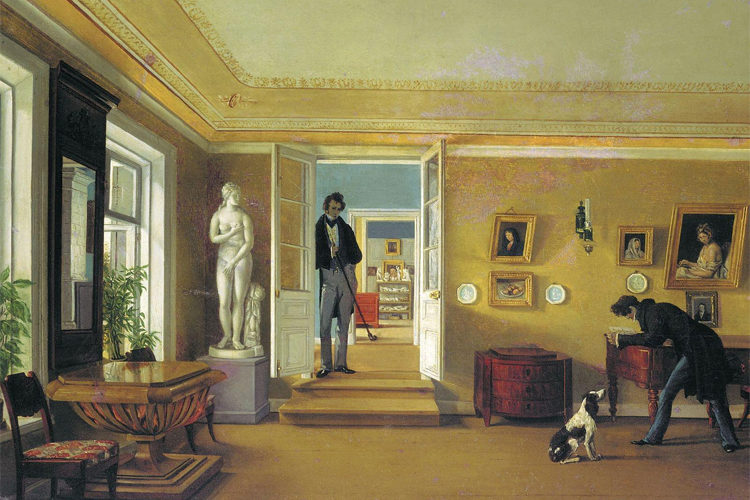
Today on the Colt is a preprint of the new book of our author Kirill Kobrin “The conversation in the rooms. Karamzin, Chaadaev, Herzen and the beginning of modern Russia. ” The book should soon appear at the UFO Publishing House. We publish a preface explaining what it will be discussed in it.
“He was all afraid to miss the smart conversations that he could hear. Looking at the confident and elegant expressions of persons gathered here, he was all waiting for something especially smart. ”
Leo Tolstoy. "War and Peace"
In the first picture, we see the anfilad of the rooms of a large apartment - or even the estate - the first third of the XIX century. Actually, there are four rooms; A series of doorways - increasingly narrow and low, as the prospect teaches - leads our gaze through until it rests against the wall of the last of the premises. However, this is not a real wall, but also a door, but closed, and permanently; It is turned into a kind of jewelry, into a part of the design of the last room of Anfilada, a storyteller is attached to it, populated, as far as possible to see in the depths of the picture, small gypsum blinds of classic sculpture. Four paintings hang on the altar itself, similar to the cross, which forms a cross, which is the basis of this cross, which is, as it were. Pictures on the sides and top are difficult to see, in the center - a portrait of a man. In the penultimate room at the door is a brown chest of drawers, and in the second room, literally on the threshold of the first one, partially blocking the prospect, the door jamb supports the young man in light gray pantalons, a black tailcoat with a white vest, a black neck and black calms. His hairstyle, according to the fashion of the late 1820s, with a combed forelock. In his hands, the young man holds an incredibly long smoking pipe of the bowl down. He misses, his pose conveys well.
The color of the walls alternates with each next room-a dark yellow (or light brown) is replaced by grayish-blue, then again dark yellow, finally-again gray-blue. All of them, except that in the foreground, seem empty or at least empty. But in Sama, the one where the artist with an easel is located, where there is a certain situation is located to us. The chest of drawers is also brown, but darker than what is mentioned above. A heavy, pompous marble table made in the form of a huge floor vase. Next to him is a chair, slightly cut off by the edge of the picture. Above it is a mirror in a wooden salary; For some reason, it reflects a narrow strip of the blue wall, as well as a white brick stove. It seems that here the artist made a mistake-the mirror should reflect the next room not painted in a grayish-blue, but the opposite yellow wall of this, in the foreground. It remains to assume that the eccentric owner of the housing painted one of the rooms in different colors. To the left of the open doors - the marble statue of Aphrodite/Venus is slightly less than human height on a high pedestal. As expected, Aphrodite/Venus with one hand bashfully covers the naked chest, the other - loins. On a long wall, to the right of the open doors, five paintings are hanging (a large female portrait, two small female portraits, a small portrait of a man, a small still life), three white porcelain plates with a relief on which you can hardly see human figures, and a lamp. At the right cut of the picture, the angle is either a piano or a bureau with carved legs. Another young man leaned on him. He, bending, reads something carefully: notes? drawing? newspaper page? The young man is dressed in grayish-blue pantalones a little darker than the color of the next room, a black tailcoat, from the sleeves of which snow-white cuffs peek out; The hairstyle is the same as his friend. At the feet of a young man sits a dog of black and white suit and carefully looks at him. At first glance, if you do not study the picture properly, it seems that the young man leaned towards the dog and even tears her hand. But this is not so. All of them froze in their calm and silence - two people and one animal. There is silence in the rooms. They are empty and boring in them.
Kapiton Alekseevich Zelentsov (1790-1845), amateur artist and St. Petersburg official, drew several paintings called “in the rooms” in the second half of the 1820s-early 1830s. The one that is described above is not the most famous; In the halls of the Tretyakov Gallery, the other work of Zelentsov attracts more attention-on it, for some reason, remotely reminiscent of the metaphysical emptiness of de Kiriko, who lived after a hundred years, is presented only two rooms of the city apartment; There is only one character there, he sits with his back to a large window, against the opposite wall, facing this wall, in a chair by the table, and reads a book. Zelentsov is really an amateur - his details are clumsy, and the prospect is somewhat distorted, but this painting makes a great, huge impression. You just need to stop, peer and think.
And on one “in the rooms”, and on the other - a lot of empty space and, most importantly, there is silence. Before us are residential chambers, but they are silent in them. If we take into account that Zelentsov portrayed the noble and bureaucratic chambers, most likely - his own or his friends and acquaintances, then silence reigns there, among these people who made up the backbone of the Russian state and the mass base of the ruling class. These are educated people and with some means; This is a “society” in the meaning of the word used by Russian writers of the first half of the 19th century. “Higher society” is not necessarily necessarily; Rather, “Russian society” we will call the totality of different societies, from aristocratic to small and secondary officials, uniting people with university education, who either serve or simply live, doing their own affairs. Actually, this is the target audience of Zhukovsky, Pushkin, Lermontov, Senkovsky, Gogol, Odoevsky, Tyutchev, Benediktov, Baratynsky, Bulgarin, and a little later - young Turgenev, Grigorovich, Dostoevsky, Tolstoy and others. It is amazing that they are really silent - at least in the paintings of Kapiton Zelentsov. Of course, this silence is symbolic - more precisely, we take this silence for the symbolic, but they said, damn it! If so, the question arises - about what.
This book will be about the time preceding when all these people, “Russian society” as such, spoke of themselves, about their problems, aspirations, their structure and their ideals. About the past, present and - especially - about the future. Not in relation to individual people - such a conversation was always - but in relation to the "society", "Russian society" entirely. Who invented the language in which such a conversation was conducted? Who proposed and formulated topics for discussion? How and when the empty chambers of Kapitone Zelentsov turned into a bit, the stuffed, noisy rooms, where the Slavophiles and Westerners, nihilists and liberals, socialists and guardians have seen? In the end, because Anna Pavlovna Sherer, described in the “war and peace”, is gossiping about politics, more precisely-gossiping about “politicians” (kings, emperors, diplomats) and international affairs, but they don’t conduct discussions on socially significant topics, was somehow replaced by a completely different type of conversation, known to us from the prose of Turgenev, Dostoevsky and Chekhov. Where is the line between them - and who translated Russian society through this line?
This will be discussed below. But first - about where the social layer is located that suddenly spoke on socially significant topics in the second third of the 19th century, between whom and whom he was. And how he corresponded with neighbors in the social hierarchy.
Above this social layer was power - the highest bureaucracy, the court aristocracy, the royal family, the king. About twenty years after the series of works by Zelentsov, the interiors of residential premises are accepted to draw another artist, already professional, the academician of the watercolor painting Ivan Petrovich Volsky (1817-1868). However, housing was also somewhat different - the interiors of the Tsarskoye Palace in Mikhailovka near Peterhof. From this series - the second picture that attracted my attention. On one of the watercolors is a strange office. The large window of the bay window goes out into the park, which is why it is light in the room; However, its far right corner is dark, since the light there blocks a powerful column - part of a kind of rectangular arch that separates the room from the blurlrined by the window of the bay window. The purpose of the room is not entirely clear; A little higher, I called her a “cabinet”, but there is no confidence that the situation is precisely in this way. The “cabinet” is indicated only by the table with written accessories and a large brown leather portfolio on one of the chairs. It is possible that someone from the royal family, returning to the palace, left him on the way to the bedroom or living room. Perhaps it was the owner of the palace - Grand Duke Mikhail Nikolaevich, in those years - the artillery commander of the Guards Cavalry Corps. One way or another, the rest of the decoration of the room does not say anything about its purpose. A large carpet lies on the wooden floor, a leather sofa and a chair, two more chairs on the wall (one with that portfolio, on the second, either a pillow or a light light cape left by someone) carry a guard with a high locker with a table and a glass door; On the table-two bottles on the sides of the white dish, miniatures hang inside the closet, there is a wooden casket and something else. At the table - another chair, from the side of it - a chair. The table, as it should be in those years, is covered with green cloth. On it (rather guessed than you can see) - feathers, inkwell, paper, but it can reliably say that there are several miniature portraits. Actually, people depicted there are the only ones in this room. It is completely empty. The empty and in the next room, where our gaze invites the open door. But the most amazing one is different here. The walls are hung with huge portraits of dogs: hunting, home, any. I counted them nine; Dogs clearly prevail over the human - albeit also purely picturesque - the population of this room. There is a temptation to say that in front of us is a very accurate image of the Russian authorities of the Empire: a rather bourgeois taste, emptiness, discomfort even from itself in its own ceremonial and public representations (the palace was not even in Peterhof, but beyond its borders) and, most importantly, a clear distrust of subjects. The Romanovs of the XIX - early XX centuries (with some, but important exception) were ready to surround themselves with animals, but not by people. There is no one to talk in these rooms and nothing. The strange world of ordinary bourgeois closed on itself, forced to rule a huge power. Public discussions and even storms, who accepted to rage in Russian society in the 1830s, did not get here; In the rooms, like a measured, serene life depicted by Ivan Volsky, so well known to us by Nicholas II. That is why it ended for them so suddenly.
If the “Russian society” “upstairs” - where, however, was almost not allowed - there was nothing to talk to with, then with those who were “below”, with the so -called people, it tried to establish a dialogue. Actually, the real story of Russia since the mid -19th century has a series of attempts to “talk to the people”, “establish contact”, “learn his language”, “teach him your language”, “create a certain common language”, “talking on his behalf” - there are many options. Moreover, this story has not yet been completed. The well -known dramatic gap between the educated classes and the “people” (preserved even after the “people” had the opportunity to finally get “education”) was considered and is considered the main problem standing on the way to the “normal” state of Russia, to its internal agreement. This plot was started by members of secret societies after the Napoleonic Wars - and indeed progressive nobles who began to establish the “Lancaster system” of mutual training of lower officials, to get schools in their estates, and so on. However, only from the second third of the 19th century - partly as a result of the influx into the ranks of the “educated” representatives of the same “people” - attempts began precisely “conversation”, and not “enlightenment” and “training”. The case was approximately the same as it was brilliantly described by Alexander Herzen in the introduction to his book “On the Development of Revolutionary Ideas in Russia” (1850) [1] : “A peasant living in these houses - all in the same position in whom his nomadic hordes of Genghis Khan caught. The events of the last centuries flashed over his head, not even forcing him to think. This is an intermediate existence between geology and history. This formation has its own special character, lifestyle, physiology, but there is no biography. <...> Speak, however, with him, and you will immediately see whether it is a sunset or childhood, whether it is barbarism following death, or barbarism preceding life. But from the very beginning, speak his tongue with him, calm him down, show that you are not an enemy to him. I am very far from condemn the Russian peasant for his timidity in front of a civilized person. A civilized person whom he knows is either his landowner or official. And the peasant feels distrust for him, looks at him with a gloomy look, bow low to him and moves away; But he does not respect him. He robs, not because he sees in him a creature of a higher order; He timids before the irresistible force. He is defeated, but he is not a footman at all. His harsh democratic, patriarchal language did not go through the science of the front. His courageous beauty was preserved by untouched under a double yoke - the king and the landowner. " A lot has recently been talking about the "internally colonial" character of the Russian authorities and Russian society; At first glance, the Herzen quote only confirms this opinion. “Peasants” (Herzen for obvious reasons could not use the word “people” in the French text) are deprived of “biography”, that is, “history”, they - unlike “civilized” people - are as if outside it, representing more than part of nature (the eternal “lifestyle”, unchanged “physiology”) than culture. That is why the appearance of a representative of the “society” before the peasant is an act of mastering the uninhabited space, an event of a clash of culture and nature. All this does not cancel the fact that this nature (read: “peasant”) has its own language - it still cannot be understood. The birds are singing, the cows are mumbled, the bears roar! However, not everything here is so simple. The fact is that Herzen does not look at the peasant from top to bottom; From his point of view, the popular language, perhaps better and more precisely - and in general it is more suitable for the conditions of Russia than the one on which they say "educated." Finally, the scheme proposed by Herzen is not dual, but triple, that is, there are three elements, three participants. This is the “king”, this is a “landowner”, and this is a “peasant”. It does not matter at all that in this case the first two are oppressors of the third; Between them, too, the abyss. This abyss arose when the conditional “landowner”, “official”, “officer”-more precisely, some, but the most lively and most energetic of them-suddenly spoke in some new language, very different from the almost unfinished conditional “king” and from the speaker in the language of an almost natural conditional “people”. And this new language appeared along with new topics, that is, with what could be called a social (or even socio-political) agenda. Kapiton Zelentsov’s rooms rustled, they were filled with people and voices. The new language and its native speakers began to speak not only for themselves, but also for the “king” and “people” - this is the peculiarity of Russian public discussion, its passion for expansion for their social limits, the desire to become a voice for the whole country, to explain it to herself and - especially the silent (power) and foreign (people). Someone tried to bring life to the rooms of Ivan Volsky, and someone (there were more of them)-even start a conversation with the Herzen peasant, with a "natural man" of new Russian history. Even a special social group appeared - the intelligentsia, which took on the role of the keeper of the new language, its developer and his historian at the same time.
But in order for all this to happen, someone had to create this language, compose vocabular, develop grammar and syntax, come up with the main topics for conversation. All this happened before the conditional 1850, when the “public discussion” in Russia really became an important factor in the development of the country; The further, the more she determined her path, until her final celebration occurred: a series of revolutions from 1905 to 1917. In a sense, this language, this social agenda, created by the middle of the 19th century, then won, absorbing / subjugating both “nursing” (for various reasons) forces-“monarchy” and “people”. The book preceded by the real introduction - about three people who, in my opinion, did more than others - much more, even almost everything - so that this language, and this agenda, and public discussion in Russia appear. Although, of course, two of these people did not want what happened in the 20th century, rather, the opposite.
So, the heroes of the book: Nikolai Mikhailovich Karamzin, Pyotr Yakovlevich Chaadaev and Alexander Ivanovich Herzen. Если объединить хронологические рамки их жизней в одну, то «эпоха от Карамзина до Герцена» длилась около ста лет, с 1766-го (рождение первого) до 1870 года (смерть последнего). Конечно же, на самом деле, началась она позже — с того времени, когда Карамзин стал культурным деятелем; то есть в конце 1780-х. Получается, что «эпоха от Карамзина до Герцена» полностью совпадает с эпохой европейских революций, от Великой французской (1789) до свержения Второй империи во Франции (1870) и (чуть-чуть не дотянув) Парижской коммуны (1871). Впрочем, последних двух событий Герцен не видел — он умер в январе 1870-го, за полгода до начала Франко-прусской войны, покончившей с режимом Наполеона III. Собственно, Герцен не дожил до первой настоящей пролетарской революции, что тоже хоть и случайно, но очень символично.
Хронологические рамки задают первую из важнейших тем этой книги. Язык русской общественной дискуссии, ее повестка исключительно сильно зависели от происходящего в Европе. А в Европе происходили революции. Период с конца XVIII по последнюю треть XIX века — время глубочайших потрясений, которые буквально втолкнули континент — а параллельно с ним Северную Америку, да и некоторые другие части мира — в эпоху «современности», modernity , modernité, как определил, еще только обнаружив лишь некоторые черты ее, Шарль Бодлер. Русские историки используют понятие «модерность», чтобы избежать двусмысленностей, связанных с употреблением слова «современный» (на английский его можно перевести и как modern , и как contemporary ). Как водится, сейчас много спорят об отношении России (и потом СССР) к «модерности» и «модернизации» — некоторые уверяют, что здесь происходил (и происходит) процесс «догоняющей модернизации», другие считают, что «модерность» не имеет одной образцовой формы (то есть условно западной), что российская/советская модерность есть один из равноправных вариантов. Несмотря на важность выбора между этими точками зрения, для нашей темы подобные споры представляют лишь отвлеченный интерес. Я исхожу из того, что Россия становилась и стала частью «современного», «модерного» мира . Появление и развитие в ней общественного мнения, выработка устойчивой общественно-политической повестки дня и общественной дискуссии с характерным только для нее языком — все это доказательства тому, причем не менее важные, нежели индустриализация, урбанизация или научно-технический прогресс. Так что отношение России к Европе в данном контексте — это отношение ее к модерному миру, а догоняла ли она паровозы современности или сама следовала в том же направлении, но до поры до времени в запряженной лошадьми кибитке — вопрос отдельный.
Собственно, втолкнула Европу в «современность» революция, точнее, сразу серия революций — политических, социальных, промышленных, научных и технологических. Индустриальная революция началась в Британии примерно тогда, когда в России родился Карамзин, однако она стала набирать обороты параллельно с началом первой и самой значительной до 1917 года политической и социальной революции — Великой французской. Британская технологическая революция, связанная с использованием машин, парового двигателя, металлических и стеклянных конструкций и так далее, не только породила на этом острове революцию индустриальную — она перекинулась на континент и к середине XIX века была везде, в том числе (пусть и в значительно более скромных масштабах) в России. Великая французская революция (будучи отчасти детищем революции в североамериканских колониях Англии) растормошила континент; она и последовавшая за ней наполеоновская эпопея привели к решительной смене социальных, политических, экономических порядков, к смене, которую не смогли отменить победившие в конце концов контрреволюционеры. Переворот свершился — и после 1815 года «легитимным» континентальным режимам оставалось только припудривать лицо новой реальности, делая вид, что она все равно похожа на маркизов и маркиз славных времен ancien régime . Великая французская революция была разом политической, социальной и национальной; соответственно, она стала толчком и примером для последующих европейских революций, пусть они чаще всего были более, так сказать, «специализированными» — либо чисто «социально-политическими» (или даже просто «политическими»), как события 1830 и 1848 годов во Франции, либо «национальными» или даже «национально-освободительными», как революции 1848—1849 годов на территории Германии и Австрии (Венгрия, Италия и так далее), поход «тысячи» Гарибальди в 1860—1861-м и польские восстания 1830—1831 и 1863 годов. Впрочем, продолжались и «смешанные» революции — вроде тех, что в том же 1848-м вспыхнули в немецких землях Германии и Австрии. Никогда ни (естественно) до, ни после Европа не переживала такой революционной лихорадки. Меньше чем за сто лет — чуть ли не десяток глубочайших потрясений [2] . Из этих потрясений Европа и вышла «современной».
В России же — если не считать восстания декабристов и драматических событий в Польше — никаких революций и даже их попыток в этот период не было. Так что опыт становления «современности» русскому общественному мнению пришлось заимствовать. Подобные вещи для России вовсе не новы: начиная с Петра Великого процесс «перенимания и усвоения» европейского образа жизни, технологий, политического, административного и социального устройства, культурных достижений и целых институций шел постоянно. Собственно, и формирование языка общественной дискуссии началось с того, что в русском стали появляться иностранные заимствования, обозначавшие вещи и идеи, которые перенимались — или имели быть воспринятыми. Поэтому первым героем нашей книги стал Николай Михайлович Карамзин, внесший больше всех прочих в этот процесс. But that was only the beginning. Описывать и анализировать процесс становления «современности», «модерности» в Европе нужно было, находясь там, внутри нее, будучи если не участником, то хотя бы включенным наблюдателем происходящего. Конечно, все это произошло почти случайно, ненамеренно, так сложились обстоятельства — к примеру, Карамзин, отправляясь в мае 1789 года в большое европейское путешествие, не знал, что через два месяца там, куда он ехал, произойдет революция. Герцен, оказавшись в Париже в 1847 году, не мог предполагать, что станет свидетелем революции сначала французской, а потом — оказавшись в Италии — еще и тамошней. Но случайности происходят со многими — однако только наши герои сделали из своих перемещений по Европе [3] именно те выводы, что оказались исключительно важны для русского общества.
Соответственно, второй важнейший элемент описываемого в этой книге процесса — состояние русского общества и русской культуры в период с конца XVIII по середину XIX века. Формирование нового общественного языка, общественной повестки и общественного мнения было бы невозможным — несмотря даже на все таланты и героические усилия Карамзина, Чаадаева или Герцена, — не будь русское общество готово к этому. Разговор на европейский лад в комнатах Зеленцова не имел шансов начаться, не существуй сами эти комнаты в известном нам виде, не будь они обставлены современной мебелью, такой же, как в Германии, или Франции, или Англии, не окажись в них всех этих псевдоантичных скульптур, бидермайеровых миниатюр, музыкальных нот, газет и прочих примет того, что еще недавно называли «цивилизацией». Конечно, и понятия, и некоторые общественно важные сюжеты были привезены/присланы из Европы русскими путешественниками Карамзиным, Чаадаевым, Герценом и многими другими — но судьба их сложилась совсем по-иному, нежели там, где они возникли. То, что русская культура, общество и российская власть «перенимали» на Западе, становилось не просто «своим», а «исключительно своим», поражая бывших бенефакторов особенностью и отдельностью. Как-то неловко повторять общие места, но явление Пушкина ровно через сто лет после переизобретения России Петром продемонстрировало не что иное, как «европейскость» русской культуры и русского общества, — привнесенный, навязанный своевольной властью новый способ отношений между «словами и вещами», неслыханный для Московской Руси, привел к появлению совершенно особой словесности, европейской и русской, очень глобальной и очень локальной одновременно. Эта словесность, названная позже «золотым веком русской литературы», легла в основу модерной русской культурной идентичности — а ведь истоком ее были чистое заимствование и импорт. Так вот то, что происходило с русской словесностью в первой трети XIX века, во второй трети того же столетия стало свершаться в общественной мысли и общественном сознании. Карамзин создавал их новый язык и формулировал их повестку, Чаадаев напомнил о глубокой пропасти между Россией и Европой, тем самым заставив многих с большей энергией продолжить дело Карамзина; наконец, Герцен «вернул» Европе долг, став активным участником тамошнего революционного движения и преподнеся бывшим учителям русский вариант социализма. С этого момента Россия стала равноправным участником общественно-политических битв Европы — пока в 1917 году не превратилась на несколько десятилетий в их чемпиона.
Однако материальных примет Европы, ее «вещей» — стен, мебели, безделушек и объектов искусства — и даже европейских слов и европейских идей мало. Нужны те, кто обживет комнаты Капитона Зеленцова и начнет разговаривать там, то есть нужны люди, социальная группа или даже класс, заинтересованные в общественной дискуссии. Этот класс стал появляться в конце XVIII столетия — и Карамзин был его представителем. Сначала их мало — людей с высшим образованием, но ведущих частную жизнь, оставивших службу, а позже — и вовсе не служивших; но со временем таких становится все больше, и постепенно складывается кадровый резерв для пополнения новой сферы деятельности в России — общественно-политической — да и отчасти уже существующей сферы, тесно переплетенной с общественно-политической, — культурной. Увы, еще одна банальность, не переставшая быть от своей общеизвестности истиной: до октября 1905 года, когда в Российской империи публичной политики не было, кроме той, что осуществляла и репрезентировала власть, людям с незаурядным общественным темпераментом было только два пути — в подпольщики и в литераторы; эти две области также нередко совпадали. Так что тут дело не только в одной из важнейших особенностей «модерности» — превращении «культуры» в «политику» в рамках нацстроительства и классовой борьбы; здесь еще и российская особенность, смешавшая все карты и оставившая тем, кто хотел заниматься «чистым искусством», одной только изящной словесностью, лишь маргинальное место. Там и нашли приют Фет и Анненский. Только появление легальных политических партий, бесцензурной партийной прессы и избираемого парламента вернуло русской словесности возможность думать о себе как о деятельности возвышенной и не зависящей от злобы дня. Без манифеста 17 октября 1905 года, к примеру, акмеизм как литературное движение был бы невозможен.
Эта книга состоит из трех глав; каждая из них посвящена одному из наших героев. Моей задачей не является ни сочинять их краткие жизненные или творческие биографии, ни давать обзор основных сочинений и идей. Еще менее книга претендует на то, чтобы быть солидным академическим исследованием, которое внесло бы вклад в карамзино-, чаадаево- или герценоведение. Цель ее совсем иная: на примере нескольких выбранных текстов (а порой даже фрагментов), написанных героями книги, продемонстрировать, как их усилиями складывался язык общественной дискуссии и формировалась общественная повестка в России. При этом я старался не упускать из виду, что ни Карамзин, ни Чаадаев, ни даже Герцен не были целиком поглощены этим делом — они занимались разными вещами; более того, даже многое из того, что было ими сделано в этой области, сделано нерефлективно и бессознательно. Но результат получился тот, который получился.
Я старался даже не «анализировать» избранные тексты и фрагменты, а, скорее, их внимательно, «медленно» прочесть, привлекая для понимания самый разнообразный материал из связанных с темой исторических и историко-культурных сюжетов. Так получилось, что большинство из привлеченных сюжетов — европейского происхождения; в этом смысле я иду по следам моих героев, как бы «привнося» Европу в Россию с тем, чтобы потом «вернуть» заимствованный материал — уже в виде «русского влияния» на европейские дела. В каком-то смысле я не ждал особенно сенсационных результатов — почти все выводы, к которым я прихожу, так или иначе известны; однако проблема заключается в том, чтобы разместить как бы «известные» вещи в надлежащем порядке. И здесь возникает еще одна проблема.
Дело в месте Карамзина, Чаадаева и Герцена в русском литературном и общественно-политическом каноне. Этих авторов чтут (и поминают, где положено), однако они по разным причинам, конечно, почти безнадежно потеряли сколько-нибудь серьезную актуальность. Иными словами, кроме специалистов и ничтожного количества энтузиастов, моих героев никто не вспоминает — разве что цитаты из них, выдернутые из контекста, понадобятся в пропагандистских целях. Причины действительно разные. Карамзина «губит» то, в чем он особенно преуспел: создатель современного русского литературного языка, расцененного современниками как неслыханное покушение на традиции, сейчас считается автором настолько лингвистически и интонационно старомодным, что читать его неловко. Повесть «Бедная Лиза», которой Карамзин открыл новую русскую прозу, сегодня выглядит весьма наивной, и это ощущение автоматически переносится на другие сочинения автора, в том числе на «Письма русского путешественника». Что касается «Истории государства Российского», то о ней судят по оценкам современников и позднейших специалистов, а также по пересказам и цитатам. С Чаадаевым еще хуже. Он навсегда остался в популярной истории русской культуры как адресат знаменитого пушкинского стихотворения и сочинитель странных «философических писем», причем зачем-то на французском языке. Еще кое-кто помнит, что Чаадаева объявили сумасшедшим. Анекдот закрыл человека, личная биография (дружба с Пушкиным и проч.) мыслителя заслонила его мысли. С Герценом и того хуже. Семь десятилетий он провел в официальных советских святцах из-за того, что Ленин отчеканил знаменитое: «Декабристы разбудили Герцена. Герцен развернул революционную агитацию». Этого нашего героя — несмотря на уважение многих неофициозных историков и литераторов в СССР — прочно поместили в ту же категорию, что и Чернышевского; Герцен стал героем анекдотов и объектом кислых шуточек и несмешных стишков. Оттого у этой книги есть еще одна, побочная (и скромная), задача: напомнить, что на самом деле Карамзин, Чаадаев и Герцен сделали для современной (во всех смыслах) России. Не «воскресить» их, как это принято в популярных книжках и медиа, предлагая переписать историю от и до в пользу несправедливо забытых, а именно «напомнить». Мои герои не нуждаются в воскрешении: они достаточно сильны, чтобы быть в своем праве.
[1] Любопытно, что эта книга написана на французском для знакомства европейской публики с указанным в ее названии предметом — точнее, для того, чтобы рассказать европейской публике о том, что «революционные идеи» в России вообще существуют.
[2] Я намеренно не упоминаю здесь революции на других континентах, ставшие результатом Великой французской. Они сыграли огромную роль — вроде Войны за независимость испанских колоний в Латинской Америке, — но в нашем случае мы вынуждены о них лишь упомянуть в примечании.
[3] Когда Чаадаев путешествовал по Европе в 1823—1826 годах, революций там не было, но с ним произошла обратная история — он вернулся в Россию вскоре после подавления восстания декабристов, с некоторыми из которых был близок. То есть он тоже получил опыт революции (хотя бы ее попытки), но революции «домашней» и им «пропущенной».