
Translated material
Lovers of the book
All the secrets of book gathering in five metaphors
Gorky continues a series of materials about professions related to book business. In the last issue, we talked about readers . Now we will talk about collectors.Books became the subject of collecting immediately after it appeared. One of the most significant collections of Ancient Greece - more than 400 scrolls - was considered a collection of Aristotle, which, according to Strabo, "the first began to collect books and taught the Egyptian kings to compile a library." However, in Greece, collecting was more public practice - that neither the temple or acropolis, then an open library. But the Romans have already sought to draw up private assemblies. Wealthy patricians were chasing rare originals and luxuriously decorated lists.
Cicero was known as a passionate collector; He called the reading “communication with the muses” and had at least three personal libraries: in Rome, Tuskul and Anition. One of the richest ancient collections - more than 20 thousand scrolls - had Titus Pomponia Attica, a friend of Cicero and his library assistant. Another friend of Cicero, the scientist and writer Mark Terentius Varron, who, on behalf of Caesar, became the creator of the first public Greek-Latin library, a rich book assembly.
The ancient book assembly is enclosed in the prism of two metaphors - floral and erotic. It was fashionable to place private libraries in gardens, which likened the collector to a prime garden. “If there is a garden next to the library, nothing will be missing,” Cicero said. The collection of books was compared in Greco-Roman poetry with a beautiful flower garden. This image was also reflected in Floriletia - collections of instructive texts (lat. Florilegus - collecting floral nectar; lat. The equivalent of the word "anthology"). The ancient collector was distinguished by the aesthetic attitude in the design of the library and-in contrast to public readings-references-secluded communication with the book, which likened to his lover, and manipulations with the book-intimate caresses. The famous poem by Horace “To your book” - “... And you know how I myself, your lover, when you get bored, squeezing you, squeezing you.”
But already in antiquity, along with true connoisseurs, there were collectors-formalists, for whom books served only the decoration of the interior and a demonstration of wealth and status. “How can you excuse a person who buys bookcases from expensive wood and, filling them with the works of unknown and worthless Pisak, walks between thousands of his books, yawning?” - Seneca ankles angrily in one of the "moral letters to Lucilia."
Lucian’s same revealing pathos in the essay to “Non-teaching who bought many books”: “You think to be known as a person who understands something in the sciences, diligently buying the best books. But the opposite comes out with you, these purchases only expose your ignorance. ” The literary image of the guns-fraternal-in the “satyricon” of Petronius: the rich freedman Trimalhion owns the Greek and Latin libraries, praises them, paints the walls of the house with scenes from Homer-but reads nothing.
With the spread of Christianity, whole monk orders became collectors of books; Especially zealous collectors were Benedictine. Usually in the monastic community there was a book guardian (sometimes it was called a presense, as a regent in a church choir), who kept taking into account spiritual books and was obliged to know them. As literacy, secular collecting also developed, private collections were replenished mainly by ancient manuscripts. Gatters are becoming more and more sophisticated in the technical intricacies of bibliness: they are already interested in the features of writing material and the handwriting of copyists, the style of illuminations (illustrations) and the composition of ink.
Starting from the Middle Ages in the collecting of books, France was the leader. Among the noble bibliophiles, Louis Saint, Charles V Wise, Philip II are known, Jean I magnificent are known; The clergyman, scientist and poet Richard de Furnival, author of the treatise "Bibline". From the British, one cannot help but mention the bishop of Richard de Beri, the writer of the famous "Philobiblon". The history of books knew and curls like Charles I great: the king enthusiastically collected books, but, according to the Frankish historian Eingard, did not learn to write. A number of historians attribute to Karl even the inability to really read.
In the late Middle Ages, the book becomes the subject of personal prestige, a status thing. A self -respecting burgher sought to acquire at least a chapel - this was considered a profitable investment and a traditional wedding gift. The image of an obsessed but brainless book love is bred in the satirical poem by Sebastian Branta “Ship of Fools” (1494).
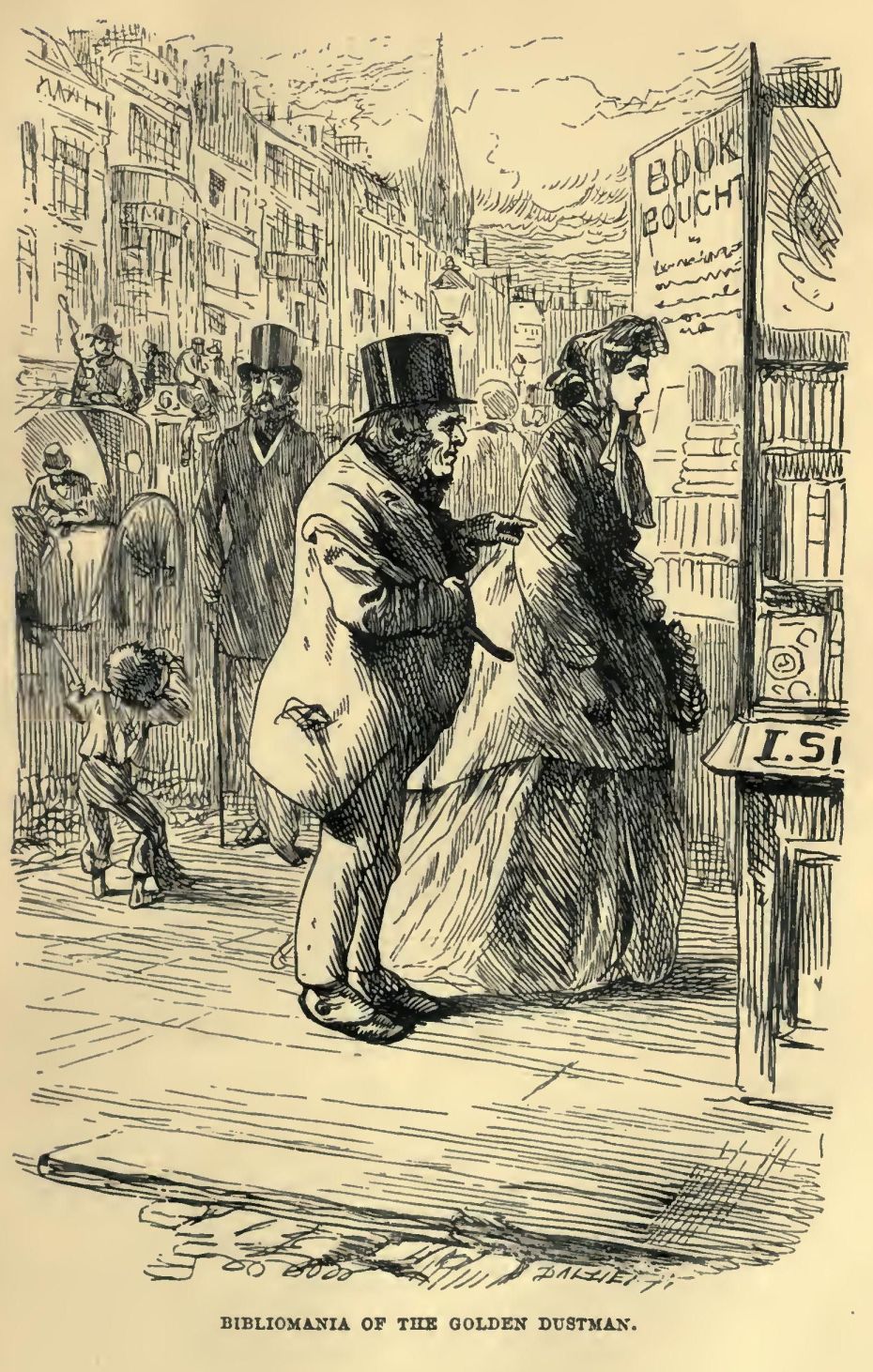
Marcus Stone. Bibliomania of the Golden Garber, Ill. To Roman Charles Dickens "Our common friend", 1901
Photo: gutenberg.org
On the typology of the fools of Brant, a well -known Sunday sermons cycle of Healer von Kaorsberg, begun in 1509, were built. The first was a sermon on seven types of book fools (German Büchernarr), three of which are characterized by collectors. The collector of books from only vanity is compared with the slave owner. Digently collecting but not reading books, a fool is likened to a crazy runner that is trying to examine the city signs in detail. A fool who copies only luxurious books is called "an insult of wisdom."
If the word “philoblabl” (lit. “Book Lovers”) was found in ancient Greek written monuments, then the concept of bibliophile is widespread from the 17th century. Initially, the so -called collectors of book rarities were called, and only closer to the end of the 19th century do bibliophiles begin to generally call connoisseurs and collectors of books. The overwhelming, insatiable or illegible collector received the neglecting name “biblofag” (Greek phagein - devour) and an ironic nickname Bookworm (English BookWorm, German. Der bücherwurm). Here there is already a food metaphor, labeling a thin line of norm and pathology, gourmet and gluttony.
At the turn of the XIX - XX centuries. Another definition appears-a biblioscope (Greek Skopein-to consider) proposed by the French publisher Louis-Octav as a law. “The biblioscope is not an enthusiastic lover, but a third -party indifferent traveler,” Lesann explains. “He examines, strokes, sniffs and feels books that he will never read.”
Separately, the names of non -normative, perverted forms of handling of books arise.
Bibliomania (new Greek. "Passion for books") - the lack of meaning and purpose of collecting books; Books brought to fetishism.
Bibliopathy (Greek. Pathos - suffering) is a generalized name for painful addictions to books.
Biblilatry (Greek. Latreno - I serve) - veneration of divine books (primary); A superstitious worship of the book, endowing it with magical properties (trans.).
Library (Greek. Tapho-I hide, I cancel)-an absurd form of bibliophilia, a reluctance to give someone books from their collection.
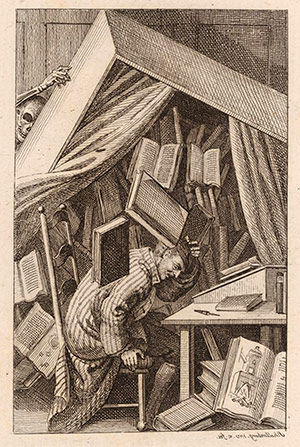 The death of the bibliophage. From the book. Johann Museus "Visions of Death in the Manner of Holbein", 1785
There is a fashion to imitate a book and love for the book. In the XVII century, publications were issued in which on one of the empty pages the title of the book was vertically printed - to cut and use in the home library as a shortcut on the spine of an empty binding. Later, the style of Faux Book (English “Imitations of the Book”), gave rise to an entire industry of man-miles, trellis imitations of libraries, false reaplets, pseudo-shows with books “burning” in them. As in antiquity, such practices were condemned by an enlightened part of society. The satires of Nikolai Ivankinchi-Pisarev, Mikhail Mikhailov, Antiochus Kantemir denounced the collection of books as a secular fashion. Let us recall the Pushkin Count Nulin, who has on a par with pins, cufflinks and loretians, Berange's poems, Gizo's books and the new Roman Scott.
It also happened that collecting was wrapped in vandalism. In Paris, the XVIII century was barbaric custom to collect book illustrations and stick on walls, indoor screens, fireplaces. The bibliophiles-casseurs (French "destroyers") collected covers, title sheets, engravings separately from books and glued into home-made albums. “At the same time, there was no attention to either the artist or school, and the sheets were glued as they acquired a collector,” explains the German art critic Joseph-Edward Veselly in the book “On the recognition and collecting of engravings. A manual for lovers ”(1874). In the novel by Nikolai Prymyalovsky “Molotov”, Bibyovandal Popikhalov “signed up in the library, writes out illustrated publications, cuts out and sells them, and sometimes it tapps the whole book.” At the same time, he does not consider himself a villain at all.
The famous London bibliophile James Graper (1723–1776) set the fashion for independent selection by collectors of engravings as book illustrations. Books at that time were often produced without binding, they could be “equipped” manually. This practice was called Granggerism, and its fans were called black and white people, since engravings were mainly monochrome.
The famous English bibliographer Thomas Dibdin, in the book “Biblimonia, or Book Madness” (1809), highlighted another type of collectors - supplying books with his own additions on nested sheets, or even on the pages of the copies themselves, or “taking together from various works (through scissors or rewriting) of each page or paragraph related to the face or subject of discussion.”
Many private collections were compiled at all without taking into account the content. They were built on interest in the book precisely as in the subject, and a rare feature of the artifact was important - so, brands with marriage are valued more than “correct”. Some lovers gathered defective specimens, others were looking for black, trial prints, others hunted the umbrella editions-existing in a single copy. The French called such collectors Curieux, "inquisitive hunters to books." Here, a hunting metaphor is closed with food, because the production of a hunter is also a game on a dining table. Such is Mr. Boffin - the “Golden Garber” - from Dickens’s novel “Our General Friend”, who collected books exclusively about the Bornings.
Other originals were chased even behind individual sheets with errors and typos. Among the eccentric collectors of the year before last, the “collector of rare-style” Yakov Berezin-Shiryaev, the possessor of how huge, equally powerless library. The subject of his special pride was the print printed on colored paper in a single copy of the article with the replacement of the points of the word “slowsmen” on the 15th page.
In addition to vandal and eccentric, it was also pathological, painful collecting. The crazy fanatic Antoine Bular (1754–1825), collecting the largest private library in Paris, began to turn his many apartments into book depots. According to legend, Bular filled with volumes as much as eight houses, laying out of books of fortresses, castles, squares and entire streets.
But the case is worse - the connection of the clinic with crime. In 1813, a rich widow was killed and robbed in Leipzig. The villain turned out to be - who would have thought! - The Saxon pastor Johann Georg Tinius, who was a sleeping book. It was not enough for him that there were already 40 thousand volumes and the acquisition of the famous library of theologian Johann August Nessel - Tinius decided to get money to replenish his collection. The instrument of murder is also impressive - a hammer for adjusting the shelves of bookcases.
There were also completely extravagant bibliomanians, whose interests stretched into the area of the forbidden. Since the 17th century, the practice of manufacturing and collecting book bindings from human skin has spread. And what a sweet name is an anthropodermic binding: you will not immediately guess what it is made of. The “material” of such books - mainly anatomical works and collections of criminal cases - were the bodies of executed criminals that bequeathed to the science of anatomes, abducted from the nights of tramps and poor people without means for the funeral. How do you, for example, have a treatise Mercier de Compire “for the glory of female breasts”, enclosed in the skin from the corresponding part of the body? On the cover, according to eyewitnesses, the nipple is clearly visible - for the most reliability.
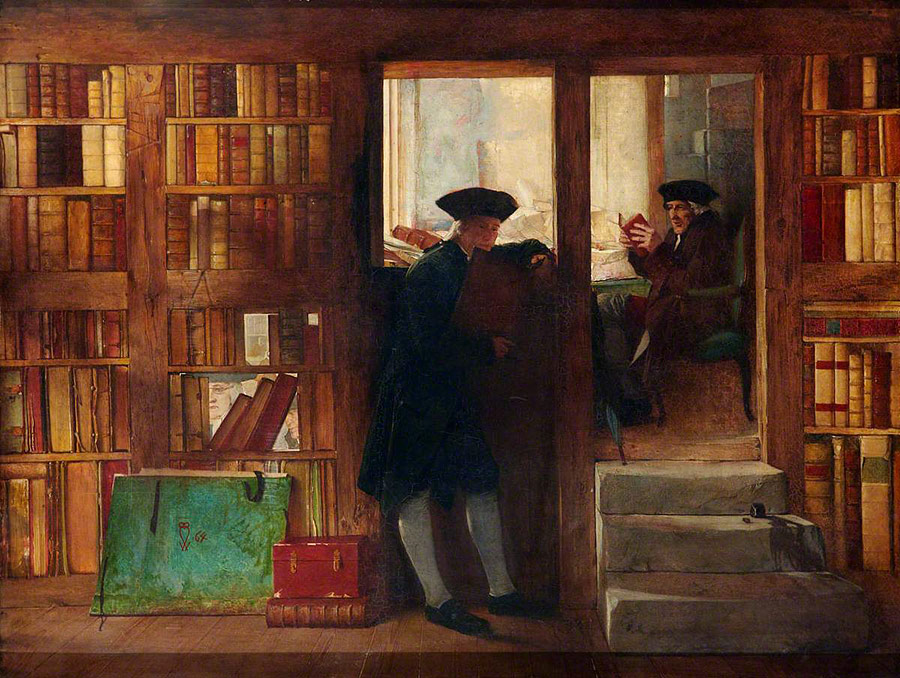
William Vetts Douglas. Favorite place of bibliophiles, or bookstore "Creech's" in Edinburgh, 1866
Photo: ThevarnishedCulture.com
Over time, the bibliomanians become an increasingly close object of the attention of writers and artists. The well -known cycle of paintings by K. Spimraga is devoted to enthusiastic scribes. A little caricature, but carefully discharged, they express the idea of isolation of an intellectual-producer from living life. F. Sh. The year in the novel “The Library of the Shechali, or memoirs for the history of good tone and exclusively good society” condemns thoughtless collection of books. Slave dependence on the libraries is depicted by S. Nodier in the novel “Biblimon” and G. Flaubert in the early story “Bibliomania”. Book maniacs of the next century-in the parable of G. Gesse “Book Man”, the short stories of J. Duamel “On Amateurs”, S. Cweig “Mendel-Bukinist”.
Here is an erotic, Goraceev metaphor in the alloy with medical - love as a disease. The hero of Nodier finds the generosity of the collector "equally natural as the frenzy of the loved one." For the Zweig Bukinist, "to hold in his hands a precious book meant the same as a date with a woman." The bibloman Dominges is a human figure of books laid out on the bed ...
The majority of Russian collectors were less exotic: they collected mainly first printed books (inconabuls), rare specimens and copyright lifetime publications. Among the first owners of private assemblies, Anikia Stroganov and Andrei Kurbsky, the first Russian biliophile emperor is called Peter I. Among the famous domestic collectors Stefan Yavorsky, Vasily Tatishchev, Alexei Musin-Pushkin, Peter Shuvalov, Fedor Tolstoy and many others.
The October Revolution has strangled the Russian bibliophilism with a decree on the confiscation of private and manor libraries. After temporary revitalization in the 1920s. It again coagulates during the Stalinist repressions. In the post-war years, they strive to give him an organized-refined nature: numerous books of book lovers are created. The present bibliophilism - with hunting and detective, gambling and raging passions - turns into a subculture.
Modernity gave rise to the latest practices - virtual and quasi -collection. Partyards are in fashion (English Partwork) - narrow -profile editions that go out in separate parts for the compilation of collections; buildups (Build Up) - brochures with the application of parts for phased assembly; “Books on numbers” - literary anthologies in a single design, with patterns on roots that form a whole ornament in a complete set. We yourself laugh at the Enlochka-Luda-eater, hungering a gilded tea strain-and we ourselves hasten to the nearest kiosk to check if the hundred-fingered number of the "magic ball" or "gold pages of Hondelup poetry" came out. The difference in the cost of real collectible publications and a stream junk as between Faberge eggs and Kinder Surprise eggs, but a fan of parole is covered by oniomania-an irresistible desire to buy for the process itself.
The Faux Book style does not give up positions, only now it is fashionable to fill the cabinets not false, but by real libraries - but component in special ordering. Well, the simplest way to own a book collection is to make bookshelfie, pictures of book shelves. Such images serve as a mobile phone for mobile phones, computer “wallpaper”, userpics in social networks.
The virtual bibliophile is also engaged in a completely speculative gathering, symbolic appropriation of books: compiles thematic collections like “Favorite Books of Childhood”, book skillists, biblines and lithotes like “Read over the year”. The collection of the "dualnide" bibliophile is a collage from covers, a heap of fragmented impressions, scraps of quotes. The main thing is not even gathering, but a constant presence in Internet communication.
The collector-gardener, lover, hunter, gourmet, crazy, vandal, and now there is still an imitator. Who is next?