
Translated material
“Siloviki in the role of saviors. Something about gays-only in the form of a joke "
The scriptwriters of Russian series tell by what rules they work
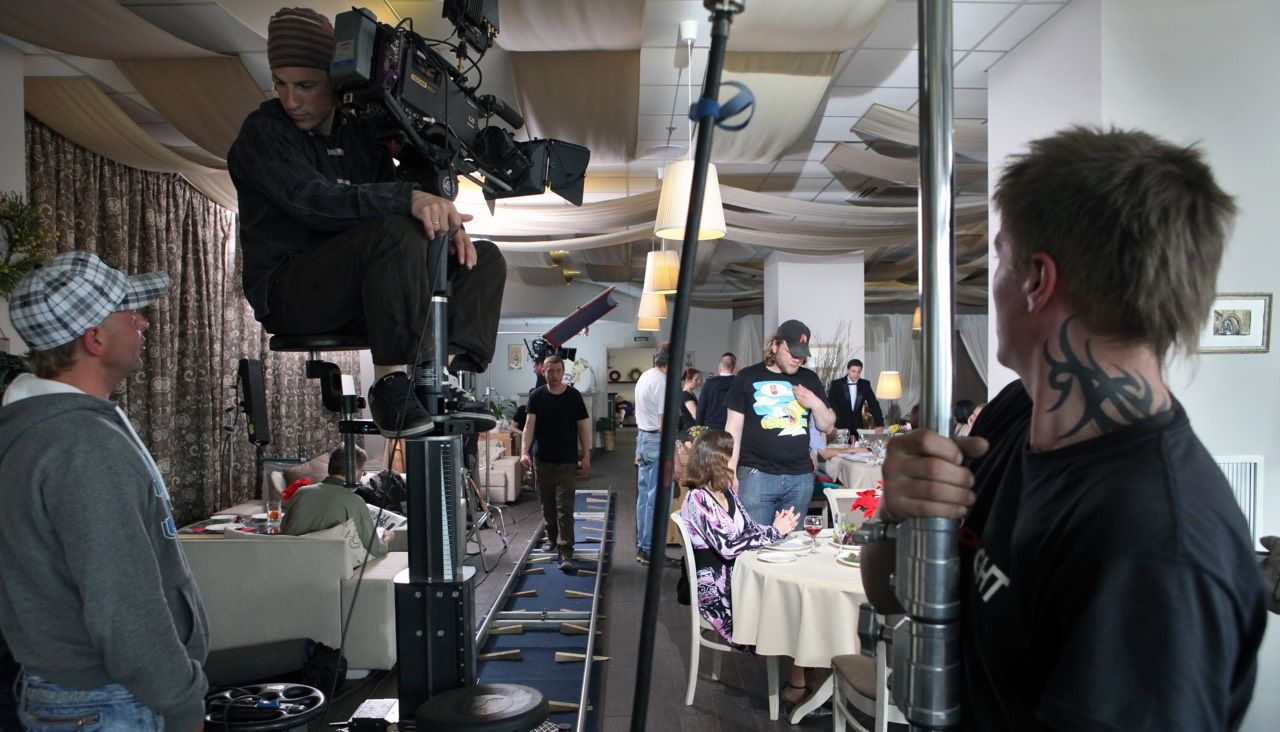
“Blood”, “Birch”, “Secrets of the investigation”, “Brother”, “sea devils”, “flint”, “testament of the princess” and so on, and so on. Daily in the morning, afternoon and evening, TV shows that watch millions of people come out on Russian television channels. The authors of the series well understand what can be discussed on the screens, and what is impossible; Who can be shown and who is not; Who is a suitable hero for NTV, and who is for Russia. Sasha Sulim found out the special corner of Medusa from the scriptwriters who collaborate with Russian television, what are the rules of composing series, how the requirements of different channels differ and how much they pay for this work. The names of some screenwriters are not named at their request.
"Russia 1": the heroine cannot meet with one man and at the same time sleep with another
Dmitry Abzeyaev : Melodramas dominate on the Russia 1 TV channel. The channel practically does not work on the territory of drama, thriller or mysticism.
The main character should be a woman with an understandable problem for a wide audience - a divorce or loss of a child. The heroine cannot meet one man and at the same time sleep with another - otherwise the audience will not understand her and will go to another channel. So it was before, but, according to the sensations, today this genre policy has become even more conservative. The channel is extremely rarely departing from the usual genre, strictly listening to the opinions of focus groups, which from year to year show the stable love of the audience for simple female stories with a happy ending.
Sometimes, however, the channel experiments, creating image projects. As a rule, these are large -budget historical productions: “Quiet Don”, “White Guard”, “Investigator Tikhonov”, “Demon of the Revolution”.
Olga Larionova : I wrote the first series for the Rossiya TV channel in 2009, it was called “Keys with Happiness”. Then I worked as a junior editor in the scenario agency "Stardast" - it represented the interests of the scriptwriters - and read everything that the authors sent us. Once we received three creative tasks from the Russia channel, the tasks consisted of the names of future series and the number of series. The names were the following: “Keys with happiness”, “Solar eclipse” and “House for two”. The channel explained that they held a focus group that these names “shot” and now they need someone who will write the series under these names. I wrote all three scenarios, and they all went on the channel with good ratings.
On “Russia 1” there was always a very clear “rider” of the heroine or the requirements that are presented to her. Firstly, the channel has a female audience, so there is always a woman in the center of history. Secondly, the heroine should be either a young girl or a woman not older than 30 years. But even if she is 18, her problems should be female, not teenage: not a crisis of self -determination, but abandoned, pregnant with a scoundrel, the parents were expelled, scammers threw, mother died, nowhere to live.
The heroine should have a simple profession close to the people - a teacher or a doctor. There should be no more than three men in the series - two are better. The heroine cannot sleep with someone at the call of his soul-everything should be only out of love. Usually a romantic line unfolds like this: the first man is a fatal mistake, the second is a reward for suffering.
And finally, all the good things that happen to the heroine in the finale should not be the result of her career efforts. This is a reward to Cinderella for good behavior.
In recent years, they began to say on the channel that they needed a more active heroine. But judging by what I see on the air, Cinderella among heroines is still much larger than business women. The series "Russia 1" are not just the leaders of the market: they know their audience very well on the channel and very rarely cheat it.
Not so long ago, the series “ Bloody lady ” was released on “Russia” - a tightly made, with an excellent script and Julia Snigir in the title role. But he passed, as far as I know, with average numbers. The audience of the channel was probably embarrassed by an ambiguous heroine.
The scriptwriter of the weekend melodram for “Russia 1” : when eight years ago I was just starting to work as a screenwriter for the second channel, they explained to me that the main plots that are interested in the channel are “Cinderella”, “sleeping beauty” and “red cap”. The latter is the most difficult genre, because some action should be present in it, some detective line. In general, the main topics for the channel are a woman in trouble or, as an option, the difficult happiness of the heroine.
When I was just starting, it seemed to me that the channel needed stories about a stupid woman, but this is not so. The editors expect smart acts from the heroine: she should not sit and be silent in a rag, should not let herself humiliate, while remaining honest and modest. “Tolerated”, in the terminology of the Bozhenes of Rynskaya, is not interesting to them. To be honest, for me this was a discovery before getting to the channel, it seemed to me that all their heroines are subtile and sluggish.
Over the years, the heroine is changing. If earlier they hinted that a young woman must be chaste, that she cannot have lovers, now everything is becoming more plastic and approximately closer to life.
One of the rules that remains unchanged: in the final, all lines must be concluded. If a good girl is in love with a good person, and he loves the main character, then leaving this girl at the end of the film hanging in the void, without endowing her a young man, somehow badly. The viewer is waiting for understandable, interpreted endings.
The main character, whatever she does in life, should meet her love in the finale. And she can only engage in a profession understandable to the viewer - no designers or artists.
Spectators who are not interested in, have long gone online, but those who stayed with the TV are happy to watch the melodramas of “Russia”. Once I came to the beauty salon where the TV was included, and there was a television movie, the script for which I wrote. And I saw how one of his employees sobs under him. For me it was a serious shock.
Channel One: the heroine can divorce, have her own business
Olga Larionova: On the first, the viewer is more complicated - the channel looks at the conditional middle class. It is assumed that he has money, the percentage of the male audience has more than that of Russia, and the women who watch it are more economically active. Therefore, the channel can afford to experiment, including because their rich advertiser can pay for these experiments.
On the first, the heroine has no strict restrictions on moral terms, she is more active, can afford to divorce on her own initiative, have his own business. The first is focused on the “beautiful picture”: even rural stories most often end with the fact that the heroine moves to the metropolis. Despite these differences, the channel still has a request for melodrama, to the history of Cinderella.
At the end of the zero, money appeared on the channel and the desire to do something new and ambitious. In those years, the series “School” of Valeria Gai Germanika, which I also wrote as part of a group of authors, was released. His ratings were not very high - but it was a sign, image project. In 2015, the series “Method” with Konstantin Khabensky was released, it was also an experiment, but already financially successful, so they decided to extend it for the second season, even despite a very ambiguous hero.
The author of the melodram for the TV Center channel, collaborated with the first channel and NTV: I heard the following phrase: “Look out the window - we have everything so gray and dull, on the screen we cannot show the same gray reality.” Channel One prefers not to copy life, but to decorate, to make it a strongly improved copy - a conditional world in which people can immerse themselves in order to distract from their problems.
Channel One loves stories that promote traditional family values. If they decide on some kind of dubious things, then only for the sake of the family, for the sake of high ideals and values. In one of the applications that was sent to the channel, the heroine decides to quit her husband - not because he beats her or changed her, but because she was tired of this marriage. The reaction of the channel was this: “Just like that, our woman does not destroy the family. They tolerate, love, forgive everyone, only extreme circumstances can force our woman to destroy the institution of marriage. ”
NTV: A simple man with understandable problems
Dmitry Abzeyaev: Hero NTV is a simple man with understandable problems for the male audience 35+. A couple of years ago, the producers decided to abandon the usual cop sagas who stopped giving a former rating. Today, a hero can be, for example, a rescuer or a fireman, sometimes an average businessman - such people are recognizable, it’s easier for them to sympathize. I don’t remember that recently, truly loud projects came out on the channel, although in 2015, after the management of the leadership, it was announced that NTV would soon become Russian HBO.
Unfortunately, our federal channels remain very conservative and cannot understand that if you do not make honest stories about complex, ambiguous heroes, then no HBO will work.
Olga Larionova: NTV is the only channel where the hero of the series can be a man. The share of the male audience is almost half of them, and it is on it that the channel is oriented. “A cool man with adult problems” is their request. It is also desirable that the series be present in the series. A separate type of Hero NTV is an “employee”: a cop, a private detective or retired military.
The author of the melodram for the TV Center television channel, collaborated with the first channel and NTV: they answered one of my scenario applications for NTV that the channel needed more stringent, male stories. In general, NTV works more with the authors of the male. They do not say this right, but it is read between the lines: it is easier for a person with a male warehouse of mind to come up with plot ups and downs for a male hero.
By the way, they often complain on the channel that they were terribly tired of stories about police and investigators, but at the same time they continue to make series about police and investigators. They look good.
Other channels: Experiments-on TV-3
Dmitry Abzeyaev: At the end of 2016, a small revolution happened on TV-3. The leadership changed on the channel - the producers of TNT Valery Fedorovich and Evgeny Nikishov came there. Thanks to them, serious dramatic projects appeared on TNT: the series "Cheating", "Sweet Life", "The Law of the Stone Jungle". These stories were unique, they forced young people who are the main audience of the channel, to think and worry.
But at some point, the leadership of the Gazprom-Media holding, which includes TNT, decided to return the channel to the original format, making it exclusively by the territory of laughter and enterized. According to rumors, the dramas were too costly and eroded the audience of the channel. Together with Nikishov and Fedorovich, projects that were developed for TNT went on TV-3. For example, Gogol and the second season of Chernobyl.
Today, the TV-3 line is divided into two slots: a pre -me-everything that goes until 21 hours-and the prime time. In the parcel, chamber mystical stories and detectives dominate, the favorite audiences from previous years. For Prime, the channel develops dozens of original formats with the so -called High Production Value - these are “movie series” that can compete with world -class television products. This slot has post -apocalyptic dramas, Scandinavian thrillers, vampire militants, even melodramas. Fedorovich and Nikishov are not afraid to experiment, in my opinion, it is they who bring the game to a fundamentally new level. The slogan of the television channel: "Everything except the usual."
Like TNT, STS is a channel focused exclusively on entertaining content. However, he has always been and remains more conservative than the same TNT. Simple and funny stories are told here, which can be interesting to both adults and young children. On the channel, colorful comedies like “Kitchen”, “Ivanov-Ivanovs”, “Psychologists” and others are successfully held on the channel. Not to mention the main long -liver of the broadcast - the seat of the Voronins, which has been on the air for almost ten years.
Olga Larionova: Scriptwriters send youth stories to TNT. This channel has created a unique system of work: they collect the so-called raining room-a group of screenwriters who together write scripts under the guidance of Showranner or the author of the idea. As far as I know, very successful channel stories were written so: “Girls”, “Real Boys” and others.
On TV-3 recently decided to enter into a direct dialogue with the audience and gave the viewer the opportunity to choose what he wants to watch. And not from the finished one, but from the fact that they are only going to shoot. Five pilots of different series were shot. In terms of quality, it was a very good product (definitely no worse with a successful TNT of “sweet life” on the air). The pilots of the series were hung on the vote on the platform of the site "Kinopoisk". The result of the experiment was unexpected: the audience reacted negatively to almost all the series and approved the continuation of only one of them. I think that the point, of course, is in the platform - visitors to KinoPoisk are much more demanding and picky than the average viewer, so the cut was not entirely objective. But the experiment itself was very interesting and important for the industry.
The author of the melodram for the TV Center channel, collaborated with the first channel and NTV: if you came up with something that has not yet been on Russian television, then this can only be carried on TV-3-there is nowhere else to do. All other channels want something that they already had, but a little differently. They know that their audience loves, and they don’t really want to take risks, they are afraid that they will not get into the viewer. In this regard, both Channel One and TNT are similar.
As for the “TV Center”, the channel orders a four-party films, mainly female stories-a detective or melodrama. The channel is not ready to spend large amounts on these television films, so the script is often cut not because of censorship, but because there are simply no money on some scenes. “Let them talk in the frame, and we will disperse” - something like this sounds like this.
What the scriptwriters prohibit: alcohol, mat, politics, gays
Dmitry Abzeyaev : Today it is impossible to tell stories about homosexuals, you can’t practically smoke and swear in the frame, often you can’t openly criticize power. But still, the censorship that we observe in the state media is not in the series yet. I do not exclude that the internal censorship is present: the producers of the channels are initially selected by the series that will resonate with the expectations of the audience. And the expectations of the audience are formulated by a news grid and news policy.
Olga Larionova : According to my sensations, politics in our series is a closed topic. If in the plot there is some kind of political “complication”, it can only be at the level of a small official: the mayor is the maximum.
Another closed topic is homosexuality. Something about gays can slip in the form of a joke, but the main characters cannot be representatives of non-traditional orientation.
The main character or heroine cannot smoke in the frame and generally have bad habits. Today I often recall my beloved heroine Nastya Kamenskaya, who constantly smoked in the frame, and I miss this very much.
Another taboo is the heroine-journalist. Personally, it seems to me that such characters are a good balance between an active and feminine heroine. But whenever I propose such a story, I get a refusal without explaining reasons.
The security forces appear in the series only in the role of saviors, if the security forces is a negative hero, then it must be emphasized that he is a renegade, an atypical representative of the profession.
All these rules, of course, are unspoken and in many ways dictated by self -censorship and scriptwriters and producers. In the Kremlin, no one is watching the series, but everyone is trying to insure him.
The scriptwriter of the weekend melodram for the Russia 1 television channel: heroes cannot use swear words in their speech at all, but even they are forbidden to pronounce the word “pancake”. On “Russia 1”, someone, apparently, reacts very sharply to this word, perhaps because the subtext is read too well behind him, what the person wanted to say.
Usually the editor leaves the following comments in the script: “Why is she doing this? Is she a fool or what? " Or "it is unlikely that a hero with higher education will say such things." And if you start arguing, you can get such an answer: "Once it was embarrassed, then this can confuse the viewer."
In general, work on the script for the Russia 1 TV channel is in the most thorough way - each letter under the sight. Поэтому когда ты видишь, что в итоге по твоему сценарию было снято, то приходишь в какой-то ужас. Так и хочется спросить: «А для чего мы так трудились?» На съемочной площадке вырезаются знаковые места, над которыми ты месяц бодался с редактором, переписываются ключевые фразы, в итоге герой, который замысливался как тонкий человек, превращается в дурака. На этой стадии технологическая цепочка, видимо, еще не отлажена.
Сценаристка мелодрам для телеканала «ТВ Центр», сотрудничала с Первым каналом и НТВ: Критика в адрес московской власти на «ТВ Центре» совершенно неуместна. Причем в любом виде — даже в виде шутки. Один из моих героев пытался пошутить про тротуарную плитку, но шутку решили на всякий случай убрать. Редакторы очень таких вещей остерегаются.
Считается, что наша страна не любит сильных независимых женщин, которых принято называть феминистками. Вот если редактору хочется опустить сценарий, то он обзывает героиню «феминисткой» и просит принести что-то еще.
Исторические периоды, которые еще до конца не осмыслены и не поняты, в российских сериалах мы тоже пока не увидим. Неспроста у нас пока не было ни одного проекта о Горбачеве и вообще об этом периоде — не совсем понимают, как к этому времени подойти, как его оценить и какими красками его раскрасить.
Дмитрий Абезяев : Два года назад я писал сценарий детективного сериала с элементом мистики, который в итоге так и не вышел. Изначально мы делали его для канала «Че» — там была свобода, но не было денег. Затем продюсеры отнесли проект на СТС. Там он долго лежал, мы неоднократно дорабатывали сценарий под их формат, но не сложилось. В итоге сценарий переехал на Первый канал. Прочитав сценарий, редакторы захотели убрать из него драматичный бэкграунд главного героя: у него сгорели родители, он пережил шок и несколько лет прожил в полном затворничестве. Нам сказали: «Сделайте нам историю про понятного мужика со сверхъестественной способностью и про обычную женщину — и чтобы они любили друг друга». На возражение о том, что, лишая главного героя сильного бэкграунда, мы обедняем историю, продюсерам ответили: «Да не нужен нам этот бэкграунд — нам нужно уютное семейное кино».
В такие моменты ты как автор чувствуешь себя раздавленным. Ты смотришь хорошие сериалы, вдохновляешься, хочешь делать такие же — небанальные, со сложными, интересными героями, а тебе говорят: «Убирайте, наша аудитория этого не поймет».
Сколько за это платят
Дмитрий Абезяев : Бюджет сериала канал рассчитывает исходя из стоимости одной серии, а уже продакшен-компания, которая снимает сериал, решает, какой гонорар заплатить сценаристу.
Есть продюсеры, которые рассуждают так: чем больше ты вкладываешь в сценарий, тем качественнее получится проект. А есть те, кто вообще не любит платить сценаристам — только насилуют их бесконечными переработками и в итоге не доплачивают за них. Многим приходится соглашаться работать и на таких условиях: работу найти сложно. Я тоже так работал, когда начинал.
Сумма гонорара зависит от формата сериала: у проектов, которые идут в дневном эфире, бюджеты небольшие, и продюсер всячески пытается сэкономить на сценарии. За серию сериала, идущего в прайм-тайме, сценаристы получают (в зависимости от статуса и фильмографии) от 150 тысяч до миллиона рублей. Но средняя ставка по Москве колеблется в районе 300 тысяч рублей.
Кажется, что это неплохо. Но здесь нужно понимать, что эти деньги сценарист получает не сразу. Сначала ему выплачивают аванс, потом начинается работа над поэпизодным планом, потом пишутся диалоги — все эти этапы оплачиваются отдельно, в итоге платежи могут растянуться на недели и даже месяцы. Поэтому простой совет для новичков: если ты только начинаешь работать сценаристом, не бросай основную работу до тех пор, пока не поймешь, что это ремесло способно обеспечить тебя и твою семью на несколько месяцев вперед.
Сценаристка, автор мелодрам выходного дня для телеканала «Россия 1»: Мелодрамы выходного дня телеканала «Россия 1» фактически состоят из четырех серий по 40–50 минут. За одну серию канал платит около 150 тысяч рублей — недавно мой гонорар немного повысился.
На Украине за такой же сценарий платят меньше — около 120 тысяч рублей, но и требования там гораздо ниже.
Ольга Ларионова: После 2014 года у российских сценаристов появились серьезные конкуренты. Сама я так об этом узнала: год назад завершила все свои долгоиграющие проекты и была готова приступить к чему-то новому, но столкнулась с тем, что мои заявки никуда не брали. Коллеги, которые оказались в такой же ситуации, рассказали мне, что это «украинские гастарбайтеры» отнимают у нас работу. Украинские авторы и раньше успешно работали для наших продакшенов, но после обвала гривны их работа стала еще и дешевле стоить.
Средний гонорар российского сценариста в два раза превышает гонорар автора из Украины. Если последний будет рад и 100 тысячам рублей за серию, то наши привыкли, что им платят не меньше 200. Эти расценки касаются так называемого длинного мыла вроде многосерийных мелодрам или детективных процедуралов . В эксклюзивных восьмисерийках расценки уже другие — там о цене договариваются с каждым автором отдельно, но и авторы обычно пишут их опытные и успешные.
Recorded Sasha Sulim