
Translated material
Velvet of the Armenian revolution
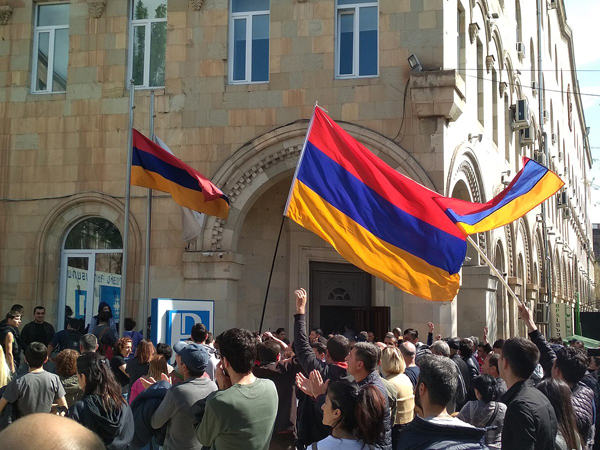
Serge Sargsyan, former president of Armenia, was elected its prime minister. This causes a sharp discontent to the opposition. The leader of the party-organizing protest performances announced the beginning of the “non-violent velvet revolution” in the republic.
Recall that the protests in Armenia began on April 13, on the eve of the elections of the new Prime Minister appointed on April 17. The fact is that with the transition of the country to the parliamentary form of government precisely in the hands of the head of government, power is concentrated, and the ruling party and its coalition partner nominated on this post of former President of Armenia Serge Sargsyan.
On April 16, clashes of the protesters with the police occurred on the streets of Yerevan. 46 people got into the hospitals. The leader of the protest shares, the head of the opposition parliamentary faction "Elk" Nikol Pashinyan called for the parliament. On April 17, he announced the beginning of the "velvet revolution." Nevertheless, Sargsyan was elected prime minister.
On April 18, the opposition was held in Yerevan. According to the Interfax news agency, the police have already detained over 60 of its participants.
Pavel Salin, Director of the Center for Political Sciences of the Financial University under the Government of the Russian Federation, agreed to talk with Polit.ru about the situation. According to him, the situation arose was quite clearly predicted and in case of its occurrence among the Armenian authorities, as well as in Moscow, if it wants to maintain influence on Armenia, there should have been a spare plan.
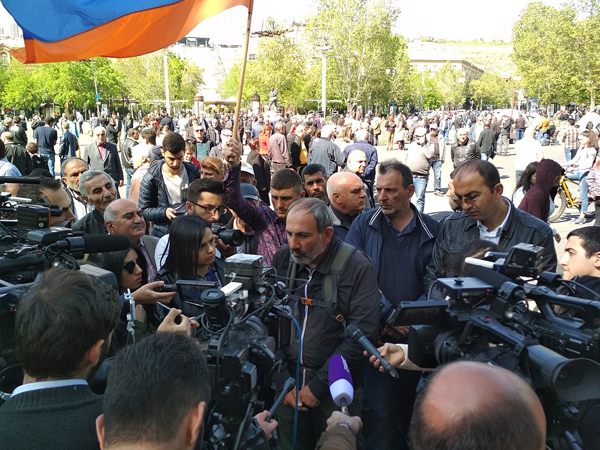 Nikol Pashinyan Wikimedia Commons
“In general, taking into account the events of previous years in Armenia, this kind of situation should be expected, because the degree of dissatisfaction with the authorities in Armenian society was very, very high. We remember the so -called "Elektromeidan" when the protesters managed to cancel the increase in electricity prices; Remember the riots that were provoked by the murder of the Armenian family to the Russian military ( we are talking about events in Gyumri - approx. Ed. ). That is, it is clear that the Armenian society is in a fairly dynamic state, and provoking it to mass performances is quite easy.
This is due to both the difficult socio-economic situation that has developed in the country, and the fact that the level of discontent by the authorities in Armenia is permanently high. Therefore, objective prerequisites for what was happening in this country now really existed. The appointment of former President Sargsyan Prime Minister means that he remains the actual head of state. And those groups of the population who associated their hopes with the election of the new president ( on March 2, Armen Sargsyan became them - approx. Ed .), They feel deceived. In this situation, of course, they are easy to manipulate.
Here you need to see if there is some external factor in what is happening or not. This is a big question - is there an attempt to foreign intervention. It could be undertaken in order to withdraw at least partially Armenia from the orbit of influence of Moscow. But in itself, such a development of the situation could be predicted in any case. Well, let's see what will happen next. In general, Moscow relied on such a tandem.
Armenian society - not all, certain forces in it - were unhappy that the authorities definitely focused on Moscow. And they were allowed to implement such a combination when the president with his Western background would lead a dialogue with the West, and the Prime Minister with his pro-Russian background would resolve all social and economic issues, would actually determine the economic (and means other) state policy.
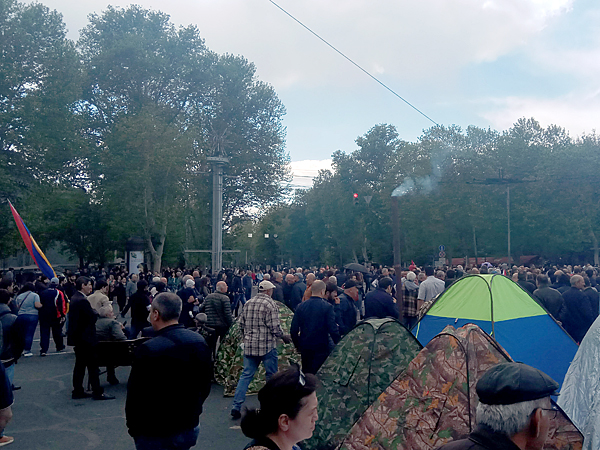 Tents on France Square in Yerevan. 04/18/2018 Wikimedia Commons
Whether the opposition will be able to destroy these plans is still unclear. But in principle, it is not too difficult to do, because, I repeat, the Armenian society has been in a rather agitated state for many years, and it is not difficult enough to encourage people for mass performances. And those who are in Moscow are responsible for the Armenian direction, in fact, had to predict a similar development of the situation, consider this option as one of the main ones and have a plan and approved tools for counteraction.
As for the “velvet” of the declared revolution, whether it will be non -violent and whether it will occur at all, depends on the actions of both protesters and the authorities, and on how long the leaders will be able to consolidate the masses of people around themselves. Yes, it was announced that this is a “velvet” revolution, and such revolutions are always non -violent. But now you need to watch how much protest leaders, Mr. Poshenan and others like him, will be able to mobilize supporters around him for a long time. And what actions the authorities will go.
Because when there was an attempt by the so -called "Elektromedan", the leaders of the protesters managed to mobilize the population around themselves exactly until the authorities played back and announced that the increase in electricity prices was canceled. Then, the political opposition tried to take advantage of this discontent, which would like to reorient the country to the west. But it was too late: as soon as the authorities said that the increase in prices was canceled, people from the streets began to diverge. Whether there will be something similar this time, another question.
It is clear that now there is no increase in prices, but will the authorities take any actions aimed at demobilizing the protesters? Now the ball is clearly on the side of the authorities, they must do something in order for the level of mobilization of the protesters to decrease and they would gradually diverge home, leave the streets. Then their leaders will feel much less confident.
What can the authorities do if the protesters are unhappy that with the transition to the parliamentary form of government, the president gets less authority than the prime minister? Well, to go completely on the protesters means to lay a delayed action under the Armenian political system. If the president and prime minister will have approximately the same powers, this will lead to a split.
Nevertheless, I repeat: in a good way, in this case there should have been a backup plan-both Moscow and the Armenian authorities-which should now begin to implement. Because they had to foresee such a development of events, ”Pavel Salin explained.