
Translated material
Emigration in literature
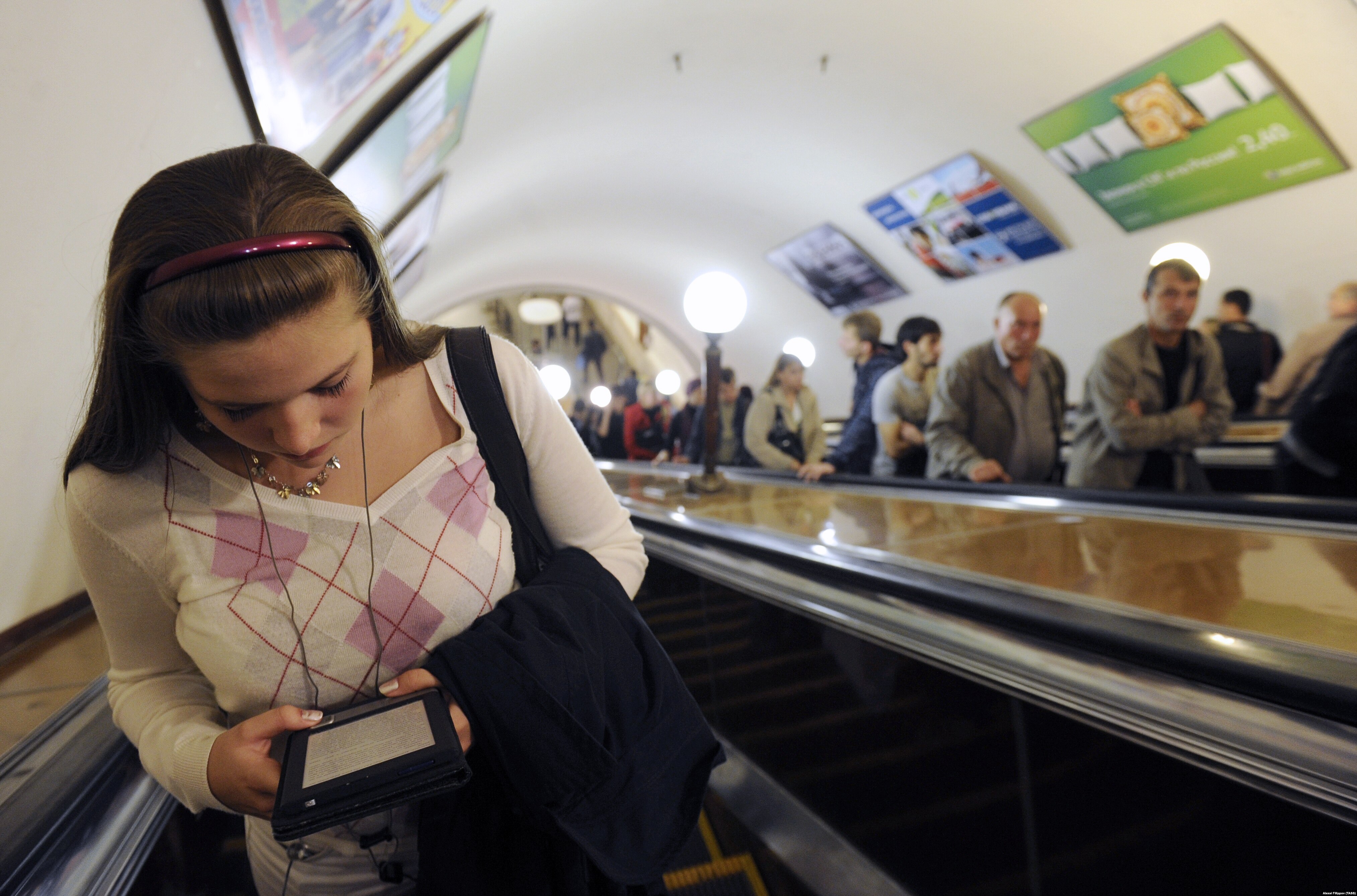
Project "Regiment" as a catalog of Russian classics
- Since Soviet times, the myth that it is the most reading country in the world has been widespread in Russia.
- Now, in terms of the number of books and publishers, Russia is greatly behind the developed Western countries.
- "Great Russian Literature" is one of the platforms of the national myth, Russianness as such.
- Russian literature in Russia was elevated to the rank of religion and needs to desecalize and demifologation.
- The Internet project "Regiment" makes you look at classical and modern literature in a new way.
Sergey Medvedev: Telegram is blocked , threatened to block Facebook, Amazon and Google want to leave Russia. All digital reality breaks up before our eyes. However, we have a great Russian literature. And just in April , the Internet project "Regiment" about Russian literature was opened. Details in the plot of our correspondent Anton Smirnov .
Anton Smirnov: The literary project "Regiment" is designed to rethink and re -create a "Literary Canon". It included 108 books. The project combines different layers of Russian literature: from Pushkin and Lermontov to Sorokin and Harms. An extensive expert group helped to choose a list of works to the project - from teachers to modern poets.
"Regiment" is a multimedia project that goes beyond the ordinary list and chronology of Russian literature. Articles about books are accompanied by audio and video materials, which allows you to consider a specific work in different contexts. This is a great addition not only for the school course of Russian literature, but also for a professional reader.
Sergey Medvedev: Our guest is the head of the project "Regiment", journalist Yuri Saprykin and Lev Oborin , poet, literary critic and editor of this project.
Yuri, do you see a connection between what is happening now with the influx of censorship and all this political atmosphere after March 2018, and a project about slow reading? Is this a kind of emigration in literature on the book shelf?
Yuri Saprykin: Yes, this is internal emigration, escapism, shelter searches, although, probably, not more escapism and emigration than a campaign in the conservatory on Kurentzis or on the retrospective of Bergman at the Moscow Film Festival. In general, I am a little embarrassed by the tendency-to appropriate to each act of cultural action or cultural consumption, not related to a direct political agenda, the status of some departure for permanent residence in some kind of Castali school or in an ivory tower.
As for the current agenda ... How can we say that this is an alternative to some free Internet if we exist on this free Internet and dependent on its freedom? We live not only on a site that has not yet fallen from this chaotic blocking of IP addresses (but on all the will of the Almighty, maybe it will also fall). We live in Telegram and Facebook. We attached to each part of our material the “Share it in Telegram” button, which, thanks to Roskomnadzor, now does not work because external links to Telegram are blocked and so on. We, of course, are part of this extensive ecosystem and suffer from its infringement in the same way as everyone else.
Sergey Medvedev: Leo, and your audience - the same people who spend most of the time on Facebook and on Telegram? Or is it wider?
Leo Oborin: These are really people who spend most of the time on social networks on the Internet, they come to modern educational projects for knowledge that they have not received before. For quite some time we thought that it would be a project, for the most part, focused on schoolchildren, applicants and students. But the farther, the more we understood that in fact, quite adults want to know something new, which, perhaps, they were once intimidated with the help of well-known didactic techniques. And we realized what it is actually proud of, if we are already told that it is worth proud of, whether there is something that answers with some of their modern aspirations, some of their problems or, conversely, something that you can leave with your head, fleeing everything that presses.
Sergey Medvedev: If I understand correctly, the meaning of the project is precisely "re -read the classics."
Yuri Saprykin: Yes, that’s right!
Sergey Medvedev: That is, this is already for educated people who are familiar with this.
Leo Oborin: This is such a school of new slow reading again.
Sergey Medvedev: But at the same time he is also relevant for schoolchildren?
The project "regiment" is a school of new slow reading again
Lev Oborin: I would like to believe that at least good schools, good teachers who learn about this will not see in this competition to the knowledge that they convey and their methods, but simply say that "there is such a site, and you can see and, perhaps, better understand something."
Sergey Medvedev: Why exactly 108 books?
Yuri Saprykin: The readers in the comments immediately explained: "It is clear why 108: because it is the Tibetan canon Ganjur, because the complete collection of Buddha's sayings occupies 108 volumes."
It was very pleasant for us to see such an interpretation, although we did not mean this at all. This is a random voting result that we held. We cut off the upper layer of books that received so many mention in the lists of our experts.
Sergey Medvedev: You have on this rating of experts “Hero of our time”, “Anna Karenina”, “Captain's daughter” - the first three. Leo, how do you explain the popularity of the "hero of our time"?
Leo Oborin: It suddenly turns out that this text is very nice to everyone and is very important for everyone to summarize the points not only because the main character of this novel by Pechorin is a bad person and a role -playing model, the best for many. This is a person whose courage and whose brilliance many believed themselves at the time in which many fell in love. In the novel by Jan Fleming "From Russia with love", the Russian spy tells James Bond that he looks like Pechorin.
But it is also important that this text with its mood, how the whimsical compositionally it is made, does not look almost any of its time. In addition, maybe people want to have some hero of our time, which we do not have.
Sergey Medvedev: And then, in a sense, he is Tarantinovsky. Times and sequence are also broken there, all this is mixed.

Yuri Saprykin: Yes, this is such a protomodernism, a thing in which this path of history is broken from point A to point B. and Lermontov shows that it can be told by some curved ways, changing the temporary sequence, the point of view of the narrator and so on.
Sergey Medvedev: Probably, soon we will be stipulated or given a subtitle: “Facebook, the social network is prohibited in Russia” as a prohibited Islamic state. But it is interesting that, after conducting such a circle of polls, you returned to the classics as a classic, and this is a kind of abstract, self -sufficient, closed group. After holding a whole round of discussions, you came to the obvious. And somewhere there were surprises for you, exits beyond the canon?
Yuri Saprykin: Firstly, the modernist prose of the 20-30s is very high there: Vaginov, prey, Prose of Mandelstam. But she is probably still undergoing a mass reader.
Leo Oborin: Harms, Vvedensky.
Yuri Saprykin: Yes, to a lesser extent the "envy" of Olesha. Babel.
Sergey Medvedev: You have linguistic experiments very widely, all this plastic avant -garde reality.
Yuri Saprykin: Yes, and we tried to lay out this list on the time line. And there are several peaks: there is a period between 1860 and 1880, when all the great Russian literature arises. And what is even more amazing: this is a gap from 1924–1925 to 1930. About 20-30 great books arise. And it is also interesting that each of these peaks precedes political frosts, and maybe it is suppressed by some next turn of twisting of nuts with dramatic consequences for authors and works.
Leo Oborin: And these great texts continue to influence the tongue and consciousness. The period of the Khrushchev thaw and the 60s is another such cultural surge, which was followed by stagnation. The 60s is such a last, probably period when there is a certain whole Russian literary tradition, and then everything interesting goes either into emigration or underground.
Yuri Saprykin: Either Trifanov, Cossacks and Vampils.
Leo Oborin: And it turns out that in the 90s, in fact, there is no new reconciliation. We find ourselves with different realities. And the writers of the postmodern generation that developed in the 80-90s play these contexts. And from the traditional camp, calls and cries are all the time - "And where is the new great Russian novel, the new Tolstoy?!"
Sergey Medvedev: And there was no such rethinking after 1991, between, relatively speaking, 1991 and 2000?
Leo Oborin: We have the last text from the main list in chronology - this is the "chapaev and emptiness" of Pelevin. Apparently, this means the point of some 20-year cut-off, behind which the classic ends and modernity begins.
Sergey Medvedev: What year is this?
Russia remains a literary -centric country
Leo Oborin: 1996. But a lot was written about the fatigue of Russian prose, that the Russian prose of the 90s and especially the 2000s, as it were, prepared those unrealized opportunities and was trying to return to some phantoms of a large plot novel. But at this time there is a huge surge in poetry, which does not have such a mass reader as the poetry of the "sixties" or the silver age. Nevertheless, some new language reality, perhaps, is created there first.
Sergey Medvedev: That is, the "regiment" ends "Chapaev"?
Yuri Saprykin: The last novel from the main list is Chapaev. But we still have the second bottom, the so -called lists that we accompanied the main part of the “shelf” are literally lists for additional reading, collection of books that show what discoveries the literature made at different times and what traces were drawn behind these discoveries. In the 90s, it is very clearly visible how in all these re-united flows of Russian literature, which ceased to be divided into foreign, underground and official, the authors begin to run in several understandable directions at once. One of them is a rethinking of injuries of the past. This begins almost immediately, that is, what we are talking about today in connection with the book of Memory of Memory of Maria Stepanova, for example, starting from the 90s, begins to happen in various forms-from Aleksievich to some almost socialist, recent novels about the era of Stalinist repressions. The second thing is attempts to somehow comprehend a new reality, largely translating it into the language of the game, conspiracy, occultism.
Leo Oborin: Mythology and folklore including.
Yuri Saprykin: Yes. The headliner of all this is Pelevin, but there is a lot of this: reality as a game, reality as an illusion. Do not describe reality with realistic methods, literally, but translate it into some virtualized, game language. Attempts to find a new language for describing reality ... a new language is searched in poetry, and the new optics in game postmodern experiments.
Sergey Medvedev: Do you have any favorite books that are not included in these 108?
Yuri Saprykin: A lot!
Leo Oborin: for example, the play of Ostrovsky “Thunderstorm”, which I love and consider the great, did not get there. On the other hand, there are no wonderful modernist texts. But here, probably, it was impossible to rely on the fact that the wide expert community would, relatively speaking, will be a novel or edition of Ilya Zdanevich "admiration" among the main masterpieces of Russian literature.
Sergey Medvedev: Russia is no longer the most reading country? Somewhere I came across information that there are fewer bookstores in Russia than, for example, in Paris.
Leo Oborin: Purely statistically, of course, not. If we look at the American book market, there we will see the difference simply at times between the number of publishers, the number of publishing books and even the number of sites and magazines devoted to the conversation about these books. Therefore, it is quite funny to think about competition on the field of literary criticism: it is simply almost gone. But at the same time, in the head of a Russian person, an idea of the great Russian literature, which is one of the cornerstones of Russianness as such, still sits in the head of a Russian person. And in this sense, Russia remains a literary -centric country. At least, in this regard, some translation difficulties may arise.
Sergey Medvedev: Probably, in the sense of the mythology of Russian literature: this is one of the platforms of the national myth.
Yuri Saprykin: Apparently, there is some gap in which the “regiment” is trying to get into: the gap between the sacred status, endless worship and, as it were, iconoclasts, who are still trying to drop Tolstoy’s bust from the boat of our time. There are not many of them and, as a rule, these are very well -read people. Basically, a wide reader’s audience sincerely believes that this is our great national treasure. And on the other hand, the family, the school and traditional cultural institutions instill some alienation in relation to this sacredness. We know that this is great, but, in fact, what to contact him once again? Here it stands somewhere in the form of a monument-well, and let it stand.
Sergey Medvedev: Does your project set yourself the goal of such deskalization? After all, a certain continuous liturgy of Russian literature is really going on. In the literature class, like icons in the seminary, portraits hang on the walls: Pushkin, Nekrasov with a beard.
Lev Oborin: Prigov wrote about monuments to Pushkin, which must be put instead of reading his poems.
Yuri Saprykin: By the number of published books or book publishers, we are now very far behind. It’s hard for me to imagine that the Gardian newspaper would roll out a list of 100 greatest Russian novels, and after that its authors would endlessly distribute an interview.
Sergey Medvedev: Maybe in Russia mythology replaced the reading itself?
Prigov wrote about monuments to Pushkin, which should be put instead of reading his poems
Leo Oborin: The thing is that in mythology, as in political propaganda, there is some grain of truth under which it adapts.
Sergey Medvedev: While you continue to fill the site?
Yuri Saprykin: We have different options for what we will do next. We would like to leave this list in a complete form and continue to move to attempts to explain some other types of literature or explain the same type of literature in some other ways.
Sergey Medvedev: That is, you would make the second “regiment” of the poetic, third “regiment” with foreign literature ...
Leo Oborin: Children's, fantastic. There are many options.
Yuri Saprykin: Or maybe not about fiction in general, or maybe not about literature at all. There are a variety of plans. The mission is in an attempt to explain some values of a high culture in such a way that a modern person can understand how to approach this, how to deal with it, how to get pleasure from it. This is the work of the guide in the museum.
Sergey Medvedev: Are there any interactive: discussions, forums, recommendation services?
Yuri Saprykin: There is, but I would like more. The most pleasant thing that was the first week after the launch: in my Facebook feed, people even without reference to the “shelf” sometimes suddenly write: “Lord! I only now realized what Anna Karenina climbed under the train.” It can be seen that the articles published in our project returned them to the texts, to the thoughts of them and to the desire to re -talk and discuss them.
Sergey Medvedev: Leo, you have no fear that everything that happens around your project is a passing nature? In the era of Twitter Donald Trump and Instagram, Ramzan Kadyrov, the smaller and smaller layer of people will read books from beginning to end.
Leo Oborin: So far, the viewing figures are discharging that everything is so terrible. People are interested. Moreover, the journalistic culture of Longrid, actively developed in the electronic media, is little by little teaching people to read large texts again, because in the air the feeling that Twitter is clearly not enough for normal communication. And, in the end, people are watching two -hour films, and not just the videos on YouTube.
Sergey Medvedev: Do you see that the next generation will be built on the foundation of these texts?
Yuri Saprykin: Until a certain level, until the school forces this, it will certainly be. Let's be honest. In many ways, our cultural identity is based on the fact that you know the names of the main characters from Eugene Onegin, and from the War and Peace you know that in Plato Karataev something rounded and the expression of the “club of folk war” was embodied. In many ways, this is a memorial identity. The school simply makes people memorize some brief compressed formulations that are related to something there.
Leo Oborin: There is no need to be afraid that the texts are aging. It is clear that today we do not read ancient classics as a fashion novel. But something archetypal from these texts remains and settles, and everything else comes to life under the gaze of the archaeologist. Archeology is not a dead science.
Юрий Сапрыкин: Нашему культурному и образовательному начальству часто кажется, что читать классику нужно потому, что она что-то воспитывает в людях, выполняет дидактическую функцию, передает какие-то правила поведения: например, Анна Каренина про то, что не надо изменять мужу, тебе же хуже будет. Но "Анна Каренина" вообще не об этом. Читать ее таким образом – это означает низводить ее до уровня каких-то картинок с подписями или мемов. Каждый большой роман Толстого – это абсолютно бескомпромиссная рубка с духом времени, с модными на тот момент идеями. Все, что он пишет про отношения Карениной и Вронского, Карениной и ее мужа, – это бесконечная полемика с представлениями о женском вопросе, о семейном вопросе, которые в этот момент витают в обществе. Местами он невероятно язвителен. Когда мы говорим про эту передачу традиций или идентичности, очень важно передавать не мемы, а понимание того, что люди об этом думали так и эдак. И это не просто какие-то булыжники, свалившиеся на нас от предков, а живые куски дымящейся совести.
Сергей Медведев: Плюс, конечно, сами тексты. Андрей Белый, по-моему, называл это "соборная цитата". Каждого автора можно представить в виде одного предложения, в котором будет передан его дух и стиль, чтобы остался именно звук этих авторов, а не мемы или названия.
Лев Оборин: В античной эстетике есть понятие катарсиса – очищения через сопереживание. Сопереживание вдумчивого читателя, который погружается в прошлое и готов понять, что там тоже жили живые люди, а не какие-то фигуры на гравюре, – это тот эффект, которого мы хотели бы достигнуть.
Сергей Медведев: Проект делает очень важную вещь. Русская литература возведена в ранг религии, и необходима какая-то секуляризация, десакрализация, демифологизация…
Юрий Сапрыкин: Рационализация, просвещение светом разума.
Сергей Медведев: Да, имеет смысл отойти от этого священного статуса религии и понять, что это живые тексты, созданные живыми людьми, которые родились из живого контекста времени. Именно это и делает проект.